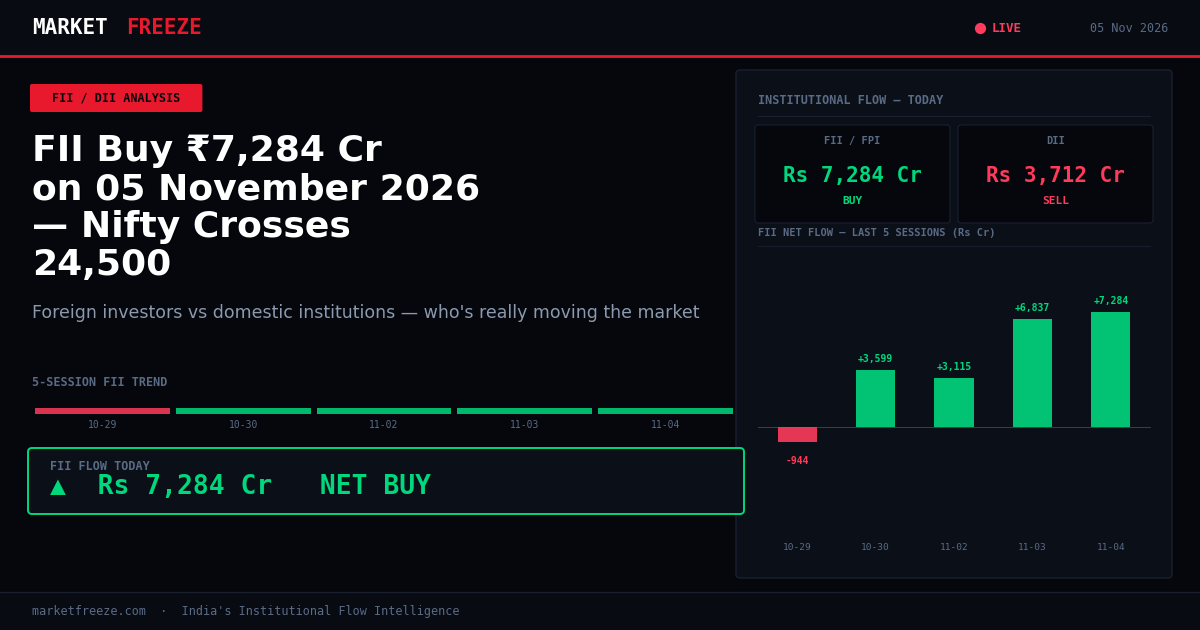
FIIs Inject ₹7,284.03 Cr as DIIs Liquidate ₹3,712.23 Cr
Foreign institutional investors deployed ₹7,284.03 Cr into Indian equities today, November 5th, 2026, marking a significant continuation of their buying spree. This aggressive inflow was counterbalanced by Domestic Institutional Investors (DIIs) who net sold ₹3,712.23 Cr, a pattern observed consistently over the last three sessions. The Nifty 50 closed at a robust 24,536.60, up 2.40%, while the Sensex surged 2.60% to 79,310.00, indicating broad market strength driven by institutional activity. This divergence between FII buying and DII selling suggests a belief among foreign entities in the current market rally, potentially fueled by external factors as highlighted by recent US election outcomes and a slight easing in crude oil prices.
Open a free demat account with
Upstox
or
Angel One
— zero brokerage on delivery trades.
FII Buying Accelerates for Sixth Consecutive Session
The ₹7,284.03 Cr FII net inflow today represents an acceleration from the previous two sessions, building on ₹7,284.03 Cr on November 4th and ₹6,836.81 Cr on November 3rd. This sustained buying pressure from FIIs, now spanning six trading days, has been a primary driver for the Nifty 50’s ascent from 23,810.85 on November 2nd to today’s close of 24,536.60. The consistency of this inflow indicates a strong conviction among foreign investors, likely reacting to improved global macroeconomic signals and a perception of India as an attractive growth destination. The immediate implication for retail investors is that this strong FII buying can provide a floor to market dips.
DII Selling Persists Despite Market Gains
Domestic Institutional Investors have consistently divested positions over the last three days, with today’s net selling of ₹3,712.23 Cr following similar patterns of ₹3,712.23 Cr on November 4th and ₹3,678.85 Cr on November 3rd. While FIIs are aggressively deploying capital, DIIs appear to be taking profits or rebalancing portfolios, a common occurrence when markets experience sharp rallies. This divergence is critical; it suggests that while foreigners are betting on India’s upside, domestic institutions might be exhibiting more caution or are adjusting to regulatory changes like the SEBI approval for net settlement of cash market trades for mutual funds, effective April 2027, which could alter their funding dynamics. Retail investors should observe if this DII selling intensifies, which could signal a short-term overhang.
Sectoral Rotation: Banking and IT Lead the Charge
The broad-based market rally, with all sectors except media and chemicals closing in the green, was significantly propelled by financial services and technology stocks. The Bank Nifty’s impressive 3.33% gain to 57,774.00 strongly suggests that FII inflows are heavily directed towards banking and financial institutions. This aligns with the anticipation of continued economic growth and potentially higher interest income for banks. Similarly, IT shares often benefit from global economic stability and renewed foreign investment, indicating that the technology sector is also a favored destination for FII capital. Retail investors holding positions in these sectors should monitor FII flow data for further confirmation of this trend.
FII Buying Levels Define Nifty Support and Resistance
The sustained FII buying activity, especially the significant deployment of ₹7,284.03 Cr today, suggests that the Nifty 50 has found strong support. Based on the current market close of 24,536.60, immediate support can be seen around the 24,200 mark, where earlier buying likely absorbed selling pressure. Resistance is now being tested above 24,650. Should FII inflows continue at this pace, a breach of 24,650 could see the index testing levels closer to 25,000. Conversely, any significant pullback in FII purchases might see the index retest the 24,200 support. Retail traders should use these levels to manage their risk exposures.
Commodity Crossover: Crude Oil’s Impact on Flows
The narrative around crude oil prices, which initially fell but then rebounded, adds an interesting layer to today’s FII activity. Story 1 mentions lower crude prices renewing foreign buying, while Story 3 notes oil prices rebounding, causing traders to lock in profits. The fact that FIIs net bought ₹7,284.03 Cr despite oil’s rebound suggests that the broader geopolitical de-escalation narrative and positive US election results are currently overriding inflationary concerns from oil. The MCX Crude oil price ending at Rs9,169.00/bbl, up 2.41%, indicates underlying demand, but FIIs seem to be prioritizing equity upside for now. Retail investors should remain aware that a sharp spike in crude could alter FII flow patterns.
Historical Flow Context: A Bullish Echo
The recent streak of substantial FII inflows, culminating in today’s ₹7,284.03 Cr purchase, mirrors periods of strong foreign buying that have historically preceded significant market upticks. Looking at the historical data, the closest parallel in terms of consistent FII buying alongside a rising Nifty is observed in the sessions leading up to November 4th and November 3rd, where FIIs net bought ₹7,284.03 Cr and ₹6,836.81 Cr respectively. The Nifty’s progression from 23,810.85 to 24,536.60 in just three trading days driven by these flows is a strong indicator. A retail investor can interpret this as a signal that sustained FII buying often leads to further upside, but should also be mindful of potential profit-taking by DIIs.
Key Macro-Financial Data Points
Today’s market action, particularly the rally in equities and a concurrent decline in benchmark bond yields (as per Story 3, though yields then saw profit-taking), reflects a complex interplay of global and domestic factors. The surge in Nifty and Sensex, attributed partly to US election results, suggests foreign capital is flowing into emerging markets like India. Simultaneously, the rebound in Gold MCX to Rs145,855.00/10g and Crude MCX to Rs9,169.00/bbl indicates ongoing commodity strength, which FIIs seem to be navigating. The SEBI’s move to allow net settlement for mutual funds (Story 4) is a long-term structural reform that could eventually impact DII trading patterns but is unlikely to have immediate effects on today’s FII-driven rally. Retail investors should focus on the immediate impact of FII flows on stock prices.
FII/DII Flow Data: Last 5 Sessions
| Date | FII Net (Cr) | DII Net (Cr) | Nifty Close |
|---|---|---|---|
| 2026-10-29 | ₹-943.60 Cr | +₹1,924.41 Cr | 22,936.75 |
| 2026-10-30 | +₹3,598.54 Cr | ₹-817.51 Cr | 23,440.80 |
| 2026-11-02 | +₹3,114.68 Cr | ₹-392.20 Cr | 23,810.85 |
| 2026-11-03 | +₹6,836.81 Cr | ₹-3,678.85 Cr | 23,810.85 |
| 2026-11-04 | +₹7,284.03 Cr | ₹-3,712.23 Cr | 24,536.60 |
Frequently Asked Questions
How much did FIIs buy or sell in Indian stocks today?
Foreign Institutional Investors (FIIs) were net buyers of ₹7,284.03 Cr in Indian equities on November 5th, 2026.
What was the Nifty 50’s closing price today?
The Nifty 50 closed at 24,536.60 on November 5th, 2026, marking a gain of 2.40%.
What is the current trend of DII activity in the Indian market?
Domestic Institutional Investors (DIIs) have been net sellers for the last three consecutive sessions, including today’s net sale of ₹3,712.23 Cr.
The sustained FII buying momentum, now a consistent feature for six trading sessions, presents a compelling narrative for the Indian equity market. This inflow is not merely opportunistic but appears to be a strategic bet on India’s long-term growth potential, bolstered by recent geopolitical easing and a more stable global economic outlook. The recent rally in the Nifty 50, gaining over 700 points from its November 2nd low of 23,810.85 to today’s close of 24,536.60, is a direct testament to this foreign capital infusion. Retail investors often find themselves in a dilemma during such strong institutional-driven rallies – whether to chase the momentum or wait for a correction. Understanding the drivers behind FII actions, such as improved corporate earnings expectations and favourable policy environments, is crucial for making informed decisions.
Divergent Flows and Retail Investor Positioning
While FIIs are aggressively buying, the consistent selling by DIIs, totaling over ₹11,000 crore in the last three sessions, warrants closer scrutiny. This could indicate that domestic funds are rebalancing their portfolios, potentially booking profits in sectors that have seen significant appreciation, or perhaps preparing for potential liquidity needs. A deeper look into mutual fund flows might reveal if there’s a shift in asset allocation away from equities. For retail investors, this divergence can be a signal. If DII selling intensifies and is accompanied by a slowdown in FII inflows, it could suggest a short-term topping out of the market. Conversely, if FII buying remains robust and DII selling tapers off, the upward trend is likely to continue. The current market strength, with the Nifty crossing the 24,500 mark, shows resilience, but this DII caution cannot be ignored entirely.
Sectoral Focus: Beyond Banks and IT
While the financial services and IT sectors are clear beneficiaries of FII inflows, it is essential to look for subtle shifts. If other sectors, such as consumer discretionary or infrastructure, begin to see increased FII interest, it would signify a broader economic recovery and increased confidence across the Indian economy. Today’s broad-based rally, with only two sectors underperforming, suggests that the positive sentiment is not confined to a narrow set of industries. The performance of sectors like automobiles, which have a strong correlation with domestic consumption, could be a good indicator of whether the rally is becoming more inclusive. Retail investors should monitor sectoral performance beyond the headline banking and IT indices for a more nuanced understanding of where institutional money is flowing.
Currency and Commodity Dynamics
The Indian Rupee’s movement against major currencies also plays a significant role in FII investment decisions. While not explicitly detailed today, a strengthening Rupee can sometimes deter FIIs by eroding their returns when converted back to their home currency. Conversely, a stable or depreciating Rupee can make Indian equities more attractive. Furthermore, the interplay between commodity prices and equity flows is noteworthy. Despite the rebound in Crude MCX to ₹9,169.00 per barrel, FIIs have continued to pour money into equities, suggesting that the positive sentiment driven by US election outcomes and perceived geopolitical stability is currently outweighing inflationary concerns from oil. However, a sustained surge in commodity prices could eventually force FIIs to reassess their risk appetite and potentially temper their equity purchases. For retail investors, tracking currency and commodity trends alongside equity flows provides a more holistic view of market dynamics.
Bottom Line
Today’s institutional flow data reveals aggressive buying by Foreign Institutional Investors (FIIs), amounting to ₹7,284.03 Cr, which significantly propelled the Nifty 50 to close at 24,536.60. This FII activity is concentrated in sectors like Banking and IT, signaling confidence in India’s growth trajectory, likely influenced by positive global developments. Meanwhile, Domestic Institutional Investors (DIIs) continue their selling trend, offloading ₹3,712.23 Cr, indicating a divergence in strategy. Retail investors should note the strong FII support around 24,200 and resistance near 24,650 as key levels to watch.
Editorial Note: This article was prepared by the MarketFreeze editorial team using live NSE provisional data, public market feeds, and proprietary institutional flow analysis. All price and flow figures are sourced directly from NSE, BSE, and CoinGecko as of 05 November 2026. This content is for informational purposes only and does not constitute investment advice. MarketFreeze is not SEBI-registered. Please consult a qualified financial advisor before making investment decisions. Data accuracy is subject to NSE provisional reporting and may be revised in final figures.