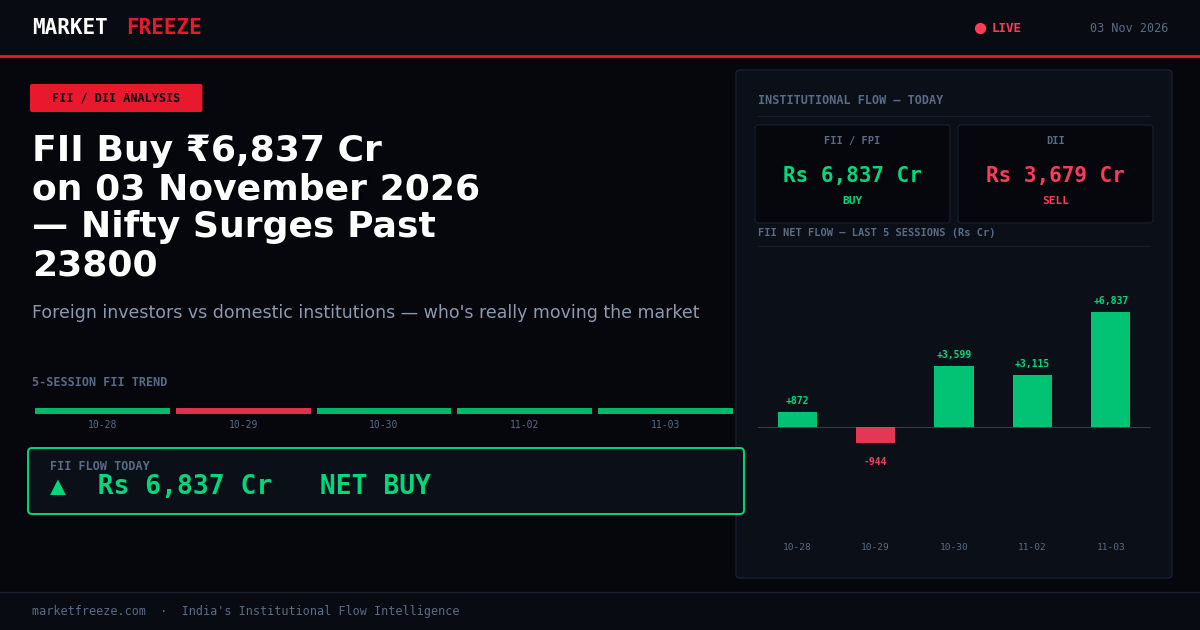
Institutional flow data released after market close shows Foreign Institutional Investors (FIIs) deployed a substantial ₹6,836.81 Cr into Indian equities today, marking a significant acceleration in their buying momentum. This aggressive inflow contrasted sharply with Domestic Institutional Investors (DIIs), who offloaded ₹3,678.85 Cr, creating a pronounced divergence in institutional activity for the session.
Open a free demat account with
Upstox
or
Angel One
— zero brokerage on delivery trades.
FII Buying Accelerates Past ₹6,800 Cr Mark
Today’s FII net buy figure of ₹6,836.81 Cr represents the largest single-day inflow recorded in the past five sessions. This substantial deployment dwarfs the ₹3,114.68 Cr net buy from November 2nd and the ₹3,598.54 Cr seen on October 30th. The gross FII buying activity stood at a robust ₹20,970.51 Cr, indicating strong conviction across a broad spectrum of stocks rather than a targeted, low-turnover purchase.
The substantial capital injection by foreign entities today directly counters the outflow of ₹943.60 Cr observed on October 29th. This rapid shift in FII behavior suggests a renewed confidence in Indian equity markets, potentially influenced by global cues and strong domestic corporate performance.
Actionable Insight for Retail Investors: The sheer volume of FII buying today suggests a broad positive bias. Consider reviewing your portfolio for sectors that typically attract significant foreign capital, as FIIs are likely adding to positions they deem undervalued or poised for growth.
DII Selling Intensifies to Nearly ₹3,700 Cr
In stark contrast to FII inflows, DIIs executed a significant sell-off today, net selling ₹3,678.85 Cr. This is the largest DII outflow in the observed five-session period, significantly exceeding the ₹392.20 Cr net sell on November 2nd and the ₹817.51 Cr offload on October 30th. This aggressive selling by domestic institutions suggests a potential rebalancing of portfolios or a tactical move to book profits, even as foreign capital floods in.
The divergence between FII buying and DII selling highlights a potential disconnect in how domestic versus foreign institutions perceive the current market valuations and future prospects. While FIIs are aggressively adding to their Indian equity exposure, DIIs are taking profits or reducing their footprint.
Actionable Insight for Retail Investors: When FIIs and DIIs diverge so sharply, it’s crucial to understand the underlying drivers. The DII selling, while significant, is being more than offset by FII inflows. Monitor the composition of DII selling to identify if it’s across the board or concentrated in specific sectors, which could signal opportunities for contrarian buying if FIIs are moving in the opposite direction.
Nifty’s 23,800 Level Holds Firm Amidst Divergent Flows
The Nifty 50 closed today at 23,810.85, a marginal increase of 1.58%. Despite the significant FII buying and DII selling, the index managed to hold its ground, indicating that the sheer quantum of FII inflows was sufficient to absorb domestic selling pressure and drive the index higher. The Nifty has now risen for four consecutive sessions, as noted in recent market highlights.
Given today’s price action and the substantial FII buying, immediate support for the Nifty can be inferred around the 23,500 mark. A sustained push above today’s closing levels could see the index testing resistance around 24,100, especially if FII inflows continue at this pace. These levels are derived from the magnitude of today’s FII deployment and the prevailing market price, assuming a significant portion of the inflow was directed into index-heavy stocks.
Actionable Insight for Retail Investors: With Nifty holding above 23,800 and strong FII backing, consider a slightly constructive view. However, be prepared for potential volatility if DII selling escalates or if FII buying falters. Maintain strict stop-losses, particularly if trading near the 23,500 support level.
Sectoral Implications: Banks and Metals Likely Beneficiaries of FII Inflows
The broad-based nature of FII buying today, coupled with the significant increase in their deployment, strongly suggests increased allocation towards sectors that typically see large foreign participation. Banking stocks, given their weightage in the index and consistent performance, are highly likely to have been a primary destination for FII capital. Additionally, the Metal sector, which has shown resilience and benefits from global commodity price movements, could also be a significant recipient of this inflow. News regarding global economic shifts, such as potential capital reallocation from US bonds following US midterm election results, aligns with FIIs seeking higher returns in emerging markets like India, favoring sectors with tangible asset backing or cyclical upside.
Conversely, the sectors being sold by DIIs are less clear without granular data. However, if DIIs are taking profits, they might be exiting positions that have seen significant gains, which could span across various segments, including IT or even defensive sectors. The aggressive FII buying in broader markets implies they are not shying away from cyclical bets.
Actionable Insight for Retail Investors: Focus on Banking and Metal stocks that show strong chart patterns and positive fundamental catalysts. The FII inflow trend suggests these sectors are currently favored. Avoid chasing fundamentally weak stocks solely based on speculative price action.
Global Cues: US Midterms and Capital Rotation
The narrative surrounding the US midterm elections today provides a crucial backdrop to the FII inflow. Reports suggest that a setback for certain political parties in the US could prompt a shift of capital from US bonds and the dollar towards riskier assets like equities and commodities. This global capital reallocation is a significant driver for emerging markets, and India, with its growth prospects, is a prime beneficiary. The substantial FII buying today aligns with this anticipated rotation, as foreign investors seek to capitalize on potential opportunities created by a changing global economic landscape.
The slight weakening of the USD/INR to Rs94.93 (-0.18%) also supports the narrative of capital seeking higher yields and potentially a less dominant US dollar, which is typically positive for Indian equities.
Actionable Insight for Retail Investors: Stay attuned to global macroeconomic events, particularly US election outcomes and central bank policy. Such events can trigger significant capital flows into or out of India. Use these global shifts as a catalyst to re-evaluate your asset allocation, ensuring you are positioned to benefit from or hedge against major capital movements.
NSE’s Strong Q2 Performance Bolsters Market Confidence
The positive corporate earnings season continues to provide a strong undercurrent for the market. Today’s news highlighted that the National Stock Exchange (NSE) reported a robust 23% year-on-year rise in its Q2 FY27 consolidated net profit to ₹2,578 crore. This performance, driven by stronger trading volumes and a 9% increase in revenue to ₹3,035 crore, showcases the underlying strength and growth potential of India’s financial infrastructure. The doubling of operating EBITDA further underscores efficient operations and profitability.
The direct impact of strong earnings from key players like NSE reinforces the attractiveness of Indian equities for both domestic and foreign investors. It provides a tangible reason for sustained buying interest, complementing the global capital flow dynamics. The fact that NSE’s stock has performed well post-listing also indicates investor confidence in the exchange’s long-term prospects.
Actionable Insight for Retail Investors: Q2 earnings have been a significant driver for market performance. Prioritize companies reporting strong earnings with forward guidance that suggests continued growth. The success of the NSE’s earnings report can serve as a proxy for the health of the broader Indian equity market’s trading ecosystem.
Historical Flow Data Analysis
| Date | FII Net (Cr) | DII Net (Cr) | Nifty Close |
|---|---|---|---|
| 2026-10-28 | +₹871.83 Cr | +₹643.35 Cr | 22,936.75 |
| 2026-10-29 | ₹-943.60 Cr | +₹1,924.41 Cr | 22,936.75 |
| 2026-10-30 | +₹3,598.54 Cr | ₹-817.51 Cr | 23,440.80 |
| 2026-11-02 | +₹3,114.68 Cr | ₹-392.20 Cr | 23,810.85 |
| 2026-11-03 | +₹6,836.81 Cr | ₹-3,678.85 Cr | 23,810.85 |
Frequently Asked Questions
Q1: How much did FIIs buy in Indian equities today?
FIIs net bought ₹6,836.81 Cr worth of Indian equities today, November 3rd, 2026.
Q2: What was the difference between FII and DII activity today?
FIIs were net buyers of ₹6,836.81 Cr while DIIs were net sellers of ₹3,678.85 Cr today, showing a significant divergence.
Q3: What was the Nifty’s closing level today?
The Nifty 50 closed at 23,810.85 today, November 3rd, 2026.
The sustained surge in FII buying, especially against the backdrop of DII selling, warrants a deeper look into potential asset rotation beyond just equities. The reported weakening of the USD/INR currency pair to Rs94.93 is a crucial indicator. A stronger rupee often accompanies significant foreign inflows as dollars are converted into rupees to purchase Indian assets. This currency movement suggests that the ₹6,836.81 Cr deployed by FIIs wasn’t just about buying stocks but also reflects a broader sentiment of capital flowing into the Indian economy, potentially seeking higher yields compared to developed markets.
Cross-Asset Correlation: Commodities and Currency Movements
While the article focuses on equities, the implications of foreign capital flows often extend to other asset classes. The observed FII buying spree could be signalling a broader strategic shift. If global investors are indeed rotating out of traditionally safe-haven assets like US treasuries (a potential consequence of the US midterms), they might simultaneously be increasing exposure to commodities alongside emerging market equities. This dual approach offers diversification and potential inflation hedging. The slight weakening of the dollar, as seen in the USD/INR movement, can sometimes be correlated with rising commodity prices, as many are dollar-denominated. Therefore, while FIIs poured ₹6,836.81 Cr into stocks, it’s worth monitoring commodity indices for parallel strength, which could provide a more comprehensive picture of foreign capital deployment strategies.
Historical Context: Echoes of 2020?
The current pattern of aggressive FII inflows countering domestic profit-booking bears a resemblance to certain phases observed in late 2020. Following the initial COVID-19 shock, as vaccine news emerged, FIIs initiated a sustained buying spree that propelled Indian markets to new heights. The scale of today’s FII net buy, the largest in five sessions, and the subsequent market reaction holding the 23,800 Nifty level, suggests a similar underlying confidence. In 2020, this was driven by India’s economic recovery prospects and attractive valuations. While the specific catalysts differ, the mechanism of foreign capital driving markets higher while domestic investors take profits is a recurring theme, particularly in growth-oriented economies.
Retail Investor Positioning: Caution Amidst Inflows
With FIIs injecting ₹6,836.81 Cr and DIIs divesting ₹3,678.85 Cr, retail investors often find themselves at a crossroads. The strong FII sentiment can be tempting, leading to FOMO (Fear Of Missing Out). However, the significant DII selling, which has historically been more reflective of domestic economic sentiment, presents a cautionary signal. Retail participants should avoid blindly following the FII trend without understanding the specific sectors or stocks that are attracting this capital. If FIIs are buying sectors that have already seen substantial gains, it might be a sign of late-stage buying, whereas DII selling could indicate a more prudent approach to risk management. The market’s ability to sustain levels above 23,800 will largely depend on the continuation of these FII inflows, which are substantial at ₹6,836.81 Cr.
Bottom Line
Today’s session was defined by a massive surge in FII buying, totaling ₹6,836.81 Cr, which more than compensated for significant DII selling of ₹3,678.85 Cr. This robust inflow, potentially driven by global capital rotation following US election results and bolstered by strong domestic earnings like that of NSE, propelled the Nifty to hold the 23,800 mark. Sectorally, Banking and Metals are likely beneficiaries of this foreign capital. Retail investors should monitor the sustainability of FII inflows and the direction of DII flows for further market direction.
Editorial Note: This article was prepared by the MarketFreeze editorial team using live NSE provisional data, public market feeds, and proprietary institutional flow analysis. All price and flow figures are sourced directly from NSE, BSE, and CoinGecko as of 03 November 2026. This content is for informational purposes only and does not constitute investment advice. MarketFreeze is not SEBI-registered. Please consult a qualified financial advisor before making investment decisions. Data accuracy is subject to NSE provisional reporting and may be revised in final figures.