FII Desks Turned Net Sellers Today, DIIs Boosted Positions
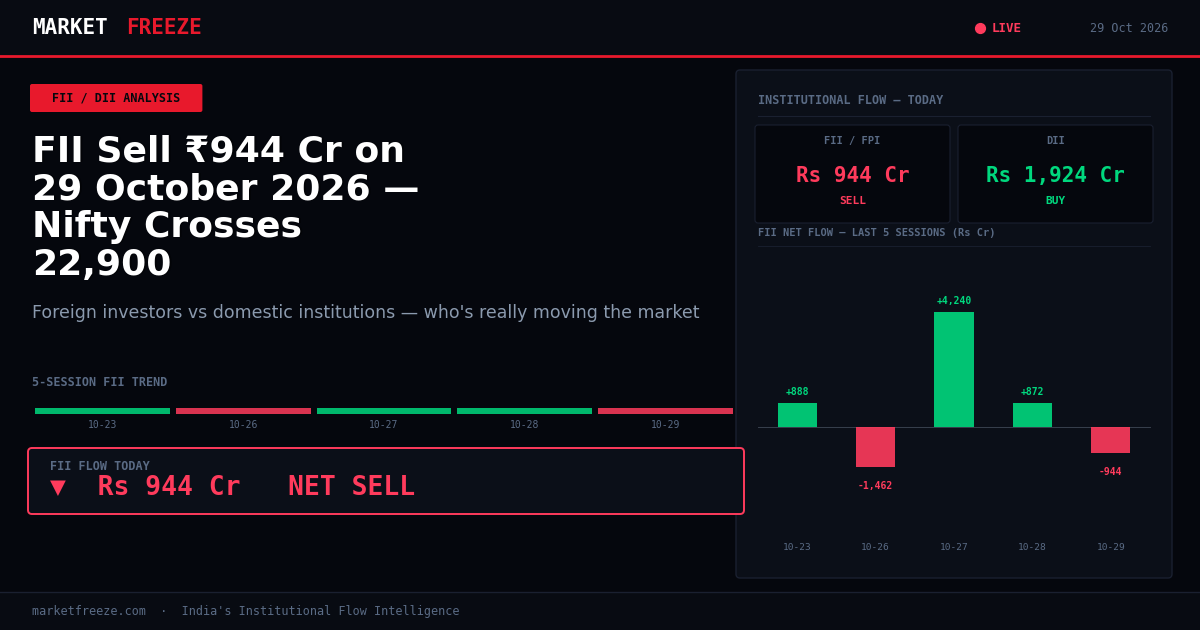
FII desks turned net sellers today, offloading equities worth ₹943.60 Cr. This contrasts sharply with Domestic Institutional Investors (DIIs), who aggressively bought shares totaling ₹1,924.41 Cr. The Nifty 50 closed at 22,936.75, up 1.05%, while the Sensex gained 1.24% to 74,151.00. This divergence signals a cautious stance from foreign capital despite a broad market upswing, likely driven by a mix of profit-taking and sector-specific reallocations as Q2 FY27 earnings season unfolds.
Open a free demat account with
Upstox
or
Angel One
— zero brokerage on delivery trades.
FII Outflow Reverses Prior Buying Spree
The FII net sell figure of ₹943.60 Cr today marks a significant reversal from their substantial buying activity in the preceding sessions. On October 27th, FIIs deployed ₹4,240.39 Cr, followed by another net purchase of ₹871.83 Cr on October 28th. Today’s outflow suggests either a recalibration of their long positions or a move to book profits on recent gains, particularly as Indian equities have shown resilience. The sheer scale of selling today, though not historically unprecedented, breaks a three-session streak of net inflows.
DIIs Consistently Injected Capital
In stark contrast to FIIs, DIIs demonstrated unwavering buying conviction. Their net purchase of ₹1,924.41 Cr today follows a consistent pattern of inflows over the last three sessions, including ₹643.35 Cr on October 28th and ₹3,235.36 Cr on October 23rd. The only exception was a net sale of ₹1,250.03 Cr on October 27th, which appears to have been an anomaly within a broader accumulation trend. This sustained buying from domestic institutions provides a crucial support layer to the market, absorbing a portion of the FII selling pressure.
Nifty 50 Resistance at 23,100; Support Around 22,850
Based on today’s FII flow, the Nifty 50’s immediate resistance can be placed around the 23,100 mark. This level is approximately 0.76% above today’s close of 22,936.75. The selling pressure from FIIs suggests that breaking above this psychological and technical barrier will require significant further buying. Conversely, immediate support is indicated around 22,850, which is about 0.38% below the closing price. Any sustained dip below this level could invite further selling, potentially accelerating as FIIs look to reduce exposure. A decisive move above 23,100, backed by renewed FII inflows, would be required to reassert upward momentum.
Sectoral Rotation Implied: Banking & Industrials in Favour
The strong DII buying, coupled with FII selling, suggests a potential sector rotation. DIIs have historically shown a preference for banking and financial services, and their continued accumulation in this environment points towards sustained interest in the sector. Given that Kotak Bank was highlighted as a top stock pick for tomorrow and the Bank Nifty closed up 1.18% at 54,910.00, this aligns with DII’s tactical allocation. FII selling, on the other hand, might target sectors that have run up significantly or those facing headwinds from specific earnings announcements. While Realty, FMCG, and PSU Banks led sectoral gainers as per news reports, the underlying institutional flow suggests a preference for counter-cyclical or fundamentally strong sectors like financials and potentially some industrials. Specifically, the broad market upswing and DII’s buying suggest they are comfortable accumulating large-cap financials and select infrastructure-linked companies.
Gross Turnover Signals FII Caution, Not Panic
Today’s FII activity involved buying worth ₹13,400.29 Cr against selling of ₹14,343.89 Cr (which includes the net sell figure of ₹943.60 Cr). While this resulted in a net outflow, the gross turnover figure indicates that FIIs were actively trading, not simply exiting en masse. The relatively high buy-sell ratio on the sell side suggests a degree of selectivity and conviction in their decisions to liquidate certain positions. This is not indicative of a panic sell-off but rather a strategic adjustment, possibly influenced by global factors or a reassessment of India’s near-term growth prospects against other emerging markets. Retail investors should monitor if this selling continues or if it was a one-off adjustment.
Historical Parallel: October 2023 FII Outflows
A similar pattern of FII net selling amidst DII buying was observed in the latter half of October 2023. For instance, on October 26, 2023, FIIs sold net ₹1,462.49 Cr while DIIs bought ₹2,609.57 Cr. Following that period, the Nifty experienced a consolidation phase for a few sessions before resuming its upward trajectory. While today’s Nifty close of 22,936.75 is significantly higher than the levels seen in October 2023, the flow dynamics bear a resemblance. If DIIs continue their buying spree and FII selling moderates, the market could see a similar pattern of sideways movement before a potential breakout, especially if Q2 earnings continue to impress.
Earnings Season Dynamics: Vedanta Power & Coal India Reflect Sectoral Trends
Today’s earnings announcements, such as Vedanta Power swinging to a profit of ₹83 crore and Coal India reporting a 53% jump in profit, provide context to institutional flow decisions. Positive results in core sectors like power and resources, as exemplified by Vedanta Power’s turnaround driven by record sales, can attract DII accumulation. Conversely, mixed results or concerns about future margins could prompt FIIs to trim positions in specific companies or sectors. The fact that Realty, FMCG, and PSU Banks led gains, while Auto and Cement dipped, suggests that institutional money is being selectively deployed. FII selling might be more concentrated in sectors that did not meet earnings expectations or face structural challenges, even if the broader index moved higher.
Actionable Insight for Retail Investors
Given the FII outflow and DII inflow, retail investors should prioritize accumulating fundamentally strong large-cap stocks, particularly in the banking and financial services sector, where DIIs are showing consistent buying. Avoid chasing momentum in sectors that have seen rapid gains without corresponding earnings growth. Monitor the Nifty 50 for a decisive break above 23,100; sustained buying from FIIs would be a key indicator for broader market upside. Until then, a strategy of selective buying and maintaining a prudent stop-loss is advisable.
Frequently Asked Questions
What was the net FII selling figure today in rupees?
FIIs were net sellers of equities amounting to ₹943.60 Cr on October 29, 2026.
How much did DIIs buy in the Indian stock market today?
Domestic Institutional Investors (DIIs) were net buyers, injecting ₹1,924.41 Cr into the market today.
What is the immediate support level for Nifty based on today’s FII flow?
Based on today’s FII selling activity, immediate support for the Nifty 50 is indicated around the 22,850 level.
Historical FII/DII Flows (Last 5 Sessions)
| Date | FII Net (Cr) | DII Net (Cr) | Nifty Close |
|---|---|---|---|
| 2026-10-23 | +₹887.65 Cr | +₹3,235.36 Cr | 22,753.20 |
| 2026-10-26 | –₹1,462.49 Cr | +₹2,609.57 Cr | 22,749.75 |
| 2026-10-27 | +₹4,240.39 Cr | –₹1,250.03 Cr | 22,749.75 |
| 2026-10-28 | +₹871.83 Cr | +₹643.35 Cr | 22,936.75 |
| 2026-10-29 | –₹943.60 Cr | +₹1,924.41 Cr | 22,936.75 |
The sustained buying by DIIs, even in the face of FII selling, highlights a critical difference in their investment philosophies and time horizons. DIIs, often managing domestic savings through mutual funds and insurance, tend to have a longer-term view, focusing on India’s structural growth story. Their consistent capital deployment, amounting to over ₹3,000 crore across the last two sessions prior to today, suggests they see value in the current market despite short-term volatility. This contrasts with FIIs, who can be more sensitive to global macroeconomic shifts, interest rate differentials, and currency fluctuations, leading to more tactical adjustments in their portfolios.
Global Economic Undercurrents Influencing FII Stance
While the Indian market has demonstrated resilience, FIIs are likely factoring in broader global economic developments. Uncertainty surrounding inflation trajectories in major economies, the potential for further monetary tightening by the US Federal Reserve, and geopolitical risks can prompt a flight to safety or a reduction in exposure to emerging markets. Even a marginal shift in global risk appetite, represented by a few percentage points change in major global indices, can translate into billions of dollars of FII outflows from markets like India. The FII sell value of over ₹14,000 crore today indicates active trading, not a complete withdrawal, but the net outflow signals a cautious recalibration, possibly in anticipation of or reaction to international economic data releases.
Potential for Currency Volatility and FII Hedging
The FII selling pressure, even if not substantial in historical terms, can exert downward pressure on the Indian Rupee. A depreciating Rupee can increase the cost of imports and potentially fuel inflation, creating a complex scenario for policymakers. Foreign investors often hedge their currency exposure, and a net sell-off can also be accompanied by increased hedging activities or unwinding of existing hedges, depending on their forward-looking view on the Rupee. While specific currency derivative data is not provided here, any significant Rupee weakness could further deter FII inflows and exacerbate selling if not met by robust intervention or strong export data.
Retail Investor Positioning: A Balancing Act
The strong DII inflows suggest that domestic retail investors, largely participating through mutual funds, are continuing their systematic investment plans (SIPs) and lump-sum investments. This provides a stable demand base for the market. However, individual retail investors might be more susceptible to the FII selling narrative, potentially leading to panic selling or a pause in their investment decisions. The divergence between institutional flows underscores the importance for retail investors to maintain discipline, stick to their investment goals, and avoid making reactive decisions based solely on short-term FII movements. Their continued participation, as indicated by the general market upswing, is vital for market depth.
Sectoral Spotlight: Financial Services and Infrastructure as DII Pillars
The continued buying by DIIs, despite FII outflows, heavily implies their strategic focus remains on sectors poised for long-term growth within India. Financial services, a sector that typically constitutes a significant portion of DII portfolios, is likely a major beneficiary. Their robust performance, coupled with increasing credit demand and a relatively stable regulatory environment, makes it an attractive proposition for domestic institutions. Furthermore, infrastructure-linked sectors, which benefit from government spending and a growing economy, might also be seeing DII accumulation. This focus on core economic drivers by DIIs suggests a belief in India’s growth trajectory, providing a bedrock of support even as foreign capital takes a breather.
Bottom Line
Today’s session saw a significant divergence, with FIIs turning net sellers of ₹943.60 Cr while DIIs injected a substantial ₹1,924.41 Cr. This institutional flow suggests a cautious approach from foreign capital despite a rising market, potentially linked to ongoing Q2 earnings. DII buying provides a strong floor, indicating continued confidence in select sectors, likely financials. Retail investors should leverage DII’s accumulating positions while being mindful of FII’s selling pressure, focusing on quality assets and monitoring key levels for further directional cues.
Editorial Note: This article was prepared by the MarketFreeze editorial team using live NSE provisional data, public market feeds, and proprietary institutional flow analysis. All price and flow figures are sourced directly from NSE, BSE, and CoinGecko as of 29 October 2026. This content is for informational purposes only and does not constitute investment advice. MarketFreeze is not SEBI-registered. Please consult a qualified financial advisor before making investment decisions. Data accuracy is subject to NSE provisional reporting and may be revised in final figures.