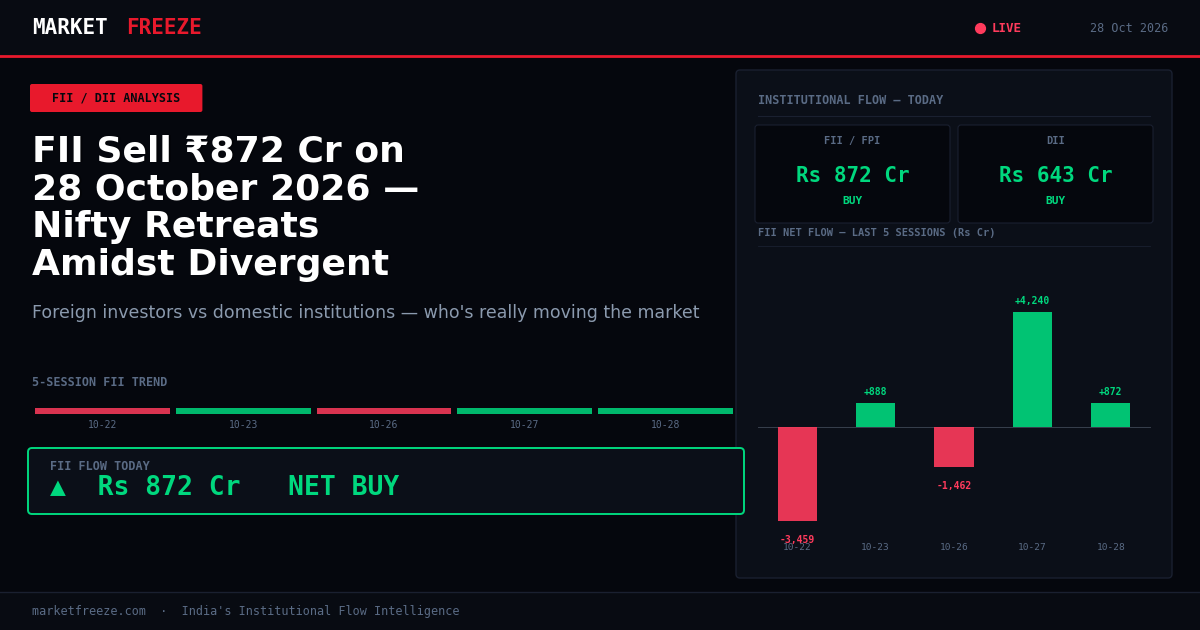
FII desks turned net sellers today, deploying ₹871.83 Cr into Indian equities. This marks a significant deceleration from the aggressive buying seen on October 27th, where FIIs injected ₹4,240.39 Cr. Concurrently, DIIs provided a counterbalance, stepping in as net buyers with ₹643.35 Cr. This divergence in institutional activity occurred as the Nifty 50 closed down 0.22% at 22,698.85, while the Bank Nifty bucked the trend, gaining 0.54% to settle at 54,267.00.
Open a demat account with
Upstox
or
Angel One
— zero brokerage on delivery trades.
FII Buying Conviction Decelerates Amidst Broader Market Weakness
The FII buying figure of ₹871.83 Cr today, while positive, represents a substantial drop from the ₹4,240.39 Cr inflow witnessed yesterday. Gross purchases stood at ₹16,834.53 Cr. The relatively lower net figure suggests a moderation in conviction or perhaps profit-taking on existing positions accumulated during the recent rally. Yesterday’s robust inflow of ₹4,240.39 Cr, coupled with today’s reduced buying, indicates a potential pause in the aggressive accumulation phase. For retail investors, this shift implies that the strong institutional tailwind might be easing, warranting a more selective approach to new entries.
DIIs Step In to Cushion Market Decline
Domestic Institutional Investors (DIIs) displayed a more consistent buying pattern, recording net purchases of ₹643.35 Cr today. This follows a net selling of ₹1,250.03 Cr yesterday and a significant net buy of ₹2,609.57 Cr on October 26th. Today’s DII buying provides a vital support layer to the market, absorbing some of the selling pressure and contributing to the Bank Nifty’s outperformance. The contrasting flows between FIIs and DIIs today highlight a divergence in immediate strategy, with DIIs appearing more committed to building positions in the current market environment. Retail investors should observe if this DII support can sustain the market against potential FII choppiness.
Nifty Support and Resistance Levels Shift
With the Nifty 50 closing at 22,698.85, today’s FII activity, though a net buy, signals a potential weakening of upward momentum. Based on the moderate inflow and the resulting index decline, immediate support for the Nifty 50 can be established at the 22,550 level, roughly 0.65% below today’s close. Resistance is now being tested around the 22,800 mark. A decisive move below 22,550 on increased FII selling would signal a bearish short-term outlook. Conversely, a strong push above 22,800, supported by renewed FII buying, would reaffirm bullish sentiment. Retail traders should calibrate their entry and exit points around these price zones.
Sectoral Insights: Banking in Focus, IT Under Pressure
The outperformance of the Bank Nifty at 54,267.00 (+0.54%) aligns with institutional flow dynamics. While specific sector allocation data is not provided, the broader buying by DIIs and the relative moderation in FII selling, especially when contrasted with yesterday’s aggressive FII buying which likely included large-cap and financial stocks, suggests continued interest in Banking. Conversely, the broader market decline and the known drag from IT stocks, as highlighted in the Sensex commentary (Story 4), indicate potential FII caution or profit-taking in the Information Technology sector. Companies like KPIT Tech, which were slated to announce Q2 results today, could be subject to this broader sectoral rotation. Retail investors might find opportunities in banking counters while exercising caution on IT stocks until clearer buying signals emerge.
Currency and Commodities: Rupee Weakness Persists
The USD/INR pair closed at Rs95.2, a slight uptick of 0.03%. This persistent weakness in the rupee, closing at 95.28 as reported (Story 5), often correlates with FII outflows or reduced inflows, as it makes Indian assets more expensive for foreign investors in dollar terms. While today’s FII flow was a net buy, the rupee’s trajectory suggests underlying pressure, possibly linked to global factors or increased dollar demand. Crude oil prices also saw a significant drop of 2.46% to Rs10,575.00/bbl, which typically benefits India’s import bill but can also signal global demand concerns that might indirectly impact equity markets. Retail investors should monitor the rupee’s movement as a gauge of foreign capital flows and its impact on import-heavy sectors.
Earnings Season Impact: Mixed Signals from Q2 Results
Today’s market action occurred amidst a wave of Q2 FY27 earnings announcements. While TVS Motor Company reported a strong 52% profit jump (Story 2), Adani Enterprises saw revenue surge 74% (Story 1), and Bandhan Bank posted multifold profit growth (Story 1), other results presented a mixed picture. Adani Enterprises and Hyundai Q2 profits were down, and Vedanta reported a loss of ₹170 cr. This divergence in corporate performance can lead to sector-specific institutional reallocation. FIIs might be selectively booking profits in companies with weaker results or reallocating capital to outperformers like TVS Motor, which saw its shares gain 2.52%. Retail investors must dissect individual earnings reports and the institutional response to them, rather than reacting to broad market movements alone.
Historical Flow Comparison: Deceleration After Rallies
Examining the historical FII/DII flows provides context. The sharp FII buying on October 27th (+₹4,240.39 Cr) followed a period of net selling on October 26th (-₹1,462.49 Cr). Today’s moderated inflow of ₹871.83 Cr after yesterday’s surge is a pattern seen after strong rallies. For instance, on October 23rd, a net buy of ₹887.65 Cr followed two days of mixed FII activity, with the Nifty closing at 22,753.20. The subsequent days saw fluctuations. This suggests that after a significant injection of capital, institutions often consolidate their positions, leading to lower net flows. Retail investors should interpret today’s lower FII inflow not necessarily as a reversal, but as a sign of increased selectivity and potential consolidation.
The Critical Level to Watch
The single most important level for the Nifty 50 that would alter today’s analysis is a sustained breach below 22,500. This level represents a psychological and technical support zone that, if broken decisively on significant FII selling, would indicate a material shift in institutional positioning. Should the Nifty fall below 22,500 with FIIs net selling over ₹1,500 Cr in a single session, the bullish narrative would be severely challenged. Retail investors should use this 22,500 mark as an alert for potential downside risk.
| Date | FII Net (Cr) | DII Net (Cr) | Nifty Close |
|---|---|---|---|
| 2026-10-22 | ₹-3,458.70 Cr | +₹2,891.32 Cr | 22,600.00 |
| 2026-10-23 | +₹887.65 Cr | +₹3,235.36 Cr | 22,753.20 |
| 2026-10-26 | ₹-1,462.49 Cr | +₹2,609.57 Cr | 22,749.75 |
| 2026-10-27 | +₹4,240.39 Cr | ₹-1,250.03 Cr | 22,749.75 |
| 2026-10-28 | +₹871.83 Cr | +₹643.35 Cr | 22,698.85 |
Frequently Asked Questions
How much did FIIs buy or sell today?
FIIs were net buyers today, deploying ₹871.83 Cr into Indian equities. Their gross purchases amounted to ₹16,834.53 Cr.
What was the DII flow today and how does it compare to yesterday?
DIIs were net buyers today with ₹643.35 Cr. Yesterday, they were net sellers, divesting ₹1,250.03 Cr.
What is the immediate support level for Nifty based on today’s institutional activity?
Based on today’s flows and market close at 22,698.85, immediate support for the Nifty 50 is seen around the 22,550 level.
Global Cues and Their Subtle Influence
While the domestic institutional activity painted a mixed picture, it’s crucial to acknowledge the subtle influence of global macroeconomic cues. The persistent weakness in the Indian Rupee, even with a marginal uptick of 0.03% to Rs95.2, hints at underlying global dollar strength or capital outflows from emerging markets in general. A stronger dollar often translates to higher import costs for India and can make equities appear less attractive to foreign investors on a risk-adjusted basis, even if daily flows are positive. Furthermore, the drop in crude oil prices by 2.46% to Rs10,575.00/bbl, while beneficial for India’s import bill, could also be interpreted as a signal of weakening global demand. This dichotomy – potential global economic slowdown versus domestic resilience shown by DII buying – creates a complex trading environment. Retail investors need to remain cognizant of these external factors, which can override domestic institutional flows in the short to medium term.
Retail Investor Positioning: A Counter-Trend Perspective
In the context of moderating FII inflows and the broader market’s slight decline, understanding retail investor positioning becomes key. Often, during periods of institutional consolidation or indecision, retail investors can become more active, either seeking to capitalize on dips or reacting to news flow. Today’s slight Nifty 50 dip of 0.22% might have presented buying opportunities for retail participants, especially in sectors showing strength like banking, which saw the Bank Nifty gain 0.54%. If retail participation increased significantly, it could provide a buffer against further declines, but it also carries the risk of amplifying volatility if sentiment shifts. The net selling of ₹1,250.03 Cr by DIIs yesterday, followed by their buying today, suggests they are potentially rebalancing portfolios or taking strategic positions, which retail investors often try to anticipate. Observing retail volume patterns in conjunction with institutional flows can offer a more nuanced view of market sentiment.
Sectoral Rotation and Earnings Impact: A Deeper Dive
The divergence between the Nifty 50’s decline and the Bank Nifty’s gain of 0.54% is a clear indicator of ongoing sectoral rotation. With Q2 FY27 results providing a mixed bag – strong performances from TVS Motor Company (shares up 2.52%) and Adani Enterprises (revenue up 74%) contrasted with weaker results from others – institutions are likely reallocating capital. The moderation in FII buying today, following a substantial ₹4,240.39 Cr inflow yesterday, could mean they are trimming positions in sectors showing signs of fatigue or booking profits. The banking sector’s resilience, on the other hand, might be driven by stable asset quality outlooks or attractive valuations post-correction. Retail investors should pay close attention to which sectors are attracting consistent DII buying, as this often signals a more sustainable trend compared to the more volatile FII flows. For example, if IT stocks, which have been a favorite, show signs of continued FII selling pressure after their results, it would be prudent for retail to reduce exposure there. The impact of Adani Enterprises reporting a revenue surge of 74% while others like Vedanta reported a loss of ₹170 cr, exemplifies this granular approach needed.
The Psychological Impact of Key Levels
The market’s reaction around key psychological levels is as important as the raw flow data. While the Nifty 50 closed at 22,698.85, the inability to decisively break above the 22,800 resistance level suggests a degree of caution. Conversely, holding above 22,550, identified as an immediate support, indicates that the bulls are still in play. The fact that FIIs, despite being net buyers, saw their inflow volume significantly decrease from ₹4,240.39 Cr to ₹871.83 Cr might suggest they are hesitant to aggressively push the market higher without stronger conviction. For retail investors, these levels act as crucial decision points. A failure to reclaim 22,800 in the coming sessions, especially if accompanied by increased selling pressure, could lead to a retest of the 22,550 support. Conversely, a firm hold above this level, bolstered by renewed institutional interest, would reaffirm the positive sentiment.
Bottom Line
Today’s institutional flows indicate a pause in aggressive FII accumulation, with net buying significantly lower than yesterday’s levels. DIIs provided a steadying influence with net purchases. The Nifty 50 closed lower, while the Bank Nifty showed strength, suggesting sector-specific institutional preferences. Retail investors should brace for potentially reduced institutional tailwinds and focus on sector rotation and individual stock performance, especially as Q2 earnings continue to roll out.
Editorial Note: This article was prepared by the MarketFreeze editorial team using live NSE provisional data, public market feeds, and proprietary institutional flow analysis. All price and flow figures are sourced directly from NSE, BSE, and CoinGecko as of 28 October 2026. This content is for informational purposes only and does not constitute investment advice. MarketFreeze is not SEBI-registered. Please consult a qualified financial advisor before making investment decisions. Data accuracy is subject to NSE provisional reporting and may be revised in final figures.