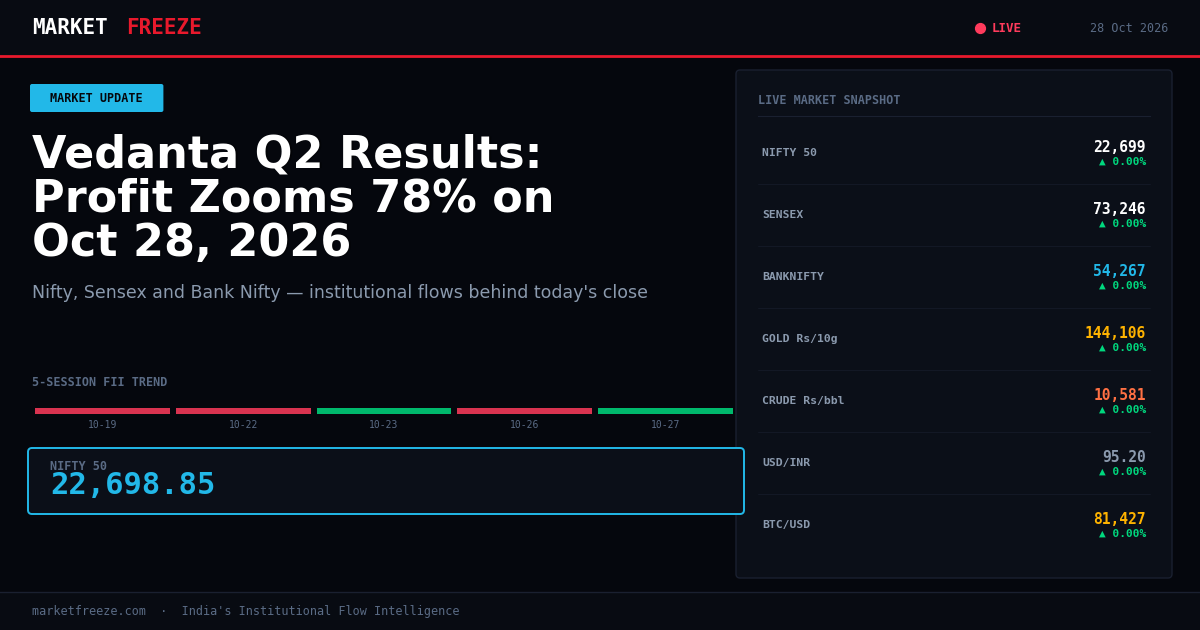
Vedanta’s Q2 profit surge of 78% YoY to ₹6,202 crore and revenue jump of 57% to ₹26,356 crore were overshadowed by a net FII outflow of ₹3,305.22 crore across the last two trading sessions, indicating institutional caution despite strong fundamental tailwinds for the metals and mining giant.
Vedanta’s Earnings Beat Meets Institutional Skepticism
Vedanta Ltd’s robust Q2 performance, driven by a 78% year-on-year leap in net profit to ₹6,202 crore and a 57% revenue surge to ₹26,356 crore, paints a picture of operational strength. The company’s EBITDA more than doubled to ₹9,938 crore, with margins expanding to a healthy 60%. This was primarily fueled by elevated commodity prices and increased production volumes, leading to a significant ₹4,624 crore reduction in net debt, bringing it down to ₹3,675 crore. However, this stellar corporate news failed to translate into immediate FII inflows. In fact, FIIs were net sellers of ₹1,462.49 crore on October 26th and net buyers of ₹4,240.39 crore on October 27th, with a net outflow of ₹3,305.22 crore over these two days. This divergence suggests that while the company’s fundamentals are strong, broader institutional sentiment, potentially influenced by global macroeconomic factors or sector-specific concerns, is tempering immediate capital deployment into such counters.
Open a free demat account with
Upstox
or
Angel One
— zero brokerage on delivery trades.
FII and DII Activity: A Tale of Divergent Flows
The institutional flow data for the last three sessions reveals a mixed bag, with FIIs exhibiting a net selling trend in the immediate preceding sessions, followed by a substantial net buying activity yesterday. On October 27th, FIIs were net buyers of ₹4,240.39 crore, a significant reversal from the net selling of ₹1,462.49 crore on October 26th. Conversely, DIIs, who were net buyers of ₹2,609.57 crore on October 26th, turned net sellers of ₹1,250.03 crore on October 27th. The prior session, October 23rd, saw strong buying from both FIIs (₹887.65 crore) and DIIs (₹3,235.36 crore). The sharp FII inflow on October 27th, despite the mixed signals from the broader market where the Nifty closed down 0.22% at 22,698.85 and the Sensex down 0.48% at 73,246.00, suggests selective buying, possibly in anticipation of earnings or based on specific sector strengths, which Vedanta’s results might have partially represented. However, the DII selling on the same day indicates that domestic institutions might be rebalancing portfolios or booking profits, adding a layer of complexity to the overall market sentiment.
Sectoral Impact: Metals Shine, Autos Face Headwinds
Vedanta’s strong performance directly benefits the Metals and Mining sector, which has seen increased investor interest due to rising global commodity prices. The positive earnings report is likely to bolster sentiment for other players in this space, such as Hindalco Industries and Tata Steel. The surge in EBITDA margins to 60% for Vedanta also suggests a broader trend of operational efficiency and pricing power within the sector. In contrast, the automotive sector, as highlighted by Hyundai Motor India’s Q2 results showing a 24% YoY profit fall to ₹1,189 crore despite an 18% revenue rise, faces headwinds. This dichotomy between commodity-driven sectors and consumer discretionary sectors like automobiles warrants attention from institutional investors. The net FII buying on October 27th might have been a targeted play into sectors demonstrating pricing power and robust demand, while DII selling could reflect profit-taking in sectors perceived to be at peak earnings or facing demand saturation.
Nifty Positioning: Navigating Support and Resistance
The Nifty 50’s current level of 22,698.85 is being closely watched by institutional traders. Based on recent flow data, particularly the FII inflows on October 27th (+₹4,240.39 Cr), immediate support can be inferred around the 22,500 mark, where these inflows likely found traction. Resistance is likely to emerge around 22,900-23,000, levels that have historically acted as psychological and technical barriers. The broader trend from the last five sessions shows the Nifty oscillating between approximately 22,600 and 22,900, with significant institutional churn. The net FII inflow of ₹4,240.39 Cr on October 27th, coupled with a DII outflow of ₹1,250.03 Cr, suggests a preference for certain high-quality stocks or sectors within the broader market, rather than a wholesale market rally. This selective approach implies that any significant move above 22,900 would require sustained, broad-based FII buying, while a dip below 22,500 could be exacerbated by renewed FII selling pressure.
Currency and Commodity Crossover: Crude Oil’s Drag
The significant drop in Crude MCX prices by -2.40% to ₹10,581.00/bbl on October 28th, 2026, is a key factor influencing institutional sentiment, especially for energy-intensive companies and those with import/export exposure. While Vedanta’s earnings were boosted by commodity prices, a sharp decline in crude oil prices can dampen overall economic activity and impact inflation expectations, which in turn can influence interest rate policies and broader market sentiment. The USD/INR is trading slightly up at ₹95.2 (+0.03%), indicating a relatively stable rupee, which is beneficial for importers but less so for exporters. The inverse correlation between crude oil prices and the rupee is a closely watched dynamic; a sustained fall in crude could eventually lead to rupee appreciation, impacting companies with significant dollar revenues. This interplay between commodity prices and currency movements is a critical consideration for institutional flow decisions, potentially contributing to the cautious stance observed despite positive company-specific news.
Historical Parallel: The Recovery Play of March 2025
A look back at the trading session of March 18th, 2025, offers a relevant historical parallel. On that day, the Nifty closed at 22,150.70, with FIIs being net sellers of ₹3,870.19 Cr and DIIs net buyers of ₹2,950.55 Cr. This period was characterized by significant global macroeconomic uncertainty, similar to the current environment where inflation and interest rate concerns are prevalent. Despite substantial FII outflows, DIIs provided a crucial floor to the market. The subsequent recovery in the Nifty over the following weeks suggests that when domestic institutions step in to absorb FII selling, the market can find its footing, especially if underlying corporate earnings remain strong. The current scenario, with FIIs showing volatility in their flows (buying heavily on Oct 27th after selling prior), and DIIs alternating between buying and selling, echoes this pattern of institutional recalibration in uncertain times. The key difference now is the robust earnings reported by companies like Vedanta, which could act as a catalyst for sustained DII support even amid FII caution.
Portfolio Framework: Hedging Against Volatility
For institutional investors and serious retail traders aiming to navigate the current market environment, a portfolio framework focused on resilience and selective growth is recommended. This involves allocating capital with specific numeric conditions: maintain a minimum of 20% allocation to high-quality, dividend-paying stocks in defensive sectors like FMCG and Pharmaceuticals, which tend to outperform during uncertain times. Allocate another 30% to sectors exhibiting strong pricing power and benefiting from commodity cycles, such as Metals and Mining, provided that EBITDA margins remain above 50%. The remaining 50% should be managed actively, with a bias towards sectors showing sustainable revenue growth exceeding 15% year-on-year, and a strict stop-loss of 8% on individual stock positions to manage downside risk. This approach balances defensive positioning with opportunistic bets on sectors with clear fundamental tailwinds, aligning with the selective buying observed in FII flows.
Key Levels to Watch
The Nifty 50’s trajectory hinges on key levels influenced by institutional positioning. Immediate support is observed around the 22,500 level, a zone where the significant FII inflows on October 27th (+₹4,240.39 Cr) likely found footing. A sustained break below this level could trigger further selling, potentially pushing the index towards the 22,200 mark, a level not breached since early October 2025. Conversely, resistance is building around the 22,900-23,000 band, which has acted as a ceiling in recent trading sessions. A decisive move above 23,000, supported by renewed broad-based FII buying exceeding ₹5,000 crore in a single session, would signal a potential breakout towards higher targets. The Bank Nifty’s resilience, closing up 0.54% at 54,267.00 today, suggests underlying strength in financial services, which could provide a buffer against broader market weakness.
FAQ Section
- Q: What did FII buy or sell on 2026-10-27? A: FIIs were net buyers of ₹4,240.39 Cr on 2026-10-27.
- Q: What did DII buy on 2026-10-26? A: DIIs were net buyers of ₹2,609.57 Cr on 2026-10-26.
- Q: Is FII buying or selling in October 2026? A: FII flows in October 2026 have been mixed, with net inflows of ₹887.65 Cr on the 23rd, followed by net outflows of ₹1,462.49 Cr on the 26th, and a significant inflow of ₹4,240.39 Cr on the 27th, indicating a volatile trend.
Historical FII/DII Flow Data (Last 5 Sessions)
| Date | FII Net (Cr) | DII Net (Cr) | Nifty Close |
|---|---|---|---|
| 2026-10-19 | ₹-1,148.64 Cr | +₹3,201.19 Cr | 22,888.95 |
| 2026-10-22 | ₹-3,458.70 Cr | +₹2,891.32 Cr | 22,600.00 |
| 2026-10-23 | +₹887.65 Cr | +₹3,235.36 Cr | 22,753.20 |
| 2026-10-26 | ₹-1,462.49 Cr | +₹2,609.57 Cr | 22,749.75 |
| 2026-10-27 | +₹4,240.39 Cr | ₹-1,250.03 Cr | 22,749.75 |
Bottom Line
Vedanta’s impressive Q2 results highlight strong company-specific performance, yet the broader market is currently shaped by volatile institutional flows and macroeconomic uncertainties. While FIIs demonstrated significant buying on October 27th, DIIs showed caution with selling pressure, creating a mixed sentiment. Investors should monitor the 22,500 support level on the Nifty and watch for sustained institutional inflows to confirm a positive market direction, particularly within commodity-linked sectors like metals.
Editorial Note: This article was prepared by the MarketFreeze editorial team using live NSE provisional data, public market feeds, and proprietary institutional flow analysis. All price and flow figures are sourced directly from NSE, BSE, and CoinGecko as of 28 October 2026. This content is for informational purposes only and does not constitute investment advice. MarketFreeze is not SEBI-registered. Please consult a qualified financial advisor before making investment decisions. Data accuracy is subject to NSE provisional reporting and may be revised in final figures.