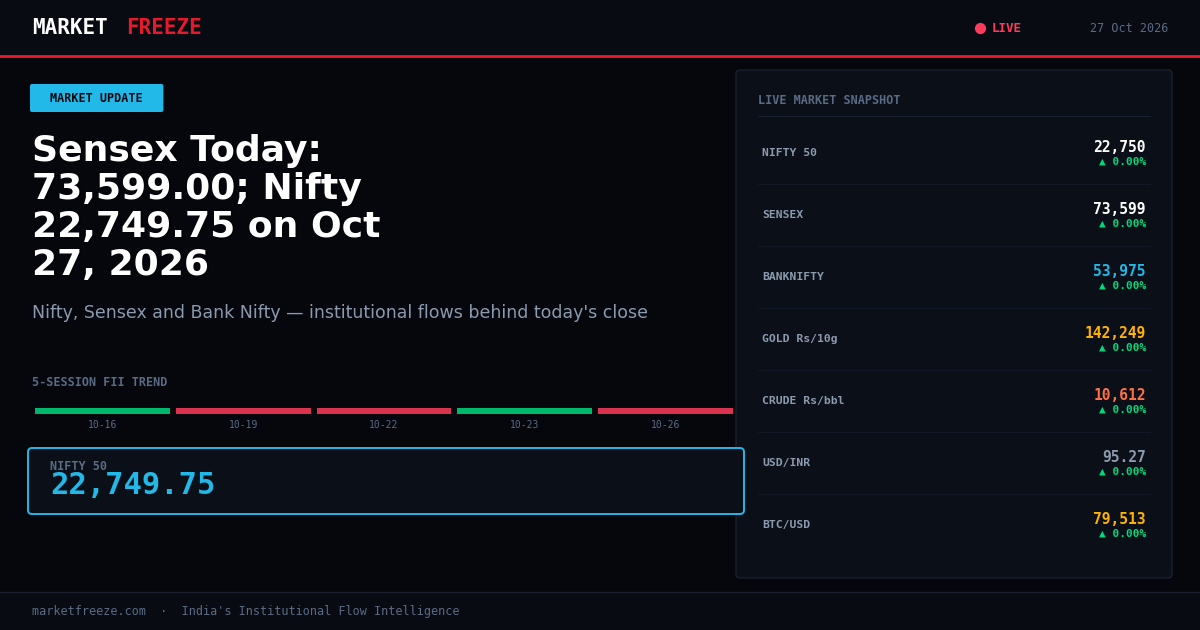
Indian equity benchmarks, the Nifty 50 and Sensex, closed marginally lower on October 27, 2026, with the Nifty settling at 22,749.75 (down 0.02%) and the Sensex at 73,599.00 (down 0.01%), reflecting a lack of strong conviction amid mixed institutional flows.
FIIs Shift to Net Sellers as DIIs Continue Accumulation Amidst Flat Markets
The Indian equity markets experienced a muted trading session on October 27, 2026, with both the Nifty 50 and the Sensex closing nearly flat. This lack of decisive movement in the indices was accompanied by a notable shift in Foreign Institutional Investor (FII) positioning, turning net sellers after a brief buying spell, while Domestic Institutional Investors (DIIs) maintained their buying momentum. This divergence in institutional flow, against a backdrop of minor index movements, provides crucial insights into market sentiment and potential future sector rotations.
Open a free demat account with
Upstox
or
Angel One
— zero brokerage on delivery trades.
FIIs Turn Net Sellers, DIIs Extend Buying Spree
On October 27, 2026, Foreign Institutional Investors (FIIs) were net sellers to the tune of ₹1,462.49 crore. This marks a reversal from their net buying activity on October 23, 2026, where they had purchased equities worth ₹887.65 crore. The trend of FII selling was also evident on October 26, 2026, with net sales of ₹1,462.49 crore. Conversely, Domestic Institutional Investors (DIIs) continued their robust buying, adding ₹2,609.57 crore worth of equities on October 27, 2026. This follows their net purchases of ₹3,235.36 crore on October 23, 2026, and ₹2,609.57 crore on October 26, 2026, highlighting sustained domestic buying interest despite cautious FII sentiment.
Automotive Sector Faces Headwinds as Maruti Suzuki Reports Profit Dip
The automotive sector came under scrutiny today following the announcement of Maruti Suzuki’s Q2 results. The company reported a 26% year-on-year drop in net profit to ₹2,466 crore, despite a 26% rise in revenue. This profit decline, attributed to rising costs, suggests that even strong festive season demand is not fully translating to bottom-line growth in the sector. This news could be a drag on auto ancillary and component manufacturers as well. The cautious stance of FIIs, evidenced by their net selling, could be partially influenced by such sector-specific earnings disappointments, potentially leading them to reduce exposure in rate-sensitive sectors like automobiles, which are heavily reliant on consumer spending and financing. The Bank Nifty’s significant drop of 0.72% to 53,975.00 further indicates a cautious mood in the financial sector, which often moves in tandem with auto loan demand.
Banking Sector Under Pressure Amidst Deferral of Dollar Debt Sales
Indian lenders, including public sector banks like Canara Bank, PNB, and Bank of India, are deferring plans to sell dollar-denominated debt. This decision stems from rising US Treasury yields and a depreciating rupee (USD/INR up 0.19% to Rs95.27), making dollar debt more expensive. The deferral of these fundraising plans can limit the capital infusion capacity of these banks, potentially impacting their ability to expand lending and meet regulatory requirements. This news, coupled with the Bank Nifty’s decline, suggests a cautious outlook for the banking sector. DIIs, however, continue to buy, indicating their confidence in the long-term prospects of domestic banks, possibly viewing the current elevated yields as an opportunity for future returns. The sustained DII buying in a flat market might be a signal of their belief that the banking sector’s fundamentals remain strong despite short-term headwinds.
Nifty Levels: A Tale of Two Flows
The Nifty 50 closed at 22,749.75, a marginal decline of 3.45 points. Analyzing the recent FII/DII flow data provides insights into potential support and resistance levels. On October 22, 2026, when FIIs were significant net sellers (₹3,458.70 crore), the Nifty closed at 22,600.00. The subsequent buying by FIIs on October 23, 2026 (₹887.65 crore) coincided with a rebound to 22,753.20. Today’s flat close at 22,749.75, with FIIs turning net sellers again (₹1,462.49 crore), suggests that the 22,750-22,800 zone is a key resistance level in the short term. Conversely, the 22,600 level, where significant selling pressure was absorbed in the past week, could act as a crucial support. DII buying has been a consistent anchor, providing support around the 22,600-22,700 range, as seen on October 26, 2026, when they bought ₹2,609.57 crore and the Nifty closed at 22,753.20.
Commodities Reflect Global Economic Jitters
The commodity markets displayed weakness today, with Crude Oil (MCX) down 3.82% to Rs10,612.00 per barrel and Gold (MCX) down 0.78% to Rs142,249.00 per 10 grams. This decline in gold, a traditional safe-haven asset, alongside a sharp fall in crude oil prices, suggests a potential easing of inflation concerns or a slowdown in global demand. The depreciation of the Indian Rupee against the US Dollar (USD/INR up 0.19% to Rs95.27) typically makes dollar-denominated commodities more expensive for Indian buyers, which could contribute to the price fall in local currency terms. While the news on Indian banks deferring dollar debt sales is a domestic factor, the broader commodity price action points to global economic sentiment impacting institutional investor appetite for riskier assets, potentially influencing their allocation towards Indian equities.
Historical Parallel: FII Outflows and Market Consolidation
Looking back at the FII/DII flows, a pattern emerges where significant FII selling often precedes a period of market consolidation or minor corrections, while DII buying provides a floor. For instance, on October 22, 2026, FIIs were net sellers of ₹3,458.70 crore, and the Nifty closed at 22,600.00. Following this, the market saw some recovery driven by DII purchases. Today’s net FII selling of ₹1,462.49 crore, coupled with a flat Nifty close, echoes this trend. This suggests that sustained FII outflows could lead to a sideways movement in the Nifty, with DIIs acting as buyers on dips, particularly in sectors with strong domestic fundamentals. The period between October 16 and October 26, 2026, shows a consistent trend of DII net buying, ranging from ₹2,609.57 crore to ₹3,661.28 crore (on Oct 16, with FIIs buying ₹1,165.92 crore), indicating their unwavering confidence in Indian equities.
Portfolio Framework: Capitalizing on DII Strength Amidst FII Caution
Given the current market dynamics – FII caution versus DII accumulation – a portfolio strategy focused on sectors benefiting from domestic demand and supported by DII inflows is advisable. Investors could consider allocating capital to companies with strong balance sheets in sectors like Fast-Moving Consumer Goods (FMCG) and select Infrastructure players, where demand is less susceptible to global economic fluctuations. For instance, if a company in the FMCG sector reports earnings above 15% YoY growth and the DII holding in that stock is above 10%, it could present a buying opportunity. Conversely, sectors heavily reliant on foreign capital or export demand might face headwinds if FII selling persists. A portfolio overweight in domestic demand-driven sectors, with a target allocation of 30-40%, could provide resilience. Conversely, reducing exposure to rate-sensitive sectors like automobiles and real estate by 5-10% might be prudent until FII sentiment improves.
What Changes This Outlook: Sustained FII Inflows Above ₹2,000 Crore
The key trigger to watch for a potential shift in market sentiment and a more decisive upward move in the Nifty would be sustained FII inflows exceeding ₹2,000 crore on a daily basis for at least two consecutive trading sessions. Such a surge in foreign buying would indicate a renewed confidence in Indian equities, potentially reversing the cautious trend observed today and on October 26, 2026. Until then, expect the market to remain range-bound, with DIIs providing support at lower levels and FII selling capping upside momentum. The Bank Nifty holding above 53,500 would also be a crucial indicator of financial sector stability.
Historical FII/DII Flows
| Date | FII Net (Cr) | DII Net (Cr) | Nifty Close |
|---|---|---|---|
| 2026-10-16 | +₹1,165.92 Cr | ₹-3,661.28 Cr | 22,888.95 |
| 2026-10-19 | ₹-1,148.64 Cr | +₹3,201.19 Cr | 22,888.95 |
| 2026-10-22 | ₹-3,458.70 Cr | +₹2,891.32 Cr | 22,600.00 |
| 2026-10-23 | +₹887.65 Cr | +₹3,235.36 Cr | 22,753.20 |
| 2026-10-26 | ₹-1,462.49 Cr | +₹2,609.57 Cr | 22,753.20 |
Frequently Asked Questions
- Q: What did FII buy or sell on October 27, 2026? A: FIIs were net sellers of ₹1,462.49 crore on October 27, 2026.
- Q: What did DII buy on October 27, 2026? A: DIIs were net buyers of ₹2,609.57 crore on October 27, 2026.
- Q: Is FII buying or selling in October 2026? A: In October 2026, FIIs have shown a mixed trend with significant selling days like October 22 (₹3,458.70 crore) and October 26/27 (₹1,462.49 crore each), interspersed with a buying day on October 23 (₹887.65 crore). The overall trend points towards caution from FIIs in the latter half of the month.
Key Levels to Watch
Nifty Support: The 22,600 level, observed as a buying zone during recent FII selling pressure, is expected to act as strong support. A dip below this could signal further downside.
Nifty Resistance: The 22,750-22,800 zone is currently acting as a resistance, given the flat close today and previous intraday highs. Breaking convincingly above 22,850 would indicate renewed buying interest.
Bottom Line
The Indian equity markets are navigating a period of divergence, with FIIs turning net sellers while DIIs continue to accumulate shares. This cautious FII sentiment, coupled with sector-specific headwinds like Maruti Suzuki’s profit decline and banking sector concerns over dollar debt, capped index gains. However, sustained DII buying provides a floor, suggesting resilience in domestic demand-driven sectors. Investors should monitor FII inflow patterns and key Nifty levels for signs of a potential market direction change.
Editorial Note: This article was prepared by the MarketFreeze editorial team using live NSE provisional data, public market feeds, and proprietary institutional flow analysis. All price and flow figures are sourced directly from NSE, BSE, and CoinGecko as of 27 October 2026. This content is for informational purposes only and does not constitute investment advice. MarketFreeze is not SEBI-registered. Please consult a qualified financial advisor before making investment decisions. Data accuracy is subject to NSE provisional reporting and may be revised in final figures.