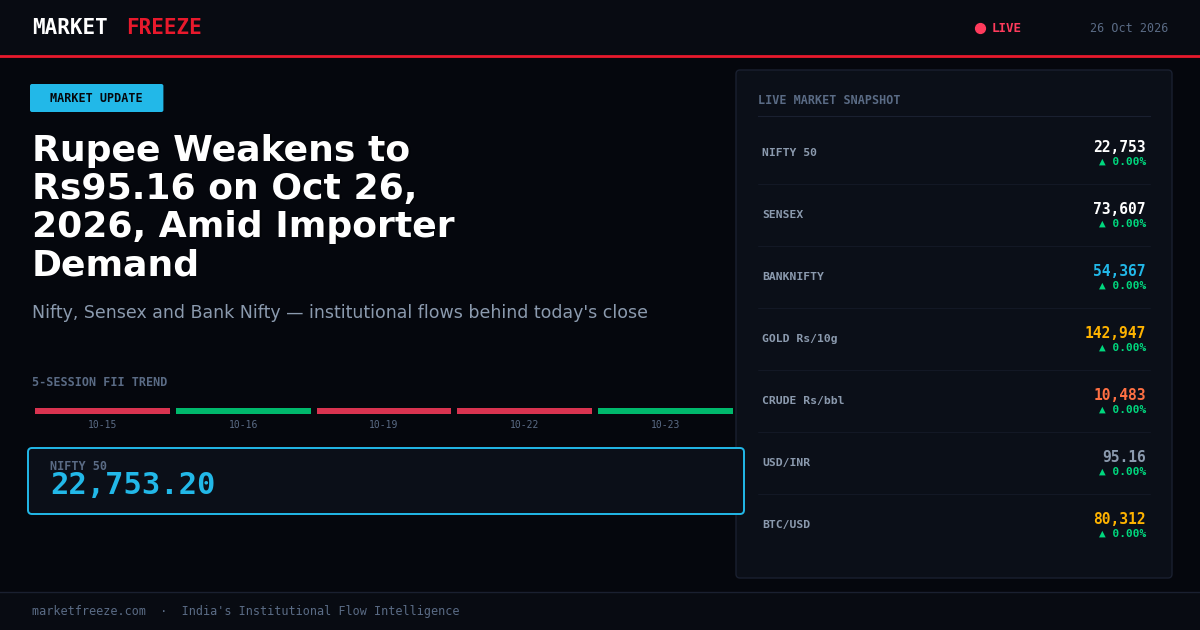
The Indian rupee depreciated for the third consecutive session on October 26, 2026, settling at Rs95.16 against the US dollar, driven by importer demand and FII outflows, which saw the Nifty 50 close at 22,753.20, up 0.68%.
Rupee Weakness Mirrors FII Retreat, Despite Broader Market Gains
Today’s session saw a divergence between the headline indices and the underlying currency pressure, as the rupee’s slide for the third straight day was directly linked to increased dollar demand from importers amid elevated crude oil prices and persistent foreign institutional investor (FII) selling. While the Nifty 50 managed to close 0.68% higher at 22,753.20 and the Sensex advanced 0.66% to 73,607.00, the rupee’s weakening trend at Rs95.16 (+0.53% for USD/INR) signals underlying headwinds that FII/DII flows are actively navigating. The news catalyst of a weakening rupee, exacerbated by rising Brent crude prices to Rs10,483.00 per barrel (-5.62%), directly impacts import costs and inflation expectations, factors that often correlate with institutional risk appetite.
Open a free demat account with
Upstox
or
Angel One
— zero brokerage on delivery trades.
FIIs Show Tentative Re-entry Amidst Dollar Pressure
Following two sessions of net selling, FIIs turned net buyers on October 23, 2026, injecting ₹887.65 Cr into the Indian equity markets. This buying activity, however, occurred on a day when the Nifty 50 remained flat at 22,600.00, suggesting a cautious re-engagement rather than a strong conviction. Domestic Institutional Investors (DIIs) continued their robust buying streak, adding ₹3,235.36 Cr on the same day. This sustained DII support has been instrumental in cushioning the market from more significant downturns, even as FIIs have exhibited more choppiness, as seen in their net selling of ₹3,458.70 Cr on October 22 and ₹1,148.64 Cr on October 19. Today’s rupee depreciation at Rs95.16 is a counterpoint to the net FII inflow on October 23, indicating that the currency market’s sentiment, influenced by import pressures and global commodity prices, may be outrunning immediate equity flow trends for foreign players.
Sectoral Ripples from Crude and Currency Woes
The persistent strength in crude oil, despite a dip today to Rs10,483.00 per barrel, and the weakening rupee at Rs95.16, create a dual pressure on sectors sensitive to import costs and inflation. The Oil & Gas sector, while directly impacted by crude prices, may see mixed reactions; upstream players could benefit from higher prices if they are hedged or can pass on costs, but downstream companies will face margin pressures. The Automotive sector, heavily reliant on imported components and sensitive to fuel prices, could experience headwinds as higher input costs and potential consumer demand slowdown due to inflation concerns emerge. Furthermore, companies with significant foreign currency debt obligations or high import content in their manufacturing processes, broadly across the Manufacturing and Consumer Discretionary sectors, will likely see their profitability squeezed. DIIs’ continued buying, particularly on October 23 (+₹3,235.36 Cr), might indicate a preference for domestic demand-driven sectors or defensive plays, potentially shying away from the more import-exposed segments.
Nifty Levels Shaped by Recent Flow Dynamics
The Nifty 50’s movement to 22,753.20 today, after consolidating around 22,600.00 for the past couple of sessions, suggests a tentative upward bias. However, the underlying FII selling pressure observed on October 22 (₹3,458.70 Cr sell-off) and October 19 (₹1,148.64 Cr sell-off) implies that significant supply could be encountered on rallies. The Nifty finding support around the 22,600 level on October 22 and 23, coinciding with DII net buys of ₹2,891.32 Cr and ₹3,235.36 Cr respectively, highlights this as a key demand zone. Conversely, the 22,888.95 level, where the Nifty closed on October 16 and 19, served as resistance before the recent dip. Given today’s upward momentum, the immediate resistance would be around 22,850, an area where FIIs might re-initiate selling if the rupee’s weakness persists. A sustained breach above 22,900, coupled with a reversal in FII flows to net buying, would signal a stronger upward move.
Currency and Commodity Cross-Currents
The weakening Indian rupee, reaching Rs95.16 against the US dollar, is a direct consequence of increased importer dollar bids, a trend amplified by elevated global crude oil prices. Brent crude, despite a sharp intraday fall to Rs10,483.00 per barrel today, remains at levels that pressure India’s import bill. This twin pressure of a depreciating rupee and high commodity prices creates a challenging environment. Gold MCX, meanwhile, edged up to Rs142,947.00/10g (+0.58%), potentially acting as a safe-haven asset amidst currency and inflation concerns, although its movement today is less pronounced than the USD/INR trend. The interplay suggests that institutional investors are closely monitoring the commodity overhang and its impact on the currency, which can indirectly influence equity valuations and sector performance.
Historical Echoes of FII Outflows and Rupee Depreciation
The current scenario, with FII net selling and a weakening rupee, has historical parallels. During the week of October 15-22, 2026, FIIs were net sellers of ₹5,285.37 Cr (Oct 15) and ₹3,458.70 Cr (Oct 22), while the Nifty saw a decline from 23,146.15 to 22,600.00. While specific daily USD/INR data for those exact periods isn’t provided, a sustained FII outflow in the past has often coincided with currency depreciation due to reduced dollar inflows. The current situation, where FIIs turned net buyers of ₹887.65 Cr on October 23 after earlier selling, while the rupee continues its descent, suggests a more complex dynamic. This might indicate that while short-term currency pressures exist, DIIs are providing a stable anchor, and FIIs are selectively re-entering, perhaps seeing value at lower levels despite the macroeconomic headwinds.
Portfolio Framework: Navigating Currency and Flow Volatility
Investors should consider a portfolio framework that balances defensiveness with selective growth. With the rupee at Rs95.16 and crude oil prices hovering around Rs10,483.00/bbl, overweighting sectors with strong pricing power and limited import dependence is prudent. Specifically, if the Nifty holds above 22,500 and FII net inflows remain positive for at least two consecutive sessions, consider increasing exposure to companies with robust domestic demand, such as select Banking stocks (where DIIs have shown consistent buying) and well-positioned Consumer Staples. Conversely, if USD/INR breaches Rs96.00 and crude oil reclaims higher levels, it would be advisable to reduce exposure to import-heavy Industrials and Automobiles, and potentially increase allocation to Gold MCX if it breaks above Rs145,000.
Key Levels to Watch
The Nifty 50, currently at 22,753.20, faces immediate resistance around the 22,850-22,900 zone. This area is critical as it was a trading range on October 19 and 22 before the market dipped. Significant selling pressure from FIIs, if they resume net outflows, could emerge here. On the support side, the 22,600 level, which saw DII accumulation on October 22 and 23, remains a crucial demand zone. A decisive break below 22,600, particularly on increased FII selling, would indicate a shift in institutional sentiment. The Bank Nifty, trading at 54,367.00, might find support near its 54,000 mark, an area where DII buying has been consistent.
Frequently Asked Questions
- Q: What did FII buy or sell on October 23, 2026? A: FIIs were net buyers of ₹887.65 Cr on October 23, 2026.
- Q: What did DII buy on October 23, 2026? A: DIIs were net buyers of ₹3,235.36 Cr on October 23, 2026.
- Q: Is FII buying or selling in October 2026? A: FII flows in October 2026 have been mixed, with net selling observed on October 19 (₹1,148.64 Cr) and October 22 (₹3,458.70 Cr), followed by net buying on October 23 (₹887.65 Cr). The overall trend is subject to ongoing market developments and currency pressures.
| Date | FII Net (Cr) | DII Net (Cr) | Nifty Close |
|---|---|---|---|
| 2026-10-15 | ₹-5,285.37 Cr | +₹3,319.39 Cr | 23,146.15 |
| 2026-10-16 | +₹1,165.92 Cr | ₹-3,661.28 Cr | 22,888.95 |
| 2026-10-19 | ₹-1,148.64 Cr | +₹3,201.19 Cr | 22,888.95 |
| 2026-10-22 | ₹-3,458.70 Cr | +₹2,891.32 Cr | 22,600.00 |
| 2026-10-23 | +₹887.65 Cr | +₹3,235.36 Cr | 22,600.00 |
What Changes This Outlook
The primary trigger to watch is the movement of the USD/INR pair. A sustained breach above Rs96.00, coupled with continued high crude oil prices above Rs10,500.00/bbl, would signal increased imported inflation and pressure on foreign exchange reserves, potentially leading to a reversal of recent FII buying into net selling. Conversely, a stabilization of the rupee below Rs95.00 and a dip in crude oil prices below Rs10,000.00/bbl, alongside sustained FII net inflows exceeding ₹1,000 Cr daily for a week, would confirm a more constructive outlook.
Bottom Line: Today’s market saw the Nifty 50 close higher at 22,753.20, buoyed by DII strength, yet a weakening rupee at Rs95.16, driven by importer demand and FII outflows in preceding sessions, presents a significant headwind. While FIIs showed a net buying of ₹887.65 Cr on October 23, the broader currency trend suggests that inflationary pressures and import costs remain a concern for institutional flow direction. Investors should monitor the ₹22,600 support level for the Nifty and a potential rupee breach of Rs96.00 as key indicators of future market direction.
Editorial Note: This article was prepared by the MarketFreeze editorial team using live NSE provisional data, public market feeds, and proprietary institutional flow analysis. All price and flow figures are sourced directly from NSE, BSE, and CoinGecko as of 26 October 2026. This content is for informational purposes only and does not constitute investment advice. MarketFreeze is not SEBI-registered. Please consult a qualified financial advisor before making investment decisions. Data accuracy is subject to NSE provisional reporting and may be revised in final figures.