Indian Markets Extend Losses as Geopolitical Fears Trump Early Gains; FIIs Remain Net Sellers
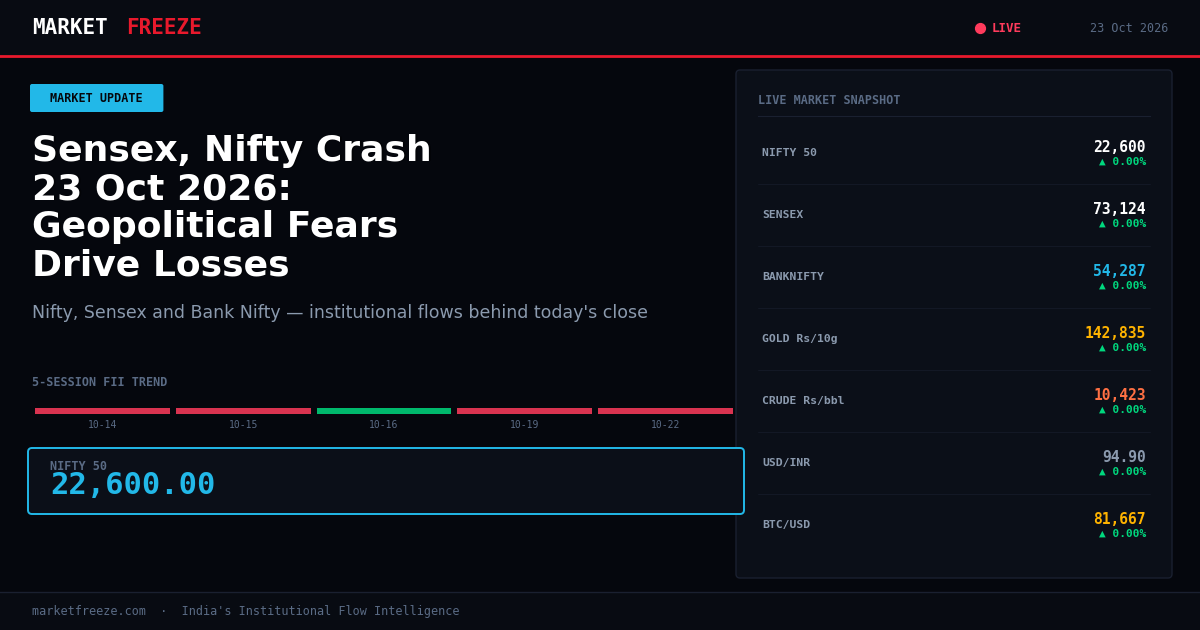
Indian equity benchmarks, the Nifty 50 and Sensex, reversed early gains to end lower for a fourth consecutive session on October 23, 2026, with the Nifty closing at 22,600.00 (down 0.39%) and the Sensex at 73,124.00 (down 0.17%), as escalating Middle East tensions and a surge in crude oil prices significantly dented investor sentiment, a trend mirrored by sustained Foreign Institutional Investor (FII) selling.
Open a free demat account with
Upstox
or
Angel One
— zero brokerage on delivery trades.
FIIs Continue to Exit as Geopolitical Headwinds Intensify
Foreign Institutional Investors (FIIs) extended their selling spree, offloading net ₹3,458.70 crore on October 22, 2026, and continued the trend in today’s session, which is likely to reflect in the final figures, indicating a clear risk-off sentiment among global investors. This sustained outflow contrasts with Domestic Institutional Investors (DIIs), who have been net buyers for the last three sessions, including a substantial ₹2,891.32 crore on October 22, attempting to cushion the market impact. The recent FII activity shows a pattern of significant net selling on October 22 (₹3,458.70 Cr) and October 19 (₹1,148.64 Cr), with only a brief respite of net buying on October 16 (+₹1,165.92 Cr). This continuous FII divestment is a direct response to the escalating geopolitical tensions in the Middle East and the consequent spike in crude oil prices, which typically triggers a flight to safety from emerging markets like India.
Sectoral Tremors: Energy and Financials Bear the Brunt
The broad-based selling pressure, amplified by surging crude oil prices, disproportionately impacted the energy and banking sectors. The Energy sector is directly vulnerable to higher crude prices, impacting refining margins and transportation costs, potentially leading to suppressed demand. The Bank Nifty, which closed down 1.16% at 54,287.00, reflects broader concerns about potential inflation and interest rate hikes that could follow sustained high energy costs, coupled with the general risk aversion which reduces credit appetite. Technology stocks also faced pressure due to global weakness in the sector, which contributed to the overall negative sentiment. While specific sector flow data for the day is pending, the sharp decline in Bank Nifty suggests that DIIs might be reallocating capital from financials to more defensive or value-oriented sectors, even as they continue to be net buyers overall.
Nifty’s Slippage and Institutional Footprints
The Nifty 50’s decline to 22,600.00 is significant as it breaches crucial support levels that were previously tested. Based on recent FII/DII flows, the 22,500 mark has seen some buying interest from DIIs during periods of FII selling, suggesting it could act as an immediate support. Conversely, sustained FII outflows, particularly exceeding ₹3,000 crore in a single session as seen on October 22, push the index towards lower support levels. If the selling pressure continues, the 22,300-22,400 range, where previous accumulation occurred during the rally from the 22,000 psychological mark, could be tested. Resistance is now firmly placed around 22,700-22,800, levels that failed to hold during intraday recovery attempts.
USD/INR Surge Reflects Global Risk Aversion
The Indian Rupee weakened against the US Dollar, with USD/INR trading at Rs94.9, a 0.67% increase. This depreciation is a direct consequence of increased global risk aversion driven by Middle East tensions and rising crude oil prices. As oil is a major import for India, higher oil prices translate to higher dollar demand for payments, putting downward pressure on the Rupee. This currency movement is often correlated with FII flows; a depreciating Rupee typically accompanies significant FII outflows as foreign investors repatriate funds or face currency devaluation risks. The surge in USD/INR reinforces the narrative of capital flight from emerging markets, aligning with the FII selling observed in Indian equities.
Historical Parallels: 2022’s Energy Shock Echoes
Today’s market action, driven by a sudden spike in crude oil prices and geopolitical instability, bears a resemblance to the market reactions witnessed in mid-2022 when similar geopolitical events and energy supply concerns led to sharp corrections. During that period, FIIs were net sellers for extended durations as global inflation fears and recessionary concerns dominated. For instance, in the week of September 16, 2022, FIIs offloaded over ₹20,000 crore in a single week, coinciding with a significant dip in crude oil prices that eventually reversed, but not before equity markets experienced considerable volatility. The current scenario, while potentially less severe in terms of duration, echoes the sensitivity of Indian markets to external energy shocks and the consequent flight of foreign capital.
Portfolio Rebalancing: DIIs Navigate FII Exodus
For investors managing their portfolios, the current environment necessitates a tactical approach. Given the sustained FII selling and the macro-economic headwinds, investors should consider reducing exposure to highly cyclical sectors that are sensitive to commodity prices and global demand, such as airlines, tourism, and manufacturing dependent on imported inputs. Conversely, sectors with a strong domestic demand tailwind or those benefiting from government capex, such as select infrastructure and defense stocks, may offer relative stability. DII flows can provide clues; their consistent buying suggests confidence in specific pockets of the market, potentially in value stocks or companies with strong balance sheets that can withstand inflationary pressures. A framework could involve allocating no more than 15% of the portfolio to energy-intensive industries if crude oil prices remain above $100 per barrel for more than two consecutive weeks.
Key Levels to Watch
The immediate support for the Nifty 50 is positioned at 22,500, a level that has shown DII accumulation in recent sessions. A decisive break below this could propel the index towards 22,350, a significant psychological and historical support. On the upside, resistance is observed around 22,700, followed by a stronger barrier at 22,800, levels that were previously tested and failed to sustain. Any sustained buying by FIIs, even for a single session with net inflows exceeding ₹2,000 crore, could signal a temporary reprieve and a potential test of these resistance levels. Conversely, continued FII selling above ₹3,000 crore per day would solidify the bearish outlook.
FAQ Section
Q: What did FII buy or sell on October 22, 2026?
A: FIIs were net sellers of ₹3,458.70 Cr on October 22, 2026.
Q: What did DII buy on October 22, 2026?
A: DIIs were net buyers of ₹2,891.32 Cr on October 22, 2026.
Q: Is FII buying or selling in October 2026?
A: In October 2026, FIIs have shown a predominantly selling trend, with net outflows of ₹3,458.70 Cr on October 22 and ₹1,148.64 Cr on October 19, interspersed with a net buy of ₹1,165.92 Cr on October 16. Overall, the month has seen significant FII divestment.
Historical FII/DII Flows (Last 5 Sessions)
| Date | FII Net (Cr) | DII Net (Cr) | Nifty Close |
|---|---|---|---|
| 2026-10-14 | ₹-1,857.44 Cr | +₹2,670.44 Cr | 22,997.35 |
| 2026-10-15 | ₹-5,285.37 Cr | +₹3,319.39 Cr | 23,146.15 |
| 2026-10-16 | +₹1,165.92 Cr | ₹-3,661.28 Cr | 22,888.95 |
| 2026-10-19 | ₹-1,148.64 Cr | +₹3,201.19 Cr | 22,888.95 |
| 2026-10-22 | ₹-3,458.70 Cr | +₹2,891.32 Cr | 22,687.65 |
Bottom Line: Indian markets are currently under pressure from external factors, primarily geopolitical tensions in the Middle East and the resultant surge in crude oil prices, leading to a significant risk-off sentiment reflected in sustained FII selling. While DIIs are providing some support, the broad-based selling and weakening Rupee indicate challenges ahead for the indices. Investors should closely monitor crude oil price movements and FII flow data for any potential shifts in market direction.
Stay ahead of the curve. Subscribe to MarketFreeze for daily institutional flow intelligence and unlock actionable insights tailored for serious investors.
Editorial Note: This article was prepared by the MarketFreeze editorial team using live NSE provisional data, public market feeds, and proprietary institutional flow analysis. All price and flow figures are sourced directly from NSE, BSE, and CoinGecko as of 23 October 2026. This content is for informational purposes only and does not constitute investment advice. MarketFreeze is not SEBI-registered. Please consult a qualified financial advisor before making investment decisions. Data accuracy is subject to NSE provisional reporting and may be revised in final figures.