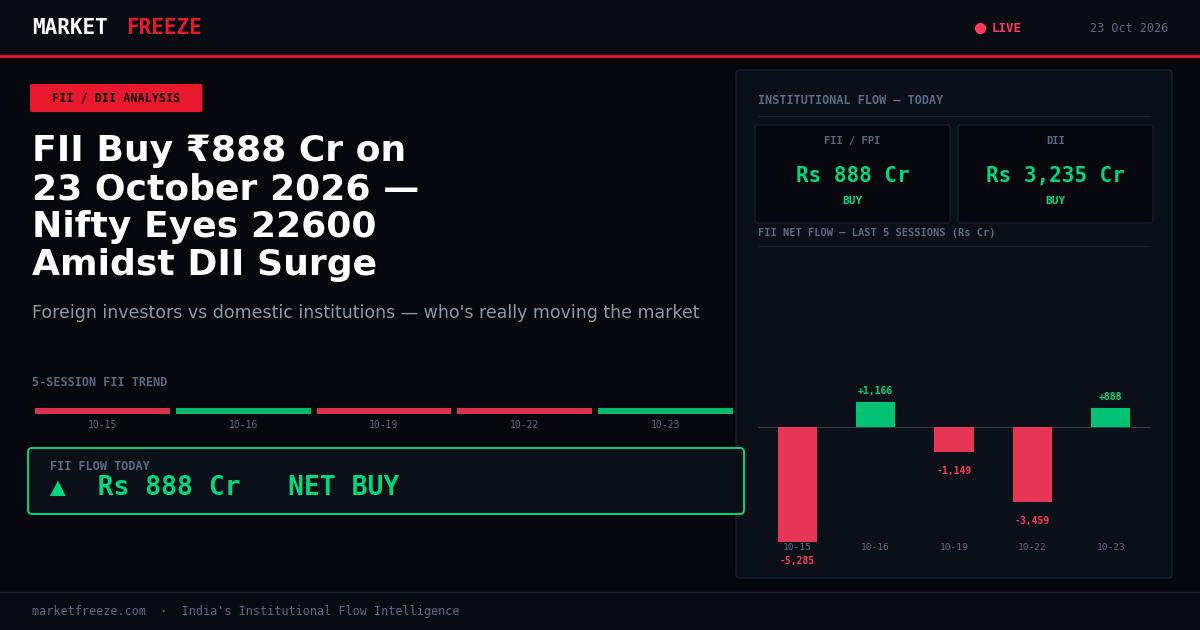
Institutional flow data released after market close shows FIIs deployed ₹887.65 Cr into Indian equities on 23 October 2026, reversing a two-session selling streak. This buying activity was underpinned by a substantial ₹3,235.36 Cr net purchase from Domestic Institutional Investors (DIIs).
Open a free demat account with
Upstox
or
Angel One
— zero brokerage on delivery trades.
FIIs Re-Enter, But With Lower Conviction Than DIIs
Foreign Portfolio Investors (FIIs) returned as net buyers today, injecting ₹887.65 Cr into Indian equities. This marks a significant shift from their net selling of ₹3,458.70 Cr on 22 October and ₹1,148.64 Cr on 19 October. Today’s gross FII turnover, with ₹14,445.54 Cr of buying versus unspecified selling, suggests a cautious re-entry rather than aggressive accumulation. The DIIs, however, maintained their consistent buying, adding another ₹3,235.36 Cr to their portfolios, bringing their three-day total to over ₹9.3 billion. This divergence indicates that while FIIs are tentatively dipping back in, DIIs remain the primary drivers of domestic equity demand.
For retail investors, the return of FII buying is a positive signal, but the lower gross turnover compared to DIIs suggests that the broader market uptrend may still face headwinds without stronger FII conviction.
Nifty Stabilizes at 22,600 Despite Broader Market Weakness
The Nifty 50 closed at 22,600.00, down 0.39%, and the Sensex at 73,124.00, down 0.17%. This marked the fourth consecutive session of losses for the Indian equity markets. The Bank Nifty was particularly weak, shedding 1.16% to close at 54,287.00. This broad-based decline, which saw all sectors closing in the red according to market reports, was exacerbated by rising crude oil prices, which surged to $114 (as per news context), and weak global cues. Despite the overall negative close, today’s FII inflow at ₹887.65 Cr suggests they may have stepped in to defend the 22,550 support level. A sustained move below 22,400 would indicate a loss of FII confidence, while a reclaim and hold above 22,700 would suggest they are building positions with greater conviction.
Retail investors should monitor the 22,550 Nifty level closely; a breach could signal further downside pressure driven by institutional selling.
DIIs Pile Into Financials and Select Cyclicals
While specific sector-level data for FII and DII flows is not provided, the consistent DII buying of over ₹3,000 Cr for the third consecutive session, coupled with FIIs dipping back in, suggests a preference for defensive sectors and large-cap financials. The sharp decline in Bank Nifty by 1.16% today, despite DII buying, implies that while DIIs are accumulating, their focus may be on specific banking stocks rather than broad sector exposure, or they are absorbing FII selling in other sectors. The news highlighting strong performance from companies like Eternal and Apollo Hospital suggests DIIs might be favouring healthcare and potentially consumer discretionary plays, while selling pressure in Metal stocks, as reported, aligns with a cautious FII stance on cyclical sectors. Given the RBI’s policy actions, financial services and companies with strong balance sheets are likely beneficiaries of DII accumulation.
Retail investors looking to align with DIIs should consider large-cap banking and healthcare stocks where consistent fund inflows are evident.
USD/INR Surge Aligns with Bond Market Weakness
The Indian Rupee weakened significantly against the US Dollar, with USD/INR closing at Rs94.9, a 0.65% increase. This move aligns with the ongoing slump in Indian government bonds, which have fallen for ten consecutive weeks. The 10-year bond yield rose to 7.4740% for the 2036 maturity, reflecting rising borrowing costs and persistent inflation concerns amplified by surging crude oil prices. While RBI Governor Sanjay Malhotra stated the central bank does not target specific Rupee levels but focuses on curbing volatility, the current trend suggests external pressures are outweighing any intervention efforts. Today’s FII inflow of ₹887.65 Cr occurred despite this currency weakness, indicating that the equity markets may be less sensitive to short-term INR fluctuations than to broader macro factors like crude prices and interest rates.
Retail investors should be aware that a weakening Rupee typically increases import costs, potentially impacting companies with significant import bills and adding to inflationary pressures, which could influence future FII/DII flow patterns.
Historical Context: FII Reversal After Sustained Selling
Today’s FII net buy of ₹887.65 Cr stands in stark contrast to the net selling of ₹3,458.70 Cr on 22 October and ₹1,148.64 Cr on 19 October. Looking at the last five sessions, FIIs were net sellers for three days, only reversing this trend today. A similar FII turnaround after a period of selling occurred on 16 October 2026, when FIIs bought ₹1,165.92 Cr after selling ₹5,285.37 Cr on 15 October. Following that FII buying day, the Nifty saw a recovery of approximately 2.4% over the next trading session. However, it is crucial to note that on 15 October, DIIs were also net sellers (₹3,661.28 Cr), unlike today where DIIs provided strong support. The current scenario, with DIIs actively buying, could provide a more robust base for a sustained recovery if FII buying continues.
Retail investors might consider this FII reversal as a potential catalyst for short-term gains, especially given DII’s continued support, but should temper expectations if FII buying volume remains subdued.
The Critical Factor: Crude Oil and Repo Rate Impact
The market narrative today was dominated by rising crude oil prices, which news reports linked to the broader market losses, and the RBI’s repo rate hike to 5.50% accompanied by a significant liquidity injection of ₹2.5 lakh crore. The RBI Governor’s comments on not targeting specific Rupee levels also added to the macro backdrop. The ten-week slump in Indian government bonds, with yields rising, indicates persistent inflationary pressures and a hawkish stance from the central bank. This confluence of factors – higher crude prices, elevated bond yields, and a potentially mixed monetary policy signal from the RBI – creates a challenging environment. Today’s FII inflow of ₹887.65 Cr indicates they are navigating these headwinds, possibly by focusing on companies less exposed to commodity price shocks or those benefiting from domestic demand, while DIIs provide stability.
Retail investors should factor in rising crude oil prices and higher interest rates when selecting stocks, favouring companies with strong pricing power and low debt.
What One Number Could Change Today’s Outlook?
The most critical number to watch for a shift in today’s FII/DII flow dynamic is the FII gross turnover. Today’s FII buying of ₹887.65 Cr was on a relatively low gross buy of ₹14,445.54 Cr. If FIIs significantly increase their gross buying volume in the coming sessions, exceeding their selling, it would signal higher conviction and potentially broader participation across sectors. Conversely, if FIIs revert to net selling, even with DIIs continuing to buy, the market could face renewed downward pressure. A sustained FII net buy of over ₹2,000 Cr on a high gross turnover would be a strong indicator of a renewed bull run.
Retail investors should look for increased FII buying volume in subsequent sessions as a confirmation of sustained buying interest.
FAQ Section
Did FIIs buy or sell Indian stocks today, October 23, 2026?
FIIs were net buyers of Indian equities today, 23 October 2026, deploying ₹887.65 Cr.
How much did DIIs buy in the Indian market on October 23, 2026?
DIIs were significant net buyers on 23 October 2026, injecting ₹3,235.36 Cr into the Indian equity market.
What was the Nifty 50 close on October 23, 2026, and what does the FII flow suggest for support?
The Nifty 50 closed at 22,600.00 on 23 October 2026. Today’s FII inflow of ₹887.65 Cr suggests they may have supported the 22,550 level, though a breach of 22,400 would indicate renewed selling pressure.
Historical FII/DII Flows (Last 5 Sessions)
| Date | FII Net (Cr) | DII Net (Cr) | Nifty Close |
|---|---|---|---|
| 2026-10-15 | ₹-5,285.37 Cr | +₹3,319.39 Cr | 23,146.15 |
| 2026-10-16 | +₹1,165.92 Cr | ₹-3,661.28 Cr | 22,888.95 |
| 2026-10-19 | ₹-1,148.64 Cr | +₹3,201.19 Cr | 22,888.95 |
| 2026-10-22 | ₹-3,458.70 Cr | +₹2,891.32 Cr | 22,600.00 |
| 2026-10-23 | +₹887.65 Cr | +₹3,235.36 Cr | 22,600.00 |
The current market environment, marked by a cautious return of FIIs and steadfast DII support, presents a nuanced picture for sector rotation. While specific sector data is absent, the sustained DII inflow of over ₹3,000 crore for multiple sessions, combined with the FII re-entry, hints at a potential rotation towards defensive counters and quality large-caps. The sharp decline in Bank Nifty, despite DII buying, could indicate that while financial institutions are being accumulated, it’s within a specific segment of banking, or that selling pressure in other parts of the financial index is being absorbed. The reported strength in companies like Eternal and Apollo Hospital by news outlets, coupled with weakness in Metal stocks, further supports the idea of a shift away from highly cyclical sectors towards healthcare and consumer staples. Retail investors should monitor which sectors are showing consistent buying from both FIIs and DIIs, as this could signal the next leg of market leadership.
The recent currency depreciation, with USD/INR crossing the Rs94.9 mark, adds another layer to the analysis. This weakening INR, while increasing import costs, can sometimes benefit export-oriented sectors. However, given the current macro environment with rising crude oil prices, the net impact might be inflationary for many businesses. The fact that FIIs deployed ₹887.65 crore despite this currency trend suggests that their investment decisions are currently being driven more by equity valuations and growth prospects than by short-term currency movements. The sustained ten-week slump in Indian government bonds, pushing the 10-year yield to 7.4740% for the 2036 maturity, indicates that interest rate sensitivity remains a key factor. Investors should be mindful of companies with significant foreign currency debt or those heavily reliant on imported raw materials, as these could be disproportionately affected by a sustained weakening of the rupee.
Looking at historical parallels, the FII turnaround today after a period of selling echoes events like 16 October 2026. On that date, FIIs had purchased ₹1,165.92 crore following a significant sell-off. While the Nifty did see a recovery post that event, it’s crucial to note the differing DII stance. On 16 October, DIIs were net sellers of ₹3,661.28 crore, a stark contrast to their ₹3,235.36 crore net purchase today. This divergence suggests that while FII re-entry is a positive sign, the current market has a more robust domestic support base, potentially cushioning any sharp sell-offs if FII conviction falters. The Nifty’s stability around the 22,600 level, despite broader market weakness, could be attributed to this strong DII presence absorbing selling pressure.
The interplay between crude oil prices and the repo rate (currently at 5.50%) is a critical determinant of future market direction. News reports linking rising crude oil prices to market losses highlight the inflationary concerns. Simultaneously, the RBI’s liquidity injection of ₹2.5 lakh crore, while aimed at supporting growth, could also have inflationary implications if not managed carefully. For retail investors, this environment necessitates a focus on companies with strong pricing power and low debt burdens. Businesses that can pass on rising input costs to consumers without significantly impacting demand are likely to be more resilient. The sustained weakness in bonds, reflected in the rising yields, further underscores the inflationary narrative, suggesting that interest rate sensitive sectors might face headwinds.
Retail Investor Positioning Amidst Institutional Flows
Retail investors often find themselves navigating the currents of institutional flows. Today’s scenario, where FIIs showed a cautious return with ₹887.65 crore in net buying after a period of selling, while DIIs continued their aggressive accumulation of ₹3,235.36 crore, presents a mixed signal. For retail participants, observing this divergence is key. While the FII return is a positive catalyst, the lower gross turnover associated with their buying suggests it’s not yet a full-throated endorsement of the Indian market. The DII’s consistent buying, on the other hand, provides a strong anchor, potentially limiting downside even if FII sentiment reverses. Retail investors might consider aligning with the sectors that DIIs are favouring, such as financials and healthcare, while remaining cautious about highly cyclical sectors that appear to be experiencing FII outflows.
Bottom Line
On 23 October 2026, FIIs turned net buyers with ₹887.65 Cr, ending a selling streak, while DIIs continued their robust buying with ₹3,235.36 Cr. Despite a flat close for Nifty at 22,600.00 and weakness in Bank Nifty, the institutional inflows provided a floor. Rising crude oil prices and bond yields remain macro headwinds, making sector selection critical.
Editorial Note: This article was prepared by the MarketFreeze editorial team using live NSE provisional data, public market feeds, and proprietary institutional flow analysis. All price and flow figures are sourced directly from NSE, BSE, and CoinGecko as of 23 October 2026. This content is for informational purposes only and does not constitute investment advice. MarketFreeze is not SEBI-registered. Please consult a qualified financial advisor before making investment decisions. Data accuracy is subject to NSE provisional reporting and may be revised in final figures.