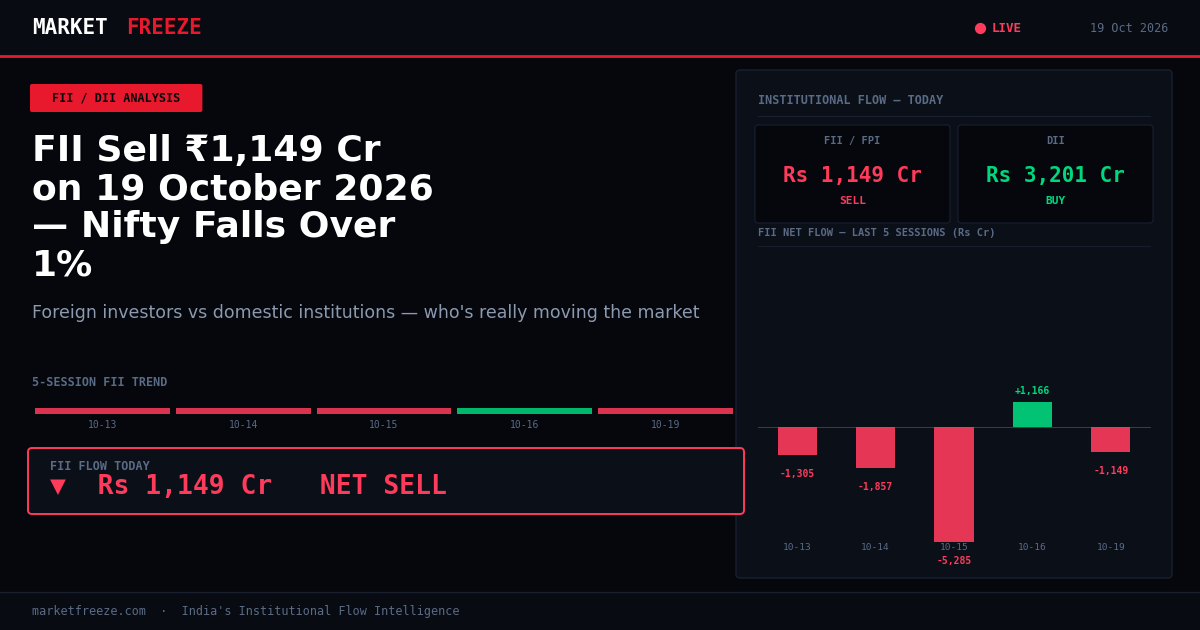
Parsing today’s institutional tape: FIIs offloaded a net ₹1,148.64 Cr in Indian equities, while DIIs injected ₹3,201.19 Cr, marking a significant divergence as indices shed over 1%.
Open a free demat account with
Upstox
or
Angel One
— zero brokerage on delivery trades.
FII Selling Rebounds After Brief Pause
Following a net buy of ₹1,165.92 Cr on Friday, Foreign Institutional Investors (FIIs) reversed course today, registering a substantial net sell of ₹1,148.64 Cr. This marks a significant shift after a single session of net inflow. The gross buying by FIIs stood at ₹11,240.64 Cr, indicating that while selling pressure resumed, it was accompanied by substantial underlying trading activity. The recent trend shows volatility: a large outflow of ₹5,285.37 Cr on October 15th, followed by a net buy, and now this renewed selling. This pattern suggests underlying caution among foreign players despite intermittent buying spells.
The key takeaway from this FII selling is its immediate impact on market direction. When FII selling exceeds ₹1,000 Cr, it often coincides with index declines, as observed today with the Nifty 50 closing at 22,888.95, down 1.11%.
DIIs Step In to Cushion the Fall
Domestic Institutional Investors (DIIs) provided a strong counter-balance to FII selling today, posting a net buy of ₹3,201.19 Cr. This is the third consecutive session of significant DII net buying, following ₹2,439.24 Cr on October 13th and ₹2,670.44 Cr on October 14th. Their buying today, however, was more aggressive than in the preceding sessions. Despite DIIs buying ₹3,661.28 Cr on October 16th, they had been net sellers prior to that. The sustained buying by DIIs, especially in the face of FII outflows, suggests domestic funds are actively deploying capital, potentially taking advantage of market dips.
The robust DII buying provides a floor to the market. Without their intervention, today’s FII selling would have likely resulted in a steeper decline for the Nifty 50 and Sensex.
Nifty 50 Faces Resistance Above 23,000
The Nifty 50 closed at 22,888.95 today, down 1.11%. The significant FII selling today reinforces the 23,000 mark as immediate resistance. Given today’s outflow, support can be identified around the 22,750 level, where buying interest might emerge if the index tests lower. Historically, the Nifty 50 has seen significant selling pressure when FII outflows surpass ₹4,000 Cr, as seen on October 15th when it fell from 23,146.15 to a lower close. Today’s outflow, while smaller, coupled with broader market weakness, points to continued choppiness.
For traders, a breach below 22,750 on increased volume could signal further downside, potentially targeting the 22,600 region. Conversely, sustained buying by DIIs and a reversal of FII selling above 23,000 would be required for an upward move.
Private Banks and IT Under Pressure, Metals Gain Traction
Today’s market action, as indicated by institutional flows and index performance, points to specific sector preferences. The sharp decline in Nifty 50 and Sensex was attributed to weakness in private banks and IT stocks, a sentiment echoed in market commentary. The FII selling today, if concentrated, would likely target these high-beta sectors. Conversely, reports suggest metals and public-sector lenders saw gains, implying DII buying might be directed towards these defensive or value-oriented segments. The earnings season, with companies like Bajaj Finance reporting results, can also influence sector-specific flows. Bajaj Finance’s NII rise of 24% is positive, but overall market reaction to private bank earnings was negative.
Retail investors should monitor which sectors FIIs avoid and DIIs favour. Today’s data suggests a tactical shift away from IT and private banks, and towards sectors that performed better on a difficult day.
USD/INR Weakness Continues
The Indian Rupee depreciated against the US Dollar, closing at Rs95.18, up 0.41%. This move is consistent with broad domestic market weakness and a surge in crude oil prices, which rose to Rs10,335.00/bbl. While not explicitly detailed in the FII/DII flow data, a depreciating rupee can sometimes signal foreign investor concerns about the Indian economy or a risk-off environment globally. The correlation between the weak rupee and FII selling today is a significant factor. A sustained weakening of the rupee beyond the Rs95.50 mark could further deter FII inflows and put additional pressure on equity markets.
Traders should watch the USD/INR pair closely. A move above Rs95.50 could signal increased currency risk for foreign investors and potentially lead to further equity outflows.
Historical Flow Comparison: A Mirror to October 15th?
Today’s FII net sell of ₹1,148.64 Cr and DII net buy of ₹3,201.19 Cr presents a divergence, but it does not mirror the extreme selling seen on October 15th (FII sell ₹5,285.37 Cr, DII buy ₹3,319.39 Cr). On October 15th, the Nifty 50 closed at 23,146.15 and subsequently fell. Today, the Nifty closed at 22,888.95, already lower. The current situation, with less aggressive FII selling but substantial DII buying, suggests domestic institutions are actively absorbing selling pressure rather than a complete capitulation seen earlier in the month. The previous large FII outflow on Oct 15th was followed by two days of mixed FII/DII flows and a sideways market.
The key difference today is the scale of FII selling. While significant, it is not at the extreme levels seen on October 15th. This implies that the market might find some footing with DII support, unlike the sharper correction that followed the larger outflow.
Q2 Results: Earnings Impact on Flows
The market is navigating the Q2 earnings season, with results from major companies like Bajaj Finance, IREDA, and Waaree Renewable announced today. While Bajaj Finance showed a 24% rise in Net Interest Income (NII), indicating positive performance for some financial entities, the broader market faced headwinds. IREDA reported flat profits, and Waaree Renewable saw a profit dip of 37%. These mixed earnings can lead to sector-specific selling or buying, influencing institutional flows. The negative reaction in private banks, as reported, suggests that earnings disappointments or cautious forward guidance can trigger significant FII selling, regardless of overall market support from DIIs.
Retail investors should analyze sector-specific earnings reports and the subsequent price action of related stocks to understand where institutions are redeploying capital based on fundamental performance.
FII/DII Flow Table (Last 5 Sessions)
| Date | FII Net (Cr) | DII Net (Cr) | Nifty Close |
|---|---|---|---|
| 2026-10-13 | ₹-1,305.13 Cr | +₹2,439.24 Cr | 22,622.70 |
| 2026-10-14 | ₹-1,857.44 Cr | +₹2,670.44 Cr | 22,997.35 |
| 2026-10-15 | ₹-5,285.37 Cr | +₹3,319.39 Cr | 23,146.15 |
| 2026-10-16 | +₹1,165.92 Cr | ₹-3,661.28 Cr | 22,888.95 |
| 2026-10-19 | ₹-1,148.64 Cr | +₹3,201.19 Cr | 22,888.95 |
FAQ
What was the total FII selling figure today?
FIIs were net sellers of ₹1,148.64 Cr in Indian equities today, October 19, 2026.
How much did DIIs buy today to offset FII selling?
DIIs bought a net of ₹3,201.19 Cr today, providing substantial support to the market against FII outflows.
What was the Nifty 50 closing price today?
The Nifty 50 closed at 22,888.95 on October 19, 2026, marking a decline of 1.11%.
Global Cues and Commodity Influence on Flows
While the immediate focus is on FII and DII activity, broader global economic sentiment and commodity price movements often act as underlying catalysts for institutional decisions. Today’s significant uptick in crude oil prices, reaching Rs10,335.00 per barrel, coupled with a depreciating rupee, creates a dual headwind for Indian equities. Foreign investors, particularly FIIs, are sensitive to rising commodity prices as they can fuel inflation and impact corporate margins, especially for energy-intensive sectors. This environment often leads to a ‘risk-off’ sentiment, where capital flows shift from emerging markets like India towards safer havens. The fact that FIIs offloaded ₹1,148.64 Cr in this context suggests a preemptive move to reduce exposure ahead of potential inflation or currency devaluation pressures, a sentiment that might have been amplified by global news impacting oil markets.
Retail Investor Positioning Amidst Institutional Divergence
In a market characterized by significant FII selling and robust DII buying, the positioning of retail investors becomes a crucial element. While direct data on retail flows isn’t presented, their behaviour can be inferred. When domestic institutions aggressively buy, as DIIs did with ₹3,201.19 Cr, it often signals a belief in underlying value or a strategic absorption of foreign selling. Retail investors, often influenced by market sentiment and short-term price movements, might be either cautiously observing or attempting to capitalize on dips. However, sustained FII outflows, especially when exceeding ₹1,000 Cr, can create a psychological overhang that deters retail participation or even prompts some to exit. The continued depreciation of the Rupee to Rs95.18 could further dissuade retail investors from adding to their equity exposure, fearing currency losses on top of potential market declines.
Sector Rotation: A Deeper Dive
The observed sector performance – weakness in private banks and IT, and gains in metals – hints at a potential sector rotation driven by institutional money. FIIs, often more sensitive to global growth prospects and interest rate differentials, tend to reduce exposure in interest-rate sensitive sectors like private banks when global yields rise or economic uncertainty increases. Similarly, the IT sector, a significant recipient of FII capital, can face selling pressure if global tech demand softens or if there are concerns about earnings growth. Conversely, the strength in metals, which often correlate with commodity cycles and industrial demand, suggests DIIs are perhaps betting on a continued domestic growth narrative or anticipating a rebound in cyclical sectors. The fact that DIIs bought ₹3,201.19 Cr in such an environment implies a strategic allocation towards these perceived defensive or value-oriented segments, potentially anticipating higher commodity prices or government infrastructure spending boosts.
Currency and Commodity Correlation: A Subtle Indicator
The interplay between the USD/INR exchange rate and commodity prices provides a subtle yet significant insight into institutional sentiment. The rupee’s movement to Rs95.18, a depreciation, alongside the surge in crude oil prices to Rs10,335.00 per barrel, paints a picture of rising import costs and potential inflationary pressures for India. For FIIs, a depreciating currency erodes the value of their investments when converted back to their home currency. Therefore, when the rupee weakens persistently, it often acts as a leading indicator for equity outflows. The fact that FIIs chose to sell ₹1,148.64 Cr today, despite the market not experiencing a catastrophic fall, suggests they are proactively managing currency risk. This correlation implies that any further weakening of the rupee beyond a critical threshold, say Rs95.50, could trigger more significant FII selling, irrespective of DII support.
Bottom Line
Today’s trading session was defined by a sharp reversal in FII flows, with significant selling resuming after a brief pause. DIIs stepped in aggressively, buying ₹3,201.19 Cr to buffer the index decline, which saw the Nifty 50 shed 1.11%. This divergence indicates domestic buying interest absorbing foreign selling pressure, particularly in sectors like metals and public-sector banks, while private banks and IT likely faced FII headwinds. The rupee’s depreciation to Rs95.18 adds another layer of caution for foreign capital deployment.
Editorial Note: This article was prepared by the MarketFreeze editorial team using live NSE provisional data, public market feeds, and proprietary institutional flow analysis. All price and flow figures are sourced directly from NSE, BSE, and CoinGecko as of 19 October 2026. This content is for informational purposes only and does not constitute investment advice. MarketFreeze is not SEBI-registered. Please consult a qualified financial advisor before making investment decisions. Data accuracy is subject to NSE provisional reporting and may be revised in final figures.