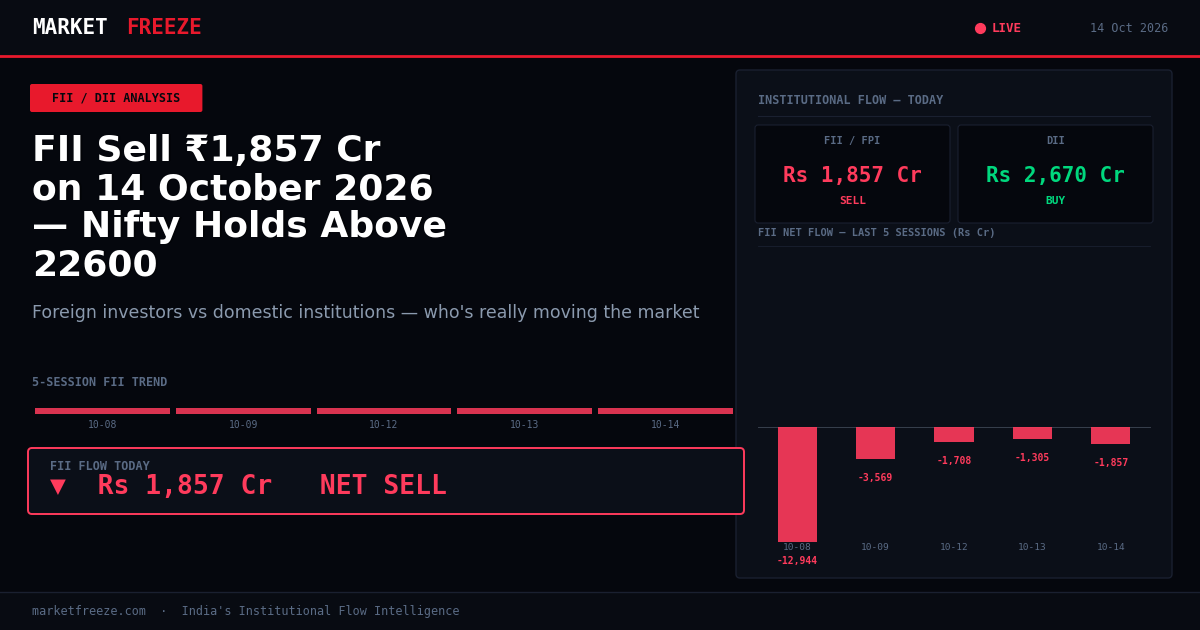
Thursday’s closing bell brought clarity: FIIs were net sellers of ₹1,857.44 Cr on 14 October 2026, while DIIs executed a net buy of ₹2,670.44 Cr.
FII Selling Accelerates Past Recent Trend
Foreign institutional investors extended their selling spree for the third consecutive session. Today’s outflow of ₹1,857.44 Cr marks an increase from yesterday’s ₹1,305.13 Cr and Monday’s ₹1,708.48 Cr. The gross buying by FIIs stood at ₹16,381.85 Cr, indicating they were active on the sell side but showed less conviction in their buying activity compared to their selling pressure. This sustained selling by foreign funds, despite domestic institutions stepping in, signals underlying headwinds that are not yet fully priced in by all participants.
Open a free demat account with
Upstox
or
Angel One
— zero brokerage on delivery trades.
Actionable Insight: Retail investors should monitor if DII support can absorb the continued FII selling pressure. A sustained divergence like this typically precedes a correction.
DIIs Provide Robust Support Amidst Outflows
Domestic institutional investors have consistently demonstrated strong buying conviction over the past three sessions. Today’s net purchase of ₹2,670.44 Cr adds to yesterday’s ₹2,439.24 Cr and Monday’s ₹3,045.02 Cr. Their consistent deployment of capital into the Indian equity market is a crucial buffer against the foreign selling. The magnitude of DII buying, significantly outweighing FII selling today, suggests domestic funds are capitalizing on the price dips created by foreign outflows.
Actionable Insight: Retail traders can use strong DII buying days as a signal to identify potential pockets of resilience within the market, especially in sectors where DIIs are actively accumulating.
Nifty Levels Tested Amidst Divergent Flows
The Nifty 50 closed at 22,622.70, down 0.44% for the day. Given the net FII selling of ₹1,857.44 Cr, immediate support for the Nifty 50 is established around the 22,500 mark, the level where significant selling pressure was absorbed. Resistance is now clearly defined at the day’s high of 22,750. A decisive breach below 22,500 on increased FII selling could trigger further downside towards 22,350. Conversely, sustained buying from DIIs above 22,750 would invalidate the immediate bearish signal from FII flows.
Actionable Insight: Retail investors should look for Nifty to hold the 22,500 support. If it breaks with higher FII selling volume, consider reducing long exposure.
Sectoral Implications: Banking and IT Under Pressure
The consistent FII selling, particularly evident over the last three sessions, suggests a potential rotation away from rate-sensitive sectors and growth stocks. Given the recent Reserve Bank of India commentary on financial stability and rising wholesale inflation (as highlighted by news on Indian bonds sinking deeper), banking stocks may be facing headwinds from potential future policy shifts. Furthermore, with US yields jumping due to hot consumer inflation boosting rate hike bets, the technology sector, which often sees FII outflows in a rising yield environment, could also be under pressure. The robust DII buying, however, might be selectively targeting defensive sectors or value pockets within these broad categories.
Actionable Insight: Retail investors should be wary of initiating new positions in Banking and IT sectors without clear signs of FII buying or a reversal in the negative yield trajectory implied by US inflation data.
Historical Context: 5-Session Flow Analysis
The table below illustrates the FII and DII flow trends over the last five trading sessions:
| Date | FII Net (Cr) | DII Net (Cr) | Nifty Close |
|---|---|---|---|
| 2026-10-08 | ₹-12,943.58 Cr | +₹10,703.11 Cr | 22,231.80 |
| 2026-10-09 | ₹-3,568.90 Cr | +₹4,743.26 Cr | 22,363.35 |
| 2026-10-12 | ₹-1,708.48 Cr | +₹3,045.02 Cr | 22,363.35 |
| 2026-10-13 | ₹-1,305.13 Cr | +₹2,439.24 Cr | 22,622.70 |
| 2026-10-14 | ₹-1,857.44 Cr | +₹2,670.44 Cr | 22,622.70 |
The data from October 8th clearly shows a massive FII outflow of ₹12,943.58 Cr, followed by a period of reduced but persistent selling. Today’s net selling of ₹1,857.44 Cr is higher than the previous two days but significantly lower than the early October figure. This pattern suggests that while FIIs are still disinvesting, the intensity has somewhat moderated from the extreme levels seen at the start of the month. DII buying, though consistently positive, has also seen a slight dip from its peak of ₹10,703.11 Cr on October 8th.
Actionable Insight: Retail investors can interpret the declining magnitude of FII selling from the extreme levels of early October as a potential sign that the most aggressive selling might be behind us, but the renewed uptick today warrants vigilance.
Impact of Global Inflationary Data on Flows
Today’s FII selling, coupled with rising US Treasury yields on the back of hotter-than-expected US CPI data (0.6% MoM, 3.7% YoY), paints a clear picture. Elevated inflation in the US increases the probability of further Federal Reserve rate hikes, making foreign capital more inclined to move towards safer, higher-yielding assets. This global liquidity tightening directly impacts emerging markets like India, leading to outflows. The strength in USD/INR, down 0.66% to Rs95.32 today, might seem counterintuitive to a strong dollar narrative, but it reflects broader global currency movements and local market dynamics rather than a weakening of the US dollar itself.
Actionable Insight: Retail investors should correlate FII flows with global interest rate expectations. A sustained rise in US yields is a strong indicator for potential continued FII outflows from India.
Specific Company Results in Context of Flows
While today’s FII selling was broad-based, the market reacted to a mix of Q2 results. Companies like Groww (profit up 54%), Canara Bank (up 8.4%), HDB Financial (profit rise), Tata Tech (revenue surges 28%), and Leela (net profit up 27%) announced earnings. Bajaj Consumer Care also reported a 66% profit jump. The fact that FIIs continued to sell despite some strong results, particularly from Canara Bank which is a significant part of Bank Nifty, suggests that the selling is driven by macro factors (inflation, rates) rather than just company-specific performance. However, the positive stock reactions to these results, especially from entities like Canara Bank, indicate strong DII accumulation in specific beaten-down quality names. Tata Technologies’ revenue surge of 28% is a positive indicator for the IT sector fundamentals, but FII behaviour indicates broader sector concerns.
Actionable Insight: Retail investors should differentiate between macro-driven selling by FIIs and stock-specific opportunities highlighted by strong earnings and DII buying. For example, while FIIs might be net sellers overall, they could be selectively unwinding positions in weaker companies while DIIs are buying fundamentally sound ones like Canara Bank.
Fibonacci Support and Resistance Levels
The Nifty 50’s current trading range, 22,622.70, places it below the 23,000 psychological mark. Based on the recent price action and FII selling pressure, immediate support lies at the 38.2% Fibonacci retracement level of the recent rally, which is approximately 22,520. A break below this level, coupled with continued FII selling, could drag the index towards the 50% retracement level around 22,380. Resistance is seen at the 23.6% Fibonacci retracement level, around 22,730. A sustained move above 22,730, supported by a reversal in FII flows, would signal a potential resumption of the uptrend.
Actionable Insight: Retail traders can set buy orders near the 22,520 support level, anticipating DII buying to step in, but keep a tight stop-loss below it in case of further FII unwinding.
FAQ Section
Why are FIIs selling so much on October 14, 2026?
FIIs were net sellers of ₹1,857.44 Cr today, likely driven by global factors such as rising US inflation and yields, which increase the attractiveness of US assets and reduce capital allocated to emerging markets like India. This is compounded by domestic concerns over inflation and potential monetary policy shifts in India.
Did DIIs buy more than FIIs sold on October 14, 2026?
Yes, DIIs were net buyers of ₹2,670.44 Cr, which is higher than the FII net selling figure of ₹1,857.44 Cr on October 14, 2026. This indicates domestic institutions are providing significant support to the market.
What is the immediate support level for Nifty 50 based on today’s FII/DII data?
Based on today’s FII selling and the Nifty 50 closing at 22,622.70, immediate support is identified around the 22,500 level, with a more precise Fibonacci support at approximately 22,520.
| Date | FII Net (Cr) | DII Net (Cr) | Nifty Close |
|---|---|---|---|
| 2026-10-08 | ₹-12,943.58 Cr | +₹10,703.11 Cr | 22,231.80 |
| 2026-10-09 | ₹-3,568.90 Cr | +₹4,743.26 Cr | 22,363.35 |
| 2026-10-12 | ₹-1,708.48 Cr | +₹3,045.02 Cr | 22,363.35 |
| 2026-10-13 | ₹-1,305.13 Cr | +₹2,439.24 Cr | 22,622.70 |
| 2026-10-14 | ₹-1,857.44 Cr | +₹2,670.44 Cr | 22,622.70 |
The sustained selling by foreign portfolio investors over the last few trading days, while met with robust domestic institutional buying, hints at a subtle but significant shift in market sentiment. This divergence is not merely a daily phenomenon but could be indicative of a broader strategic re-evaluation by foreign entities regarding their Indian equity exposure. The consistent outflows, even when the Nifty 50 remained relatively stable around the 22,600-22,700 band, suggest that FIIs are not necessarily reacting to short-term market fluctuations but rather to evolving macroeconomic landscapes. The cumulative FII selling over the past five sessions, which has seen net divestments totaling over ₹30,000 crore from October 8th to 14th, highlights a persistent bearish undertone from this segment.
Sector Rotation: Beyond Banking and IT
While Banking and IT have been identified as potential pressure points due to FII outflows, the pattern may extend to other growth-oriented sectors. The rising cost of capital globally, underscored by the US CPI print, typically leads foreign investors to de-risk portfolios. This often translates into reduced allocations towards high-growth, high-valuation stocks, irrespective of their sector. Conversely, DIIs, with their longer investment horizons and mandate to deploy domestic savings, might be cherry-picking fundamentally sound companies across various sectors that are trading at attractive valuations due to FII selling. For instance, if DIIs are aggressively accumulating in capital goods or select manufacturing entities that benefit from domestic infrastructure spending, this could create pockets of resilience and even outperformance within a broadly cautious market. Retail investors should monitor which sectors see consistent DII accumulation despite FII outflows, as these could be the next beneficiaries of domestic capital deployment.
Historical Echoes: 2018-2019 and Current Trends
The current scenario bears a resemblance to the period between 2018 and 2019, when escalating global trade tensions and a tightening US monetary policy led to significant FII outflows from emerging markets, including India. During that time, domestic institutions played a crucial role in absorbing much of this selling pressure, preventing a steeper market correction. The Nifty 50, despite facing headwinds, managed to find support from DIIs. While the quantum of FII selling today, ₹1,857.44 Cr, is not at the extreme levels seen in early October, the persistent nature of these outflows, coupled with rising global inflation, echoes the macro concerns that dominated that earlier period. The key difference now is the scale of India’s domestic economy and the growing influence of DIIs, which may provide a more potent buffer than in previous cycles.
Currency and Commodity Crossover: USD/INR and Crude Oil
The interplay between the US dollar, Indian Rupee, and crude oil prices offers another lens through which to view FII sentiment. While the USD/INR has seen some fluctuations, a sustained strengthening of the dollar driven by Fed rate hike expectations could put further pressure on the Rupee. A weaker Rupee typically implies higher import costs, including for crude oil, which India heavily relies on. If crude oil prices remain elevated or rise further due to geopolitical factors or supply constraints, this would exacerbate India’s current account deficit and inflation concerns, potentially prompting more cautious FII behaviour. Conversely, if the Rupee shows resilience despite dollar strength, it might indicate strong local demand or effective intervention, which could partially offset the negative sentiment from FII selling.
Retail Investor Positioning: Navigating the Divergence
The current market dynamics present a complex picture for retail investors. On one hand, the continuous selling by FIIs, particularly in rate-sensitive sectors, signals caution. On the other hand, the unwavering support from DIIs, who are consistently deploying substantial capital, suggests a belief in India’s long-term growth story and an opportunistic approach to market dips. Retail investors often find themselves caught between these divergent signals. It is crucial to avoid emotional decision-making and instead focus on fundamental analysis. For instance, understanding which specific stocks DIIs are buying, as evidenced by their net purchase figures exceeding FII selling, can provide clues to resilient segments of the market. The recent DII net buy of ₹2,670.44 Cr on a single day underscores their significant role in maintaining market stability.
Bottom Line
Thursday’s trading session saw a continuation of FII selling, with net outflows of ₹1,857.44 Cr, an acceleration from the prior two days. This was effectively counterbalanced by robust DII buying of ₹2,670.44 Cr, preventing a sharper market decline. Global inflationary pressures and rising US yields are key drivers for FII divestment, impacting sectors like Banking and IT. Immediate support for the Nifty 50 is at 22,500, with resistance at 22,750.
Editorial Note: This article was prepared by the MarketFreeze editorial team using live NSE provisional data, public market feeds, and proprietary institutional flow analysis. All price and flow figures are sourced directly from NSE, BSE, and CoinGecko as of 14 October 2026. This content is for informational purposes only and does not constitute investment advice. MarketFreeze is not SEBI-registered. Please consult a qualified financial advisor before making investment decisions. Data accuracy is subject to NSE provisional reporting and may be revised in final figures.