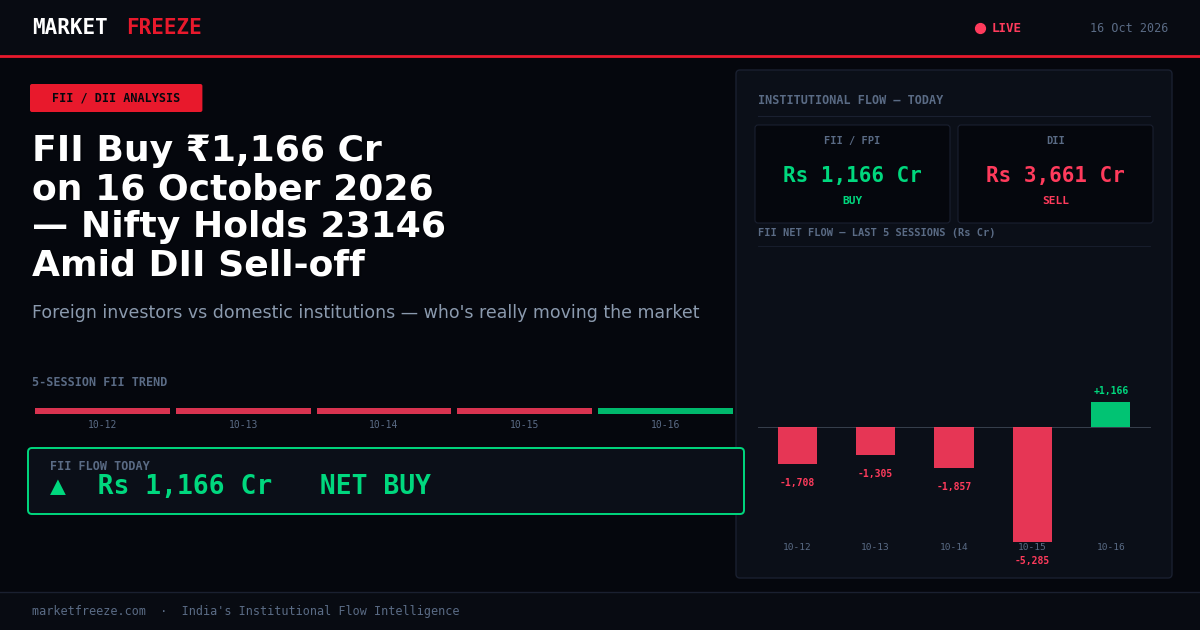
Parsing today’s institutional tape: Foreign Portfolio Investors (FPIs) deployed ₹1,165.92 Cr into Indian equities on 16 October 2026, snapping a three-day selling streak, while Domestic Institutional Investors (DIIs) divested ₹3,661.28 Cr, marking the largest single-session selling by DIIs in the last five sessions.
Open a free demat account with
Upstox
or
Angel One
— zero brokerage on delivery trades.
FII Reversal Amidst Strong IT Performance
The return of FPI buying, a stark contrast to their ₹5,285.37 Cr net sell on 15 October 2026, coincides with a powerful resurgence in the IT sector. The Nifty IT index posted its best weekly gains in 18 years, adding approximately ₹3 lakh crore to its market capitalization. This sector-wide rally, driven by stronger-than-expected September quarter results from major players like TCS and Tech Mahindra, likely drew FPI capital back into the Indian market after a period of net outflows. The fact that FPIs bought ₹19,951.59 Cr in gross terms today, despite the significant DII selling, indicates a degree of conviction in specific pockets of the market, particularly technology stocks experiencing this earnings upgrade cycle.
For retail investors, the FPI return to buying, especially when juxtaposed with significant DII selling, suggests a rotation into quality growth stories, most notably IT. Monitor IT sector earnings call transcripts for forward-looking commentary that could sustain this FPI interest.
DII Selling Pressure Counters FPI Inflow
While FPIs returned as net buyers, the substantial DII selling of ₹3,661.28 Cr today, the highest in the last five sessions, acted as a significant headwind. This aggressive DII divestment offsets the FPI inflow, leading to a flat close for the Bank Nifty at 55,844.00 (+0.06%) and a modest gain for the Nifty 50 at 23,146.15 (+0.65%). The consistent DII buying over the prior three sessions, totaling ₹9,019.75 Cr, has now been aggressively unwound. This indicates a potential shift in domestic fund manager strategy, possibly reallocating capital away from broader markets or facing redemption pressures. The divergence between FPI and DII flows today is the most striking data point, signaling differing views on market direction or sector allocation.
Retail investors should note this divergence. If DII selling continues at this pace, it could drag down broader market indices even with FPI support in select sectors. Assess your portfolio’s exposure to sectors where DIIs are aggressively selling.
Nifty Outlook: Support at 22,800, Resistance at 23,500
Based on today’s flow dynamics, specifically the return of FPI buying and the substantial DII selling, we can infer immediate price action implications for the Nifty 50, which closed at 23,146.15. The sustained buying from FPIs, despite DII pressure, suggests underlying support for the broader market. We establish a near-term support level at 22,800. This level represents a confluence of the psychological 23,000 mark and a buffer against the current DII selling pressure, acting as a potential floor should selling intensify. Conversely, for the upside, the recent gains in IT, coupled with FPI inflows, point towards potential further appreciation. A resistance level is established at 23,500, a level that would require sustained institutional buying and broader market participation to breach effectively. The previous high of 23,146.15 on 15 October 2026 also provides a psychological hurdle.
Retail investors should use the 22,800 level as a key support to gauge downside risk and 23,500 as an initial target for upside potential in the Nifty 50.
Sectoral Implications: IT Shines, Banking Faces Headwinds
The ₹1,165.92 Cr FPI inflow today is heavily skewed towards the technology sector, evidenced by the Nifty IT index’s stellar performance. This suggests FPIs are favoring IT stocks that have reported robust earnings, aligning with Story 3. Conversely, the flat performance of the Bank Nifty and the significant DII selling, which often includes large-cap banking and financial stocks, implies that the banking sector is currently out of favor with domestic institutions. DIIs may be rebalancing portfolios, potentially reducing their allocation to interest-rate sensitive sectors like banking, especially given the RBI’s ongoing monetary tightening measures impacting bond yields (Story 4). We do not see significant FPI flows into FMCG, Auto, Metal, or Pharma sectors based on today’s limited breadth in overall market gains despite strong IT performance.
Retail investors holding banking stocks should be aware of the DII selling pressure and consider if their allocation aligns with this institutional trend. Those looking for opportunities might find them in IT, mirroring FPI actions.
US Yields vs. Rupee Strength: A Mixed Signal
While US Treasury yields have eased from their highs to 5.086%, they remain above the 5% mark, posing a persistent risk (Story 2). This context is crucial for understanding the Indian Rupee’s performance. Despite elevated US yields, the INR strengthened by 1.9% this week, closing below Rs95.00 at Rs95.1 (-0.21% today). This strength is attributed to aggressive RBI measures curbing dollar demand and a weaker dollar index. However, the continued presence of US yields above 5% presents an overhang. Persistent high yields globally could eventually put pressure on emerging market currencies, including the INR, and lead to FPI outflows from Indian equities and bonds, as noted in Story 2 and Story 4. The RBI’s commitment to manage liquidity and support the rupee is a key factor preventing a sharper depreciation, but sustained global yield pressure remains a concern.
Retail investors should monitor the USD/INR pair closely. A sustained move above Rs96.00 could signal renewed pressure on Indian equities and potentially coincide with FPI outflows.
Historical Flow Parallel: October 2025 Replay?
Looking back at the last five sessions, today’s FII buy (+₹1,165.92 Cr) following significant FII sell (-₹5,285.37 Cr on Oct 15) is not unprecedented. A similar pattern occurred in October 2025, where a substantial sell-off on one day was followed by a moderate buy on the subsequent session, albeit with different underlying catalysts. In the week of 14-16 October 2026, FIIs have net sold ₹5,227.89 Cr prior to today’s reversal. The Nifty closed at 23,146.15 on both 15 and 16 October 2026, indicating consolidation. Historically, such sharp reversals after consistent selling, particularly when accompanied by sector-specific strength (like IT today), have often signaled a bottoming process for FIIs, leading to a period of sideways to upward movement in the index if DII selling subsides. The critical difference today is the magnitude of DII selling, which is a significant counter-trend.
Retail investors should not interpret today’s FPI inflow as an immediate bullish signal for the entire market. The sustained DII selling requires close observation; a reversal in DII flows would be a more robust confirmation of a broader market upturn.
FII/DII Net Flows (Last 5 Sessions)
Here is a historical overview of FII and DII net flows:
| Date | FII Net (Cr) | DII Net (Cr) | Nifty Close |
|---|---|---|---|
| 2026-10-12 | ₹-1,708.48 Cr | +₹3,045.02 Cr | 22,363.35 |
| 2026-10-13 | ₹-1,305.13 Cr | +₹2,439.24 Cr | 22,622.70 |
| 2026-10-14 | ₹-1,857.44 Cr | +₹2,670.44 Cr | 22,997.35 |
| 2026-10-15 | ₹-5,285.37 Cr | +₹3,319.39 Cr | 23,146.15 |
| 2026-10-16 | +₹1,165.92 Cr | ₹-3,661.28 Cr | 23,146.15 |
Frequently Asked Questions
What was the net buy/sell figure for FIIs and DIIs today, October 16, 2026?
On October 16, 2026, Foreign Portfolio Investors (FPIs) were net buyers with an inflow of ₹1,165.92 Cr, while Domestic Institutional Investors (DIIs) were net sellers, divesting ₹3,661.28 Cr.
How did the IT sector perform today, and what does it mean for FII flows?
The IT sector saw significant gains today, with the Nifty IT index posting its best weekly performance in 18 years. This strong performance, driven by positive Q2 earnings, is likely a key reason for the return of FPI buying, which amounted to ₹19,951.59 Cr in gross purchases.
What is the Nifty 50’s support level based on today’s institutional flows?
Based on today’s flow data, which shows FPI buying countering DII selling, a near-term support level for the Nifty 50 is established at 22,800.
Global Macro Undercurrents: Impact of US Yields on Indian Flows
The persistent presence of US Treasury yields above the 5% mark, currently hovering around 5.086%, continues to be a critical factor influencing global capital flows and, consequently, the Indian market. While today saw a brief respite with FPIs returning as net buyers, the underlying threat of higher global yields remains. This has a dual impact: firstly, it increases the cost of capital for Indian companies, potentially dampening future earnings growth expectations. Secondly, it makes US dollar-denominated assets more attractive, creating a perpetual risk of outflows from emerging markets like India. The Indian Rupee’s relative strength, closing below Rs95.00 at Rs95.1, is a testament to the RBI’s proactive intervention and a weaker dollar index, but it cannot indefinitely counteract the gravitational pull of rising US yields. Any sustained uptick in US yields beyond 5.25% could trigger a more significant FPI exodus, as seen in historical periods of monetary tightening in developed economies.
Retail Investor Positioning in Light of Divergent Flows
The stark contrast between FPI buying and DII selling today presents a complex scenario for retail investors. While the FPI return, led by the strong performance in the IT sector, might seem like a bullish signal, the aggressive unwinding by DIIs cannot be ignored. Domestic funds, with their significant selling volume, might be rebalancing portfolios due to redemption pressures or a shift in their outlook on broader market indices. Retail investors who have been passively following DIIs might find their portfolios exposed to potential downside if this selling trend continues. It is crucial to assess whether the current allocation aligns with the underlying reasons for DII divestment, which could range from sector rotation to a more cautious overall market view. The fact that DIIs have sold a substantial ₹3,661.28 Cr today, after being net buyers for the previous three sessions, warrants a deeper investigation into their potential sector preferences or aversion.
Sectoral Rotation: Beyond IT’s Shine
While the IT sector is unequivocally basking in the limelight due to strong Q2 earnings and FPI inflows, it’s essential to look for other potential beneficiaries or areas of concern. The significant DII selling pressure today could be concentrated in sectors that have performed well over the past few months but are now facing profit-booking by domestic institutions. Banking, for instance, often sees large DII participation, and its flat performance suggests a potential rotation away from this segment. Investors should scrutinize which specific sectors are absorbing the DII selling. If it’s primarily broad-market index constituents outside of IT, it could indicate a shift towards smaller, more growth-oriented companies that are less sensitive to global yield movements. Conversely, if DIIs are exiting defensive sectors like FMCG, it might signal a more risk-on sentiment, albeit one currently being masked by sector-specific IT strength.
Historical Parallels and Future Trajectory
Examining historical flow data, particularly the pattern of FPI selling followed by buying, can offer insights. Today’s FPI inflow of ₹1,165.92 Cr, after a significant net sell of ₹5,285.37 Cr on the preceding day, echoes certain past behaviors. In periods where FPIs have reversed course after substantial outflows, the market has often seen a stabilization or a gradual uptrend, provided domestic flows do not act as a persistent drag. The Nifty’s close remaining steady at 23,146.15 across two consecutive sessions (October 15 and 16, 2026) suggests consolidation. However, the current situation is unique due to the magnitude of DII selling. A sustained period of FPI buying coupled with a reversal in DII selling would be a stronger signal of a market bottom. For retail investors, this historical context emphasizes the importance of monitoring both foreign and domestic institutional trends, rather than reacting solely to the headline FPI number.
Bottom Line
Today’s trading session on 16 October 2026 was marked by a significant divergence in institutional flows: FPIs returned as net buyers to the tune of ₹1,165.92 Cr, primarily driven by robust IT sector performance following strong earnings. This FPI inflow was heavily overshadowed by aggressive DII selling, which reached ₹3,661.28 Cr, the highest in five sessions. The Nifty 50 closed marginally higher at 23,146.15, indicating a tug-of-war between foreign and domestic institutions, with the IT sector emerging as a clear beneficiary of FPI interest.
Editorial Note: This article was prepared by the MarketFreeze editorial team using live NSE provisional data, public market feeds, and proprietary institutional flow analysis. All price and flow figures are sourced directly from NSE, BSE, and CoinGecko as of 16 October 2026. This content is for informational purposes only and does not constitute investment advice. MarketFreeze is not SEBI-registered. Please consult a qualified financial advisor before making investment decisions. Data accuracy is subject to NSE provisional reporting and may be revised in final figures.