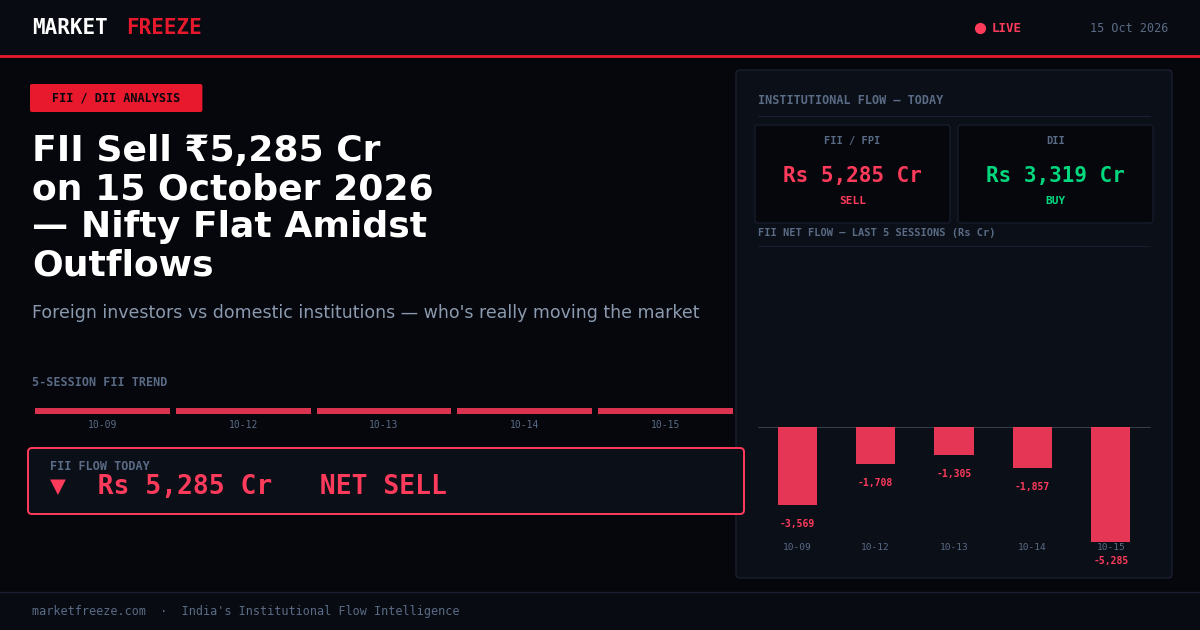
FII desks turned net sellers today, offloading ₹5,285.37 Cr in Indian equities. This outflow marks a significant acceleration from the prior two sessions, which saw FII net sales of ₹1,857.44 Cr and ₹1,305.13 Cr respectively. Conversely, DIIs maintained their buying momentum, adding ₹3,319.39 Cr to their portfolios. The Nifty 50 closed at 22,997.35, largely unchanged from yesterday’s close of 22,997.35, indicating that despite the substantial FII selling, DII purchases and potential retail participation absorbed the pressure.
FII Selling Surges to a 3-Session High
The ₹5,285.37 Cr FII net sell figure on October 15, 2026, represents the largest single-day outflow from Indian equities by foreign portfolio investors in the last three reported sessions. Prior to this, FII net sales were contained: ₹1,857.44 Cr on October 14 and ₹1,305.13 Cr on October 13. The total FII buy turnover for the day stood at ₹12,735.59 Cr. This sharp increase in selling pressure suggests a tactical shift by FIIs, possibly reacting to macroeconomic data or global market cues, despite the domestic market’s resilience as evidenced by the Nifty’s flat close.
Open a free demat account with
Upstox
or
Angel One
— zero brokerage on delivery trades.
For retail investors, this intensified FII selling signals a potential near-term headwind. Consider reducing exposure in highly FII-driven segments until selling pressure abates.
DIIs Continue to Provide a Floor
Domestic Institutional Investors (DIIs) demonstrated sustained buying, adding ₹3,319.39 Cr to their holdings on October 15, 2026. This follows consistent DII net purchases of ₹2,670.44 Cr on October 14 and ₹2,439.24 Cr on October 13. The cumulative DII buying over the last three sessions, amounting to approximately ₹8,429.07 Cr, has been instrumental in cushioning the market against the substantial FII outflows. This consistent domestic buying indicates strong conviction from local funds, potentially leveraging FII sales to acquire assets at more attractive valuations.
Retail investors should monitor DII buying patterns; their sustained support can act as a significant buffer against global capital flight.
Historical FII/DII Flow Snapshot
| Date | FII Net (Cr) | DII Net (Cr) | Nifty Close |
|---|---|---|---|
| 2026-10-09 | ₹-3,568.90 Cr | +₹4,743.26 Cr | 22,363.35 |
| 2026-10-12 | ₹-1,708.48 Cr | +₹3,045.02 Cr | 22,363.35 |
| 2026-10-13 | ₹-1,305.13 Cr | +₹2,439.24 Cr | 22,622.70 |
| 2026-10-14 | ₹-1,857.44 Cr | +₹2,670.44 Cr | 22,997.35 |
| 2026-10-15 | ₹-5,285.37 Cr | +₹3,319.39 Cr | 22,997.35 |
The table above illustrates a consistent trend of FII net selling over the observed period, with a marked surge on October 15, 2026. DIIs, in contrast, have been net buyers throughout, with their purchasing power increasing in recent sessions. The Nifty’s movement has been broadly supported by DII inflows, preventing sharper declines despite the FII selling pressure.
Retail traders should note the increasing DII purchase magnitude as a potential indicator of domestic institutional confidence in the current market valuation.
Nifty Levels: Support and Resistance Zone
With the Nifty 50 closing at 22,997.35, the surge in FII selling today implies immediate resistance at the 23,200 mark. Should selling pressure intensify, we could see the index test support around 22,850. The significant DII buying, however, suggests that levels above 22,700 are likely to be defended. The absence of substantial intraday price movement despite the large FII outflow suggests a broad consolidation phase is in play, with demand emerging at lower prices.
Traders might consider initiating buy positions with a tight stop-loss if the Nifty finds firm support around the 22,850 level, anticipating DIIs to continue their buying activity.
Sectoral Implications: IT Under Pressure, Banking Holds Firm
The substantial FII selling today could disproportionately impact sectors heavily held by foreign investors. Information Technology (IT) stocks are likely to face headwinds, especially in light of mixed Q2 results. Wipro’s Q2 net profit decline of 1.9% year-on-year, despite revenue growth, and its forecast for Q3 IT services revenue between $2.571 billion and $2.625 billion, highlights potential earnings pressure. While Wipro ADRs surged 5% on optimism about future bookings, the broader FII selling could negate such individual stock gains. Conversely, Banking stocks may find continued support from DII accumulation, given their defensive qualities and potential for stable earnings. The resilience of the Bank Nifty, which closed up 0.89% at 55,810.00, supports this view.
Retail investors should be selective in the IT pack, focusing on companies with strong execution and outlook, while considering overweight positions in Banking given DII support.
Global Cues: Inflation Fears and Tech Sell-off
Overnight US market performance provides crucial context. The Nasdaq sinking 1.18% on concerns over hotter-than-expected inflation fueling Federal Reserve rate hike fears, coupled with AI spending concerns, suggests a risk-off environment for global technology stocks. This aligns with potential FII selling in Indian IT counters. The Dow’s gain indicates strength in non-tech sectors, a theme that might be mirrored domestically. The USD/INR trading at Rs95.25, down 0.25%, suggests the RBI’s intervention smoothed volatility, providing a stable currency backdrop, which is generally positive for equities but does not entirely offset global risk aversion.
Given the global tech weakness, retail investors should be wary of chasing IT stocks that have seen significant run-ups, especially if their earnings growth does not justify the valuations.
Q2 Earnings Season: Mixed Signals
Today’s Q2 FY27 earnings announcements, including L&T Finance’s profit rise of 33% and Tech Mahindra’s dividend announcement, alongside Wipro’s results, paint a mixed picture of corporate performance. While some companies are showing resilience and growth, others, like Wipro, are facing margin pressures. The market’s reaction to these results will be critical. The fact that Wipro ADRs surged 5% despite a profit dip suggests that forward-looking guidance and potential anti-AI trade dynamics are influencing stock prices, rather than just historical performance. This divergence highlights the importance of nuanced analysis beyond headline numbers.
Retail investors should prioritize companies with robust Q3 guidance and strong balance sheets, as these are likely to withstand broader market pressures and FII outflows.
FAQ Section
Why did FIIs sell ₹5,285.37 Cr today?
FIIs sold ₹5,285.37 Cr today, likely in response to global macroeconomic concerns such as inflation fears in the US impacting tech stocks, as well as potentially rebalancing portfolios ahead of further economic data releases. The exact trigger for this increased selling is not fully discernible from domestic data alone.
What does the DII buying of ₹3,319.39 Cr mean for the Nifty 50?
The DII net buy of ₹3,319.39 Cr today indicates strong domestic institutional support for the Indian market. This buying has helped to absorb the significant FII selling pressure, preventing the Nifty 50 from falling significantly from its previous day’s close, thereby providing a floor for the index around the 22,900-23,000 range.
How does the current FII outflow compare to last week?
Today’s FII outflow of ₹5,285.37 Cr is substantially higher than last week’s figures. Last week, FII net sales were ₹1,305.13 Cr on October 13 and ₹1,857.44 Cr on October 14, indicating a significant increase in foreign selling activity in the current session.
Sector Rotation: A Shift in Institutional Play?
The stark difference in performance between the Nifty 50, which closed unchanged, and the Bank Nifty, which gained 0.89%, suggests a potential sector rotation underway. As FIIs reduce their exposure to growth-oriented sectors like IT, which saw a 1.18% dip in the Nasdaq, they might be reallocating capital to more value-oriented or defensive sectors. The banking sector, often considered a safe haven during uncertain times and benefiting from consistent DII support, appears to be a prime beneficiary. This dynamic, where FII selling in one segment is met with DII buying in another, points to a strategic repositioning rather than an outright market exit. For retail investors, this could signal an opportunity to align their portfolios with the prevailing DII sentiment, potentially increasing allocations to financial services and other traditionally defensive sectors that have demonstrated resilience amidst broader FII outflows.
A Glimpse at Historical Parallels
While today’s specific figures are significant, observing historical patterns of FII flows can provide valuable context. In periods of heightened global uncertainty, such as the initial phases of the COVID-19 pandemic, FIIs have historically exhibited similar patterns of significant outflows, sometimes exceeding today’s ₹5,285.37 Cr. During those times, domestic institutions, including mutual funds and insurance companies, stepped in to absorb selling pressure, preventing sharper market corrections. The current scenario, with DIIs injecting approximately ₹3,319.39 Cr, mirrors this historical playbook. The key difference today is the relative stability of the domestic market, with the Nifty 50 managing to hold its ground at 22,997.35, a testament to the increasing depth and sophistication of domestic institutional participation.
Currency and Commodity Crossover: A Subtle Influence
While the primary focus remains on equity flows, the currency market often provides a secondary indicator. The USD/INR trading at Rs95.25, down 0.25%, suggests a relatively stable or strengthening Rupee. A stable Rupee can be a double-edged sword. On one hand, it reduces the currency risk for foreign investors, potentially making Indian equities more attractive. On the other hand, a strengthening Rupee can sometimes be associated with a global economic slowdown, which might trigger risk aversion among FIIs. Today, the slight Rupee appreciation did not deter the significant FII selling, implying that other macro concerns, such as US inflation data, were the dominant drivers. However, sustained Rupee strength could eventually draw back foreign capital if global economic sentiment improves.
Retail Positioning: Navigating the Volatility
With FII desks offloading ₹5,285.37 Cr and DIIs buying ₹3,319.39 Cr, the retail investor is caught between two powerful forces. The Nifty 50’s flat close at 22,997.35 suggests that retail participation, along with DII inflows, is effectively absorbing the FII selling pressure. This scenario often leads to increased market volatility in the short term. Retail traders might be tempted to book profits or cut losses based on short-term FII movements, but the consistent DII buying suggests underlying confidence in the Indian market’s long-term prospects. It is crucial for retail investors to differentiate between tactical FII selling, which might be short-lived, and a broader trend of capital withdrawal. Given that FII buy turnover stood at ₹12,735.59 Cr, the volume of selling is substantial but does not represent the entire market’s activity.
Bottom Line
Today’s session was characterized by a sharp escalation in FII selling, amounting to ₹5,285.37 Cr, which was partially offset by robust DII buying of ₹3,319.39 Cr. The Nifty 50 closed flat at 22,997.35, demonstrating resilience but also highlighting the potential for increased volatility if FII selling continues. Sectorally, IT may face further pressure due to global tech weakness and mixed earnings, while Banking likely remains supported by domestic inflows. Investors should closely watch the sustainability of DII buying against persistent FII outflows.
Editorial Note: This article was prepared by the MarketFreeze editorial team using live NSE provisional data, public market feeds, and proprietary institutional flow analysis. All price and flow figures are sourced directly from NSE, BSE, and CoinGecko as of 15 October 2026. This content is for informational purposes only and does not constitute investment advice. MarketFreeze is not SEBI-registered. Please consult a qualified financial advisor before making investment decisions. Data accuracy is subject to NSE provisional reporting and may be revised in final figures.