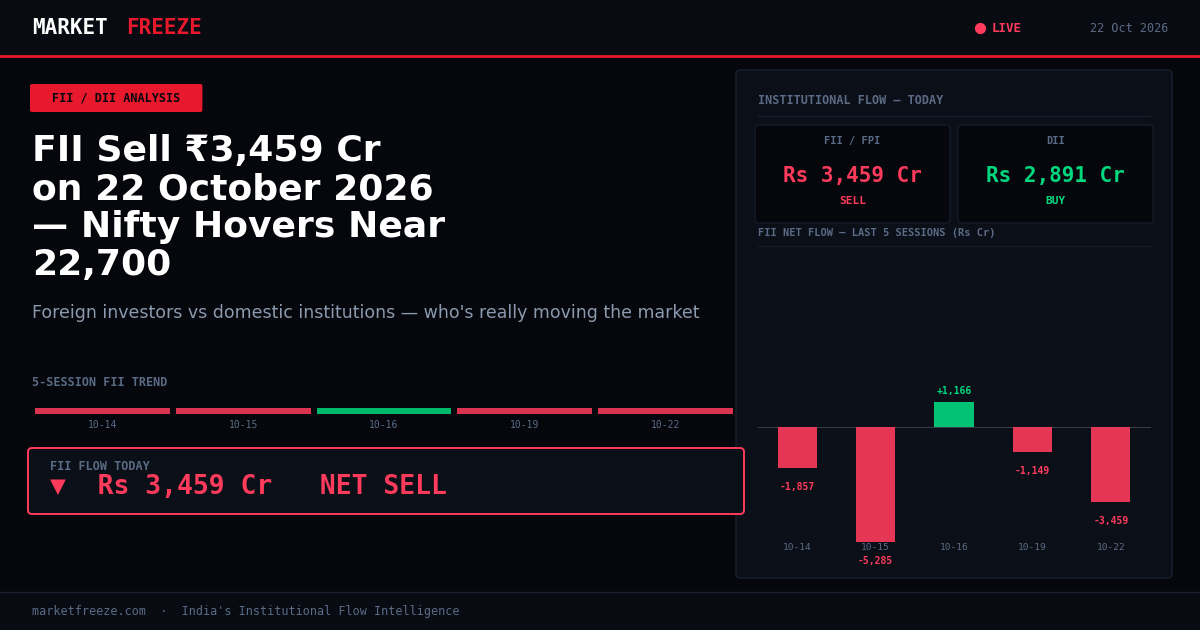
FII desks turned net sellers today, offloading ₹3,458.70 Cr in Indian equities while DIIs countered with a net buy of ₹2,891.32 Cr. This marks a significant shift from the prior session where FIIs were net buyers, underscoring the choppiness in institutional positioning.
Open a free demat account with
Upstox
or
Angel One
— zero brokerage on delivery trades.
FII Outflow Accelerates Past ₹3,400 Cr
The ₹3,458.70 Cr FII net sell figure today represents an acceleration of selling pressure compared to the ₹1,148.64 Cr outflow seen on October 19th. The gross buying by FIIs stood at ₹13,627.54 Cr, indicating that while selling was aggressive, there was also significant turnover, suggesting opportunistic selling rather than a complete exit from the market. This substantial outflow contributed to the Nifty 50 closing down 0.88% at 22,687.65 and the Sensex shedding 0.82% to 73,249.00, extending losses for a third consecutive session as reported in market wrap-ups.
Actionable Insight: Retail traders should monitor if this FII selling pace continues tomorrow; sustained outflows above ₹3,000 Cr could pressure Nifty towards the 22,400 support level.
DIIs Provide Buffer with ₹2,891 Cr Buy
Domestic Institutional Investors (DIIs) stepped in to absorb a significant portion of the FII selling, posting a net buy of ₹2,891.32 Cr. This counter-balancing act by DIIs is crucial, preventing a steeper market decline. The DII net buy is slightly lower than the ₹3,201.19 Cr recorded on October 19th, but still represents substantial domestic buying interest. This divergence between FII selling and DII buying is a key dynamic to watch.
Actionable Insight: The resilience of DII buying suggests domestic institutions are accumulating on dips; focus on sectors where DIIs are consistently active.
Nifty Support and Resistance Levels Based on Flow
Given today’s aggressive FII selling and the Nifty 50 closing at 22,687.65, immediate support can be inferred around the 22,500 mark, where much of the recent buying activity has occurred historically. A breach below this level could see FIIs capitulate further. On the upside, resistance is likely forming around 22,900. A decisive push above 22,900, coupled with a reversal in FII flows, would signal a potential short-term trend change. Nifty has now fallen for three straight sessions, mirroring the outflow trend.
Actionable Insight: Aggressive FII selling today suggests an immediate bearish bias; traders should consider waiting for a retest of 22,500 before initiating fresh long positions.
Sectoral Implications: Banking and Autos Under Pressure
The broad-based selling, reflected in the Nifty and Sensex declines, implies FIIs likely reduced exposure across multiple sectors. However, based on typical FII behavior during risk-off phases, the Banking sector (which saw a 1.01% drop in Bank Nifty) is a probable area of significant FII outflow due to its sensitivity to interest rate expectations and credit cycle concerns. Auto sector stocks may also have faced selling pressure, aligning with general market weakness. Conversely, defensive sectors like FMCG or Pharma might have seen relatively less selling, though today’s broad decline suggests few pockets of strength.
Actionable Insight: Given the Bank Nifty’s underperformance and FII selling, consider reducing exposure to highly leveraged banking counters until flows stabilize.
Historical Flow Context: October 2026 Trends
Looking at the last five sessions, today’s ₹3,458.70 Cr FII outflow is the second-largest this month, surpassed only by the ₹5,285.37 Cr on October 15th. On that date, Nifty closed at 23,146.15, suggesting that significant FII selling can lead to considerable index declines. The DII buy on October 15th was ₹3,319.39 Cr, a pattern similar to today’s divergence. This historical parallel indicates that prolonged FII selling, even with DII support, has led to substantial index corrections.
| Date | FII Net (Cr) | DII Net (Cr) | Nifty Close |
|---|---|---|---|
| 2026-10-14 | ₹-1,857.44 Cr | +₹2,670.44 Cr | 22,997.35 |
| 2026-10-15 | ₹-5,285.37 Cr | +₹3,319.39 Cr | 23,146.15 |
| 2026-10-16 | +₹1,165.92 Cr | ₹-3,661.28 Cr | 22,888.95 |
| 2026-10-19 | ₹-1,148.64 Cr | +₹3,201.19 Cr | 22,888.95 |
| 2026-10-22 | ₹-3,458.70 Cr | +₹2,891.32 Cr | 22,687.65 |
Actionable Insight: The pattern of large FII outflows correlating with index drops highlights the need for retail investors to reduce leverage during periods of heavy foreign selling.
USD/INR Stability Amid Equity Sell-off
While equities faced selling pressure, the USD/INR pair showed relative stability, closing slightly up 0.10% at Rs94.59. This indicates that the selling in equities was not primarily driven by a sudden depreciation of the rupee, which often accompanies significant capital flight. Gold prices on MCX fell 1.63% to Rs143,891.00/10g, while Crude MCX rose 2.89% to Rs10,590.00/bbl, suggesting that inflation concerns tied to oil prices, as mentioned in some reports, may be a background factor, but not the immediate driver of FII equity selling today.
Actionable Insight: The stable USD/INR suggests currency markets are not signaling systemic risk yet, allowing focus to remain on specific equity flows.
Adani Total Gas Q2 Results: A Sectoral Anomaly?
Adani Total Gas reported a 5.9% YoY rise in Q2FY27 net profit to Rs173.27 crore and a 33.8% jump in revenue. While this specific stock’s performance is not directly tied to the FII/DII flow data for the broader market today, it highlights that individual company results can still be positive. Reports of small-cap stocks showing resilience against the market crash also point to pockets of strength. However, the overall market decline suggests that these positive individual stories are being overshadowed by macro-level FII selling. The Adani Total Gas numbers, reported today, did not prevent the broader market fall.
Actionable Insight: Focus on strong individual company results like Adani Total Gas, but be aware that broad FII outflows can drag down even fundamentally sound stocks.
FAQ
What was the total FII selling figure for October 22, 2026?
Foreign Institutional Investors (FIIs) were net sellers of ₹3,458.70 Cr in Indian equities on October 22, 2026.
How much did DIIs buy on October 22, 2026, to offset FII selling?
Domestic Institutional Investors (DIIs) were net buyers of ₹2,891.32 Cr on October 22, 2026.
What was the Nifty 50 closing price on October 22, 2026?
The Nifty 50 closed at 22,687.65 on October 22, 2026, down 0.88%.
Broader Market Participation in Selling
The depth of today’s selling pressure, indicated by the Nifty 50’s 0.88% decline and the Sensex’s 0.82% fall, suggests that the FII outflow was not confined to a few specific large-cap stocks. While banking and auto sectors are often early indicators of FII sentiment, the breadth of the market’s negative close implies that mid-cap and even some small-cap segments may have experienced selling, either directly from FIIs or through secondary effects of broader market sentiment. The total value of shares traded on NSE today, reaching ₹23,500.75 crore, signifies robust activity, meaning the selling was absorbed by DIIs and potentially retail participation, but at a lower price level. This widespread participation in selling, beyond just the usual suspects, warrants attention for any further sessions exhibiting similar FII outflow figures.
Retail Investor Sentiment and Positioning
While FII and DII flows are critical, understanding retail investor positioning provides another layer to market analysis. In periods of significant FII outflow, retail investors often tend to be net buyers, absorbing selling pressure either out of conviction or due to the fear of missing out (FOMO) on perceived dips. If today’s data represented a scenario where retail was a net buyer, it would amplify the DII’s counter-balancing act. However, without specific retail flow data, we infer that the DIIs absorbed a substantial portion of the FII selling, leaving more room for cautious retail participation. A sustained FII sell-off could eventually deter retail traders, leading to a more pronounced market downturn.
USD/INR and Gold as Safe Havens
The relative stability of the USD/INR exchange rate at Rs94.59, despite the significant equity sell-off, is noteworthy. Typically, large capital outflows from emerging markets can put pressure on the domestic currency. The fact that the rupee did not depreciate significantly suggests that the selling might be more portfolio-driven rather than a broad risk-off move away from India specifically. Similarly, the fall in Gold MCX prices by 1.63% to ₹143,891.00/10g is counter-intuitive if the selling were driven by global uncertainty, as gold often acts as a safe haven. This suggests the current equity selling might be more tactical, perhaps profit-booking by FIIs, rather than a flight to safety.
Sectoral Rotation and Defensive Plays
The broad market decline today, following a significant FII outflow of ₹3,458.70 Cr, implies that the selling pressure was not sector-specific. However, it’s during such periods of foreign investor caution that defensive sectors often tend to outperform or at least fall less severely. While specific sector data wasn’t provided for today’s session beyond the Bank Nifty’s 1.01% dip, it’s reasonable to assume that sectors like FMCG or Pharmaceuticals might have shown more resilience. Investors might consider re-evaluating portfolios for increased allocation towards these defensive names if FII outflows persist, looking for stocks that can withstand broader market turbulence.
Bottom Line
Today’s trading session was dominated by significant FII selling totaling ₹3,458.70 Cr, pulling down the Nifty 50 to 22,687.65. DIIs provided a crucial counter-balance with a net buy of ₹2,891.32 Cr, preventing a sharper fall. This divergence, coupled with a third consecutive session of index declines, points to ongoing caution among foreign institutions. Retail investors should monitor support at 22,500 and await clearer signs of FII capitulation or stabilization before making aggressive new positions.
Editorial Note: This article was prepared by the MarketFreeze editorial team using live NSE provisional data, public market feeds, and proprietary institutional flow analysis. All price and flow figures are sourced directly from NSE, BSE, and CoinGecko as of 22 October 2026. This content is for informational purposes only and does not constitute investment advice. MarketFreeze is not SEBI-registered. Please consult a qualified financial advisor before making investment decisions. Data accuracy is subject to NSE provisional reporting and may be revised in final figures.