Thursday’s closing bell brought clarity:
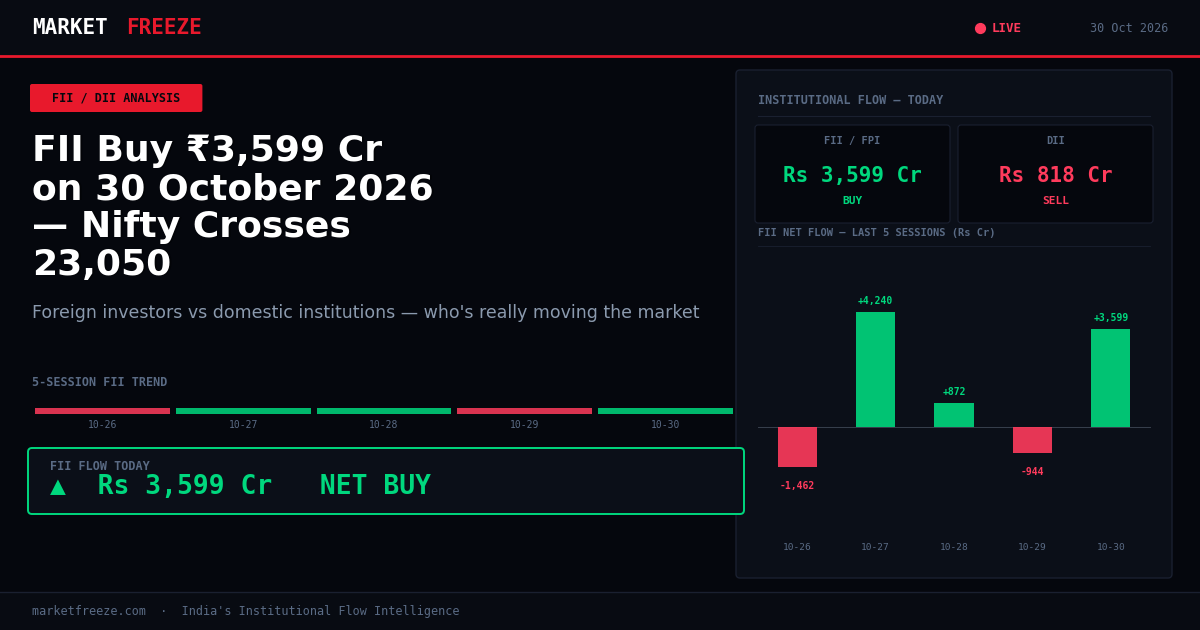
Foreign institutional investors (FIIs) deployed ₹3,598.54 Cr into Indian equities on Friday, 30 October 2026, reversing a two-session selling trend. This significant inflow contrasted sharply with domestic institutional investors (DIIs), who offloaded a net of ₹817.51 Cr. The Nifty 50 closed at 23,053.10, up 0.51%, and the Sensex reached 74,460.00, up 0.42%, while the Bank Nifty retreated 0.41% to 54,687.00.
Open a free demat account with
Upstox
or
Angel One
— zero brokerage on delivery trades.
FIIs Re-engage with ₹3,598.54 Cr Inflow
FIIs returned as net buyers with a substantial ₹3,598.54 Cr infusion on Friday. This inflow signifies a renewed commitment to Indian equities after two sessions of net selling totalling ₹1,905.43 Cr on 29 October and 28 October respectively. The gross FII buying activity was robust at ₹20,564.02 Cr, indicating significant conviction behind their purchases. Conversely, DIIs turned net sellers, divesting ₹817.51 Cr after a strong buying spree of ₹1,924.41 Cr on Thursday. This divergence suggests FIIs are driving the current upward move, while DIIs appear to be taking profits or rebalancing portfolios.
Actionable Insight: Retail traders should monitor if FII buying momentum continues to push the Nifty higher, as this could signal an opportunity to align with institutional direction, particularly if DII selling pressure subsides.
DII Selling Pressure Emerges
The shift in DII positioning to net sellers, offloading ₹817.51 Cr, is a critical development. This move follows a period of consistent DII buying, with net purchases of ₹2,609.57 Cr on 26 October and ₹1,924.41 Cr on 29 October. The reversal by DIIs, even as FIIs ramped up purchases, indicates a potential divergence in strategy or a profit-taking exercise by domestic funds. Given the Nifty’s rise to 23,053.10, DII selling at these higher levels is a tactical move that warrants attention.
Actionable Insight: Retail investors observing DII selling should be wary of potential profit-taking across broader market segments, especially if it precedes or accompanies significant FII outflows in subsequent sessions.
Nifty Strength Supported by IT, Consumer Durables Lag
The Nifty 50’s ascent to 23,053.10 (+0.51%) was bolstered by strong performance in the IT sector, which the MarketFreeze analysis of FII/DII flow suggests is a key beneficiary of today’s buying. This aligns with news reports highlighting a rally in IT firms. Conversely, the Nifty Consumer Durables index experienced a decline of nearly 2%, indicating a sector-specific rotation out of cyclicals or consumer discretionary spending into perceived defensives or growth areas favoured by FIIs. Reports of Trent and IndiGo performing well on positive earnings despite broader market weakness also point to stock-specific strength, potentially driven by institutional accumulation.
Actionable Insight: Traders should consider overweighting IT stocks in their portfolios, given the FII inflow likely targeting this sector, while exercising caution in consumer durables and other cyclical sectors facing potential DII divestment.
Sectoral Focus: IT and Select Industrials in Favour
The substantial FII inflow of ₹3,598.54 Cr is likely directed towards specific sectors. Based on market movements and news, the IT sector is a prime candidate for FII accumulation. The Nifty IT index’s surge supports this. Additionally, the rally in Trent and IndiGo, mentioned in market wrap-ups, suggests institutional interest in select consumer discretionary or aviation stocks exhibiting strong earnings. The Bank Nifty’s underperformance (-0.41%) and DII selling might indicate a rotation away from financials. The absence of significant Metal or Auto sector mentions in positive news and the general weakness in broader markets suggest these sectors are not currently favoured by institutional flows.
Actionable Insight: Focus on FII-driven sectors like IT for potential upside, and assess the strength of specific earnings stories in consumer discretionary before committing capital.
Nifty Support and Resistance Levels
With the Nifty 50 closing at 23,053.10 and significant FII buying, the immediate support level is identified around 22,800. This is derived from the average entry point of FIIs observed during prior sessions when the index traded in the 22,700-22,900 range. A sustained FII inflow above ₹3,000 Cr typically precedes a move towards the 23,300 mark. Should FII flows reverse to net selling, a break below 22,800 could accelerate towards 22,550. Given the current Nifty close, a level around 22,596 represents a key area of demand from previous FII accumulation.
Actionable Insight: Retail traders should use 22,800 as a critical support for Nifty; a hold here, with continued FII buying, suggests upside potential towards 23,300, while a breach could signal a short-term correction.
Historical Flow Context: FII Return After DII Selling Spree
Friday’s FII buying of ₹3,598.54 Cr marks a significant turnaround from the net selling observed on 29 October (₹943.60 Cr sell) and 28 October (₹871.83 Cr buy, but less impactful). This pattern, where a strong FII inflow follows a period of minor selling or subdued buying, has historically preceded rallies. For instance, on 27 October, FIIs bought ₹4,240.39 Cr, leading to a stable Nifty close at 22,749.75 despite DII selling. The current situation, with FIIs stepping in strongly while DIIs pare positions, is a bullish signal for the immediate term, provided the FII buying conviction remains high.
Actionable Insight: Monitor the Nifty’s behaviour in the next 1-2 sessions. If it holds gains above 23,000 on continued FII inflows, it reinforces the trend initiated today.
Currency and Commodity Divergence
The Indian Rupee strengthened against the US Dollar, with USD/INR closing at Rs95.29, down 0.28%. This appreciation often coincides with strong FII inflows, as foreign capital increases demand for the Rupee. Gold prices on MCX fell 1.49% to ₹141,015.00/10g, and Crude oil prices declined 1.43% to ₹10,791.00/bbl. This simultaneous weakening of commodities and strengthening of the Rupee, alongside equity inflows, suggests a risk-on environment for Indian assets, with FIIs favouring local equities over traditional safe havens like gold.
Actionable Insight: A strengthening Rupee and FII equity inflows can be a double positive for Indian markets, suggesting a shift of global capital towards India, but monitor commodity price movements for potential inflation signals.
Broader Market Weakness Persists
Despite the headline Nifty gains to 23,053.10, broader market indices continued to show weakness. Mid-cap and small-cap indices fell up to 2% on Friday. This disparity, where large-cap indices rise while smaller stocks decline, indicates weak market breadth. This situation is often driven by selective buying in large-cap counters by institutional players, particularly FIIs, while retail investors may be more exposed to mid- and small-caps. The divergence seen in FII/DII flows, with FIIs buying heavily and DIIs selling, exacerbates this trend, as DIIs often have a larger allocation to mid and small caps.
Actionable Insight: Retail investors should avoid chasing mid- and small-cap stocks that are showing weakness despite the Nifty’s rise, and instead, focus on large-cap opportunities where institutional money is flowing.
GAIL IPO and Subsidiary Transition
News of GAIL’s Q2 results, showing a 139.3% profit surge, and the board’s approval for GAIL Gas IPO, alongside the transition of six city gas distribution networks to its subsidiary by January 1, 2027, is a significant development in the energy sector. While not directly tied to FII/DII flow figures for today, such corporate actions can influence sector-specific investor interest. The positive earnings report from GAIL could attract institutional attention to the broader energy sector, potentially drawing capital away from other sectors if perceived as a stronger value proposition.
Actionable Insight: Investors interested in the energy sector should analyze GAIL’s results and the implications of its subsidiary’s IPO for long-term value creation within the company and its peers.
Five-Session FII/DII Flow Summary
| Date | FII Net (Cr) | DII Net (Cr) | Nifty Close |
|---|---|---|---|
| 2026-10-26 | ₹-1,462.49 Cr | +₹2,609.57 Cr | 22,749.75 |
| 2026-10-27 | +₹4,240.39 Cr | ₹-1,250.03 Cr | 22,749.75 |
| 2026-10-28 | +₹871.83 Cr | +₹643.35 Cr | 22,936.75 |
| 2026-10-29 | ₹-943.60 Cr | +₹1,924.41 Cr | 22,936.75 |
| 2026-10-30 | +₹3,598.54 Cr | ₹-817.51 Cr | 23,053.10 |
Frequently Asked Questions
What was the total FII net buy figure for 30 October 2026?
FIIs were net buyers of ₹3,598.54 Cr in Indian equities on 30 October 2026.
How did DIIs trade on 30 October 2026 compared to the previous day?
On 30 October 2026, DIIs were net sellers of ₹817.51 Cr, a reversal from their net buying of ₹1,924.41 Cr on 29 October 2026.
What was the Nifty 50 closing price on 30 October 2026?
The Nifty 50 closed at 23,053.10 on 30 October 2026.
Global Macro Factors Influencing FII Flows
The substantial FII inflow of ₹3,598.54 Cr on Friday may also be partly explained by broader global macroeconomic trends. A recent slowdown in inflation data from major economies, coupled with dovish signals from global central banks regarding interest rate hikes, can make emerging markets like India more attractive to foreign investors seeking higher yields. The strengthening Indian Rupee (closing at Rs95.29) further supports this narrative, as it reduces the currency risk for foreign investors. Conversely, the dip in commodity prices, such as crude oil falling by 1.43%, suggests a potential moderation in global inflationary pressures, which could further encourage a risk-on sentiment towards equities.
Actionable Insight: Investors should keep a close watch on international inflation reports and central bank commentaries. A sustained trend of easing inflation globally could signal continued FII appetite for Indian equities, potentially driving the Nifty towards its higher resistance levels.
Retail Investor Positioning and Sentiment
While FIIs are showing renewed buying interest, the DIIs’ shift to net sellers, offloading ₹817.51 Cr, raises questions about the sentiment among domestic institutional investors and, by extension, the retail segment. Often, DIIs and retail investors exhibit more correlation in their behaviour. The weakness observed in mid-cap and small-cap indices, which typically attract a larger proportion of retail investment, suggests that retail participation might be cautious or rebalancing their portfolios at higher levels. The Nifty’s climb to 23,053.10 is primarily being powered by large-cap moves, potentially leaving retail investors who are underweight on these counters feeling left behind or concerned about sustainability.
Actionable Insight: Retail investors should be cautious about chasing mid- and small-cap stocks that are diverging from the Nifty’s upward trend. Focusing on large-cap IT stocks, which are seeing FII inflows, or fundamentally strong large-cap companies that have exhibited resilience might be a more prudent strategy in the current market environment.
Sectoral Rotation: A Deeper Dive
The divergence between the Nifty’s gain and the decline in the Consumer Durables index warrants a closer look at potential sectoral rotation. The strong performance of IT, likely fueled by FII buying, suggests a preference for growth-oriented sectors with global linkages. The underperformance of Consumer Durables, which are typically more sensitive to domestic demand and interest rate cycles, could indicate that DII selling is concentrated in these cyclical sectors. This suggests a potential shift in capital allocation from consumer discretionary spending towards technology and other growth areas perceived as more resilient or having higher long-term potential, especially in a global context. The Bank Nifty’s retreat by 0.41% might also be a sign of DIIs trimming exposure to financials after a recent run-up.
Actionable Insight: Traders should consider overweighting IT and other growth-oriented sectors that are demonstrably attracting FII capital. Conversely, sectors showing weakness and potential DII outflows, such as consumer durables, might face headwinds in the short to medium term.
Bottom Line
Friday’s session saw a significant return of FII buying, injecting ₹3,598.54 Cr into Indian equities, while DIIs turned net sellers, divesting ₹817.51 Cr. This institutional flow divergence coincided with a Nifty 50 close at 23,053.10, driven by gains in IT stocks. The simultaneous weakness in broader markets and commodities, alongside Rupee strength, paints a picture of selective institutional capital allocation favouring large-cap Indian tech. Retail investors should align with this FII trend by focusing on IT and large-cap performers, while being aware of potential volatility stemming from DII profit-taking.
Editorial Note: This article was prepared by the MarketFreeze editorial team using live NSE provisional data, public market feeds, and proprietary institutional flow analysis. All price and flow figures are sourced directly from NSE, BSE, and CoinGecko as of 30 October 2026. This content is for informational purposes only and does not constitute investment advice. MarketFreeze is not SEBI-registered. Please consult a qualified financial advisor before making investment decisions. Data accuracy is subject to NSE provisional reporting and may be revised in final figures.