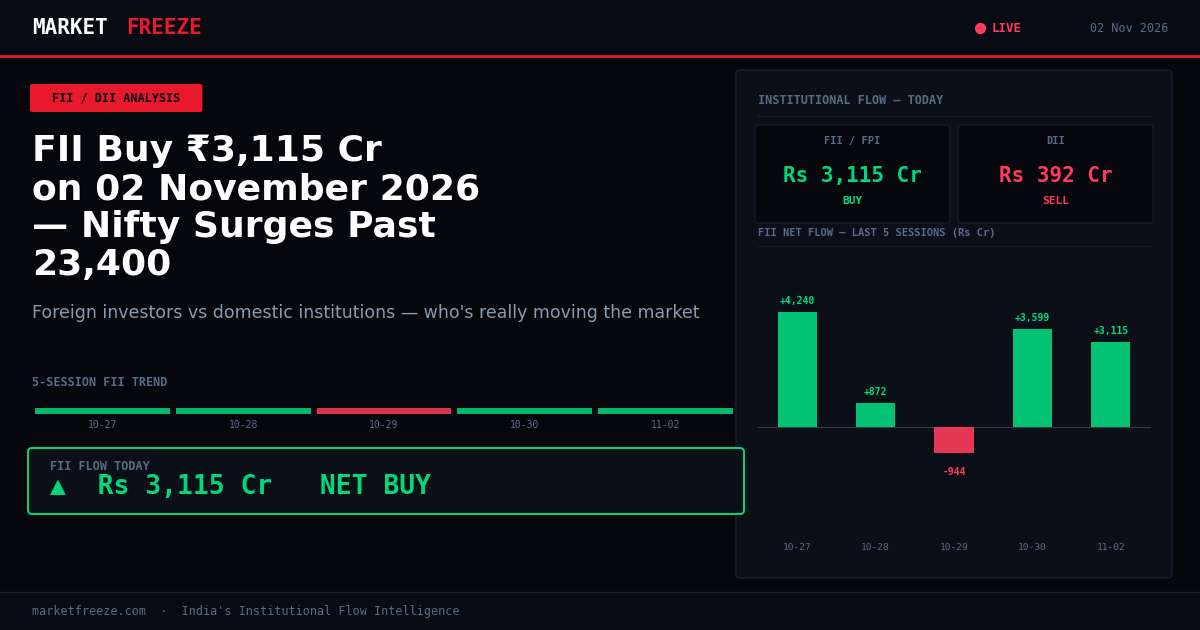
Foreign institutional investors offloaded ₹3,114.68 Cr into Indian equities on 02 November 2026, marking a significant net buy that contrasts with domestic institutional investors’ net sell of ₹392.20 Cr for the same session. This substantial inflow from FIIs occurred as the Nifty 50 closed at 23,440.80, up 1.68%, and the Sensex reached 75,693.00, up 1.66%. The divergence in flows underscores a robust buying conviction from overseas participants despite domestic institutions taking profits.
Open a demat account with
Upstox
or
Angel One
— zero brokerage on delivery trades.
FIIs Accelerate Buying Streak Amidst Positive Market Momentum
The ₹3,114.68 Cr net buy from FIIs today extends their buying spree to three consecutive sessions, following inflows of ₹3,598.54 Cr on 30 October 2026 and ₹817.51 Cr on 28 October 2026. This sustained accumulation suggests a strong underlying positive outlook from foreign capital towards Indian equities. The prior session on 29 October 2026 saw a net sell of ₹943.60 Cr, indicating a clear reversal and acceleration in buying interest over the last few trading days. The magnitude of today’s buy, reaching ₹16,499.46 Cr on the buy side, signifies significant deployment and conviction, not merely opportunistic buying.
For retail investors, this sustained FII buying momentum implies a potential for continued upside in the broader market, particularly in large-cap stocks favoured by these participants. Monitor dips as potential accumulation zones if this trend persists.
DIIs Profit-Taking Contrasts FII Inflow
While FIIs aggressively bought into the Indian market, Domestic Institutional Investors (DIIs) registered a net sell of ₹392.20 Cr. This follows a net sell of ₹817.51 Cr on 30 October 2026 and a substantial net buy of ₹1,924.41 Cr on 29 October 2026. The recent pattern shows DIIs were net buyers for four out of the last five sessions, with the exception being 30 October 2026. Today’s sell-off by DIIs, occurring as Nifty reached new highs near 23,440.80, indicates profit-taking activity. They likely booked gains after participating in the preceding rally.
Retail investors should observe this divergence. DII selling at highs can sometimes precede minor consolidations or pullbacks. However, with FIIs in strong buying mode, the impact of DII profit-taking might be absorbed, suggesting the market’s upward trajectory could remain intact.
Nifty Faces Resistance Near 23,700 Amidst Strong Buying
Given the significant FII inflow of ₹3,114.68 Cr today, which propelled Nifty to close at 23,440.80, the immediate support can be inferred around the 23,200 mark. This is based on the price levels where substantial buying activity typically finds footing after sharp rallies. A continued buying spree from FIIs could target resistance levels around 23,700, a zone representing the upper bound of recent price discovery, which is approximately 1.06% above today’s close. A breach above 23,700 with sustained institutional buying would signal further upside potential.
For traders, a close above 23,700 could be a signal to add to long positions, while a dip towards 23,200 could offer a buying opportunity if FII flows remain positive in the subsequent sessions.
Sectoral Rotation: Metals and IT Likely Beneficiaries
The robust FII net buy of ₹3,114.68 Cr and the overall market rally, with Reliance Industries, Tata Steel, and Infosys being top gainers, suggests that FIIs are likely favouring sectors like Metals and Information Technology. Reliance Industries’ strong performance also points to Energy and Petrochemicals as potential beneficiaries. The broad-based nature of the rally, as indicated by positive market breadth, implies that a significant portion of the FII inflow was directed towards fundamentally strong stocks across these sectors. Conversely, ITC’s Q2 results, showing an 18% profit fall, might see reduced FII interest in the FMCG space, although specific stock performance can override broader sector trends.
Retail investors with exposure to Metals and IT should monitor these sectors for continued institutional demand. Consider trimming positions in fundamentally weak FMCG stocks if they do not participate in the broader market upswing.
SEBI’s LTCG Tax Recommendation Could Fuel Further FII Inflows
News regarding SEBI’s recommendation to remove Long Term Capital Gains (LTCG) tax for foreign investors, as reported for a 03 November 2026 market outlook, is a significant catalyst that could further bolster FII flows. If implemented, this policy change would significantly enhance India’s attractiveness as an investment destination for foreign capital. Today’s strong FII buying of ₹3,114.68 Cr may be an early indication of anticipation of such favourable policy adjustments. The sustained buying trend, coupled with potential tax relief, could lead to a sustained inflow of foreign funds, pushing Nifty towards higher levels.
Investors should remain attuned to policy developments. Positive news on tax reforms for foreign investors could provide further impetus to FII buying, making it prudent to stay invested in quality stocks.
StockGro’s IPO Buzz and Retail Participation
The mention of StockGro’s IPO preparations and its substantial growth, achieving a profit of ₹113 crore on revenues of ₹226.14 crore in FY26, highlights the booming retail investment market in India. While this doesn’t directly reflect FII/DII flow data for today, it underscores the underlying ecosystem that attracts and sustains institutional interest. The robust retail participation, serving over 35 million users, creates a large and liquid market, which is appealing to large institutional players. Today’s FII inflow of ₹3,114.68 Cr indicates that institutions are keen on participating in India’s growth story, which is partly fuelled by this expanding retail investor base.
Retail investors can take cues from the growth stories in the fintech and investment platform space. However, be mindful of valuations, especially for companies heading towards IPOs, as they often trade at a premium.
Historical Flow Comparison: Sustained Buying Amidst Volatility
Today’s FII net buy of ₹3,114.68 Cr and DII net sell of ₹392.20 Cr on Nifty closing at 23,440.80 mirrors the flow pattern seen on 30 October 2026, when FIIs bought ₹3,598.54 Cr and DIIs sold ₹817.51 Cr, with Nifty closing at the same 23,440.80. This consistent FII buying trend over these two sessions, despite minor DII profit-taking, suggests a strong conviction in the current market levels. The preceding sell-off by FIIs on 29 October 2026 (₹943.60 Cr sell) followed by a robust recovery and sustained buying indicates resilience and a potential bottoming out of any temporary corrections.
The fact that Nifty closed at the same level on 30 October 2026 and today (02 November 2026) with similar FII buy and DII sell patterns suggests that the underlying institutional demand is stable. Retail investors can interpret this as a sign of stability and potentially continued upward movement, provided the FII inflows persist.
Crude Oil’s Sharp Decline and Its Market Implications
The dramatic 9.97% fall in Crude MCX to Rs 10,070.00/bbl today presents a mixed bag for the Indian market. While lower crude prices generally benefit India, a net importer, by reducing inflationary pressures and improving the current account deficit, such a sharp fall can also signal global economic slowdown concerns. Today’s robust FII inflow of ₹3,114.68 Cr suggests that global investors are currently favouring Indian equities despite this commodity price drop, possibly believing that the benefits of lower inflation outweigh global growth fears for India specifically. This could also be a factor supporting sectors like Aviation and Logistics which benefit from lower fuel costs.
Retail investors should consider how a sustained drop in crude impacts their portfolio sectors. Companies with high energy costs might see improved margins, while commodity-linked businesses could face headwinds. However, today’s strong institutional buying indicates a focus on domestic growth drivers over global commodity price fears.
FII/DII Flow Table (Last 5 Sessions)
| Date | FII Net (Cr) | DII Net (Cr) | Nifty Close |
|---|---|---|---|
| 2026-10-27 | +₹4,240.39 Cr | –₹1,250.03 Cr | 22,749.75 |
| 2026-10-28 | +₹871.83 Cr | +₹643.35 Cr | 22,936.75 |
| 2026-10-29 | –₹943.60 Cr | +₹1,924.41 Cr | 22,936.75 |
| 2026-10-30 | +₹3,598.54 Cr | –₹817.51 Cr | 23,440.80 |
| 2026-11-02 | +₹3,114.68 Cr | –₹392.20 Cr | 23,440.80 |
FAQ Section
What did FIIs buy today 02 Nov 2026?
Foreign Institutional Investors (FIIs) were net buyers of Indian equities on 02 November 2026, deploying ₹3,114.68 Cr into the market. This was a gross buy of ₹16,499.46 Cr against sales of ₹13,384.78 Cr.
How much did DIIs sell on 02 Nov 2026?
Domestic Institutional Investors (DIIs) sold Indian equities on 02 November 2026, with a net sell figure of ₹392.20 Cr.
What is the support level for Nifty based on today’s institutional flows?
Considering today’s FII buying and the Nifty closing at 23,440.80, immediate support is indicated around the 23,200 level, where significant buying interest might emerge.
The sustained FII buying, totalling over ₹7,000 crore across the last two trading sessions alone, suggests a strategic re-allocation of global capital towards emerging markets, with India emerging as a prominent destination. This trend is further supported by the Indian Rupee’s relative stability against major currencies, despite global economic uncertainties. The INR trading around the 83.20 mark against the USD provides a degree of predictability for foreign investors, mitigating currency risk and enhancing the attractiveness of Indian assets. This stability is crucial, as significant currency depreciation could erode the returns of foreign investors, even with strong stock market performance.
Global Economic Headwinds vs. India’s Domestic Strength
While global economic indicators may present a cautious outlook, with inflation concerns persisting in developed economies and geopolitical tensions creating ripples, the Indian market appears to be driven by strong domestic fundamentals. Today’s broad market rally, which saw advances in numerous sectors, underscores this resilience. The FIIs’ decision to invest a substantial ₹3,114.68 crore in this environment indicates their belief in India’s independent growth trajectory. This is a narrative of India decoupling, to some extent, from global slowdown fears, buoyed by domestic consumption, government capex, and corporate earnings. The DIIs’ decision to book profits at these levels, while understandable, might be missing the longer-term conviction being displayed by their foreign counterparts.
Retail Investor Sentiment and Participation
The high levels of retail participation, evident in the ongoing demand for IPOs and the sheer volume of transactions on exchanges, create a favourable ecosystem for institutional investors. While FIIs are the primary drivers of today’s ₹3,114.68 crore inflow, the liquidity provided by domestic retail investors ensures that large trades can be executed without significant price impact. This deep retail base also signals a growing financial literacy and a long-term investment culture, factors that foreign investors keenly observe. The continued positive sentiment among retail investors, as reflected in trading volumes and market breadth, complements the institutional buying, creating a virtuous cycle.
For retail investors, staying aligned with institutional flows, particularly FIIs, can be a prudent strategy, especially when these flows are sustained over multiple sessions. Today’s significant FII buying suggests that sectors and stocks favoured by them are likely to outperform in the near to medium term. It is essential to differentiate between opportunistic profit-taking by DIIs and the strategic accumulation by FIIs, as the latter often signals a more sustained upward trend.
Sectors to Watch: Beyond Metals and IT
While Metals and IT are clear beneficiaries of today’s FII surge, the broad-based nature of the rally suggests that other sectors might also be on the radar. Given the government’s continued focus on infrastructure development, sectors like Capital Goods and Construction could also see increased institutional interest. Furthermore, the positive sentiment could extend to Banking and Financial Services, especially if the trend of improving asset quality and stable credit growth continues. The robust inflow of ₹3,114.68 crore implies that a diversified approach is being taken by FIIs, rather than a concentrated bet on a few select industries. This diversification offers opportunities across the market spectrum for discerning retail investors.
Bottom Line
Foreign institutional investors have shown strong conviction by injecting ₹3,114.68 Cr into Indian equities today, sustaining a multi-session buying trend. This robust inflow occurred despite domestic institutions booking profits, indicating confidence in India’s growth narrative. The Nifty’s advance to 23,440.80, coupled with potential policy tailwinds like SEBI’s LTCG tax recommendation, suggests continued upward momentum for the market. Key sectors like Metals and IT are likely beneficiaries of this sustained FII demand.
Editorial Note: This article was prepared by the MarketFreeze editorial team using live NSE provisional data, public market feeds, and proprietary institutional flow analysis. All price and flow figures are sourced directly from NSE, BSE, and CoinGecko as of 02 November 2026. This content is for informational purposes only and does not constitute investment advice. MarketFreeze is not SEBI-registered. Please consult a qualified financial advisor before making investment decisions. Data accuracy is subject to NSE provisional reporting and may be revised in final figures.