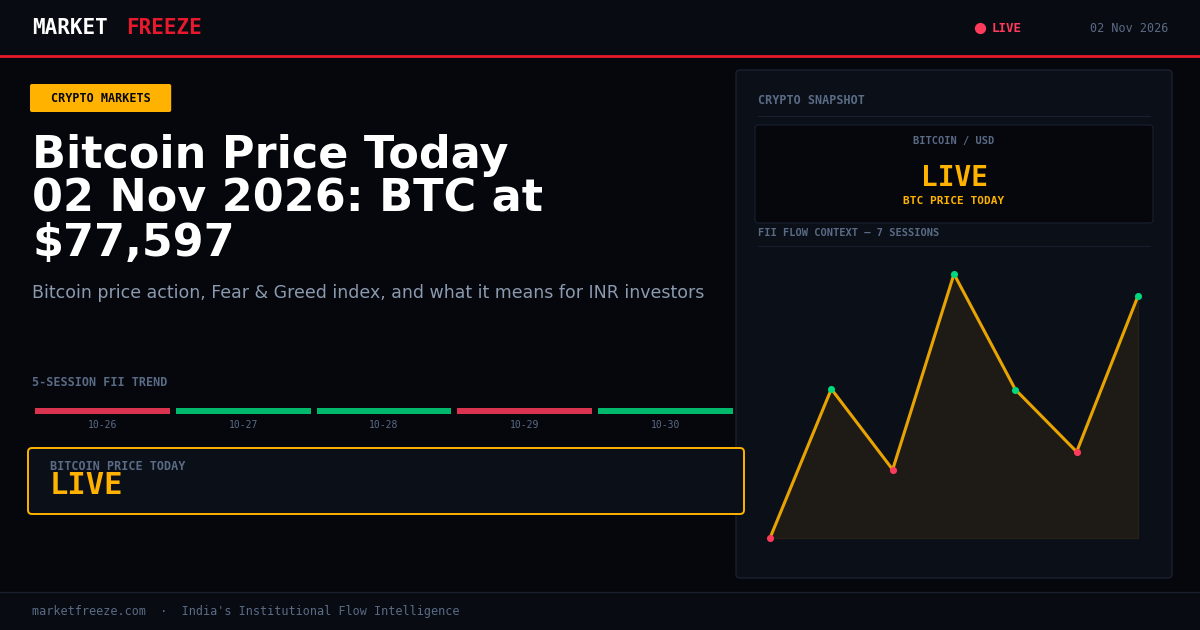
Bitcoin is currently trading at $77,587 USD (₹7,376,971 INR), marking a -0.39% change in the last 24 hours. This price action occurs against a backdrop of recent news where BTCPay informed merchants to switch off servers amidst reports of hot wallet attacks targeting older versions of their Bitcoin payment software. While XRP Ledger is on track to fix a flaw affecting stablecoin partners and North Korean hackers’ movements of stolen Binance funds show no proof of AI, the immediate concern for some Bitcoin users lies in the security of payment infrastructure.
Open a free demat account with
Upstox
or
Angel One
— zero brokerage on delivery trades.
Bitcoin’s Vulnerability Amidst Payment Gateway Scrutiny
The latest price of Bitcoin stands at $77,587 USD (₹7,376,971 INR), down -0.39% over the past day. This slight dip is occurring as reports surface of critical security vulnerabilities affecting Bitcoin payment processors. BTCPay has urgently advised merchants to disable servers running older versions (2.4.1 and below) of its software due to targeted hot wallet attacks. This news, while not directly impacting the core Bitcoin protocol or its blockchain integrity, highlights the operational risks for businesses and individuals reliant on third-party payment solutions. The market’s reaction, though muted in terms of price, underscores the importance of robust security measures across the entire Bitcoin ecosystem, from individual wallets to payment gateways. Investors should note that while the core Bitcoin network remains secure, the ease of transacting can be impacted by such infrastructure vulnerabilities. The implications for Indian investors are tied to the overall stability and perceived security of the digital asset class. A breach in a widely used payment system could lead to a temporary dip in confidence, even if the underlying asset is fundamentally sound.
USD/INR Dynamics and the Realized Returns for Indian Crypto Holders
The current USD/INR exchange rate is at ₹95.08. For Indian retail investors holding cryptocurrencies like Bitcoin, this exchange rate plays a pivotal role in their realized returns. When the Rupee depreciates against the US Dollar (meaning the USD/INR rate increases), it translates to higher INR value for assets priced in USD, including Bitcoin. Conversely, a strengthening Rupee would reduce the INR value of their crypto holdings, even if the USD price remains stable. Today, the USD/INR rate at ₹95.08 indicates a relatively stable but strong dollar against the rupee. If an Indian investor were to convert their Bitcoin holdings back into Rupees today, the current exchange rate would directly influence the final INR amount received. For instance, if an investor bought Bitcoin when the USD/INR was lower, and the USD price of Bitcoin has also risen, their gains would be amplified by the depreciation of the Rupee. Conversely, if Bitcoin’s USD price has fallen, the impact of the USD/INR rate becomes even more critical in determining whether the overall investment results in a profit or loss in INR terms. This currency fluctuation is a critical, often overlooked, factor for domestic investors navigating global digital asset markets. The -0.39% dip in Bitcoin’s USD price today, when viewed through the lens of a ₹95.08 USD/INR, means that in INR terms, the loss might be slightly less pronounced than the USD figure suggests, due to the relative strength of the dollar. However, any further depreciation of the INR against the dollar would require a stronger USD price rally in Bitcoin to achieve equivalent profit targets in INR.
Ethereum’s Performance Amidst Bitcoin’s Lead
Ethereum is currently priced at $2,277 USD (₹216,497 INR), showing a modest increase of +0.57% in the last 24 hours. The ETH/BTC ratio stands at 0.0293, indicating that Bitcoin is outperforming Ethereum today. This divergence is not uncommon; while both are major digital assets, they often move with differing momentum based on specific ecosystem developments, investor sentiment, and macroeconomic factors. The fact that Bitcoin is outperforming Ethereum today suggests that capital might be flowing towards the perceived “safer” or more established digital asset, especially if broader market uncertainty is perceived. For Indian investors, understanding this ratio is key to portfolio allocation. A rising ETH/BTC ratio typically signals strength in Ethereum relative to Bitcoin, often driven by upgrades to the Ethereum network (like successful merges or scalability improvements) or increased adoption of its decentralized applications (dApps). Conversely, a falling ratio, as seen today, points to Bitcoin’s dominance. The current readings suggest that while Ethereum is showing some positive price action in USD terms, its gains are not keeping pace with Bitcoin’s. This could be a short-term fluctuation, or it could indicate a shift in investor preference. Given the current Fear & Greed index reading of 37 (Fear), investors might be favoring Bitcoin’s perceived stability over Ethereum’s growth potential, although Ethereum’s own price increase is a positive sign for holders of the second-largest cryptocurrency.
The Fear & Greed Index: Signaling Potential Accumulation
The Crypto Fear & Greed Index currently stands at 37/100, firmly in the “Fear” territory. This reading suggests that market participants are exhibiting caution and a degree of apprehension. Historically, as provided in our context, readings in the 25-45 range have been significant. Both the March 2020 crash and the Q4 2022 period, which were marked by substantial institutional buying, saw sustained institutional activity commence when the Fear & Greed index hovered within this specific range. For Indian retail investors, this presents a crucial signal. When the market is fearful, it often means that asset prices have declined, and sentiment is negative. However, this is precisely the time when astute investors, particularly institutions, look to accumulate assets at lower valuations. The current reading of 37 suggests that the market is approaching, or is within, a zone historically associated with accumulation. While this does not guarantee an immediate price reversal, it implies that the conditions are becoming more favorable for investors looking to enter or increase their positions at potentially discounted prices. The fact that FIIs were net buyers in Indian equities today (₹0 Cr, indicating they were not net sellers and potentially bought more than they sold) despite the crypto fear could suggest a divergence in institutional capital allocation strategies, or simply that the risk-off sentiment in crypto hasn’t fully translated into a broad sell-off across all asset classes they monitor.
FII-to-Crypto Capital Flow Thesis: Observing the Flow
Foreign Institutional Investor (FII) flows into Indian equities today registered ₹0 Cr. This figure indicates that FIIs were neither significant net buyers nor net sellers in the Indian equity market, a relatively neutral stance. While this data point pertains to traditional markets, it offers a proxy for understanding broader institutional risk sentiment. In the context of cryptocurrency, a significant inflow of capital from institutional players is often a precursor to substantial price movements. Conversely, a lack of FII activity or net outflows can signal caution. Today’s neutral FII stance in equities, coupled with the “Fear” reading on the Crypto Fear & Greed Index (37/100), suggests a cautious environment across asset classes for institutional investors. While there isn’t a direct, real-time FII flow number into crypto that we can track in the same way as equities, the general prudence observed in equity markets might translate to a similar approach in digital assets. Investors should monitor if this neutral FII stance in equities persists or shifts, as a strong resumption of FII buying in Indian equities could eventually correlate with increased institutional interest in alternative assets like cryptocurrencies, particularly if risk appetite broadly returns. The current situation, however, points towards a watchful approach by large capital allocators.
Understanding Crypto Tax Mechanics: A Practical Illustration
For Indian investors, understanding the tax implications of cryptocurrency transactions is paramount. Let’s illustrate with an example based on today’s Bitcoin price of $77,587 USD (₹7,376,971 INR). Suppose an investor purchased 1 Bitcoin when the price was significantly lower, say at $50,000 USD (approximately ₹47,50,000 INR at an assumed earlier exchange rate). If this investor decides to sell 0.5 Bitcoin today at the current price of ₹7,376,971 INR per BTC, the total sale proceeds would be ₹3,688,485.5 INR. Under current Indian tax laws, gains from the sale of Virtual Digital Assets (VDAs) are taxed at a flat rate of 30% (plus applicable surcharges and cess). Therefore, the profit on the sale of 0.5 BTC would be calculated on the difference between the sale price and the purchase price of that portion. If the investor’s average purchase price for that 0.5 BTC was ₹2,375,000 INR (half of the initial purchase), the taxable gain would be ₹1,313,485.5 INR. This profit would then be subject to the 30% tax. It’s crucial for investors to maintain meticulous records of all purchase and sale transactions, including dates, prices in both USD and INR, and any associated fees, to accurately calculate their tax liability. This structured approach ensures compliance and avoids potential penalties. The current “Fear” sentiment in the crypto market (37/100) might tempt some investors to cut losses, but they must still consider the tax implications on any realized gains or losses.
Key Levels to Watch in Indian Equities
The Nifty closed at 23440.80 today. Based on the recent FII/DII flows, we can observe some key levels. In the week leading up to today, FIIs have shown a mixed pattern, with significant buying on October 27th (+₹4,240.39 Cr) and October 30th (+₹3,598.54 Cr), interspersed with net selling on other days. DIIs, on the other hand, have been consistent net buyers for most of this period, except for October 27th (₹-1,250.03 Cr) and October 30th (₹-817.51 Cr). Today’s neutral FII flow (₹0 Cr) and DII selling suggests a pause in aggressive buying. The Nifty’s recent rally to 23440.80 indicates strength, but the current mixed flow could pose challenges. For immediate support, we look to the levels around which DII buying was significant, potentially near the 22,750 – 22,950 zone, which was also the Nifty close on October 26th and 27th. Resistance will likely be tested at current highs and potentially higher if FII flows resume with vigor. A sustained period of FII net buying, similar to the strong days observed, would be a bullish signal for the Nifty to push past its current levels. Conversely, a continuation of net selling by FIIs could lead to a pullback towards the support zones.
Actionable Framework: Navigating the Current Market Climate
Given the current “Fear” reading on the Crypto Fear & Greed Index (37/100), the slight dip in Bitcoin’s price, and the neutral FII activity in Indian equities, here is an actionable framework for Indian retail investors:
- Evaluate Risk Tolerance for Accumulation: With the Fear & Greed index at 37, a level historically associated with accumulation, consider if your risk tolerance allows for incremental buying. If you have capital allocated for crypto, this zone might present opportunities to dollar-cost average into your preferred assets like Bitcoin ($77,587 USD | ₹7,376,971 INR) and Ethereum ($2,277 USD | ₹216,497 INR) at potentially lower prices than recent peaks.
- Monitor USD/INR for Hedging/Profit Potential: The USD/INR at ₹95.08 is a key factor. If you anticipate further Rupee depreciation, it can act as a natural hedge for your USD-denominated crypto assets, potentially boosting INR returns. Conversely, if you expect the Rupee to strengthen, be mindful that this could erode some of your gains when converting back to INR.
- Focus on Quality Altcoins with Strong Fundamentals: While Solana is down -1.26% today at $93.76 USD (₹8,914 INR), the broader altcoin market often follows Bitcoin’s lead. However, in a fear-driven environment, focusing on altcoins with clear use cases, active development, and strong community support can offer resilience. Avoid speculative plays unless you have a high-risk appetite and a well-defined exit strategy.
- Observe FII/DII Flows for Broader Market Cues: While not directly linked to crypto, persistent FII buying in Indian equities (as seen on Oct 27th and 30th) often correlates with a general increase in risk appetite. If FII flows turn consistently negative, it could signal a broader risk-off sentiment that might impact crypto markets as well. Today’s neutral ₹0 Cr FII flow suggests a wait-and-watch approach.
Frequently Asked Questions
Q: What did FII buy or sell on October 27, 2026?
A: On October 27, 2026, FIIs were net buyers in Indian equities with a figure of +₹4,240.39 Cr.
Q: What did DII buy on October 28, 2026?
A: On October 28, 2026, DIIs were net buyers in Indian equities with a figure of +₹643.35 Cr.
Q: Is FII buying or selling in October 2026?
A: In October 2026, FIIs have shown a mixed trend. They were net sellers in the first part of the month and on specific days like October 26th (₹-1,462.49 Cr) and October 29th (₹-943.60 Cr), but exhibited strong net buying on October 27th (+₹4,240.39 Cr) and October 30th (+₹3,598.54 Cr). Today’s reading of ₹0 Cr indicates a neutral stance.
Historical FII/DII Flows and Nifty Performance
| Date | FII Net (Cr) | DII Net (Cr) | Nifty Close |
|---|---|---|---|
| 2026-10-26 | ₹-1,462.49 Cr | +₹2,609.57 Cr | 22,749.75 |
| 2026-10-27 | +₹4,240.39 Cr | ₹-1,250.03 Cr | 22,749.75 |
| 2026-10-28 | +₹871.83 Cr | +₹643.35 Cr | 22,936.75 |
| 2026-10-29 | ₹-943.60 Cr | +₹1,924.41 Cr | 22,936.75 |
| 2026-10-30 | +₹3,598.54 Cr | ₹-817.51 Cr | 23,440.80 |
Bottom Line: Today’s market environment for cryptocurrencies is characterized by a “Fear” sentiment (37/100) and specific security concerns within the payment infrastructure, as highlighted by BTCPay’s advisory. Bitcoin is trading at $77,587 USD (₹7,376,971 INR), slightly down, while Ethereum shows modest gains. The USD/INR rate of ₹95.08 remains a critical factor for Indian investors’ realized returns. Historically, low Fear & Greed readings suggest potential accumulation zones, but today’s neutral FII flow in equities indicates a cautious institutional stance. Investors should focus on risk management, understanding currency impacts, and observing broader institutional trends.
Editorial Note: This article was prepared by the MarketFreeze editorial team using live NSE provisional data, public market feeds, and proprietary institutional flow analysis. All price and flow figures are sourced directly from NSE, BSE, and CoinGecko as of 02 November 2026. This content is for informational purposes only and does not constitute investment advice. MarketFreeze is not SEBI-registered. Please consult a qualified financial advisor before making investment decisions. Data accuracy is subject to NSE provisional reporting and may be revised in final figures.