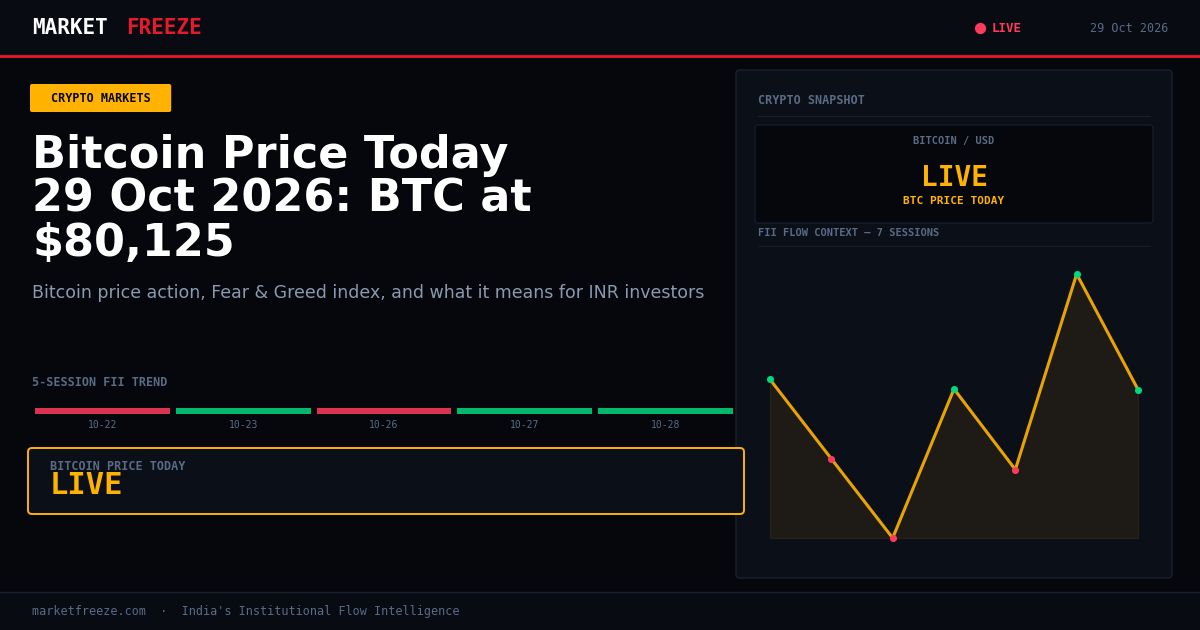
Bitcoin is trading at $80,083 USD or ₹7,631,909 INR, showing a 24-hour change of -0.58%. Today’s price action is overshadowed by the news that Polygon is extending its stablecoin payments infrastructure to Solana, a move that could streamline cross-border transactions and embed financial services deeper into the blockchain ecosystem. This development, while directly impacting Solana’s utility, also hints at broader integration trends that could eventually influence how larger cryptocurrencies like Bitcoin are perceived for institutional settlement and asset tracking.
Open a free demat account with
Upstox
or
Angel One
— zero brokerage on delivery trades.
USD/INR Dynamics for Indian Crypto Investors
The current USD/INR rate stands at ₹95.3. For Indian investors holding Bitcoin, this exchange rate has a direct impact on their realized returns when converting back to Rupees. A strengthening Rupee (meaning a lower USD/INR) would reduce the INR value of their USD-denominated crypto holdings, while a weakening Rupee would boost it. Given today’s crypto price movements are largely flat or slightly down, the USD/INR rate becomes a more significant factor in determining whether an Indian investor is in profit or loss when measured in local currency. For instance, if an Indian investor bought Bitcoin when the USD/INR was higher, a stable or falling USD/INR could exacerbate losses in INR terms even if BTC prices hold steady in USD. Conversely, if they acquired Bitcoin when the USD/INR was lower, today’s stable exchange rate offers some buffer against minor USD price dips. The -0.58% dip in Bitcoin’s USD price, when considered against the ₹95.3 USD/INR, means that in Rupee terms, Bitcoin has also seen a similar percentage decrease, settling around ₹7,631,909 INR.
Ethereum’s Performance Relative to Bitcoin
Ethereum is currently priced at $2,324 USD or ₹221,477 INR, with a 24-hour change of -0.44%. The ETH/BTC ratio is at 0.029. This indicates that Bitcoin is holding steadier than Ethereum in percentage terms over the last 24 hours, as Ethereum’s slight dip is more pronounced than Bitcoin’s. While this is not a dramatic shift, it reflects a common pattern where larger-cap cryptocurrencies like Bitcoin often exhibit more resilience during periods of minor market choppiness. For Indian investors, this means that a portfolio heavily weighted towards Ethereum might have seen a slightly larger decline in INR terms than a Bitcoin-centric portfolio today. The news regarding Polygon extending its stablecoin infrastructure to Solana, while not directly tied to Ethereum’s performance, highlights the ongoing innovation in the altcoin space. Such developments can sometimes divert investor attention and capital from established players like Ethereum, especially if they promise greater efficiency or novel use cases.
Altcoin Landscape: Solana’s Integrated Future
Solana is trading at $100.63 USD or ₹9,590 INR, down -0.50% in the last 24 hours. The significant news today is Polygon’s expansion of its stablecoin payments infrastructure to Solana. This integration offers Solana businesses a unified point for connecting bank funding, embedded wallets, cross-chain transfers, and global payouts. Kira, a cross-border firm, is noted as one of the early adopters. This move is a substantial step for Solana, enhancing its utility as a platform for financial services and potentially attracting more real-world asset tokenization and payment solutions. For Indian investors observing the altcoin market, this news positions Solana as a strong contender in the payments and stablecoin infrastructure space. While Solana itself is down slightly today, this foundational development could be a catalyst for future growth, making it an interesting case study for how infrastructure upgrades can impact token value independent of broader market sentiment. The interconnectedness of these ecosystems, as demonstrated by Polygon’s move to Solana, suggests a trend towards greater interoperability which could benefit the entire crypto market long-term.
Market Psychology: Navigating the Neutral Zone
The Fear & Greed Index is currently at 51/100, indicating a neutral market sentiment. Historically, as the provided context states, neutral readings between 45 and 60 often precede significant directional moves in either asset class. For Indian retail investors, this neutral sentiment suggests a period where fundamental developments and institutional flows are likely to be more influential than raw speculative frenzy. The fact that the index is precisely at 51 means that neither overwhelming fear nor excessive greed is dominating investor psychology. This can be a period of careful accumulation for those with a long-term view, as it suggests that current prices are not being driven by irrational exuberance, nor are they depressed by panic selling. The stability in crypto prices today, with Bitcoin at $80,083 USD (₹7,631,909 INR) and Ethereum at $2,324 USD (₹221,477 INR), aligns with this neutral reading, suggesting a market pausing to digest recent events and assess future catalysts.
Institutional Flows and Their Echo in Crypto Markets
In today’s Indian equity markets, FII net flows are recorded as ₹0 Cr, indicating they are net buyers. This is a positive sign for broader market liquidity and stability. While there isn’t a direct, instantaneous correlation between FII/DII flows and crypto prices, sustained positive institutional interest in Indian equities can sometimes correlate with a more favorable risk environment, which may indirectly benefit alternative assets like cryptocurrencies. However, today’s FII number is neither significantly positive nor negative, suggesting a balanced approach from foreign institutions. The historical data for the last five sessions reveals a mixed picture:
| Date | FII Net (Cr) | DII Net (Cr) | Nifty Close |
|---|---|---|---|
| 2026-10-22 | ₹-3,458.70 Cr | +₹2,891.32 Cr | 22,600.00 |
| 2026-10-23 | +₹887.65 Cr | +₹3,235.36 Cr | 22,753.20 |
| 2026-10-26 | ₹-1,462.49 Cr | +₹2,609.57 Cr | 22,749.75 |
| 2026-10-27 | +₹4,240.39 Cr | ₹-1,250.03 Cr | 22,749.75 |
| 2026-10-28 | +₹871.83 Cr | +₹643.35 Cr | 22,936.75 |
The recent trend shows FIIs have been net buyers on three out of the last five sessions, with a notable inflow on October 27th, followed by a more modest buy on October 28th. Today’s ₹0 Cr FII figure suggests a pause or consolidation, which, in conjunction with the neutral Fear & Greed index, points to a market environment where speculative capital might be cautious. If FII flows were to turn significantly negative, it could exert downward pressure on both Indian equities and, by extension, risk assets like crypto, given the current USD/INR of ₹95.3.
Understanding Crypto Taxation: A Bitcoin Scenario
Let’s consider a hypothetical scenario for an Indian investor today. Suppose an investor purchased 0.5 BTC (Bitcoin) on October 15, 2026, when Bitcoin was trading at approximately $78,000 USD (₹7,488,000 INR, assuming a USD/INR of ₹96 at that time). Today, on October 29, 2026, this investor decides to sell this 0.5 BTC. The current price is $80,083 USD or ₹7,631,909 INR.
The purchase cost in INR would be 0.5 BTC * ₹7,488,000 INR/BTC = ₹3,744,000 INR.
The sale proceeds in INR are 0.5 BTC * ₹7,631,909 INR/BTC = ₹3,815,954.5 INR.
The capital gain would be Sale Proceeds – Purchase Cost = ₹3,815,954.5 INR – ₹3,744,000 INR = ₹71,954.5 INR.
Under current Indian tax laws for Virtual Digital Assets (VDAs), this short-term capital gain of ₹71,954.5 INR would be taxed at a flat rate of 30%, plus applicable surcharge and cess. This means the investor would owe approximately ₹21,586.35 INR in taxes on this transaction, excluding any cess or surcharge. The current USD/INR of ₹95.3 is crucial for calculating the exact INR purchase and sale values, highlighting the importance of tracking both crypto prices and the forex rate for accurate tax calculations.
Key Levels for Indian Equities Amidst Crypto Stability
With Nifty closing yesterday at 22,936.75 and FIIs being net buyers today at ₹0 Cr (meaning they are actively buying, not selling), the immediate outlook for the Indian equity market appears stable to positive. The presence of consistent DII buying over the last five sessions, as seen in the table, also provides a supportive backdrop. Given these factors, the Nifty might find support around its recent closing levels. A key support level to watch would be the 22,800 mark, which has previously acted as a psychological and technical barrier. Resistance could be seen around the 23,000-23,100 zone. Any sustained move above 23,100, especially with renewed FII inflows, could signal further upside. Conversely, a break below 22,800, particularly if accompanied by a sudden shift in institutional flows or broader global economic news, might indicate a short-term correction. The neutral Fear & Greed index (51/100) suggests that while there isn’t strong conviction for a sharp rally, neither is there overwhelming selling pressure.
Navigating the Crypto Landscape: Actionable Insights
Considering today’s market dynamics, Indian investors might find value in the following actionable framework:
- Monitor USD/INR closely: With Bitcoin trading at $80,083 USD (₹7,631,909 INR) and Ethereum at $2,324 USD (₹221,477 INR), the USD/INR rate of ₹95.3 is a critical determinant of INR-denominated returns. If the INR weakens (USD/INR rises), it can offset minor USD price dips for crypto holdings. If the INR strengthens (USD/INR falls), it can amplify USD price gains.
- Evaluate Solana’s Infrastructure Play: The Polygon integration on Solana (trading at $100.63 USD or ₹9,590 INR) signals a maturing ecosystem for DeFi and payments. Investors looking for altcoin exposure might consider Solana’s potential long-term growth driven by such infrastructural advancements, rather than purely speculative price action.
- Contextualize Neutral Sentiment: The Fear & Greed Index at 51/100 suggests a non-extreme market. This is a favorable environment for dollar-cost averaging (DCA) into assets like Bitcoin ($80,083 USD | ₹7,631,909 INR) and Ethereum ($2,324 USD | ₹221,477 INR) if they align with your long-term investment thesis. Avoid impulsive decisions based on minor price fluctuations.
- Observe FII/DII Flows for Risk Appetite Clues: While FIIs are net buyers today at ₹0 Cr and DIIs are also positive, any significant shift in these institutional flows in Indian equities (Nifty at 22,936.75) can provide broader market sentiment indicators that may indirectly influence crypto investment decisions.
Frequently Asked Questions
Q: What did FII buy or sell on October 27, 2026?
A: On October 27, 2026, FIIs were net buyers of Indian equities to the tune of +₹4,240.39 Cr.
Q: What did DII buy on October 23, 2026?
A: On October 23, 2026, DIIs were net buyers of Indian equities to the tune of +₹3,235.36 Cr.
Q: Is FII buying or selling in October 2026?
A: In October 2026, based on the available data for the last five sessions, FIIs have shown a mixed trend but have been net buyers on three out of the five days, indicating an overall inclination towards buying Indian equities.
Bottom Line
Today’s crypto market presents a picture of relative stability, with Bitcoin at $80,083 USD (₹7,631,909 INR) and Ethereum at $2,324 USD (₹221,477 INR), underpinned by a neutral Fear & Greed index. The USD/INR rate of ₹95.3 remains a crucial factor for Indian investors’ realized returns. Developments like Polygon’s expansion to Solana highlight ecosystem growth, while the FII’s net neutral stance in Indian equities suggests a steady, rather than aggressive, institutional approach. This period of calm, with limited directional conviction, is ideal for strategic portfolio assessment and potentially dollar-cost averaging into fundamentally strong digital assets.
Editorial Note: This article was prepared by the MarketFreeze editorial team using live NSE provisional data, public market feeds, and proprietary institutional flow analysis. All price and flow figures are sourced directly from NSE, BSE, and CoinGecko as of 29 October 2026. This content is for informational purposes only and does not constitute investment advice. MarketFreeze is not SEBI-registered. Please consult a qualified financial advisor before making investment decisions. Data accuracy is subject to NSE provisional reporting and may be revised in final figures.