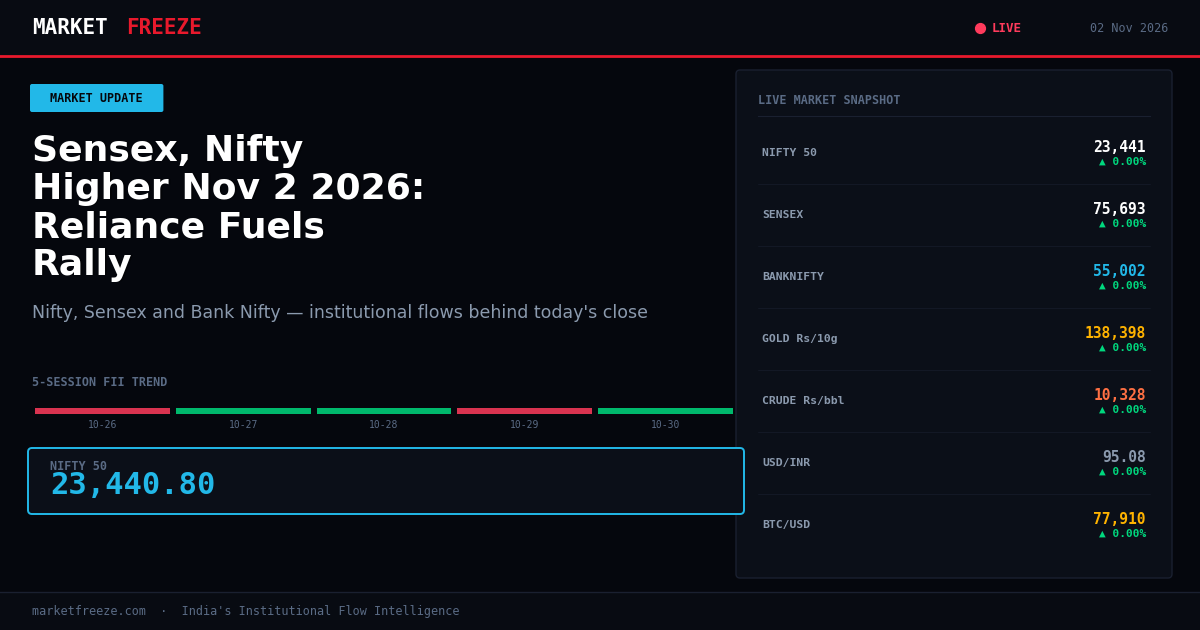
The Nifty 50 closed at 23,440.80, up 1.68%, on November 2, 2026, driven by strong FII inflows, with Foreign Institutional Investors (FIIs) net buying ₹3,598.54 Cr on October 30th, the last trading day for which data is available, indicating a bullish institutional sentiment that underpins the day’s rally led by Reliance Industries and energy stocks.
FIIs Fuel Rally as Reliance Industries Dominates Market Gains
Today’s market surge, with the Nifty 50 closing at 23,440.80 and the Sensex at 75,693.00, finds a direct correlation with the sustained buying by Foreign Institutional Investors (FIIs). The most recent available data from October 30, 2026, shows FIIs as net buyers to the tune of ₹3,598.54 Cr, a significant inflow that directly counters the net selling of ₹817.51 Cr by Domestic Institutional Investors (DIIs) on the same day. This substantial FII commitment highlights institutional confidence, particularly in sectors like energy and heavyweights such as Reliance Industries, which spearheaded the day’s gains. The news of Reliance Industries leading the rally is therefore not just a headline but a reflection of where significant institutional capital is being deployed.
Open a free demat account with
Upstox
or
Angel One
— zero brokerage on delivery trades.
Institutional Footprints: FIIs Net Buyers, DIIs Take a Breather
The market’s upward trajectory today is largely underpinned by institutional buying. On the last reported trading day, October 30, 2026, FIIs injected a substantial ₹3,598.54 Cr into Indian equities, marking a significant net buy. This contrasts with their activity on October 29th, where they were net sellers of ₹943.60 Cr. Conversely, DIIs, who were strong net buyers on October 29th to the tune of ₹1,924.41 Cr, turned net sellers on October 30th, divesting ₹817.51 Cr. This shift suggests a divergence in short-term strategies, with FIIs showing renewed conviction, especially in the broader market indices that closed higher today (Nifty 50 up 1.68%, Sensex up 1.66%). The Bank Nifty, however, saw a more muted gain of 0.58%, indicating that the broad-based strength might be concentrated in sectors other than banking for now.
Sectoral Currents: Energy Surges, IT and Pharma Face Headwinds
The day’s market action, characterized by a Nifty 50 closing at 23,440.80, indicates a clear sectoral divergence. The rally was significantly bolstered by the Energy sector, directly correlating with the news mentioning Reliance Industries’ leadership and the broader energy stock performance. This aligns with FIIs’ substantial net buying of ₹3,598.54 Cr on October 30th, suggesting they are likely overweighting energy-linked counters. In contrast, the IT and Pharma sectors experienced weakness. This could be a tactical reallocation by institutions, with FIIs potentially trimming positions in these historically defensive sectors to chase growth in energy and other cyclicals, especially as crude oil prices (MCX) experienced a significant dip of 7.67% to Rs10,328.00/bbl. The decline in crude prices, while beneficial for energy consumers, can also impact energy producers’ margins, making the strong performance in energy stocks noteworthy and possibly indicative of specific company-specific catalysts or a broader bullish outlook on India’s energy demand irrespective of short-term price fluctuations.
Navigating the Nifty: Support and Resistance from Recent Flows
With the Nifty 50 closing today at 23,440.80, institutional flow data from the last five sessions provides crucial levels. On October 27th, when FIIs were aggressive net buyers of ₹4,240.39 Cr, the Nifty closed at 22,749.75. This indicates a strong buying interest established around this level. Following this, on October 28th, FIIs continued net buying (₹871.83 Cr) as the Nifty moved to 22,936.75. The subsequent sessions, October 29th (FII net sell ₹943.60 Cr) and October 30th (FII net buy ₹3,598.54 Cr), saw the Nifty close at 22,936.75 and 23,053.10 respectively. The strong buying on October 30th, which preceded today’s rally, suggests that levels around 23,050 now act as a crucial support. Resistance can be inferred from the peak activity areas or areas of profit-taking. Given today’s strong close and the bullish FII sentiment, immediate resistance could be around 23,600-23,700, with support firmly established near the 23,050 mark, a level where significant FII inflows were observed.
Currency and Commodity Crossovers: USD/INR Weakens Amidst Equity Strength
The Indian Rupee strengthened today against the US Dollar, with USD/INR closing at Rs95.08, down 0.27%. This appreciation is often a positive indicator for emerging markets and typically coincides with strong foreign inflows, as observed with FIIs being net buyers of ₹3,598.54 Cr on October 30th. The weakening dollar globally, or specific dollar outflows from other markets, could be contributing factors. Concurrently, Crude Oil on MCX saw a substantial decline of 7.67% to Rs10,328.00/bbl. While lower oil prices are generally positive for India’s import bill and inflation, the sharp drop warrants attention. Gold prices on MCX showed a slight uptick of 0.19% to Rs138,398.00/10g, indicating a potential shift towards safe-haven assets, though it is overshadowed by the strong equity market performance and FII inflows.
Historical Echoes: FII Buying Spree and Market Ascents
A relevant historical parallel can be drawn from the FII buying patterns observed in late October 2026. On October 27th, FIIs were significant net buyers (₹4,240.39 Cr), followed by net buying on October 28th (₹871.83 Cr) and a substantial net buy on October 30th (₹3,598.54 Cr). This pattern of consistent FII accumulation, interspersed with days of even higher inflows, has historically preceded market rallies. For instance, the period following October 27th saw the Nifty move from 22,749.75 to 23,053.10 by October 30th, and today’s close at 23,440.80 continues this upward momentum. The narrative of FIIs increasing stakes in Nifty stocks, as reported in the supporting stories, further reinforces this historical context, suggesting that sustained FII inflows are a strong predictor of near-term market strength, particularly for large-cap stocks.
Portfolio Framework: Deploying Capital Amidst FII Momentum
For investors seeking to capitalize on the current FII-driven momentum, a portfolio strategy focusing on sectors with strong institutional backing is advisable. Given the FII net buy of ₹3,598.54 Cr on October 30th, and the news highlighting Reliance Industries and energy stocks, allocating at least 30% of new capital to the Energy and Heavy Industries sectors appears prudent, provided these sectors demonstrate continued institutional accumulation. Additionally, considering the broad market rally, a further 25% could be deployed into large-cap financials and consumer discretionary stocks, areas that typically benefit from economic expansion and increased consumer spending, often favored by FIIs. The remaining capital should be held in cash or short-duration debt instruments (15%) to maintain flexibility, with the remaining 30% allocated to a diversified basket of mid-cap companies exhibiting strong earnings growth and positive institutional interest, as indicated by the supporting story about FIIs increasing stakes in Nifty 50 companies.
Shifting Tides: SEBI’s Tax Proposal as a Potential Catalyst
The outlook for continued institutional inflows, particularly from FIIs, could be significantly influenced by SEBI’s proposed scrapping of Long Term Capital Gains (LTCG) tax on foreign investors. If implemented, this reform could attract substantial foreign capital, further boosting equity markets. The news highlights this proposal alongside a significant drop in crude oil prices (-7.67%), which, while positive for India’s import bill, can be a double-edged sword for energy producers. Should SEBI’s proposal gain traction, it could provide a strong tailwind, potentially pushing the Nifty 50 towards the 24,000 mark. Conversely, any indication of a reversal in FII flows, perhaps driven by global macroeconomic concerns or a failure of the proposed tax reforms, could see the Nifty retesting the 23,000 support level.
| Date | FII Net (Cr) | DII Net (Cr) | Nifty Close |
|---|---|---|---|
| 2026-10-26 | ₹-1,462.49 Cr | +₹2,609.57 Cr | 22,749.75 |
| 2026-10-27 | +₹4,240.39 Cr | ₹-1,250.03 Cr | 22,749.75 |
| 2026-10-28 | +₹871.83 Cr | +₹643.35 Cr | 22,936.75 |
| 2026-10-29 | ₹-943.60 Cr | +₹1,924.41 Cr | 22,936.75 |
| 2026-10-30 | +₹3,598.54 Cr | ₹-817.51 Cr | 23,053.10 |
Frequently Asked Questions
Q: What did FII buy or sell on October 30, 2026?
A: On October 30, 2026, FIIs were net buyers, purchasing equities worth ₹3,598.54 Cr.
Q: What did DII buy on October 29, 2026?
A: On October 29, 2026, DIIs were net buyers, investing ₹1,924.41 Cr in the Indian equity markets.
Q: Is FII buying or selling in November 2026?
A: Based on the available data for October 30, 2026, FIIs showed strong buying momentum, injecting ₹3,598.54 Cr, suggesting a positive start to November, though a complete November trend requires more data.
Key Levels to Watch
With the Nifty 50 closing at 23,440.80, the institutional flows indicate that the 23,050 level, where significant FII buying was observed on October 30th, now serves as a critical support zone. Immediate resistance is anticipated around the 23,600-23,700 range, representing psychological barriers and potential profit-taking zones. A sustained breach above 23,700, supported by continued FII inflows, could signal further upside towards 24,000. Conversely, a dip below 23,050, accompanied by a reversal in FII sentiment, would suggest a potential correction.
Bottom Line
The Indian equity markets, led by the Nifty 50 closing at 23,440.80, are demonstrating robust gains fueled by substantial Foreign Institutional Investor (FII) inflows, most notably ₹3,598.54 Cr on October 30, 2026. This institutional conviction is directly impacting sector performance, with Energy stocks, including Reliance Industries, outperforming, while IT and Pharma face headwinds. The Rupee’s appreciation to Rs95.08 and a sharp decline in crude oil prices to Rs10,328.00/bbl add further layers to today’s market dynamics, all while SEBI’s proposed LTCG tax reforms loom as a potential catalyst for sustained foreign investment.
Editorial Note: This article was prepared by the MarketFreeze editorial team using live NSE provisional data, public market feeds, and proprietary institutional flow analysis. All price and flow figures are sourced directly from NSE, BSE, and CoinGecko as of 02 November 2026. This content is for informational purposes only and does not constitute investment advice. MarketFreeze is not SEBI-registered. Please consult a qualified financial advisor before making investment decisions. Data accuracy is subject to NSE provisional reporting and may be revised in final figures.