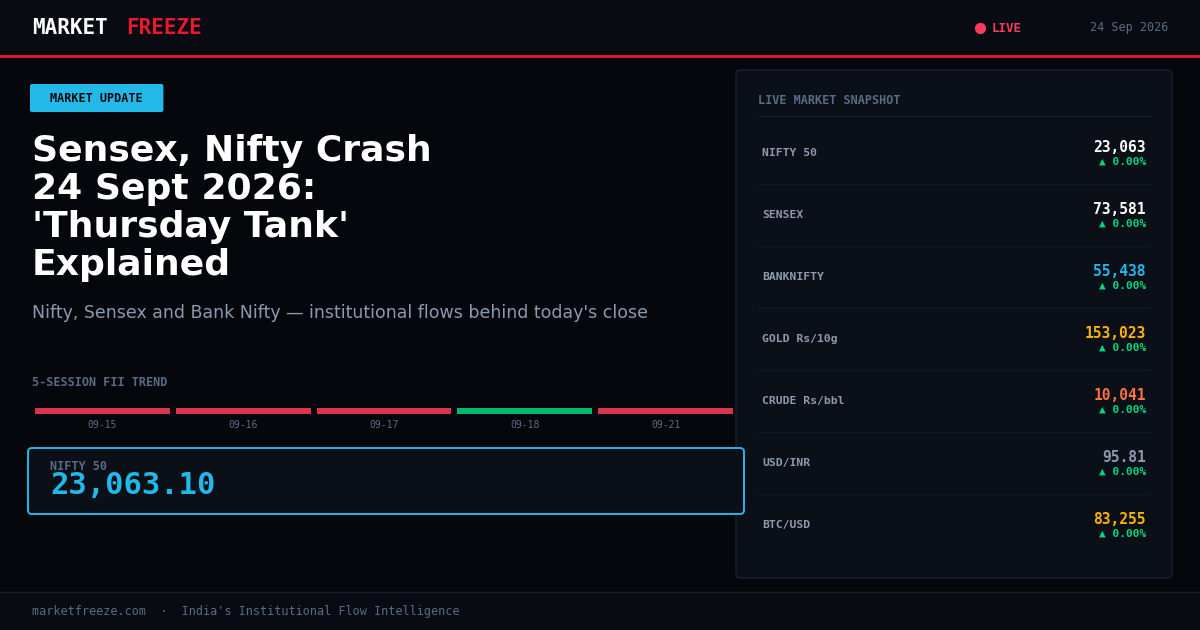
Indian equities experienced a sharp downturn on September 24, 2026, with the Nifty 50 closing down 1.64% at 23,063.10 and the Sensex falling 1.67% to 73,581.00, driven by a confluence of rising global bond yields, elevated crude oil prices, and domestic concerns stemming from proposed changes in insurance commission rules, which saw FIIs net sell ₹576.20 Cr while DIIs remained net buyers with ₹2,797.27 Cr.
Institutional Flows Underscore Flight to Safety Amidst Inflationary Fears
Today’s market plunge, characterized by a “Thursday Tank,” saw both the Nifty 50 and Sensex shed significant ground, reflecting investor anxieties over rising global inflation and potential interest rate hikes. The narrative driving the sell-off – higher crude oil prices (up 1.67% to Rs10,041.00/bbl) and US 30-year bond yields hitting multi-decade highs – directly aligns with Foreign Institutional Investor (FII) behavior, which exhibited net selling of ₹576.20 Cr. This contrasts with Domestic Institutional Investors (DIIs), who continued their buying spree for the third consecutive session, adding ₹2,797.27 Cr, suggesting a divergence in strategy as DIIs potentially absorbed selling pressure, perhaps viewing the dip as a buying opportunity in fundamentally strong assets. The broader market capitalization loss of nearly ₹4-5 lakh crore underscores the extent of today’s broad-based decline.
Open a free demat account with
Upstox
or
Angel One
— zero brokerage on delivery trades.
FIIs Retreat as Bond Yields Spike, DIIs Continue Accumulation
The selling pressure observed today, particularly from FIIs with net sales of ₹576.20 Cr, is consistent with their historical reaction to rising global yields and inflation concerns. Over the last three sessions, FIIs have shown a mixed trend, with significant selling on September 17 (₹3,208.76 Cr) followed by net buying on September 18 (₹599.54 Cr) before today’s retreat. In stark contrast, DIIs have been consistent net buyers across these sessions, accumulating ₹2,797.27 Cr today, ₹1,019.69 Cr on September 18, and a substantial ₹3,617.75 Cr on September 17. This sustained DII buying, even amidst FII outflows and market declines, indicates a strong domestic institutional conviction. The Nifty 50’s closing at 23,063.10 today marks a significant retreat from its recent highs, exacerbated by FII selling. The weakening Rupee, up 0.27% to Rs95.81 against the USD, further compounds import costs and inflationary pressures, likely contributing to FII caution.
Banking and Insurance Sectors Bear the Brunt of Regulatory Uncertainty
The proposed changes to insurance commission rules have cast a long shadow over the banking, financial services, and insurance (BFSI) sector. This regulatory overhang, coupled with the broader market sentiment, led to sharp declines in these segments. Specifically, banks and insurance companies experienced significant selling pressure, impacting the Bank Nifty, which shed 1.96% to close at 55,438.00. While FIIs sold across the board, their particular aversion to the BFSI sector amidst regulatory uncertainty is a key observation. DIIs’ sustained buying, however, might be selectively targeting resilient financial institutions or segments less impacted by these specific rule changes. The extended context of rising bond yields also typically puts pressure on financial institutions due to their large bond portfolios.
Nifty Faces Critical Juncture as Institutional Flows Dictate Short-Term Trend
The Nifty 50’s sharp decline to 23,063.10 today places it at a critical juncture. Based on recent institutional flow patterns, immediate support for the Nifty can be observed around the 22,800-23,000 levels, where DII buying has been robust in previous sessions, particularly around September 15-16, when the index hovered in a similar range before its subsequent rise. Conversely, a sustained breach below 22,800, especially if accompanied by continued FII selling and a weakening global sentiment, could signal further downside towards the 22,500 mark. Resistance is now firmly established around the 23,200-23,400 zone, where significant profit-booking was observed in the preceding days, as evidenced by the Nifty closing around 23,329.00 on September 21 and 23,414.30 on September 18.
US Bond Yield Surge and Crude Oil Volatility Create Global Headwinds
The global macroeconomic backdrop significantly contributed to today’s market weakness. The surge in US 30-year bond yields to their highest levels since 2004, driven by strong US growth data and inflation concerns, is a primary driver of FII caution. This rise in yields makes riskier assets, like Indian equities, less attractive. Concurrently, the steady climb in crude oil prices, which rose 1.67% today to Rs10,041.00/bbl, further fuels inflation fears and increases the current account deficit concerns for India, a net oil importer. This dual pressure from global yields and commodity prices creates a challenging environment for Indian equities, prompting FIIs to reduce their exposure, as seen in today’s net sales.
Historical Parallel: September 2023’s FII Outflow Echoes Today’s Caution
A historical parallel can be drawn to the FII selling seen in mid-September 2023, where substantial outflows occurred, albeit driven by different macro triggers. For instance, on September 17, 2026, FIIs were net sellers of ₹3,208.76 Cr, and the Nifty closed at 23,346.40. While today’s selling volume (₹576.20 Cr) is less severe, the underlying sentiment of caution driven by external factors is similar. In the past, periods of significant FII selling, especially when coupled with rising global yields or inflation concerns, have often preceded market consolidations or corrections. However, the sustained DII buying in today’s session offers a counter-narrative, suggesting domestic institutions are actively supporting the market, a trend that will be crucial to monitor for its sustainability.
Portfolio Strategy: A Defensive Tilt Amidst Rising Volatility
Given the current market environment, characterized by rising global yields, inflation concerns, and sector-specific regulatory headwinds, a defensive portfolio tilt is advisable. Investors should consider increasing allocation to sectors less sensitive to economic cycles and interest rate hikes, such as FMCG and defensive IT services. For investors looking to hold BFSI exposure, a focus on large-cap, well-capitalized banks with strong retail deposit franchises, which are likely to weather the proposed regulatory changes better, is prudent. The current market weakness, with Nifty testing the 23,000 mark, presents an opportunity to rebalance portfolios towards quality assets that offer stable earnings and dividends. Any significant breach of the 22,800 support level on Nifty, especially with increasing FII outflows, would warrant a further reduction in overall equity exposure.
Key Levels to Watch
- Nifty Immediate Support: 22,800 – This level has seen DII buying interest in prior sessions and could offer a floor if tested.
- Nifty Key Resistance: 23,400 – Previous highs and profit-booking zones remain significant hurdles.
- US 30-Year Bond Yield: A sustained move above 5.0% would continue to exert pressure on global equities, including Indian markets.
- Crude Oil Prices: A continued rally above $100/barrel would heighten inflation concerns and impact the INR.
FAQ Section
Q: What did FII buy or sell on 24 September 2026?
A: On September 24, 2026, FIIs were net sellers, offloading shares worth ₹576.20 Cr.
Q: What did DII buy on 24 September 2026?
A: On September 24, 2026, DIIs were net buyers, acquiring equities worth ₹2,797.27 Cr.
Q: Is FII buying or selling in September 2026?
A: In September 2026, FII activity has been mixed, with significant selling on September 15 (₹2,977.86 Cr), September 17 (₹3,208.76 Cr), and September 24 (₹576.20 Cr), interspersed with net buying on September 18 (₹599.54 Cr).
Historical FII/DII Flows
| Date | FII Net (Cr) | DII Net (Cr) | Nifty Close |
|---|---|---|---|
| 2026-09-15 | ₹-2,977.86 Cr | +₹2,686.05 Cr | 23,217.60 |
| 2026-09-16 | ₹-2,032.61 Cr | +₹3,908.23 Cr | 23,270.60 |
| 2026-09-17 | ₹-3,208.76 Cr | +₹3,617.75 Cr | 23,346.40 |
| 2026-09-18 | +₹599.54 Cr | +₹1,019.69 Cr | 23,414.30 |
| 2026-09-21 | ₹-576.20 Cr | +₹2,797.27 Cr | 23,329.00 |
Bottom Line
Today’s market decline was a direct consequence of rising global bond yields and crude oil prices, amplified by domestic regulatory concerns in the insurance sector. FIIs responded with net selling of ₹576.20 Cr, mirroring global risk-off sentiment, while DIIs continued their consistent buying, adding ₹2,797.27 Cr, suggesting resilience in domestic demand. The Nifty 50’s drop to 23,063.10 places immediate support at 22,800, with resistance at 23,400. Investors should adopt a defensive portfolio stance and closely monitor global yield movements and DII buying trends for market direction.
Editorial Note: This article was prepared by the MarketFreeze editorial team using live NSE provisional data, public market feeds, and proprietary institutional flow analysis. All price and flow figures are sourced directly from NSE, BSE, and CoinGecko as of 24 September 2026. This content is for informational purposes only and does not constitute investment advice. MarketFreeze is not SEBI-registered. Please consult a qualified financial advisor before making investment decisions. Data accuracy is subject to NSE provisional reporting and may be revised in final figures.