Indian Equities Retreat as Rising Crude Sparks Inflation Fears; FIIs Extend Selling Streak
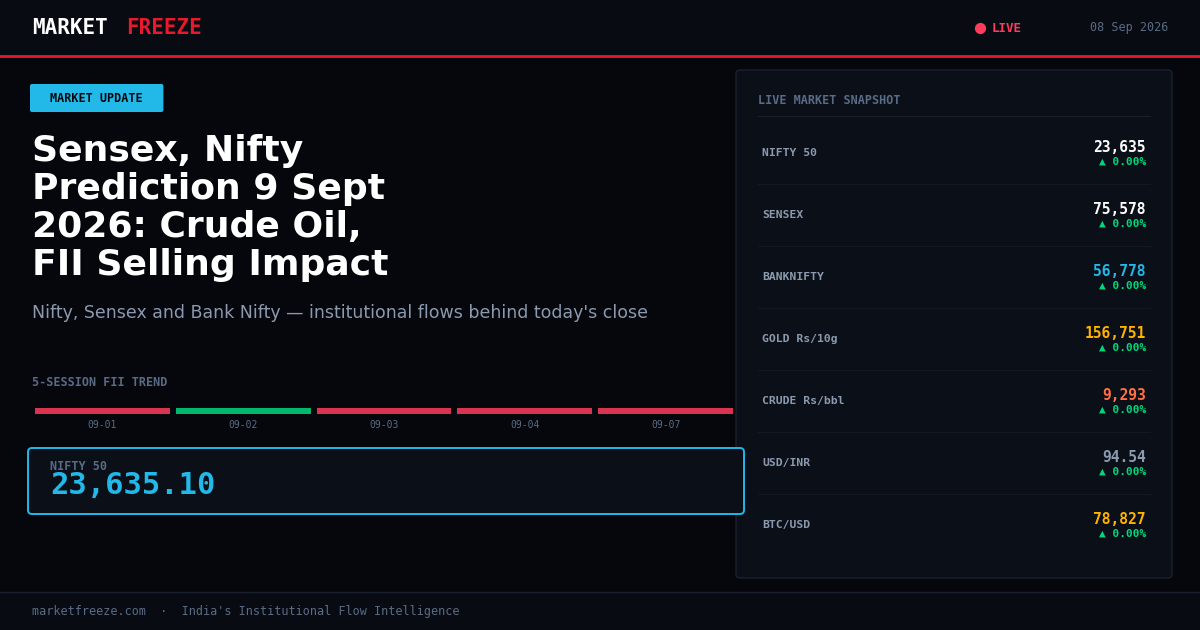
Indian equities saw a broad-based decline on September 8, 2026, with the Nifty 50 shedding 0.61% to close at 23,635.10 and the Sensex dropping 0.73% to 75,578.00, driven by escalating crude oil prices and a lack of domestic catalysts, a move amplified by sustained Foreign Institutional Investor (FII) selling, which stood at ₹3,111.94 Cr in the last session, while Domestic Institutional Investors (DIIs) continued their buying spree, adding ₹8,930.12 Cr.
Open a free demat account with
Upstox
or
Angel One
— zero brokerage on delivery trades.
Crude Oil Surge Fuels Inflationary Concerns, Leading to FII Outflow
The persistent rise in global crude oil prices, evidenced by MCX Crude futures climbing +2.42% to ₹9,323.00/bbl today, has become a primary driver of sentiment in Indian markets. This price escalation is not merely an isolated commodity event; it directly feeds into inflation expectations. The market narrative is increasingly linking higher energy costs to potential policy responses from global central banks, most notably the US Federal Reserve, which could contemplate interest rate hikes to curb inflationary pressures. This anticipated monetary tightening abroad casts a shadow over emerging market equities, making them less attractive for risk-averse foreign capital. Today’s FII net selling of ₹3,111.94 Cr on September 7, following a similar trend of ₹2,345.87 Cr on September 4 and September 3, directly reflects this sentiment. FIIs are preemptively reducing their exposure to riskier assets like Indian equities as the specter of higher interest rates looms, impacting the valuation multiples of companies, especially those with significant debt or operating in cyclical industries. The current FII selling streak, spanning at least the last three sessions for which data is provided, indicates a coordinated institutional response to this macroeconomic shift.
DIIs Counter FII Selling with Robust Buying, Defending Key Levels
While FIIs continue to divest, Domestic Institutional Investors (DIIs) have stepped in as significant buyers, a pattern that has held for the last three reported sessions. On September 7, DIIs were net buyers to the tune of ₹8,930.12 Cr, a substantial counterweight to the FII outflow of ₹3,111.94 Cr. This consistent DII support, which also saw them buying ₹4,977.46 Cr on September 4 and September 3, suggests a divergent view on India’s domestic economic resilience or a strategic rebalancing of portfolios. DIIs, often more attuned to domestic economic fundamentals and long-term growth prospects, may be viewing the current market dip as an accumulation opportunity, particularly in sectors less susceptible to global headwinds. Their aggressive buying has been instrumental in preventing a sharper decline in the indices, acting as a crucial buffer against foreign outflows. This dichotomy in institutional flow – FII selling versus DII buying – is a critical indicator of market sentiment and directional bias.
Sectoral Headwinds and Resilience Amidst Geopolitical Tensions
The escalating crude oil prices and the resultant inflation fears are creating distinct sectoral impacts. The Oil & Gas sector, while directly benefiting from higher crude prices, faces the dual pressure of potential government intervention to control consumer fuel prices and a broader market sentiment shift. Conversely, sectors reliant on discretionary consumer spending or those with significant input costs sensitive to energy prices, such as Automobiles and Consumer Durables, are likely to face headwinds. The increasing cost of logistics and manufacturing, directly linked to fuel prices, will put pressure on margins. The Financials sector, particularly banks, could see a mixed impact. While higher interest rates could potentially improve net interest margins in the long run, near-term concerns about asset quality due to slower economic growth and higher borrowing costs for consumers could weigh on sentiment. However, DII’s continued buying in banking stocks, evident in their persistent net purchases, suggests they are looking past short-term volatility. The broader indices, including the Nifty Midcap 100 and Nifty Smallcap 100, showing slight recovery of +0.21% and +0.17% respectively, indicate that pockets of the market are exhibiting resilience, possibly driven by domestic demand and specific sector tailwinds not directly tied to crude oil.
FII/DII Flow Table: Last 5 Trading Sessions
| Date | FII Net (Cr) | DII Net (Cr) | Nifty Close |
|---|---|---|---|
| 2026-09-01 | ₹-7,985.88 Cr | +₹4,588.88 Cr | 24,055.80 |
| 2026-09-02 | +₹1,143.38 Cr | +₹1,846.94 Cr | 23,914.45 |
| 2026-09-03 | ₹-2,345.87 Cr | +₹4,977.46 Cr | 23,873.45 |
| 2026-09-04 | ₹-2,345.87 Cr | +₹4,977.46 Cr | 23,897.70 |
| 2026-09-07 | ₹-3,111.94 Cr | +₹8,930.12 Cr | 23,779.15 |
USD/INR Crosses ₹94.50 as Global Factors Tighten Grip
The Indian Rupee (USD/INR) weakened against the US dollar, trading at Rs94.54, marking a +0.41% move today. This depreciation is a direct consequence of the prevailing global economic uncertainty, exacerbated by rising crude oil prices. Higher crude prices not only increase India’s import bill, thereby straining the current account deficit and weakening the rupee, but also signal potential inflationary pressures that could lead to higher interest rates globally. While the Reserve Bank of India’s (RBI) dollar sales and inflows under special schemes have historically provided some support, the sheer force of the macro headwinds appears to be overwhelming these measures. The current level of Rs94.54 indicates a weakening trend that, if sustained, could further dampen investor sentiment, especially for foreign portfolio investors who repatriate earnings in dollars. The rupee’s movement is a critical barometer of external financial flows and economic stability.
Nifty Levels: Support at 23,500, Resistance at 23,800 Based on Recent Flow Patterns
Analyzing the recent flow data, particularly the sustained DII buying activity around the 23,700-23,900 Nifty levels in the last week, suggests a floor of support. The significant DII net buys of ₹8,930.12 Cr on September 7 and ₹4,977.46 Cr on September 3 and 4, at Nifty closing levels of 23,779.15 and 23,873.45 respectively, indicate institutional commitment to these price points. Therefore, the 23,500 mark emerges as a crucial support level. Any sustained dip below this level without commensurate DII buying would signal a potential capitulation. On the resistance side, the FII selling pressure observed as the Nifty moved above 23,900 in earlier sessions suggests that the 23,800-24,000 zone could act as a ceiling. The consistent FII outflows, totaling ₹3,111.94 Cr on September 7 and ₹2,345.87 Cr for the prior two sessions, imply a reluctance to build long positions at higher levels. Thus, a decisive move above 23,800 would require a significant reversal in FII sentiment or a strong catalyst to break through this perceived resistance.
Historical Parallel: Inflation Fears and FII Sell-offs in Q4 2023
A historical parallel can be drawn to the market behavior observed in late Q4 2023. During that period, concerns over persistent global inflation, coupled with hawkish commentary from major central banks, led to a significant increase in FII outflows from emerging markets, including India. Specifically, in November 2023, FIIs offloaded equities worth over ₹20,000 Cr net over a two-week period as inflation data remained stubbornly high and interest rate hike expectations solidified. This triggered a market correction where the Nifty saw a decline of approximately 5% from its peak. The current scenario, with crude oil acting as a primary inflation trigger and the USD/INR pair showing renewed strength, bears a striking resemblance. The DII buying, while strong, was not enough to fully offset FII selling in November 2023 when the macro fears were acute. This suggests that if the current inflationary trend persists and central banks adopt a more aggressive stance, the current DII support might eventually be tested, leading to a deeper correction.
Portfolio Framework: Hedging Against Inflationary Shocks
For investors looking to navigate the current market environment, a tactical portfolio adjustment is warranted. Given the rising inflation risks and potential for higher interest rates, consider reducing exposure to highly leveraged companies and those with significant input cost sensitivities. Specifically, allocate no more than 10% of your equity portfolio to sectors like capital-intensive manufacturing or consumer discretionary names where margin compression is likely. Conversely, increase allocation to sectors that are historically more resilient during inflationary periods or benefit from elevated commodity prices. This could include companies with strong pricing power, such as select FMCG players with established brands, or those directly linked to commodity cycles, provided they are not purely speculative plays. A minimum allocation of 15% to Gold ETFs or digital gold could serve as a hedge against currency depreciation and broader inflation. Ensure your overall equity exposure remains within your risk tolerance, and consider dollar-cost averaging into quality stocks on dips, particularly those favored by DIIs.
What Changes This Outlook: A Decisive Shift in Fed Policy Stance
The most critical factor that could alter the current market outlook is a definitive signal from the US Federal Reserve regarding its monetary policy trajectory. If upcoming inflation data in the US shows a significant and sustained deceleration, prompting the Fed to signal a pause or even a pivot away from further rate hikes, it would dramatically improve the risk appetite for emerging market equities. Conversely, any indication from the Fed, or indeed other major central banks like the ECB, that they are prepared to tolerate higher inflation to avoid a recession, or conversely, that they will aggressively hike rates, would exacerbate the current selling pressure. For India, a sustained move in USD/INR above Rs95.00 would also be a significant warning sign, indicating that external pressures are overwhelming domestic stabilizers and potentially forcing the RBI into more aggressive intervention, which could have its own economic implications.
Frequently Asked Questions
Q: What did FII buy or sell on September 7, 2026?
A: FIIs were net sellers of ₹3,111.94 Cr on September 7, 2026.
Q: What did DII buy on September 7, 2026?
A: DIIs were net buyers of ₹8,930.12 Cr on September 7, 2026.
Q: Is FII buying or selling in September 2026?
A: FIIs have been net sellers in September 2026, with consistent outflows observed in the initial trading sessions for which data is available.
Key Levels to Watch for Nifty
Support: 23,500 (Based on recent DII accumulation levels)
Resistance: 23,800 (Indicative of FII selling pressure at higher price points)
Bottom Line
Indian markets succumbed to rising crude oil prices on September 8, 2026, leading to a 0.61% drop in the Nifty 50. This downturn was mirrored by sustained FII selling, totaling ₹3,111.94 Cr in the last session, as global inflation fears intensified. However, robust DII buying, amounting to ₹8,930.12 Cr, provided a cushion, signaling divergent institutional views. The weakening Rupee to Rs94.54 against the USD further underscores the external pressures impacting Indian equities.
Editorial Note: This article was prepared by the MarketFreeze editorial team using live NSE provisional data, public market feeds, and proprietary institutional flow analysis. All price and flow figures are sourced directly from NSE, BSE, and CoinGecko as of 08 September 2026. This content is for informational purposes only and does not constitute investment advice. MarketFreeze is not SEBI-registered. Please consult a qualified financial advisor before making investment decisions. Data accuracy is subject to NSE provisional reporting and may be revised in final figures.