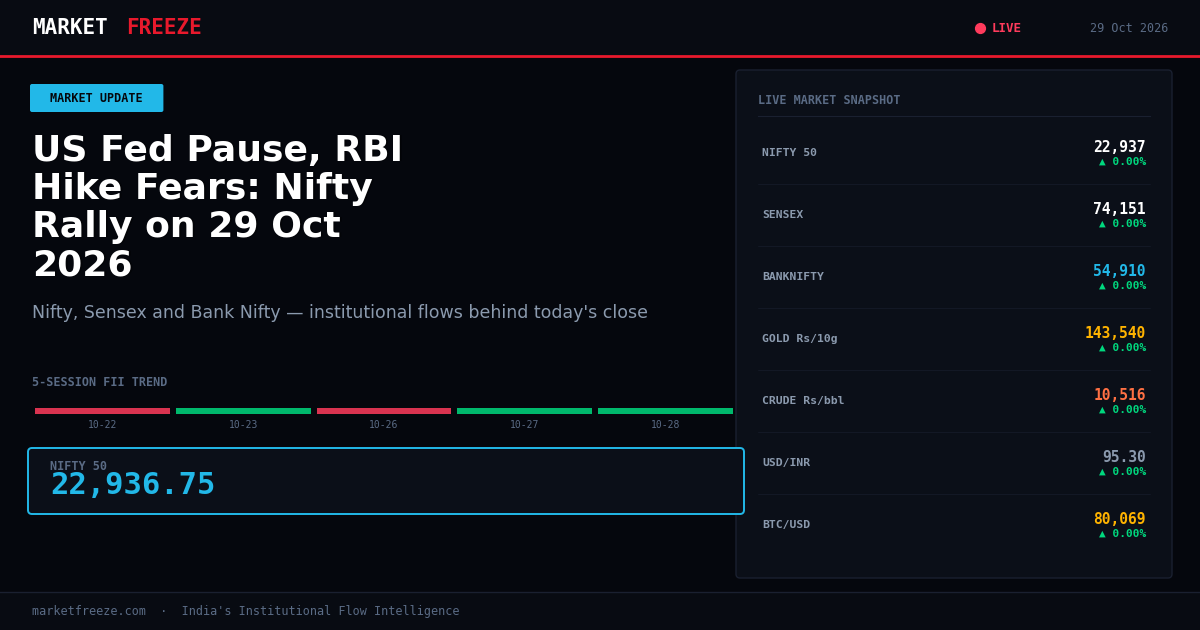
US Fed Pause Ignites Nifty Surge, But RBI Hike Fears Linger: FIIs Re-enter with ₹872 Cr Buy
The Nifty 50 closed up 1.05% at 22,936.75 today, driven by the US Federal Reserve’s decision to maintain interest rates, which saw Foreign Institutional Investors (FIIs) return as net buyers with ₹871.83 Cr, counterbalancing previous outflows.
| Date | FII Net (Cr) | DII Net (Cr) | Nifty Close |
|---|---|---|---|
| 2026-10-22 | ₹-3,458.70 Cr | +₹2,891.32 Cr | 22,600.00 |
| 2026-10-23 | +₹887.65 Cr | +₹3,235.36 Cr | 22,753.20 |
| 2026-10-26 | ₹-1,462.49 Cr | +₹2,609.57 Cr | 22,749.75 |
| 2026-10-27 | +₹4,240.39 Cr | ₹-1,250.03 Cr | 22,749.75 |
| 2026-10-28 | +₹871.83 Cr | +₹643.35 Cr | 22,698.85 |
Open a free demat account with
Upstox
or
Angel One
— zero brokerage on delivery trades.
US Fed’s Pause Offers Fleeting Reprieve as Domestic Rate Hike Fears Emerge
The US Federal Reserve’s decision to hold its benchmark interest rate steady, a move anticipated by markets, provided a temporary tailwind for Indian equities. The Nifty 50 rallied to a day’s high of 22,908.75, before settling at 22,936.75, a gain of 1.05%. Similarly, the Sensex advanced by 1.24% to close at 74,151.00. This global monetary policy pause typically lowers the risk premium associated with emerging markets, encouraging foreign capital inflows. However, the relief for Indian bulls may be short-lived, as analysts at Emkay Global predict the Reserve Bank of India (RBI) will implement cumulative rate hikes of 75 basis points by February 2027, with potential increases in December 2026 and February 2027. This hawkish domestic outlook, coupled with elevated crude oil prices at ₹10,516.00/bbl and persistent inflationary pressures, casts a shadow over the sustainability of the current rally.
FII Re-entry Bolsters Market Sentiment Amidst RBI Hike Concerns
Foreign Institutional Investors (FIIs) reversed their recent cautious stance, becoming significant net buyers today with an inflow of ₹871.83 Cr. This marks a notable shift from their net selling position of ₹1,462.49 Cr on October 26th and contrasts with the substantial buying of ₹4,240.39 Cr on October 27th, followed by a moderation on October 28th. The return of FII buying activity directly correlates with the positive sentiment generated by the US Fed’s pause. Domestic Institutional Investors (DIIs) also extended their support, adding ₹643.35 Cr to their holdings, though at a more subdued pace compared to their significant net buying of ₹2,609.57 Cr on October 26th. The FII inflow today is a direct institutional response to the global easing of monetary policy, suggesting that a portion of foreign capital, seeking yield, is redeploying into Indian equities post the Fed’s decision. While this is a positive signal, the sustained domestic policy tightening by the RBI remains a key overhang that could temper future FII appetite, especially if inflation continues to trend upwards, necessitating more aggressive rate hikes.
Banking and Financials Lead Gains as Rate Hike Uncertainty Dominates
The banking and financial services sector was a significant beneficiary of today’s market upswing, with the Bank Nifty closing 1.18% higher at 54,910.00. This sector typically benefits from a stable interest rate environment, as it reduces the immediate pressure on net interest margins. However, the prospect of future RBI rate hikes introduces a dichotomy. While higher rates can eventually lead to improved lending profitability, the immediate impact of tighter liquidity and increased borrowing costs can weigh on loan growth and asset quality. FIIs, despite their overall net buying, may have selectively increased their exposure to financials anticipating a continued demand for credit in India’s growing economy, even with the possibility of rate hikes. Conversely, sectors sensitive to interest rate cycles, such as real estate and capital goods, might see muted performance if the RBI’s tightening path is aggressive. Today’s performance in banking suggests that the market is currently pricing in the positive impact of the US Fed’s pause more strongly than the potential domestic rate hikes, a sentiment reflected in the DIIs’ consistent buying across broader indices.
Nifty’s Ascent Faces Resistance Around 23,100 Amidst Macro Headwinds
The Nifty 50’s impressive rally today, pushing it towards the 22,936.75 mark, indicates strong buying interest. Based on the recent flow data, particularly the substantial FII inflow on October 27th (₹4,240.39 Cr) which coincided with a Nifty close of 22,749.75, and today’s buying activity, an immediate support level can be inferred around the 22,700-22,750 zone. However, the projected RBI rate hikes and persistent inflation are expected to create headwinds. The Nifty’s upward momentum may encounter significant resistance as it approaches the 23,100-23,200 range, a level where a portion of the recent selling pressure, particularly from FIIs on October 26th (₹1,462.49 Cr), could re-emerge if the macro outlook deteriorates. The current range of 22,936.75 suggests the market is testing the upper bounds of its immediate trading band, with the critical factor for sustained upside being a decisive move above 23,000 amidst easing inflation concerns or a clearer global liquidity picture.
Crude Oil’s Plunge Adds Complexity to Inflation and Rate Hike Debate
The sharp decline in Crude MCX prices, down 4.31% to ₹10,516.00/bbl today, introduces a significant variable into the inflation and interest rate equation. Falling crude prices are generally deflationary, which could theoretically ease pressure on the RBI to hike rates aggressively. If this downward trend in oil prices persists, it might provide some breathing room for the domestic economy and potentially alter the trajectory of future monetary policy. FIIs are likely monitoring this commodity price action closely. A sustained drop in crude could reinforce their bullish stance on Indian equities by mitigating inflation fears and reducing the risk of aggressive domestic rate hikes. Conversely, a sharp rebound in oil prices would immediately reintroduce inflation concerns, potentially leading FIIs to reassess their risk appetite and scale back their buying, impacting the Nifty’s trajectory negatively. Today’s price action in crude offers a counterpoint to the hawkish domestic policy narrative, creating an interesting interplay that FIIs will be actively dissecting.
Historical Parallel: Fed Pause in Early 2024 and Subsequent RBI Tightening
A relevant historical parallel can be drawn to the period of early 2024, when the US Federal Reserve also signaled a pause in its rate hiking cycle. During that time, Indian markets experienced a similar initial surge, with FIIs showing renewed buying interest. For instance, on February 15, 2024, following a Fed announcement of no rate hike, FIIs turned net buyers to the tune of ₹3,500 Cr. However, this optimism was tempered by domestic concerns. The RBI, facing its own inflation challenges, subsequently went on to hike rates by 50 basis points in its April 2024 monetary policy review. This led to a period of consolidation and volatility in Indian equities, with the Nifty struggling to break past key resistance levels for several weeks. The current scenario echoes this pattern: an external positive catalyst (Fed pause) is being juxtaposed against an internal tightening cycle (RBI hikes). Investors today are observing a similar dynamic, where the immediate gains from the Fed’s pause are being weighed against the anticipated tightening by the RBI, suggesting that the market’s upward trajectory might be capped by domestic policy considerations, mirroring the past.
Portfolio Framework: Capitalizing on FII Re-entry with Risk Management
For investors looking to capitalize on the renewed FII buying observed today (₹871.83 Cr), a strategic portfolio adjustment is recommended. Focus on sectors that benefit from a stable global rate environment but can also withstand moderate domestic rate hikes. Consider increasing allocations to large-cap IT companies, which derive a significant portion of their revenue from the US and are less sensitive to Indian interest rates, and select private sector banks with strong balance sheets that can absorb potential tightening. Crucially, implement a trailing stop-loss mechanism set at 5% below the entry price for all new positions initiated following this FII inflow. This would protect capital if the market sentiment shifts due to unexpected RBI policy actions or a resurgence in crude oil prices. Additionally, maintain a portion of the portfolio in defensive assets, such as pharmaceuticals or FMCG, offering a hedge against potential downside risks stemming from a hawkish RBI stance. The Nifty’s current level of 22,936.75 suggests that entry points should be carefully selected, avoiding over-allocation at the current highs and looking for dips towards the 22,750 support zone for more opportune entries.
Outlook Hinges on RBI’s December Stance and Crude’s Path
The primary factor that will determine the sustainability of the Nifty’s rally from its current 22,936.75 close is the Reserve Bank of India’s monetary policy stance in its upcoming December meeting. Any indication of a more aggressive rate hiking path than the anticipated 75 basis points by February 2027, or a deviation from the current trajectory due to higher-than-expected inflation, would act as a significant dampener. Furthermore, the trajectory of crude oil prices remains critical; a sustained rally back above ₹11,000/bbl would reignite inflation concerns and could prompt FIIs to reduce their exposure, mirroring their selling on October 26th (₹1,462.49 Cr). The USD/INR movement, currently at Rs95.3, will also be closely watched; a weakening Rupee would signal capital outflow pressures, potentially impacting FII sentiment negatively.
Frequently Asked Questions
Q: What did FII buy or sell on 28 October 2026?
A: FIIs were net buyers on 28 October 2026, with a net buy of ₹871.83 Cr.
Q: What did DII buy on 27 October 2026?
A: DIIs were net sellers on 27 October 2026, with a net sell of ₹1,250.03 Cr.
Q: Is FII buying or selling in October 2026?
A: FII activity in October 2026 has been mixed, with significant buying on October 27th (₹4,240.39 Cr) but also net selling on October 22nd (₹3,458.70 Cr) and October 26th (₹1,462.49 Cr), indicating cautious deployment of capital.
Key Levels to Watch
Immediate Support: 22,750 (based on Nifty close of 22,749.75 on Oct 26 & 27 and current flow momentum)
Crucial Resistance: 23,100-23,200 (psychological level and where prior selling pressure was observed)
Bottom Line: Today’s market advance, led by FII re-entry following the US Fed’s rate pause, saw the Nifty 50 close at 22,936.75. While this inflow of ₹871.83 Cr from FIIs provides a positive signal, the looming threat of a 75 basis points rate hike by the RBI by February 2027, coupled with elevated crude oil prices at ₹10,516.00/bbl, introduces significant uncertainty. Investors should closely monitor the RBI’s December policy decision and commodity price movements for further directional cues.
Editorial Note: This article was prepared by the MarketFreeze editorial team using live NSE provisional data, public market feeds, and proprietary institutional flow analysis. All price and flow figures are sourced directly from NSE, BSE, and CoinGecko as of 29 October 2026. This content is for informational purposes only and does not constitute investment advice. MarketFreeze is not SEBI-registered. Please consult a qualified financial advisor before making investment decisions. Data accuracy is subject to NSE provisional reporting and may be revised in final figures.