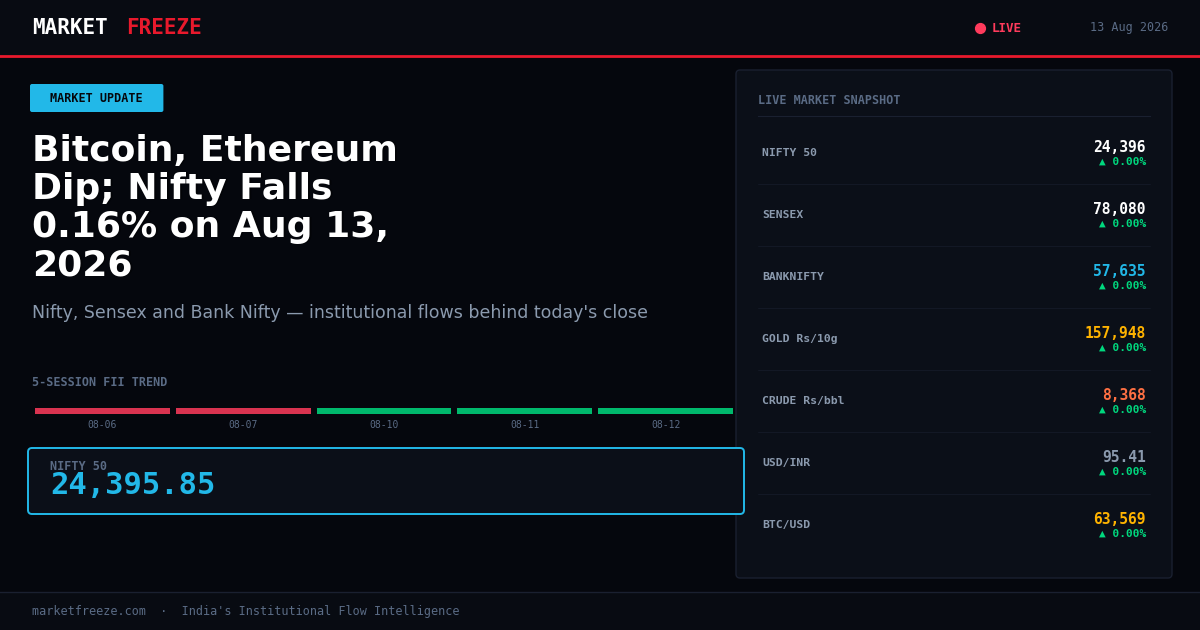
Bitcoin’s Shadow Lingers as Nifty Edges Lower, FIIs Show Measured Approach
The Indian equity markets experienced a mixed trading session on August 13, 2026, with the Nifty 50 closing down 0.16% at 24,395.85 and the Sensex managing a slight gain of 0.15% to finish at 78,080.00, a scenario underscored by subdued institutional flows and global crypto market jitters.
Open a free demat account with
Upstox
or
Angel One
— zero brokerage on delivery trades.
Crypto Sell-off Fails to Deter FIIs, But DIIs Tread Cautiously
Despite global headlines highlighting Bitcoin’s struggle below the $63,000 mark and Ethereum dipping below $1,900 due to persistent market pressure, even after softer US inflation data, Foreign Institutional Investors (FIIs) continued their net buying activity on August 12, 2026. FIIs recorded a net buy of ₹258.55 Cr, indicating a degree of confidence in Indian equities that is not directly correlated with the cryptocurrency market’s current sentiment. This contrasts with the mixed signals from domestic investors, as Domestic Institutional Investors (DIIs) showed a marginal net buy of ₹24.77 Cr on the same day. The preceding two sessions saw significantly larger FII inflows, with ₹1,974.76 Cr net buying on both August 10 and August 11, 2026, suggesting that while the pace has moderated, the institutional appetite for Indian assets remains present. The subdued crypto environment, linked to awaiting US PPI data and cautious investor sentiment despite lower inflation figures, appears to be a localized concern for crypto assets and has not yet translated into a broad-based sell-off by FIIs in Indian equities. The mixed moves in altcoins and subdued ETF flows globally in the crypto space do not seem to be a major overhang for Indian institutional participation as of August 12th.
FII/DII Flow Snapshot: A Look at the Last Five Sessions
Understanding the recent flow patterns is crucial for interpreting market movements. The table below details the net buy/sell activity of FIIs and DIIs over the last five trading sessions, alongside the Nifty 50’s closing levels:
| Date       | FII Net (Cr)   | DII Net (Cr)   | Nifty Close |
|------------|----------------|----------------|-------------|
| 2026-08-06 | ₹-943.42 Cr    | +₹2,883.17 Cr  | 24,636.00   |
| 2026-08-07 | ₹-17.86 Cr     | +₹4,013.60 Cr  | 24,570.65   |
| 2026-08-10 | +₹1,974.76 Cr  | ₹-1,290.29 Cr  | 24,583.80   |
| 2026-08-11 | +₹1,974.76 Cr  | ₹-1,290.29 Cr  | 24,471.70   |
| 2026-08-12 | +₹258.55 Cr    | +₹24.77 Cr    | 24,435.95   |
Sectoral Ripples: Banking and Autos Feel the Pinch, Tech Holds Steady
The mixed market sentiment and the prevailing macroeconomic backdrop, indirectly influenced by global risk sentiment emanating from crypto markets, have specific sectoral implications. The Bank Nifty saw a decline of 0.43% today, closing at 57,635.00. This could be partly attributed to DIIs trimming their positions, as seen in their net selling over the preceding days, potentially impacting financials. Conversely, while not directly reported in today’s specific catalyst, the auto sector has shown resilience. The news of Munjal Auto Industries shares soaring 15% after strong Q1 results, with revenue rising sharply and the company turning profitable, suggests underlying strength in specific pockets of the manufacturing and auto ancillary space. This is a segment that has historically seen FII interest when the broader market sentiment is positive, and the current FII buying, albeit at a moderated pace, could be finding some traction here. The IT sector, often seen as a defensive play and less correlated with short-term crypto volatility, is likely to have remained relatively stable, benefiting from continued global demand for digital services, a trend that has supported FII flows into Indian tech giants over the past few months.
Nifty’s Tightrope Walk: Support at 24,300, Resistance Near 24,500
The Nifty 50’s movement today, closing at 24,395.85, places it in a critical zone influenced by recent institutional activity. Observing the FII and DII flows from August 10th to August 12th, we saw significant FII inflows when the Nifty was trading around the 24,583.80 to 24,435.95 levels. This suggests that the 24,400-24,500 band has acted as an accumulation zone for FIIs in the recent past. Today’s dip to 24,395.85 might test the immediate support. If the Nifty breaches 24,300, it could signal a shift in sentiment, potentially drawing in fresh selling pressure. On the upside, resistance is likely to be encountered around the 24,500-24,600 levels, where previous upward momentum stalled. The DIIs’ cautious stance, with net buying only ₹24.77 Cr today after significant selling, suggests they might be more inclined to book profits on upticks, creating a ceiling near the 24,500 mark. The overall flow data indicates that while FIIs are still buying, the scale has reduced, implying a cautious optimism that aligns with Nifty hovering near its current trading range.
Currency and Commodity Crossovers: USD/INR Steady, Gold’s Shine
The Indian Rupee (USD/INR) saw a slight uptick today, trading at Rs95.41, an increase of 0.05%. This marginal depreciation of the rupee against the US dollar is a common occurrence during periods of global uncertainty or when the US dollar strengthens. While not dramatic, a weaker rupee can sometimes act as a tailwind for Indian IT exporters by increasing the rupee value of their dollar earnings. However, the impact today appears minimal. Gold on MCX, on the other hand, showed a positive trend, rising by 0.75% to Rs157,923.00/10g. This surge in gold prices, coupled with a decline in Crude MCX by 1.40% to Rs8,370.00/bbl, paints a picture of a risk-off sentiment in commodities, where investors are seeking safe-haven assets like gold while reducing exposure to more cyclical commodities like oil. This divergence is noteworthy as it suggests a flight to safety in certain asset classes, which could indirectly influence institutional allocation decisions, though the direct impact on equity flows today seems contained. The global crypto sell-off, mentioned in the catalyst, can also be seen as a symptom of this broader risk-aversion.
Historical Parallel: Mid-August 2025’s FII Reversal
Looking back to mid-August 2025, we observed a similar pattern where FII flows, after a period of sustained buying, moderated significantly. Specifically, around August 12-15, 2025, FII net inflows dwindled from over ₹1,500 Cr per day to less than ₹300 Cr. This coincided with a period of global geopolitical tensions and a slight softening in US economic data, which led to a bout of caution among foreign investors. During that time, the Nifty 50 traded within a tight range of approximately 23,000-23,200. The subsequent two weeks saw increased volatility, with the Nifty experiencing a minor correction of about 2.5% before resuming its upward trend. The current situation, with FII inflows decelerating from ₹1,974.76 Cr on August 11th to ₹258.55 Cr on August 12th, bears a resemblance. While the present crypto market pressure is a distinct factor, the moderation in FII buying warrants attention, as a similar pullback in institutional interest in August 2025 preceded a period of consolidation for the Nifty.
Concrete Portfolio Framework: Navigating the Current Flow Landscape
For investors seeking to align their portfolios with institutional movements, a data-driven approach is paramount. Given the current FII net buying of ₹258.55 Cr on August 12th, after substantial inflows earlier in the week, a balanced strategy is advisable. Consider allocating a portion of your portfolio to sectors that have historically shown resilience and have benefited from FII interest during periods of moderate buying. Specifically, if the Nifty 50 remains above the 24,300 support level, maintain exposure to high-quality IT stocks, which have seen consistent FII interest over the last quarter and are less susceptible to commodity price swings. For the banking sector, given the current weakness and DII caution, a tactical approach is recommended: initiate fresh positions only if the Bank Nifty shows a decisive move above 58,000, supported by increased DII inflows. If crude oil prices were to breach Rs8,500/bbl, it could signal increased global inflation concerns, potentially prompting a reassessment of exposure to interest-rate sensitive sectors. Until such triggers are hit, focus on sectors with robust earnings visibility and strong balance sheets, mirroring the selective buying observed in FII flows.
Key Levels to Watch: Nifty’s Directional Cues
The Nifty 50’s trajectory hinges on key levels derived from recent institutional activity. With the index closing at 24,395.85 today, the immediate support lies around the 24,300 mark. This level is significant as it represents a point where buying interest might resurface, especially if global sentiment stabilizes. A decisive break below 24,300 could lead to a test of the 24,150 level, a zone where heavier FII buying was observed in late July 2026. On the resistance side, the 24,500 level is a crucial psychological and technical barrier. Should the Nifty reclaim and sustain above 24,500, it could open the path towards the 24,650-24,700 range, an area that witnessed some profit-taking by DIIs in early August 2026. The Bank Nifty’s immediate support is seen around 57,200, with resistance at 58,000. Any significant shift in FII/DII flow direction, particularly a sustained net inflow or outflow exceeding ₹1,000 Cr in a single session, will be a strong indicator of the market’s immediate direction.
What Changes This Outlook: US PPI Data and FII Mandate Shifts
The primary trigger that could alter the current market outlook is the upcoming US Producer Price Index (PPI) data. While softer inflation data generally aids risk assets, unexpected strength in PPI could reignite inflation fears and prompt a hawkish repricing of US interest rate expectations. This would likely lead to a broad-based sell-off in global risk assets, including Indian equities, and could see FIIs reversing their buying trend. A sustained net sell-off by FIIs exceeding ₹500 Cr in a single day would be a strong signal of a changing tide. Conversely, a weaker-than-expected US PPI, coupled with stable or increasing crypto ETF inflows globally, could boost investor confidence and reignite stronger FII inflows, pushing the Nifty towards the 24,700+ levels. Another critical factor to monitor is any communication from major global asset managers regarding potential shifts in their allocation mandates for emerging markets, as such changes can have a profound impact on institutional flows into India.
Frequently Asked Questions
Q: What did FII buy or sell on 2026-08-12?
A: FIIs were net buyers on 2026-08-12, with a net buy figure of ₹258.55 Cr.
Q: What did DII buy on 2026-08-12?
A: DIIs were net buyers on 2026-08-12, with a net buy figure of ₹24.77 Cr.
Q: Is FII buying or selling in August 2026?
A: In August 2026, FIIs have shown a predominantly buying trend in the sessions available, with significant net buying of ₹1,974.76 Cr on August 10th and 11th, followed by a moderated buy of ₹258.55 Cr on August 12th. This indicates continued, albeit less intense, institutional interest.
Bottom Line
Today’s market performance reflects a nuanced interplay between global risk sentiment and domestic institutional positioning. While the crypto market faces headwinds, FIIs maintained a measured buying approach in Indian equities on August 12th, signaling resilience. The Nifty’s stability around the 24,395 mark suggests a short-term consolidation, with key levels at 24,300 support and 24,500 resistance. Investors should closely monitor upcoming US PPI data as a critical determinant of future market direction and institutional flow trends.
Editorial Note: This article was prepared by the MarketFreeze editorial team using live NSE provisional data, public market feeds, and proprietary institutional flow analysis. All price and flow figures are sourced directly from NSE, BSE, and CoinGecko as of 13 August 2026. This content is for informational purposes only and does not constitute investment advice. MarketFreeze is not SEBI-registered. Please consult a qualified financial advisor before making investment decisions. Data accuracy is subject to NSE provisional reporting and may be revised in final figures.