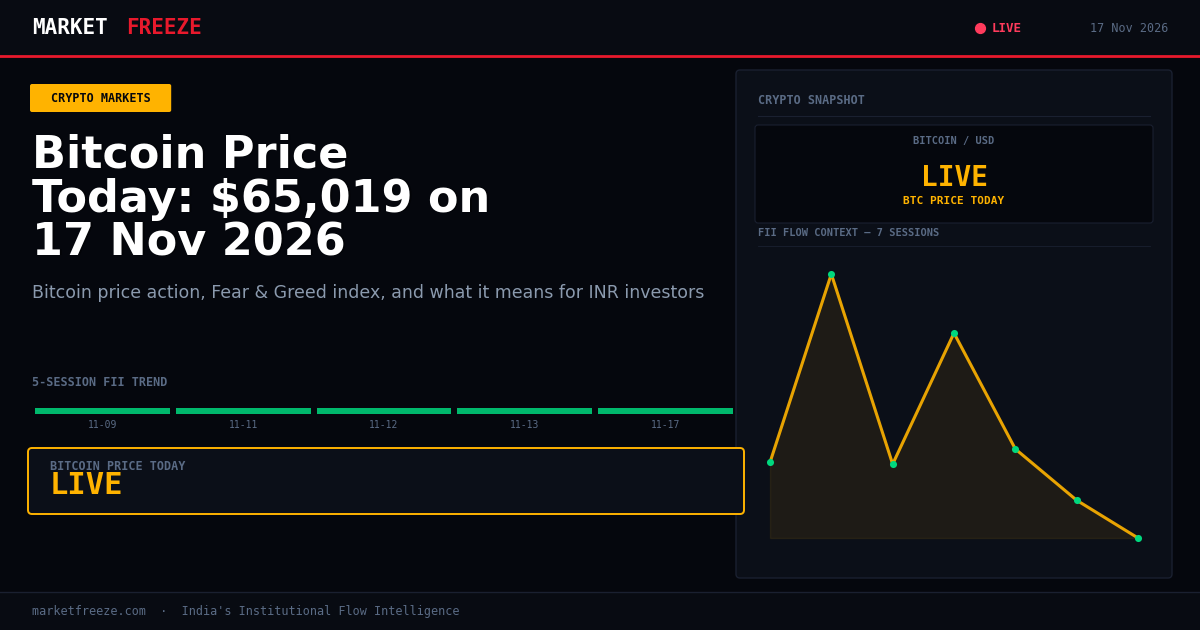
Bitcoin is trading at $65,019 USD, equivalent to ₹6,109,185 INR, marking a +1.39% increase over the last 24 hours. Today’s price action is unfolding against a backdrop of significant developments in the digital asset space, with Ethereum’s upcoming ‘Glamsterdam’ upgrade raising concerns about compatibility issues for automated applications, potentially impacting up to 15,000 dApps. This news, coupled with a deeply fearful market, presents a complex picture for crypto investors looking to navigate the current landscape.
Open a free demat account with
Upstox
or
Angel One
— zero brokerage on delivery trades.
Ethereum’s Upgrade Risks Spark Caution Amidst Broader Market Fear
Ethereum, currently priced at $1,823 USD (₹171,289 INR), has seen a +1.35% uptick in the past 24 hours. The digital asset, however, faces potential headwinds from its upcoming ‘Glamsterdam’ upgrade. Reports indicate that this upgrade carries the risk of disrupting as many as 15,000 automated applications. Independent audits have already identified hundreds of compatibility issues, prompting core developers to re-evaluate the changes. This uncertainty surrounding a major upgrade in Ethereum, the second-largest cryptocurrency by market capitalization, adds another layer of complexity to an already cautious market. The ETH/BTC ratio currently stands at 0.028, suggesting that Bitcoin is exhibiting more stability than Ethereum today. This divergence, though slight, warrants attention given Ethereum’s critical role in the DeFi ecosystem.
USD/INR Dynamics: Amplifying Returns for Indian Crypto Holders
The current USD/INR exchange rate stands at ₹93.96. For Indian retail investors holding cryptocurrencies denominated in USD, this exchange rate plays a crucial role in their actual returns. A strengthening INR (meaning fewer rupees required to buy one US dollar) would diminish the INR value of their crypto holdings, while a weakening INR would enhance it. Today, the INR is relatively stable against the USD, meaning that the price movements in Bitcoin and Ethereum are translating more directly into INR returns without significant FX amplification or erosion. Investors should continuously monitor the USD/INR trend as it can significantly impact their portfolio’s bottom line, especially during periods of high crypto volatility or significant currency fluctuations.
Solana’s AI Push: A Glimmer of Altcoin Optimism
Solana is experiencing a notable surge, trading at $73.98 USD (₹6,951 INR), a impressive +4.46% increase in the last 24 hours. This strong performance is partly attributed to news that Solana is betting big on AI agents, with the Solana Foundation’s head of AI stating that agents now account for three-quarters of AI token usage and require robust blockchain infrastructure for payment processing. This narrative suggests a potential catalyst for altcoin growth, particularly for projects aligned with emerging technological trends like artificial intelligence. While the broader market remains subdued, Solana’s proactive approach in leveraging the AI revolution could position it for further gains, offering a potential avenue for diversification beyond Bitcoin and Ethereum for risk-tolerant investors.
Extreme Fear Grips Markets: Historical Precedent for Crypto Recovery
The Crypto Fear & Greed Index currently reads 12 out of 100, firmly in the “Extreme Fear” territory. This sentiment is deeply ingrained in the market, reflecting investor anxiety and capitulation. Historically, when the Fear & Greed index drops below 25, Bitcoin has demonstrated a median recovery of 15% to 25% over the subsequent 30 days. However, it’s critical to note that these recoveries can be immediate, as seen in December 2019, or delayed by several weeks, as observed in June 2022. The current “Extreme Fear” reading, while indicative of potential future upside, also underscores the elevated risk of further downside before any significant rebound materializes. This historical context provides a framework for managing expectations during such deeply pessimistic periods.
FII Inflow Signals Potential for Indian Equity Market Resilience
Foreign Institutional Investors (FIIs) have been net buyers in Indian equities for the last five trading sessions, with today’s net inflow standing at a significant ₹4,195.38 Cr. This sustained buying interest from FIIs is a positive signal for the Indian equity market, reflected in the Nifty’s close at 25,387.40. The table below illustrates the recent flow patterns:
| Date | FII Net (Cr) | DII Net (Cr) | Nifty Close |
|---|---|---|---|
| 2026-11-09 | +₹7,212.22 Cr | ₹-7,172.53 Cr | 25,255.05 |
| 2026-11-11 | +₹12,563.33 Cr | ₹-8,434.53 Cr | 25,255.05 |
| 2026-11-12 | +₹7,830.60 Cr | ₹-6,331.17 Cr | 25,144.30 |
| 2026-11-13 | +₹5,736.55 Cr | ₹-2,253.58 Cr | 25,144.30 |
| 2026-11-17 | +₹4,195.38 Cr | +₹196.93 Cr | 25,387.40 |
The consistent FII buying, even on days when Domestic Institutional Investors (DIIs) were net sellers, suggests a growing confidence in Indian assets. This inflow of foreign capital can provide a buffer against global market headwinds and potentially support higher valuations for Indian equities. For crypto investors, this strong FII appetite for Indian equities might indicate a broader “risk-on” sentiment among institutional players, which could indirectly spill over into digital assets if this trend persists.
Navigating Crypto Taxes: A Look at Potential Scenarios
Understanding the tax implications of cryptocurrency transactions is paramount for Indian investors. Let’s consider a hypothetical scenario involving Bitcoin. Suppose an investor purchased Bitcoin at $50,000 USD (₹4,693,750 INR) and today, with Bitcoin at $65,019 USD (₹6,109,185 INR), decides to sell a portion of their holdings. If they were to sell 1 Bitcoin, the capital gain would be $15,019 USD (₹1,415,435 INR). This gain would be subject to India’s cryptocurrency tax regulations, which levy a 30% tax on all crypto gains, plus applicable surcharges and cess. It is crucial for investors to meticulously track their buy and sell transactions to accurately calculate their tax liabilities and ensure compliance with tax laws.
Key Levels to Watch for Indian Equities
The Nifty’s recent performance, supported by sustained FII inflows, suggests a degree of resilience. Key support levels for the Nifty can be observed around the 25,000 – 25,100 mark, where buying interest has previously emerged. On the upside, immediate resistance appears to be around 25,450 – 25,550. A decisive breach above this resistance, especially with continued FII buying, could pave the way for further upside towards 25,700 – 25,800. Conversely, a failure to hold the support levels could see the index retest the 24,900 zone. The interplay between FII flows and global economic indicators will be crucial in determining the direction of these levels.
Actionable Framework: Capitalizing on Crypto Downturns
Given the current “Extreme Fear” reading (12/100) and the historical data suggesting median recoveries of 15-25% after such dips, investors can consider a phased accumulation strategy. The framework below outlines potential entry points based on current and projected Bitcoin prices:
- Phase 1 Accumulation: If Bitcoin experiences a retracement to $60,000 USD (₹5,632,500 INR), consider initiating a small position. This level represents a significant psychological and technical support.
- Phase 2 Accumulation: If Bitcoin drops further to $55,000 USD (₹5,163,125 INR), increase the allocation. This zone has historically shown strong buying interest.
- Phase 3 Accumulation: In a more extreme scenario, if Bitcoin revisits the $50,000 USD (₹4,693,750 INR) level, consider a more substantial investment. This would align with potential capitulation points seen in previous cycles.
This tiered approach allows investors to mitigate risk by not deploying all capital at once while positioning to benefit from potential rebounds driven by the historical patterns observed during periods of extreme fear.
Frequently Asked Questions
Q: What did FII buy or sell on 17 November 2026?
A: FIIs were net buyers of Indian equities to the tune of ₹4,195.38 Cr on 17 November 2026.
Q: What did DII buy on 17 November 2026?
A: DIIs were net buyers of Indian equities to the tune of +₹196.93 Cr on 17 November 2026.
Q: Is FII buying or selling in November 2026?
A: In November 2026, FIIs have shown a consistent trend of net buying in Indian equities, indicating sustained interest in the Indian market during this period.
Understanding India’s Virtual Digital Asset (VDA) Tax Framework
For Indian investors navigating the cryptocurrency landscape, a clear understanding of the tax regulations is essential. India introduced a specific tax regime for Virtual Digital Assets (VDAs) in its Union Budget 2022. Under this framework, any income derived from the transfer of a VDA, such as Bitcoin or any other cryptocurrency, is taxed at a flat rate of 30%. This rate applies regardless of the investor’s income tax slab. Additionally, this 30% tax is subject to applicable surcharges and cess, further increasing the effective tax liability. For example, if an investor realizes a profit of ₹1,415,435 INR (equivalent to $15,019 USD) from selling Bitcoin, they would be liable to pay 30% of this amount as tax, plus any applicable surcharges and cess. Importantly, losses from the transfer of one VDA cannot be set off against income from another VDA, nor can they be carried forward to future tax years. This stringent taxation policy underscores the need for meticulous record-keeping of all VDA transactions to ensure accurate tax reporting and compliance.
Strategic Accumulation Levels for Ethereum
While Bitcoin often takes center stage, strategic accumulation of Ethereum can also be a viable approach, especially considering its critical role in the DeFi and NFT ecosystems. Given the current market sentiment and potential headwinds from the ‘Glamsterdam’ upgrade, identifying key support levels for Ethereum is prudent. A phased accumulation strategy for ETH could look like this:
- Phase 1 Entry: If Ethereum drops to the $1,700 USD (₹159,500 INR) range, consider initiating a small position. This level historically represents a significant psychological and technical floor.
- Phase 2 Entry: Should Ethereum test the $1,500 USD (₹140,895 INR) mark, a more substantial allocation could be considered. This zone has demonstrated strong buying pressure in previous downturns.
- Phase 3 Entry: In a more bearish scenario, if ETH falls back to the $1,200 USD (₹112,716 INR) level, this could present an opportunity for significant investment, particularly if broader market conditions begin to show signs of stabilization.
This tiered approach allows investors to dollar-cost average into Ethereum, mitigating the risk of buying at a temporary peak and maximizing potential gains during a market recovery.
Bottom Line
Today’s crypto market presents a dichotomy of potential opportunity amidst significant fear. While Bitcoin holds steady around $65,019 USD (₹6,109,185 INR), Ethereum’s upgrade concerns loom. The extreme fear reading on the Crypto Fear & Greed Index, however, offers historical precedent for future recovery. In Indian equities, robust FII inflows totaling ₹4,195.38 Cr provide a bullish undertone, with the Nifty closing at 25,387.40. Investors should leverage the USD/INR rate to their advantage and consider phased accumulation strategies during these downturns, always mindful of tax implications.
Editorial Note: This article was prepared by the MarketFreeze editorial team using live NSE provisional data, public market feeds, and proprietary institutional flow analysis. All price and flow figures are sourced directly from NSE, BSE, and CoinGecko as of 17 November 2026. This content is for informational purposes only and does not constitute investment advice. MarketFreeze is not SEBI-registered. Please consult a qualified financial advisor before making investment decisions. Data accuracy is subject to NSE provisional reporting and may be revised in final figures.