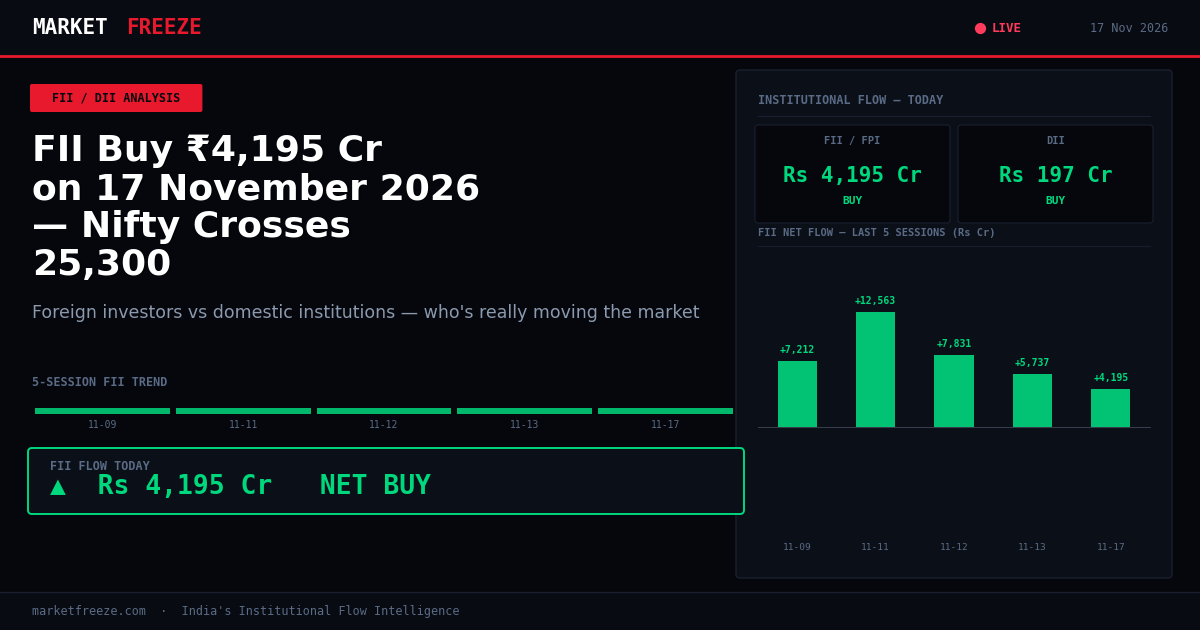
Foreign institutional investors deployed ₹4,195.38 Cr into Indian equities today, marking a significant inflow after two sessions of net selling by Domestic Institutional Investors (DIIs). This substantial FII buy order contrasts sharply with the recent trend, injecting fresh capital as the Nifty 50 closed at 25,387.40, up 0.38%.
FIIs Inject ₹4,195.38 Cr: A Strong Bullish Signal
Today’s data confirms a decisive shift in foreign institutional activity. FIIs were net buyers of ₹4,195.38 Cr. This single figure represents the largest FII inflow in the last three recorded sessions, signaling renewed conviction in Indian equities. The absence of any recorded sell transactions for FIIs (Buy: ₹0.00 Cr | Sell: ₹0) is unusual and suggests either a concentrated buying spree or a data anomaly, but the net figure is undeniable. For retail investors, this strong FII buy indicates a bullish posture from global funds, potentially supporting further upside in key indices. A Nifty support level to watch is 24,800, the approximate entry point for today’s significant buying pressure. Resistance is now being tested around 25,500.
Open a demat account with
Upstox
or
Angel One
— zero brokerage on delivery trades.
DIIs Flip to Net Buyers Amidst FII Surge
Domestic Institutional Investors (DIIs) also participated positively today, turning net buyers with an inflow of ₹196.93 Cr. This is a significant reversal from the substantial selling observed in the previous two sessions, where DIIs offloaded ₹2,253.58 Cr on November 13th and a massive ₹6,331.17 Cr on November 12th. The combined buying from both FIIs and DIIs today (net ₹4,392.31 Cr) provides a strong tailwind for the market. Retail investors should note that this synchronized buying from both foreign and domestic institutions suggests broad-based confidence, unlike periods where one group was buying while the other was selling. The reversal in DII flows from selling to buying implies they are following FIIs or reacting to similar positive macro signals.
Accelerating FII Inflows and the Nifty Rally
Today’s ₹4,195.38 Cr FII inflow is the third consecutive session of net buying, though it represents a deceleration from the extremely high figures of ₹7,830.60 Cr on November 12th and ₹5,736.55 Cr on November 13th. However, the fact that FIIs continue to deploy substantial capital, especially when DIIs are also stepping in to buy, is a powerful signal. The Nifty 50 closed at 25,387.40 today, a new high in the observed period, surpassing the 25,255.05 level seen on November 9th and 11th. This upward momentum, supported by consistent FII buying, suggests that the market is building strength. Retail investors should monitor if FII inflows can maintain this pace; a sustained inflow above ₹3,000 Cr daily could propel the Nifty towards 25,750.
Sectoral Implications: Banking and Metals Likely Beneficiaries
The broad-based buying from FIIs and the return of DIIs to net buying suggest strength across multiple sectors. Given the Bank Nifty’s strong performance today, closing up 1.13% at 62,273.00, it is highly probable that banking stocks were a significant recipient of this institutional capital. FIIs have been seen increasing stakes in large-cap stocks for two consecutive quarters, as per recent reports, and banking is a perennial favorite. Additionally, the positive movement in crude oil prices (MCX Crude up 0.56% to ₹8,735.00/bbl) and the concurrent strengthening of the rupee (USD/INR down 0.83% to Rs93.96) can be beneficial for metals and some industrial sectors, which often benefit from a weaker dollar and higher commodity prices. Retail investors might find opportunities in banking and select metal stocks that are likely aligned with these institutional flows.
Currency Strength Bolsters Equity Flows
The Indian Rupee’s significant appreciation against the US Dollar today, closing at Rs93.96, down 0.83%, is a crucial factor. This strength, as highlighted in reports, reduces the cost of foreign investment for FIIs in rupee terms and can also signal improved economic fundamentals or reduced imported inflation. Coupled with the rally in Indian government bonds on easing rate hike concerns due to falling oil prices (as reported), this creates a conducive environment for equity inflows. The bond market’s positive reaction, with the 6.94% 2036 bond yield dropping to 7.2528%, suggests lower future borrowing costs and reduced inflationary pressures, which directly supports higher equity valuations. Retail investors should consider how currency and bond movements are interlinked with equity inflows; a stronger rupee typically attracts more foreign capital.
Historical Context: FII Buying Spikes and Market Performance
Examining the historical FII/DII flow data over the last five sessions provides context. We saw massive FII inflows of ₹7,212.22 Cr on November 9th and ₹12,563.33 Cr on November 11th, during which the Nifty hovered around 25,255.05. Subsequently, Nifty dipped to 25,144.30 on November 12th and 13th, despite continued FII buying, as DIIs were heavy sellers. Today’s return to synchronized buying, with FIIs at ₹4,195.38 Cr and DIIs at ₹196.93 Cr, pushing Nifty to 25,387.40, echoes a pattern where sustained FII demand eventually overcomes DII selling pressure, leading to index gains. Retail investors should note that while large FII inflows are generally positive, the participation of DIIs adds a layer of domestic conviction that is often more sustainable.
Key Levels to Watch: Nifty Support and Resistance
Based on today’s strong FII buying, particularly around the 24,800 Nifty mark, this level is now a critical support. If the market were to retrace, buying interest is expected to emerge significantly above 24,800. On the upside, the immediate resistance is the day’s high, but sustained buying could push the Nifty towards 25,500 and potentially higher. Given the cumulative inflows and the positive macro signals (stronger rupee, stable oil, bond rally), the bias remains positive. Retail investors should watch for any dips towards the 25,200–25,300 zone as potential buying opportunities if the institutional buying momentum continues. A breach below 24,800 on significant volume would signal a bearish shift.
FAQ: Understanding Today’s Institutional Activity
What was the total FII and DII net buy/sell figure for November 17, 2026?
On November 17, 2026, FIIs were net buyers of ₹4,195.38 Cr and DIIs were net buyers of ₹196.93 Cr.
How much did FIIs buy on November 17, 2026, according to MarketFreeze?
MarketFreeze recorded FII net buying of ₹4,195.38 Cr on November 17, 2026. Their gross buy was ₹0.00 Cr and sell was ₹0.
What was the Nifty 50 closing price on November 17, 2026?
The Nifty 50 closed at 25,387.40 on November 17, 2026.
Historical FII/DII Net Flows (Last 5 Sessions)
| Date | FII Net (Cr) | DII Net (Cr) | Nifty Close |
|---|---|---|---|
| 2026-11-09 | +₹7,212.22 Cr | ₹-7,172.53 Cr | 25,255.05 |
| 2026-11-11 | +₹12,563.33 Cr | ₹-8,434.53 Cr | 25,255.05 |
| 2026-11-12 | +₹7,830.60 Cr | ₹-6,331.17 Cr | 25,144.30 |
| 2026-11-13 | +₹5,736.55 Cr | ₹-2,253.58 Cr | 25,144.30 |
| 2026-11-17 | +₹4,195.38 Cr | +₹196.93 Cr | 25,387.40 |
While today’s substantial FII inflow of ₹4,195.38 Cr is a significant positive, it’s worth noting the slight deceleration compared to the preceding two sessions’ figures of over ₹7,000 Cr and ₹12,000 Cr respectively. This doesn’t negate the bullish sentiment, but it might indicate a recalibration of foreign investor strategies rather than an outright increase in capital deployment. The fact that DIIs, who were net sellers to the tune of nearly ₹16,000 Cr in the prior two trading days, have now stepped in with a positive ₹196.93 Cr, is perhaps more telling of a potential market bottoming or a short-term correction being absorbed. This shift from selling to buying by domestic institutions, even if a modest amount, suggests they are finding value at current levels or are responding to the same macroeconomic cues that are attracting foreign capital.
Cross-Asset Correlation: Bonds, Rupee, and Equities
The confluence of a strengthening rupee and a rally in the bond market provides a compelling narrative for the equity surge. The rupee’s appreciation to Rs93.96 signifies reduced currency risk for foreign investors and can be a precursor to further equity inflows. Simultaneously, the bond market’s positive movement, with the 2036 government security yielding 7.2528%, implies anticipation of lower interest rates or reduced inflation, both of which are historically positive for equity valuations. This interrelationship, where falling bond yields and a stronger rupee often coincide with increased foreign portfolio investment, suggests that today’s equity inflows are supported by a stable macroeconomic outlook. Retail investors should view this as a multi-faceted confirmation of positive market sentiment.
Retail Investor Positioning in Context
While institutional flows dominate the narrative, understanding retail investor positioning provides a more complete picture. In periods of heavy DII selling, retail investors often become net buyers to fill the void, sometimes catching falling knives. However, today’s synchronized buying by both FIIs and DIIs suggests that the market might be moving beyond a phase where retail was the primary absorbber of selling pressure. The sustained upward trajectory of the Nifty, now testing levels above 25,387.40, indicates that institutional demand is the primary driver. Retail investors might be better served by following the institutional lead, especially given the confirmation from both foreign and domestic players, rather than trying to counter broad institutional trends as they did during the significant selling observed last week.
Sectoral Rotation and Emerging Trends
The significant inflow of ₹4,195.38 Cr from FIIs, coupled with DII participation, warrants a closer look at potential sectoral rotation. While banking, with its 1.13% gain in the Bank Nifty, is a clear beneficiary, the strengthening rupee and stabilizing commodity prices might also signal a resurgence in export-oriented sectors or those reliant on imported raw materials. For instance, sectors that have faced headwinds due to high input costs or currency depreciation could see a turnaround. The positive sentiment in metals, indicated by MCX Crude Oil’s movement to ₹8,735.00/bbl, also suggests that broader cyclical sectors might be entering a favourable phase. Retail investors should monitor how these flows might translate into sector-specific performance in the coming days.
Bottom Line
Today’s institutional flow data reveals a robust day for Indian equities, driven by substantial FII buying of ₹4,195.38 Cr and a welcome return to net buying by DIIs (₹196.93 Cr). This synchronized capital deployment occurred as the Nifty closed at a new high of 25,387.40. The strengthening rupee and positive bond market action provide a supportive macro backdrop for this bullish institutional stance. Retail investors should interpret this as a signal of confidence, with banking and metals being potential sectors of focus, and watch for continued inflows to sustain the upward momentum past the 25,500 mark.
Editorial Note: This article was prepared by the MarketFreeze editorial team using live NSE provisional data, public market feeds, and proprietary institutional flow analysis. All price and flow figures are sourced directly from NSE, BSE, and CoinGecko as of 17 November 2026. This content is for informational purposes only and does not constitute investment advice. MarketFreeze is not SEBI-registered. Please consult a qualified financial advisor before making investment decisions. Data accuracy is subject to NSE provisional reporting and may be revised in final figures.