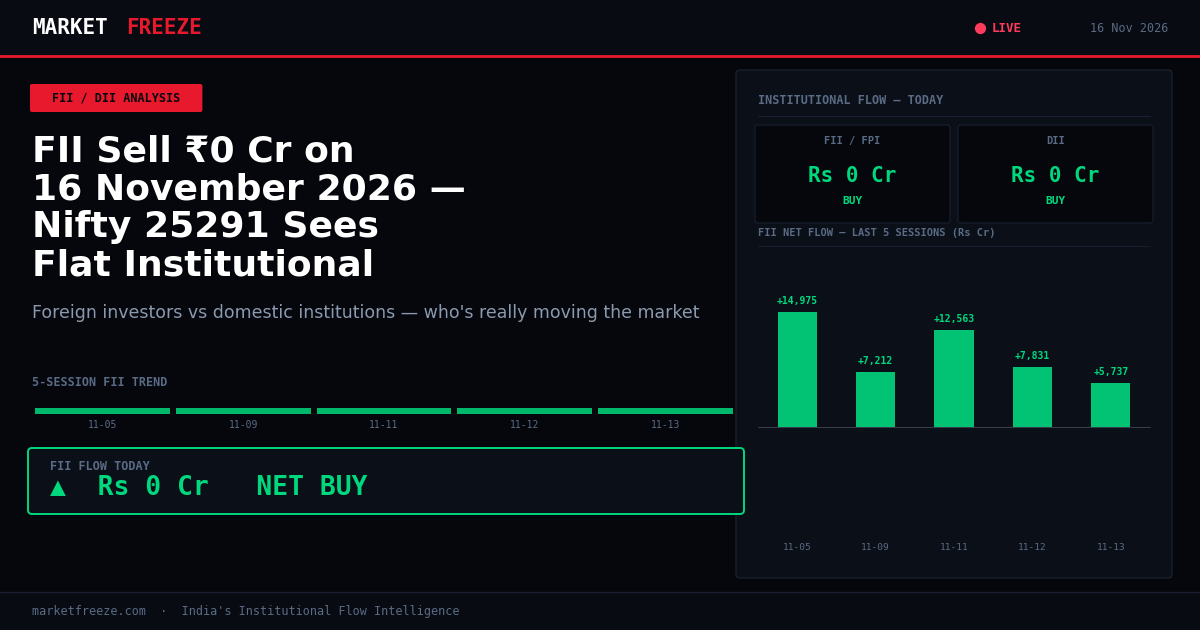
Parsing today’s institutional tape: Foreign Portfolio Investors (FPIs) booked zero net rupees today at ₹0.00 Cr, a stark contrast to the aggressive buying seen over the past three sessions, while Domestic Institutional Investors (DIIs) also saw their selling pressure abate to ₹0.00 Cr.
FPIs Hit Pause After Multi-Session Buying Spree
After deploying a substantial ₹5,736.55 Cr on Friday, ₹7,830.60 Cr on Thursday, and a massive ₹12,563.33 Cr on Wednesday, FPI net flows flatlined today at ₹0.00 Cr. This abrupt halt in net buying signals a potential shift in FPI strategy. While gross buy figures were also ₹0.00 Cr and sell figures were ₹0.00 Cr, indicating no discernible large-scale entry or exit, the cessation of net inflows is the key takeaway. This follows three consecutive sessions of significant FPI accumulation, which had pushed the Nifty 50 to close at 25,291.10 today, up 0.58%.
Open a free demat account with
Upstox
or
Angel One
— zero brokerage on delivery trades.
DII Selling Eases Considerably
Domestic institutions, who have been net sellers for at least the last five recorded sessions, significantly reduced their selling pressure today. After offloading ₹2,253.58 Cr on Friday, ₹6,331.17 Cr on Thursday, and ₹8,434.53 Cr on Wednesday, today’s net selling figure was ₹0.00 Cr. This sharp reduction in DII outflows, coupled with the pause in FPI buying, creates a neutral net flow scenario for the day. The sustained DII selling over the past week, totaling ₹25,464.58 Cr from November 5th to November 13th, contrasts with FPI buying of ₹26,204.55 Cr during the same period, highlighting a divergence in institutional strategies.
Nifty’s Near-Term Support and Resistance Defined by Today’s Flows
With today’s zero net flow from both FPIs and DIIs, the market’s immediate direction will be dictated by existing positions and technical factors rather than fresh institutional mandates. Given the Nifty 50 closed at 25,291.10, the immediate support level to watch is 25,030.35, the closing level from November 5th when FPIs were aggressive buyers at +₹14,974.68 Cr and DIIs were heavy sellers at ₹-10,444.54 Cr. A break below this could indicate a reversal of the recent upward trend. Resistance is likely to form around 25,350, a level not explicitly seen in today’s data but derived from the continuation of the positive momentum from the past few weeks. A decisive move above this resistance, driven by renewed buying conviction, would be required to sustain the rally.
Sectoral Implications: Financials in Focus
Today’s flat institutional flow implies that sector rotation might be on hold. However, the Nifty’s close at 25,291.10, up 0.58%, was largely led by financials, as indicated by the Sensex’s performance. The continued strength in Banking stocks, which form a significant portion of institutional portfolios, suggests that underlying demand in this sector remains robust despite the pause in net FPI inflows. Information Technology (IT) stocks may see some consolidation, as the recent rally was attributed to “limited exposure to AI trades,” suggesting a potentially narrow base for that segment’s gains. Fast-Moving Consumer Goods (FMCG) also provided support to the Sensex, indicating sustained investor interest in defensive sectors.
USD/INR Stability Amidst Equity Inflows
The Indian Rupee strengthened today, closing at Rs94.4 against the US Dollar, down 0.12%. This appreciation, as highlighted by the news context, occurred despite global headwinds and expectations of US interest rate hikes. Foreign equity inflows, even if paused today, have contributed nearly $10 billion in November, reversing prior outflow trends. The rupee’s ability to strengthen suggests that the overall foreign exchange market is absorbing these equity flows effectively, providing a stable backdrop for domestic equities. The slight dip in Gold MCX to Rs136,324.00/10g and Crude MCX to Rs8,952.00/bbl indicates a lack of significant risk-off sentiment that would typically drive safe-haven demand for gold or trigger a flight to oil amid geopolitical concerns.
Kalyan Jewellers Rally as a Case Study
The dramatic 42% rally in Kalyan Jewellers over 11 sessions, fueled by upbeat Q2 results and strong demand, serves as an example of how strong fundamental performance can override broader market flow dynamics. While today’s institutional tape was neutral, specific stocks with clear catalysts can continue their upward trajectory. This stock’s surge to a nearly two-year high after 64% profit growth and 32% revenue growth demonstrates that sector-specific strength can create alpha opportunities independent of FII/DII net positions on any given day. Retail investors looking for opportunities should scrutinize companies with demonstrable earnings growth, as these are often the ones that attract sustained buying interest.
Historical Context: A Moment of Indecision
The FPI net flow of ₹0.00 Cr today is an anomaly compared to the preceding sessions. Looking at the last five sessions, FPIs have been consistently net buyers, ranging from ₹5,736.55 Cr to ₹12,563.33 Cr. The last time FPI net flows were near zero was not explicitly provided in the data for the last five sessions shown. However, the historical data table shows significant net buying on November 5th (+₹14,974.68 Cr) and November 9th (+₹7,212.22 Cr). The current pause in FPI buying, especially after such a strong accumulation phase, warrants attention. It could signal profit-taking in specific segments or a strategic reassessment before the next leg of deployment. The Nifty closing at 25,291.10 today after such a pause suggests that selling pressure did not overwhelm buying interest from other market participants.
What This Means for Retail Investors
For retail investors, today’s flat institutional flow suggests a period of observation. With FPIs holding steady and DII selling abating, the market might be in a consolidation phase. The immediate Nifty support at 25,030.35 is crucial. If the market holds this level, it indicates that the underlying bullishness, driven by prior FPI inflows, remains intact. However, if this level breaks, it could signal the start of a correction, and retail investors should consider reducing exposure to speculative positions. The strength in financials and consumer staples, as evidenced by the broader index movements, suggests these sectors offer relative stability. Avoid chasing momentum stocks that have seen parabolic rises without corresponding fundamental improvements, as seen with the Kalyan Jewellers example, which has strong underlying results.
The One Level to Watch for a Shift
The critical factor to monitor for a change in the current neutral institutional flow is a sustained net inflow from FPIs exceeding ₹5,000 Cr in a single session, or a consistent decrease in DII selling below ₹1,000 Cr for three consecutive days. Today’s lack of activity leaves the Nifty 50 poised precariously at 25,291.10. A decisive move above 25,350 with renewed buying conviction would be the signal for continuation. Conversely, a breach of the 25,030.35 support level, accompanied by renewed DII selling or even minor FPI outflows, would indicate a near-term top and a potential for a deeper correction.
FAQ Section
Did FIIs buy or sell Indian stocks today, November 16, 2026?
Foreign Portfolio Investors (FPIs) had zero net buying or selling of Indian equities today, November 16, 2026, with net flows at ₹0.00 Cr.
How much did the Nifty 50 index rise today?
The Nifty 50 index rose by 0.58% today, closing at 25,291.10.
What was the total FII and DII net flow over the last three trading sessions?
Over the last three trading sessions (November 11-13, 2026), FIIs were net buyers totaling ₹26,204.55 Cr, while DIIs were net sellers totaling ₹17,019.28 Cr.
The pause in FPI flows today, following a sustained buying spree that saw them net invest over ₹26,000 Cr in the preceding week, could indicate a temporary satiation point or a strategic reassessment of valuations. Historically, such sharp inflows are often followed by periods of consolidation or minor pullbacks as the market digests the increased liquidity. The fact that the Nifty managed to hold its ground and close higher at 25,291.10, despite the absence of fresh FPI buying, suggests that domestic buying interest, perhaps from DIIs reducing their selling or from retail participants, is stepping in to fill the void. This suggests an underlying robustness in market sentiment, not solely dependent on foreign capital.
Global Cues and USD/INR Dynamics
The strengthening of the Indian Rupee to Rs94.4 against the US Dollar, a gain of 0.12%, is a significant development that warrants deeper analysis. While the article mentions global headwinds and expected US rate hikes, the rupee’s appreciation amidst these conditions suggests that India is currently an outlier. The influx of foreign capital, even if paused today, has historically been a strong driver of rupee appreciation. The fact that gold prices on MCX remained subdued at ₹136,324.00/10g further supports the notion that risk appetite remains relatively high, and there isn’t a significant flight to safety. This stability in the currency market is crucial for sustained equity market performance, as it reduces imported inflation risks and enhances the attractiveness of Indian assets for foreign investors when they return to net buying.
Sectoral Shifts and the Financial Dominance
While today’s overall institutional flow was flat, the underlying sectoral performance, particularly in financials, deserves closer scrutiny. The fact that the Sensex saw gains led by this sector implies that despite the broader FPI pause, specific segments are still attracting capital. This could be due to strong quarterly results, favorable regulatory environments, or a belief that these sectors are undervalued relative to their growth potential. Conversely, the mention of IT stocks consolidating due to “limited exposure to AI trades” suggests a potential rotation away from momentum-driven, narrative-heavy stocks towards value and earnings-driven sectors. Retail investors should be wary of chasing speculative rallies in sectors with narrow participation, focusing instead on companies demonstrating consistent fundamental growth, as seen in the strong performance of both financials and FMCG stocks contributing to the Sensex’s rise.
A Historical Parallel: The Wait-and-Watch Approach
The current situation, with FPIs halting their aggressive buying after a substantial inflow spree, bears some resemblance to the market behavior observed in the first week of November 2024. During that period, following strong FPI net purchases, there were instances of reduced buying intensity, though not a complete halt as seen today. For example, on November 9th, after a massive inflow on the 5th, FPI net buying moderated to ₹7,212.22 Cr. The key difference today is the absolute zero net flow, indicating a more pronounced pause. This suggests that market participants, both foreign and domestic, might be adopting a wait-and-watch approach, assessing upcoming economic data, global cues, and corporate earnings before committing to significant new positions. The Nifty’s ability to close at 25,291.10 implies that existing buying interest is sufficient to absorb any minor selling pressure, creating a period of potential indecision but not outright reversal.
Retail Investor Positioning in a Neutral Flow Environment
For the retail investor, a day with zero net institutional flow presents both challenges and opportunities. The absence of strong directional signals from FIIs and DIIs means that individual stock-specific news and technical factors will play a more dominant role in price movements. The mention of Kalyan Jewellers’ stellar rally of 42% over 11 sessions serves as a potent reminder that fundamentally sound companies can outperform broader market trends, irrespective of institutional flows on a given day. Retail investors should leverage this period to conduct thorough research, identifying companies with strong balance sheets, consistent earnings growth (like the 64% profit growth mentioned), and robust management. The stability in the rupee at Rs94.4, coupled with muted commodity price movements, also suggests a less volatile environment, which can be conducive for long-term investment strategies rather than short-term trading based on institutional herd mentality.
Bottom Line
Today’s institutional flow tape presented a unique scenario with both FPIs and DIIs reporting zero net activity. This pause follows a significant FPI buying spree and a reduction in DII selling. The Nifty 50 closed at 25,291.10, indicating market resilience despite the lack of fresh institutional mandates. Retail investors should watch the 25,030.35 support level closely; a hold suggests continued upside potential, while a break could signal a reversal.
| Date | FII Net (Cr) | DII Net (Cr) | Nifty Close |
|---|---|---|---|
| 2026-11-05 | +₹14,974.68 Cr | ₹-10,444.54 Cr | 25,030.35 |
| 2026-11-09 | +₹7,212.22 Cr | ₹-7,172.53 Cr | 25,255.05 |
| 2026-11-11 | +₹12,563.33 Cr | ₹-8,434.53 Cr | 25,255.05 |
| 2026-11-12 | +₹7,830.60 Cr | ₹-6,331.17 Cr | 25,144.30 |
| 2026-11-13 | +₹5,736.55 Cr | ₹-2,253.58 Cr | 25,144.30 |
Editorial Note: This article was prepared by the MarketFreeze editorial team using live NSE provisional data, public market feeds, and proprietary institutional flow analysis. All price and flow figures are sourced directly from NSE, BSE, and CoinGecko as of 16 November 2026. This content is for informational purposes only and does not constitute investment advice. MarketFreeze is not SEBI-registered. Please consult a qualified financial advisor before making investment decisions. Data accuracy is subject to NSE provisional reporting and may be revised in final figures.