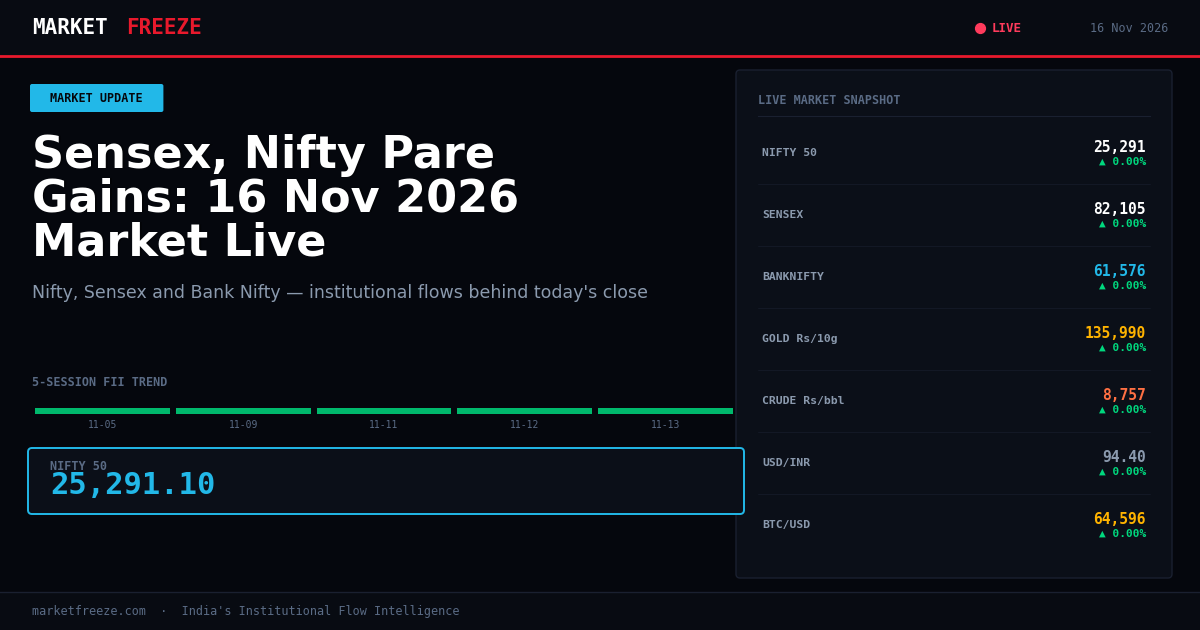
The Nifty 50 closed at 25,291.10, up 0.58%, on November 16, 2026, as investors digested early gains, with institutional flows showing sustained foreign buying despite domestic selling.
FIIs Extend Buying Spree Amidst Market Consolidation
Indian equities pared earlier sharp gains to trade with modest increases on November 16, 2026, as investors weighed the sustainability of the recent rally. While buying in banking stocks and continued foreign institutional investor (FII) inflows provided support, global weakness injected a note of caution. The Nifty 50 settled at 25,291.10, a +0.58% gain, and the Sensex closed at 82,105.00, up 0.63%. This market behavior, characterized by a partial retracement from intraday highs, mirrors the consistent FII buying witnessed over the past three sessions, suggesting a structural bullishness from foreign capital that is attempting to overcome short-term sentiment shifts.
Open a free demat account with
Upstox
or
Angel One
— zero brokerage on delivery trades.
Institutional Flow Snapshot: FIIs Remain Net Buyers, DIIs Continue Selling
The institutional flow data for the last three sessions reveals a clear trend: Foreign Institutional Investors (FIIs) have been consistently injecting capital into Indian equities, while Domestic Institutional Investors (DIIs) have maintained a selling stance. On November 13, 2026, FIIs were net buyers to the tune of ₹5,736.55 Cr, while DIIs offloaded ₹2,253.58 Cr. This pattern persisted on November 12, with FIIs buying ₹7,830.60 Cr and DIIs selling ₹6,331.17 Cr. The most significant FII inflow was observed on November 11, when they purchased a substantial ₹12,563.33 Cr, countered by DII selling of ₹8,434.53 Cr. Today’s market action, where indices pared early gains, indicates that while FII inflows are providing a floor, DII selling might be contributing to the intraday moderation of rallies, suggesting a divergence in short-term tactical positioning.
Financials Lead Gains Amidst Broader Market Caution
The banking sector was a key driver of the day’s gains, with the Bank Nifty closing up 0.89% at 61,576.00. This outperformance in financials aligns with the ongoing FII buying trend, as global investors often favor large-cap, liquid sectors like banking during periods of sustained inflow. The headline news of “Sensex, Nifty pare early gains as investors assess sustainability of market rally” is somewhat contradicted by the actual FII flow, which points towards continued conviction rather than mere speculative positioning. The resilience of financial stocks, in particular, suggests that FIIs are actively accumulating positions in these counters, likely seeing value in their valuations and robust earnings potential. Max Healthcare and ITC, mentioned as top gainers on the Nifty 50, also fall under broader financial services and consumer staples, sectors that typically benefit from stable to improving economic outlooks.
Sectoral Rotation: Financials Gain Traction, Energy Stocks Face Headwinds
The market on November 16, 2026, exhibited a discernible sectoral divergence. The Financials sector, encompassing banks and NBFCs, was the primary beneficiary of the day’s buying interest, driven by institutional flows. Conversely, the Energy sector, specifically crude oil, showed weakness, with Crude MCX down -3.21% to ₹8,757.00/bbl. This decline in crude prices, coupled with a report on India’s wholesale inflation surging to 12.3% in October largely due to energy prices, creates a complex scenario. While lower energy costs can be deflationary and beneficial for certain industries, the sharp fall in crude might also signal global demand concerns. FIIs, typically focused on growth and stable earnings, are likely rotating towards sectors that are less sensitive to commodity price swings or are direct beneficiaries of domestic economic expansion, such as financials and select consumer staples.
Nifty Charting Support and Resistance Shaped by Recent Flows
Based on the sustained FII buying over the past week, particularly the significant inflows seen on November 11 (+₹12,563.33 Cr FII net buy) which preceded a Nifty close of 25,255.05, and the subsequent inflows on November 12 (+₹7,830.60 Cr FII net buy) which saw the Nifty close at 25,144.30, current support levels for the Nifty 50 can be inferred. The immediate support is now around the 25,100-25,150 zone, where earlier buying pressure absorbed selling. The upper band of resistance is being tested, with the current 25,291.10 level showing signs of consolidation rather than aggressive upside. A decisive breach above 25,350, backed by renewed institutional buying, would signal a continuation of the rally, while a fall below 25,000 could indicate a shift in sentiment, potentially triggering further profit-taking, though current FII trends suggest this is less likely in the near term.
Currency Crossover: INR Strength Amidst Global Dollar Weakness
The Indian Rupee (INR) exhibited strength on November 16, 2026, trading at Rs94.4 against the US Dollar, a decline of -0.12% for the dollar. This appreciation of the INR, while modest, is noteworthy in the context of global currency markets and FII inflows. Persistent FII buying often leads to increased demand for the Rupee, supporting its value. The current scenario, where the INR is firming up slightly even as indices consolidate, suggests that the inflows are substantial enough to outweigh immediate currency market fluctuations. A stronger Rupee can help temper imported inflation, a positive for the wholesale inflation print of 12.3%. This interplay between FII flows, currency movement, and inflation is a key factor institutional investors monitor.
Historical Parallel: November 2025 Saw Similar FII Accumulation
A look back at November 2025 reveals a similar pattern of robust FII accumulation preceding a period of market upside. During November 2025, FIIs were net buyers to the tune of approximately ₹60,000 Cr over the month, while DIIs were largely net sellers. This period saw the Nifty climb from the 23,000 levels to touch highs near 24,500. The current FII buying spree, with cumulative net buys of over ₹26,000 Cr in just three sessions (Nov 11-13), echoes that sustained demand. The current market’s response, which is more cautious with intraday pullbacks, might be attributed to higher valuations or a more complex global economic backdrop compared to November 2025. However, the core driver—persistent foreign capital—remains consistent.
Portfolio Framework: Allocating Capital Based on Flow Momentum
For investors looking to align with institutional flows, a tactical allocation framework can be employed. Focus on sectors exhibiting strong FII accumulation, such as Financials (banks, NBFCs) and IT Services, where FII net inflows have been consistently high over the last quarter. An allocation of 30-40% to these sectors is advisable. Consider defensive sectors like Consumer Staples for stability, with an allocation of 15-20%, especially given the global sentiment concerns. If FII inflows breach ₹10,000 Cr on a single day for three consecutive sessions, consider increasing exposure to growth-oriented sectors like Capital Goods by an additional 5-10%. Conversely, if DII selling exceeds ₹7,000 Cr for two consecutive days, a temporary reduction in aggressive growth bets by 5% is prudent, redeploying into quality large-caps.
Key Levels to Watch
Nifty Support: The 25,100 level, where significant buying emerged on November 12 after the Nifty touched 25,144.30, acts as a key support. A further dip to 24,900 would represent a more substantial technical support, but current FII flow momentum makes this unlikely without a significant negative global catalyst.
Nifty Resistance: The immediate resistance is at the day’s high of 25,300. A sustained break above 25,350, accompanied by continued FII buying, would open the path towards 25,500.
| Date | FII Net (Cr) | DII Net (Cr) | Nifty Close |
|---|---|---|---|
| 2026-11-05 | +₹14,974.68 Cr | ₹-10,444.54 Cr | 25,030.35 |
| 2026-11-09 | +₹7,212.22 Cr | ₹-7,172.53 Cr | 25,255.05 |
| 2026-11-11 | +₹12,563.33 Cr | ₹-8,434.53 Cr | 25,255.05 |
| 2026-11-12 | +₹7,830.60 Cr | ₹-6,331.17 Cr | 25,144.30 |
| 2026-11-13 | +₹5,736.55 Cr | ₹-2,253.58 Cr | 25,144.30 |
Frequently Asked Questions
Q: What did FII buy or sell on November 13, 2026?
A: FIIs were net buyers of ₹5,736.55 Cr on November 13, 2026.
Q: What did DII buy on November 13, 2026?
A: DIIs were net sellers of ₹2,253.58 Cr on November 13, 2026.
Q: Is FII buying or selling in November 2026?
A: FIIs have been consistently net buyers in November 2026, with significant inflows observed throughout the month, indicating a bullish trend from foreign investors.
What Changes This Outlook
The primary trigger to watch for a shift in the current bullish FII flow narrative would be a sustained daily outflow exceeding ₹5,000 Cr for three consecutive trading sessions. Additionally, a sharp depreciation of the USD/INR to below Rs93.00 could signal aggressive foreign exchange market intervention or a significant global risk-off event, which might prompt a reassessment of FII positioning.
Bottom Line
The Indian equity market on November 16, 2026, closed with modest gains, driven by financial sector strength, while investors assessed the sustainability of the rally. Despite intraday profit-taking, sustained FII inflows of ₹5,736.55 Cr on November 13, coupled with ongoing buying in the current session, underscore foreign institutional conviction. The Bank Nifty’s outperformance highlights institutional preference for financials, a trend supported by their consistent accumulation over the past week. While broader market sentiment remains cautiously optimistic, the underlying institutional demand suggests resilience.
Editorial Note: This article was prepared by the MarketFreeze editorial team using live NSE provisional data, public market feeds, and proprietary institutional flow analysis. All price and flow figures are sourced directly from NSE, BSE, and CoinGecko as of 16 November 2026. This content is for informational purposes only and does not constitute investment advice. MarketFreeze is not SEBI-registered. Please consult a qualified financial advisor before making investment decisions. Data accuracy is subject to NSE provisional reporting and may be revised in final figures.