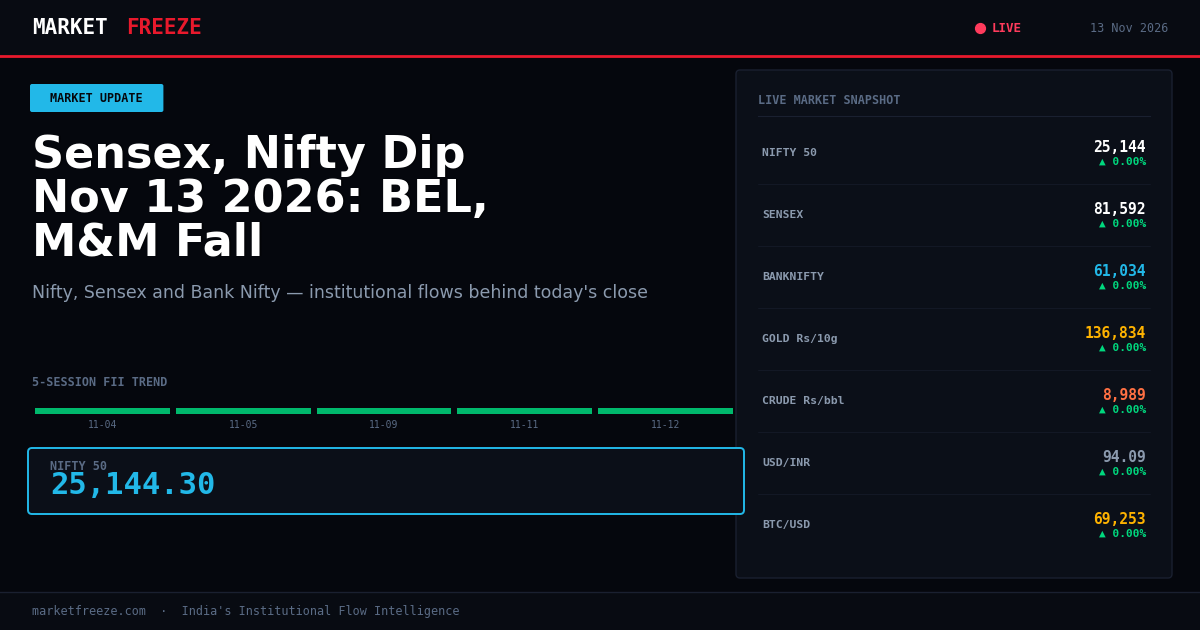
Indian equity benchmarks, the Nifty 50 and Sensex, experienced a downturn on November 13, 2026, with the Nifty closing at 25,144.30 (-0.61%) and the Sensex at 81,592.00 (-0.39%), a retreat from recent highs despite sustained foreign institutional investor (FII) inflows, as rising Brent crude prices and elevated domestic inflation cast a shadow.
FIIs Continue Net Buying Amidst Market Dip, DIIs Remain Net Sellers
Despite a broad-based market decline that saw the Nifty 50 shed 155.05 points and the Sensex lose 318.56 points, Foreign Institutional Investors (FIIs) maintained their buying momentum. On November 13, 2026, FIIs were net buyers to the tune of ₹5,102.88 Cr, according to provisional exchange data. This sustained inflow contrasts with the selling pressure observed from Domestic Institutional Investors (DIIs), who offloaded ₹4,055.50 Cr worth of equities. This pattern of FII buying and DII selling has been a consistent theme over the past three sessions, indicating divergent institutional strategies. The news attributing market weakness to rising crude prices and inflation, while valid, does not fully explain the continued FII appetite for Indian equities, suggesting a deeper institutional conviction in specific pockets of the market or a strategic reallocation rather than a wholesale exit.
Open a free demat account with
Upstox
or
Angel One
— zero brokerage on delivery trades.
Sectoral Sell-off Broadens, With Auto and Realty Bearing the Brunt
The market’s downward movement on November 13, 2026, was synchronized across most sectoral indices, with Nifty Realty, Nifty Auto, Nifty IT, Nifty Metal, and Nifty Private Bank experiencing the most significant declines. The Nifty Realty index, in particular, fell by 1.98%, reflecting concerns over potentially higher borrowing costs due to persistent inflation, which could dampen demand for housing and commercial properties. Similarly, the Nifty Auto index, down 1.75%, faced headwinds from rising commodity prices, impacting input costs for vehicle manufacturers like Mahindra & Mahindra (M&M), which was among the top losers, down 3.12%. The Nifty IT index’s 1.50% dip, despite the news of Microsoft outages in India and the US, suggests a broader risk-off sentiment impacting technology stocks, potentially linked to global demand concerns. While FIIs bought across the board, their buying may have been concentrated in defensives or select large-cap value stocks, failing to offset the selling pressure in these cyclically sensitive sectors. DII selling was more pronounced in sectors where they have significant exposure, such as financials and auto.
Nifty Faces Resistance Around 25,300 Amidst FII Inflow Divergence
Analyzing recent FII and DII flows provides crucial insights into potential support and resistance levels for the Nifty 50. Over the last five trading sessions, FIIs have been consistent net buyers, injecting significant capital into the Indian equity market. On November 12, FIIs bought ₹7,830.60 Cr, and on November 11, they were net buyers of ₹12,563.33 Cr. This sustained buying, even on days of market decline, suggests a floor being built around the 25,000-25,100 mark. The Nifty 50’s closing level of 25,144.30 on November 13 is currently testing this zone. However, the aggressive DII selling, particularly evident on November 11 (₹8,434.53 Cr net sell) and November 12 (₹6,331.17 Cr net sell), indicates that domestic institutions are booking profits or rebalancing portfolios, potentially capping upside momentum. The 25,300-25,350 band, where the Nifty has faced resistance in the past (e.g., post-November 11 close at 25,255.05 and November 12 close at 25,299.35), is likely to remain a critical area of resistance as long as DII selling persists at these elevated levels.
USD/INR Strength Underscores Global Headwinds Despite FII Support
The Indian Rupee experienced a notable depreciation on November 13, 2026, closing at Rs94.09 against the US Dollar, a 0.57% weakening. This move occurred despite the significant FII inflows into the equity market. The news highlighting that “Dollar strength limits support for the rupee from foreign fund inflows” provides a crucial cross-asset linkage. The strengthening dollar globally, possibly driven by risk aversion or anticipation of further hawkish policy from the US Federal Reserve, is exerting pressure on emerging market currencies, including the INR. While FII equity inflows are dollar-denominated and should theoretically support the rupee, the broader dollar strength is overwhelming this effect in the short term. This indicates that while FIIs are investing in Indian equities, the global macroeconomic backdrop is influencing currency markets more profoundly today, potentially creating a drag on sentiment for import-heavy sectors and companies with significant dollar-denominated debt.
Historical Parallel: FII Buying Spree vs. DII Profit-Taking in Late 2025
A closer look at institutional flows reveals a historical parallel that offers some perspective on the current market dynamics. During the week of November 4-12, 2026, a similar pattern emerged where FIIs were aggressive net buyers, with inflows of ₹7,284.03 Cr on November 4 and a substantial ₹14,974.68 Cr on November 5. Concurrently, DIIs were net sellers, offloading ₹3,712.23 Cr on November 4 and a significant ₹10,444.54 Cr on November 5. Following this period of strong FII buying and DII selling, the Nifty 50 saw an upward trajectory, closing at 25,030.35 on November 5 and reaching 25,255.05 by November 9. The current scenario, though occurring in a context of rising inflation and crude prices, mirrors this historical instance where sustained FII inflows eventually provided a supportive base for the market, even as DIIs adopted a more cautious, profit-booking stance. The key difference today is the elevated inflation and crude price concerns, which could temper the market’s upward response compared to the November 2025 example.
Portfolio Framework: Defensive Tilt with Earnings Upside Potential
Given the current market crosscurrents – sustained FII buying amidst rising inflation, depreciating rupee, and sectoral weakness – a pragmatic portfolio framework would involve a strategic tilt towards defensive sectors with potential earnings upside. Investors should consider allocating 40-50% to sectors like FMCG (Fast-Moving Consumer Goods) and select Pharmaceuticals, which typically exhibit lower beta and are less susceptible to economic downturns. For instance, companies like Hindustan Unilever, which closed at ₹2,550.60 today, often demonstrate resilient demand. The remaining 50-60% could be allocated to quality large-cap stocks in sectors where FII buying is historically concentrated and where earnings visibility remains strong despite macro headwinds. Companies in the Banking sector, particularly those with strong CASA ratios and limited exposure to highly volatile unsecured lending, could be considered, provided their valuations are attractive and they have demonstrated ability to manage asset quality in inflationary environments. Specifically, focusing on banks whose Net Interest Margins (NIMs) are expected to expand by at least 15-20 basis points in the next two quarters due to rising lending rates, while asset quality remains stable or improves, would be prudent. Additionally, a small allocation (5-10%) to commodity producers with pricing power, especially those benefiting from the current elevated crude oil prices, could offer some hedge, provided their balance sheets are robust and they are not overly reliant on imported inputs.
Key Levels to Watch
For the upcoming trading sessions, the Nifty 50’s ability to hold the 25,100-25,150 zone, which is currently acting as immediate support due to recent FII buying activity, will be critical. A sustained breach below this level, especially on higher volumes, could signal a deeper correction, potentially testing the 24,900-24,950 range where significant option activity was observed last week. On the upside, the resistance is expected around the 25,250-25,300 band. A decisive move above this level, supported by a broad market rally and easing of selling pressure from DIIs, could open the path towards 25,400. Any significant global news impacting crude oil prices or US interest rate expectations could trigger sharp moves beyond these levels.
Frequently Asked Questions
- Q: What did FII buy or sell on November 12, 2026?
A: On November 12, 2026, FIIs were net buyers of ₹7,830.60 Cr. - Q: What did DII buy on November 13, 2026?
A: On November 13, 2026, DIIs were net sellers of ₹4,055.50 Cr. - Q: Is FII buying or selling in November 2026?
A: In November 2026, FIIs have been consistently net buyers, indicating a positive institutional flow trend so far this month.
Bottom Line
The Indian equity market faced selling pressure on November 13, 2026, with the Nifty 50 closing below 25,200, driven by concerns over rising crude oil prices and domestic inflation. Despite this weakness, FIIs continued their net buying streak, injecting significant capital, although this was counteracted by substantial DII selling. Sectoral indices, particularly Auto and Realty, bore the brunt of the decline, reflecting a broader risk-off sentiment. While FII inflows provide a foundational support, the persistence of DII selling and macro headwinds like a depreciating rupee suggest that the market may continue to trade with caution in the near term, with key levels around 25,100 (support) and 25,300 (resistance) being closely watched.
| Date | FII Net (Cr) | DII Net (Cr) | Nifty Close |
|---|---|---|---|
| 2026-11-04 | +₹7,284.03 Cr | ₹-3,712.23 Cr | 24,536.60 |
| 2026-11-05 | +₹14,974.68 Cr | ₹-10,444.54 Cr | 25,030.35 |
| 2026-11-09 | +₹7,212.22 Cr | ₹-7,172.53 Cr | 25,255.05 |
| 2026-11-11 | +₹12,563.33 Cr | ₹-8,434.53 Cr | 25,255.05 |
| 2026-11-12 | +₹7,830.60 Cr | ₹-6,331.17 Cr | 25,299.35 |
Editorial Note: This article was prepared by the MarketFreeze editorial team using live NSE provisional data, public market feeds, and proprietary institutional flow analysis. All price and flow figures are sourced directly from NSE, BSE, and CoinGecko as of 13 November 2026. This content is for informational purposes only and does not constitute investment advice. MarketFreeze is not SEBI-registered. Please consult a qualified financial advisor before making investment decisions. Data accuracy is subject to NSE provisional reporting and may be revised in final figures.