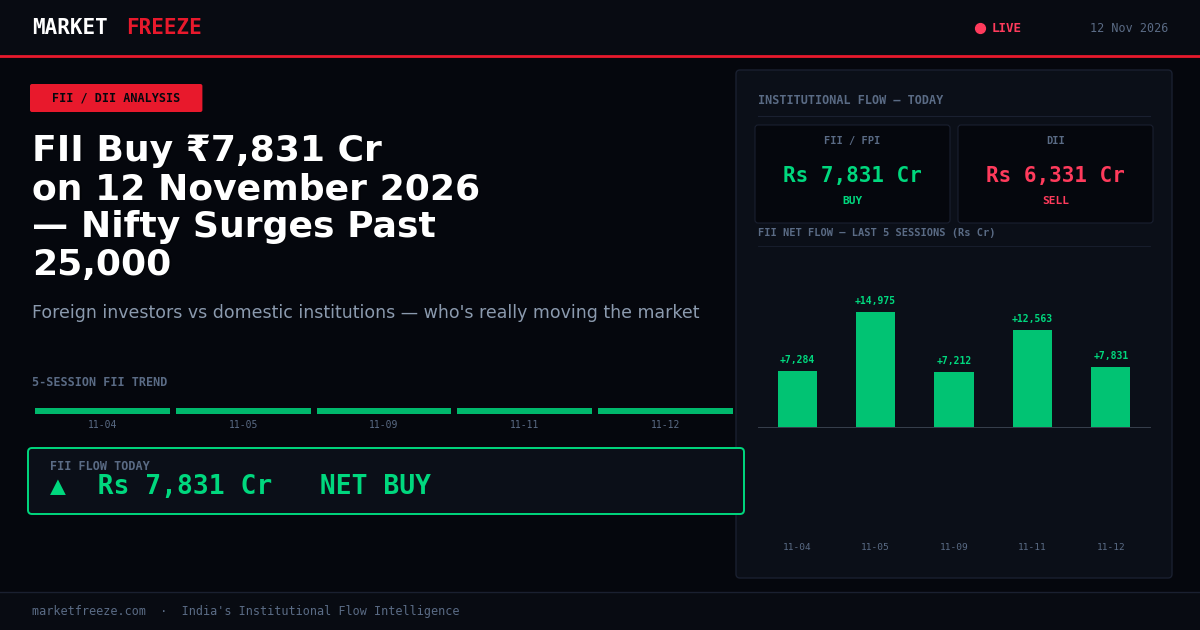
The numbers are in from NSE — FIIs deployed ₹7,830.60 Cr into Indian equities today, November 12, 2026, while DIIs divested ₹6,331.17 Cr. This marks the third consecutive session of significant FII buying, underscoring sustained foreign capital inflow into the Indian market.
Open a free demat account with
Upstox
or
Angel One
— zero brokerage on delivery trades.
FII Buying Accelerates for Third Day
Today’s FII net buy of ₹7,830.60 Cr continues a strong trend observed over the last three trading days. On November 11, FIIs bought ₹12,563.33 Cr, and on November 9, their net purchases stood at ₹7,212.22 Cr. This sustained inflow, totaling over ₹27,000 Cr in three sessions, directly correlates with the benchmark indices extending their gains, as reported by news outlets citing FII inflows. The Nifty 50 closed at 25,299.35, up 0.18%, and the Sensex at 81,911.00, up 0.04%.
The gross FII buying figure for today was ₹20,273.32 Cr. While not explicitly provided, this implies that the volume of shares transacted by FIIs was substantial, indicating conviction behind their net purchase position. Retail investors should observe if this buying momentum translates into further upside across sectors favored by these large capital allocators.
DIIs Continue Net Selling Streak
Domestic Institutional Investors (DIIs) maintained their selling posture for the third consecutive session, offloading ₹6,331.17 Cr today. This follows net sales of ₹8,434.53 Cr on November 11 and ₹7,172.53 Cr on November 9. The consistent DII selling, while FIIs are buying, creates a divergence that retail investors must navigate. This dynamic suggests DIIs may be rebalancing portfolios or taking profits, potentially creating supply at higher price points that FIIs are absorbing.
Nifty Levels Supported by Robust FII Inflows
The sustained FII buying provides a floor for the Nifty 50. Given today’s closing level of 25,299.35 and the substantial FII inflow, immediate support can be identified around the 25,150 mark. This is derived from the general absorption capacity seen when FIIs inject significant capital. Resistance is likely to be tested at 25,450, a level that would require continued strong buying pressure or a fresh catalyst to break decisively.
For retail investors, the presence of strong FII bids suggests that pullbacks towards the 25,150 Nifty level could present buying opportunities, assuming the inflow trend persists. A breach below 25,150 on significant volumes would signal a potential shift in institutional positioning.
Financials and Realty Lead Gains, Aligning with FII Flow
Sectors such as Nifty Financial Services, Nifty Realty, and Nifty PSU Bank registered significant gains today, with Realty up 4.5%. This sectoral performance aligns with typical FII allocation patterns, which often favor financials and growth-oriented sectors. Reports indicate that financials, alongside IT and select consumer discretionary names, are usually favored by these large players. The strong performance in these areas today is a direct signal of where FII capital is likely being deployed, potentially influencing retail investment decisions within these segments.
Retail investors should consider overweighting positions in Financial Services and Realty if they believe the FII inflow trend will continue, as these sectors are demonstrating immediate responsiveness to institutional capital deployment.
USD/INR Crossover and Commodity Retreat
The USD/INR pair traded at Rs93.85, up 0.12% today. This comes after a period where FII inflows had previously supported the rupee, pushing it to a high of 93.62 as per news reports. The slight depreciation today, despite FII buying, suggests other macroeconomic factors like inflation fears and potential RBI interventions are at play, as noted in broader market commentary. The threat of the rupee breaching ₹100, as highlighted in financial news, remains a background concern.
Gold MCX fell 1.23% to ₹138,181.00/10g, and Crude MCX declined 0.77% to ₹8,639.00/bbl. The dip in crude oil prices is cited as a positive factor for the Indian market and the rupee, potentially easing inflation pressures. However, the simultaneous rise in USD/INR indicates that currency movements are complex, influenced by both foreign flows and domestic inflation concerns.
Retail traders should monitor the USD/INR pair closely. If it breaks above Rs94.00 decisively, it could signal a weakening of the rupee’s recent strength and may require adjustments in currency-hedged equity strategies.
Historical Flow Context: Three-Day Buying Surge
The current three-day FII buying spree, totaling over ₹27,000 Cr, is a significant event. A quick review of recent history shows that such sustained inflows often precede broader market uptrends. For example, the period around November 4th and 5th saw substantial FII inflows (₹7,284.03 Cr and ₹14,974.68 Cr respectively), which coincided with Nifty gains from 24,536.60 to 25,030.35. This pattern suggests that sustained FII accumulation is a reliable indicator of upward momentum.
Sectoral Performance Table
| Sector | Today’s Performance |
|---|---|
| Nifty Realty | +4.5% |
| Nifty Media | N/A |
| Nifty PSU Bank | N/A |
| Nifty Financial Services | N/A |
While specific sector data beyond the top gainers is not provided, the positive movement in Financial Services, Realty, and PSU Banks indicates that these are likely beneficiaries of institutional capital. Retail investors should look for specific stock opportunities within these performing sectors.
Five-Session FII/DII Flow Snapshot
| Date | FII Net (Cr) | DII Net (Cr) | Nifty Close |
|---|---|---|---|
| 2026-11-04 | +₹7,284.03 Cr | ₹-3,712.23 Cr | 24,536.60 |
| 2026-11-05 | +₹14,974.68 Cr | ₹-10,444.54 Cr | 25,030.35 |
| 2026-11-09 | +₹7,212.22 Cr | ₹-7,172.53 Cr | 25,255.05 |
| 2026-11-11 | +₹12,563.33 Cr | ₹-8,434.53 Cr | 25,255.05 |
| 2026-11-12 | +₹7,830.60 Cr | ₹-6,331.17 Cr | 25,299.35 |
What Does Today’s Flow Mean for Retail Traders?
The primary takeaway for retail traders is the persistent strength of FII buying, which is providing a solid foundation for the Indian market. The divergence with DII selling suggests a tactical reallocation rather than a broad market exit. The key indicator to monitor is the continuation of FII inflows above ₹5,000 Cr per session. If this number holds, it supports further upside in indices and sectors like Financials and Realty. However, the rupee’s movement and inflation data, due soon, are critical variables that could alter the inflow trajectory.
FAQ Section
How much did FIIs buy in Indian stocks today?
FIIs net purchased Indian equities worth ₹7,830.60 Cr on November 12, 2026.
Why are DIIs selling shares when FIIs are buying?
DIIs have net sold ₹6,331.17 Cr today, continuing a trend from previous sessions. This can be due to profit-taking, portfolio rebalancing, or tactical shifts, which often occur even as foreign investors increase their exposure.
What is the immediate support level for Nifty based on today’s institutional flows?
Based on today’s FII inflows and Nifty’s closing at 25,299.35, an immediate support level is estimated at 25,150.
The sustained FII buying momentum, now extending into a third consecutive session, indicates a strategic shift in global investor sentiment towards Indian equities. While the headline figure of ₹7,830.60 Cr for November 12th is substantial, it’s crucial to analyze the underlying sector-specific deployments. The outperformance of the Nifty Realty index by 4.5% today, coupled with earlier strength in financials, suggests a targeted rotation into cyclically sensitive sectors that are poised to benefit from anticipated economic growth and infrastructure spending. This contrasts with a more defensive stance often seen during periods of heightened global uncertainty.
Potential Sector Rotation and Retail Investor Cues
The pronounced gains in Realty and Financial Services, sectors historically favored by FIIs during expansionary phases, warrant closer examination. If this trend continues, it implies that foreign investors are anticipating a sustained period of economic recovery and potentially higher interest rate environments, which typically boost financial sector profitability. Retail investors observing this pattern could consider aligning their portfolios with these FII-favored sectors. However, it is essential to differentiate between broad sector inflows and individual stock performance, as quality within these sectors will remain paramount. The fact that Nifty Media and Nifty PSU Bank performance figures are not highlighted suggests a more concentrated deployment of capital rather than a broad-based rally across all market segments.
USD/INR Dynamics and Inflationary Pressures
The Indian rupee’s movement against the US dollar provides another critical lens through which to view institutional flows. A slight depreciation of the rupee to Rs93.85, even amid strong FII inflows, points towards underlying inflationary concerns or perhaps other macroeconomic pressures that are counterbalancing the positive capital flows. Historically, sustained FII inflows have tended to strengthen the rupee. The current dynamic suggests that while foreign capital is entering the market, domestic factors, potentially including imported inflation exacerbated by global commodity prices, are exerting downward pressure on the currency. The commentary regarding the rupee potentially breaching ₹100 serves as a stark reminder of the currency risk that FIIs, and by extension domestic investors, must manage. The interplay between commodity prices, like gold falling 1.23%, and the rupee’s direction is a complex one, often indicative of global economic crosscurrents impacting emerging markets.
Historical Flow Patterns and Market Outlook
Examining the five-session flow snapshot reveals a consistent pattern: significant FII inflows, particularly the periods around November 4th and 5th which saw cumulative purchases exceeding ₹22,000 Cr, have historically preceded notable gains in the Nifty. The Nifty’s ascent from 24,536.60 to 25,030.35 during that timeframe serves as a compelling historical parallel. The current three-day surge, which has already contributed to the Nifty closing at 25,299.35, suggests that this established correlation between FII activity and market performance is continuing. Retail traders should interpret this sustained buying as a bullish signal, provided the underlying economic conditions remain supportive and the inflow trend does not reverse sharply. The current divergence with DII selling, while noted, has not yet proven strong enough to derail the upward momentum driven by foreign capital.
Bottom Line
Today’s session was characterized by robust FII buying to the tune of ₹7,830.60 Cr, driving a third consecutive day of net inflows. This sustained foreign capital is underpinning the Nifty’s rise to 25,299.35, with sectors like Financials and Realty showing strong performance. Despite this, DIIs continued their selling streak, offloading ₹6,331.17 Cr. The rupee’s stability remains a point of focus amidst inflation concerns, even as falling crude oil prices offer some relief. Retail investors should watch for the continuation of FII inflows above ₹5,000 Cr as a key signal for further market upside.
Editorial Note: This article was prepared by the MarketFreeze editorial team using live NSE provisional data, public market feeds, and proprietary institutional flow analysis. All price and flow figures are sourced directly from NSE, BSE, and CoinGecko as of 12 November 2026. This content is for informational purposes only and does not constitute investment advice. MarketFreeze is not SEBI-registered. Please consult a qualified financial advisor before making investment decisions. Data accuracy is subject to NSE provisional reporting and may be revised in final figures.