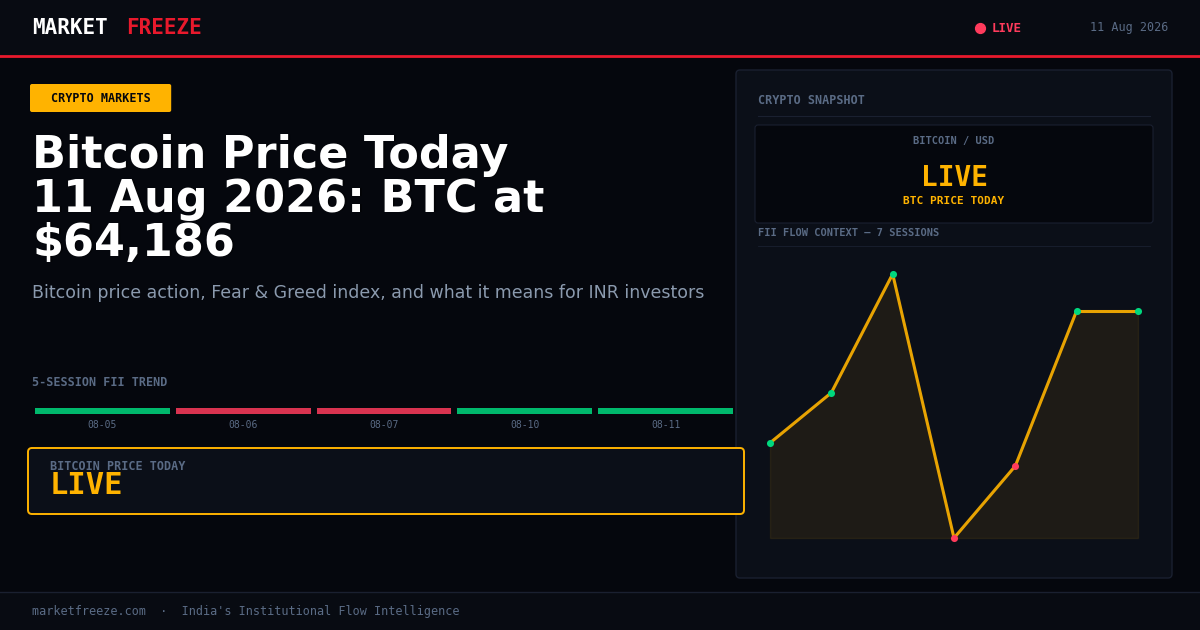
Bitcoin is trading at $64,186 USD, equivalent to ₹6,121,418 INR, experiencing a -1.06% dip in the last 24 hours. This price action unfolds amidst a broader crypto market showing caution and a renewed focus on real-world asset tokenization, as highlighted by the news that blockchain startups are looking to bring liquidity to the booming Pokémon card market by tokenizing physical cards into digital assets.
Open a free demat account with
Upstox
or
Angel One
— zero brokerage on delivery trades.
FIIs Inject Capital Amidst Crypto’s Cautious Tone
Today, foreign institutional investors (FIIs) have demonstrated a strong commitment to Indian equities, marking a net buy of ₹1,975 Cr. This influx of foreign capital into the Indian market contrasts with a subdued performance across major cryptocurrencies. Bitcoin is down -1.06% to $64,186 USD (₹6,121,418 INR), and Ethereum has seen a -1.02% decline to $1,887 USD (₹179,963 INR). The ETH/BTC ratio stands at 0.0294, indicating Bitcoin is holding steadier than Ethereum. Solana is also in the red, down -1.00% to $75.85 USD (₹7,233 INR). This divergence suggests that institutional capital, while actively seeking opportunities in India’s equity landscape, is not translating into significant inflows into the crypto space at this moment. The Fear & Greed index is currently at 29/100, firmly in the ‘Fear’ territory, which historically has been an accumulation zone for sustained institutional buying, but today’s FII flow indicates a preference for traditional assets.
The Impact of USD/INR on Indian Crypto Investors
The current USD/INR exchange rate stands at ₹95.37. For Indian retail investors holding cryptocurrencies denominated in USD, this exchange rate has a direct impact on their realized returns when converting back to INR. A strengthening INR (which would imply a lower USD/INR rate) would reduce the INR value of their crypto holdings, assuming the USD price remains constant. Conversely, a weakening INR (a higher USD/INR rate) would boost the INR value. Today, with the USD/INR at ₹95.37, any depreciation in the INR against the dollar will serve as a partial buffer against the minor dips seen in major cryptocurrencies like Bitcoin (-1.06%) and Ethereum (-1.02%). For example, a 1% drop in Bitcoin’s USD price could be offset by a similar depreciation in the INR, leading to a more stable INR-denominated return for Indian investors. This dynamic underscores the importance of monitoring both crypto price action and the forex market for a complete picture of an Indian investor’s portfolio performance.
FII Flows and the Crypto Capital Thesis
The ₹1,975 Cr net buying by FIIs in Indian equities today is a significant data point that warrants attention from crypto investors. Historically, periods of strong FII inflows into equities have sometimes correlated with increased speculative capital finding its way into riskier assets, including cryptocurrencies. However, this correlation is not always direct and can be influenced by numerous factors such as global liquidity, specific asset class attractiveness, and regulatory environments. The current ‘Fear’ reading on the Fear & Greed index (29/100) suggests that crypto markets are not yet experiencing a strong speculative boom, despite the positive institutional sentiment towards Indian equities. The sustained institutional buying observed in crypto during periods of similar ‘Fear & Greed’ readings (25-45 range) in March 2020 and Q4 2022 suggests that if this cautious sentiment persists or deepens, it could present an opportunity for accumulation, provided FII flows eventually find their way into digital assets. For now, the capital appears to be predominantly channeled into the Indian stock market.
Solana’s Global Reach Expands with MoneyGram Partnership
In a significant development for the altcoin ecosystem, Solana is expanding its reach through a partnership with MoneyGram. This collaboration will allow wallets and applications built on the Solana blockchain to leverage MoneyGram’s extensive global network, facilitating seamless conversion between digital assets and local fiat currencies. This move is particularly impactful as it addresses a critical bottleneck in crypto adoption: the ease of on-ramping and off-ramping fiat. The news comes as Solana itself experiences a slight dip of -1.00% to $75.85 USD (₹7,233 INR) in the last 24 hours, mirroring the broader market trend. However, the strategic partnership with MoneyGram positions Solana to capture a larger share of mainstream users seeking practical utility from their digital assets, potentially driving future demand and adoption beyond speculative trading. This development is a testament to the ongoing innovation in the crypto space, even as Bitcoin and Ethereum experience minor pullbacks.
Navigating Crypto Tax: A Bitcoin Scenario
Understanding the tax implications of cryptocurrency trading in India is crucial for all investors. Let’s consider a scenario for an Indian investor looking to sell Bitcoin. Suppose an investor purchased 0.5 BTC when it was priced at $60,000 USD (approximately ₹5,700,000 INR at the time), and today they decide to sell it at the current price of $64,186 USD (₹6,121,418 INR). The profit on this transaction would be approximately $4,186 USD per Bitcoin, or ₹421,418 INR per Bitcoin. For 0.5 BTC, this would amount to a capital gain of approximately $2,093 USD (₹210,709 INR). Under India’s current crypto tax laws, this gain would be subject to a 30% tax rate, plus applicable surcharges and cess. Therefore, the tax liability on this specific transaction would be roughly ₹63,212.70 INR. It’s important to note that losses from crypto trading cannot be offset against other income, and only profits are taxed. This highlights the importance of diligent record-keeping for all crypto transactions.
The ‘Fear’ Zone and Institutional Accumulation Potential
The Fear & Greed index currently stands at 29/100, firmly within the ‘Fear’ zone. Historically, as per the provided context, readings within the 25-45 range have often signaled accumulation phases for institutional investors. The chart data shows that in March 2020 and Q4 2022, sustained institutional buying commenced when these fear indicators were prevalent. While today’s FII flow of ₹1,975 Cr is directed towards Indian equities, the current crypto market’s fear sentiment could, in a different scenario, attract similar institutional attention to digital assets. If the broader market sentiment shifts or if these ‘Fear’ readings persist, we might see a gradual increase in institutional interest in cryptocurrencies. For now, however, the focus of institutional capital seems to be on the Indian equity market, as evidenced by today’s FII activity. The key takeaway is that prolonged periods of fear in the crypto market, when accompanied by favorable macroeconomic conditions, have historically been conducive to significant institutional entry.
Market Freeze Crypto FAQ
What was FII’s net investment in Indian equities on August 10, 2026?
On August 10, 2026, FIIs were net buyers in Indian equities to the tune of +₹1,974.76 Cr.
What was DII’s net investment in Indian equities on August 5, 2026?
On August 5, 2026, DIIs were net sellers in Indian equities with a net figure of ₹-936.14 Cr.
What is the trend of FII investment in Indian equities in early August 2026?
In early August 2026, FIIs have shown a mixed trend with significant buying on August 5th (+₹2,446.47 Cr) and August 10th/11th (+₹1,974.76 Cr), interspersed with net selling on August 6th (₹-943.42 Cr). However, the recent trend indicates a return to net buying.
Key Levels to Watch for Nifty
Considering the recent FII buying trend and today’s Nifty close of 24471.70, key levels to watch would be the immediate support around the 24,300 mark, which historically has seen buying interest emerge. Resistance is expected around the 24,600-24,700 range, where selling pressure may increase, especially if global cues turn negative or if FII flows show a significant slowdown. The sustained FII inflows suggest a bullish undertone, but the global crypto ‘Fear’ sentiment and the USD/INR rate of ₹95.37 warrant cautious optimism.
The Indian government has been actively refining its approach to digital assets, with recent discussions around the taxation of Virtual Digital Assets (VDAs). While the existing 30% tax on crypto gains remains a significant factor for investors, there’s an ongoing dialogue about potentially introducing a Goods and Services Tax (GST) on VDA transactions. Currently, the 30% tax is levied on all VDA gains, irrespective of the holding period, and losses cannot be offset against other income. If a GST were to be implemented, it could add another layer of taxation, impacting the profitability of crypto trades further. For instance, a hypothetical 1% GST on a $2,093 USD (₹210,709 INR) profit from selling 0.5 BTC could add approximately $20.93 USD (₹2,107 INR) to the tax burden, in addition to the 30% income tax. This potential shift warrants close monitoring by Indian crypto enthusiasts.
Strategic Accumulation Framework: Key Levels for Bitcoin and Ethereum
Given the current ‘Fear’ sentiment in the crypto market (Fear & Greed Index: 29/100) and the divergence in institutional flows, adopting a strategic accumulation framework can be beneficial for Indian investors. For Bitcoin, the immediate support level to watch is around $60,000 USD (₹5,700,000 INR), a level that has historically acted as a strong floor and psychological barrier. A sustained hold above this could see upward pressure towards the $68,000 – $70,000 USD (₹6,470,000 – ₹6,660,000 INR) range. Conversely, a break below $60,000 USD (₹5,700,000 INR) might trigger a retest of the $55,000 USD (₹5,240,000 INR) mark, which represented significant accumulation zones during previous cycles. For Ethereum, immediate support lies around the $1,700 USD (₹162,000 INR) to $1,800 USD (₹171,500 INR) range. A bounce from here could target the $2,000 – $2,100 USD (₹190,500 – ₹200,000 INR) resistance. A failure to hold the support could lead to a decline towards the $1,500 USD (₹143,000 INR) level, which represents a crucial pivot point. These levels, when combined with the prevailing USD/INR rate of ₹95.37, provide actionable insights for portfolio adjustments.
Bottom Line
Today’s market action presents a picture of divergent institutional capital allocation, with significant FII inflows into Indian equities contrasting with a cautious crypto market. While Bitcoin and Ethereum are experiencing minor declines, the strategic expansion of Solana via its MoneyGram partnership highlights ongoing utility-driven developments. The current ‘Fear’ reading in the crypto market, coupled with historical data, suggests potential accumulation zones may be forming, though immediate institutional focus remains on Indian stocks. Indian investors must continue to monitor both crypto price action and the USD/INR rate for a comprehensive view of their portfolio performance.
Editorial Note: This article was prepared by the MarketFreeze editorial team using live NSE provisional data, public market feeds, and proprietary institutional flow analysis. All price and flow figures are sourced directly from NSE, BSE, and CoinGecko as of 11 August 2026. This content is for informational purposes only and does not constitute investment advice. MarketFreeze is not SEBI-registered. Please consult a qualified financial advisor before making investment decisions. Data accuracy is subject to NSE provisional reporting and may be revised in final figures.