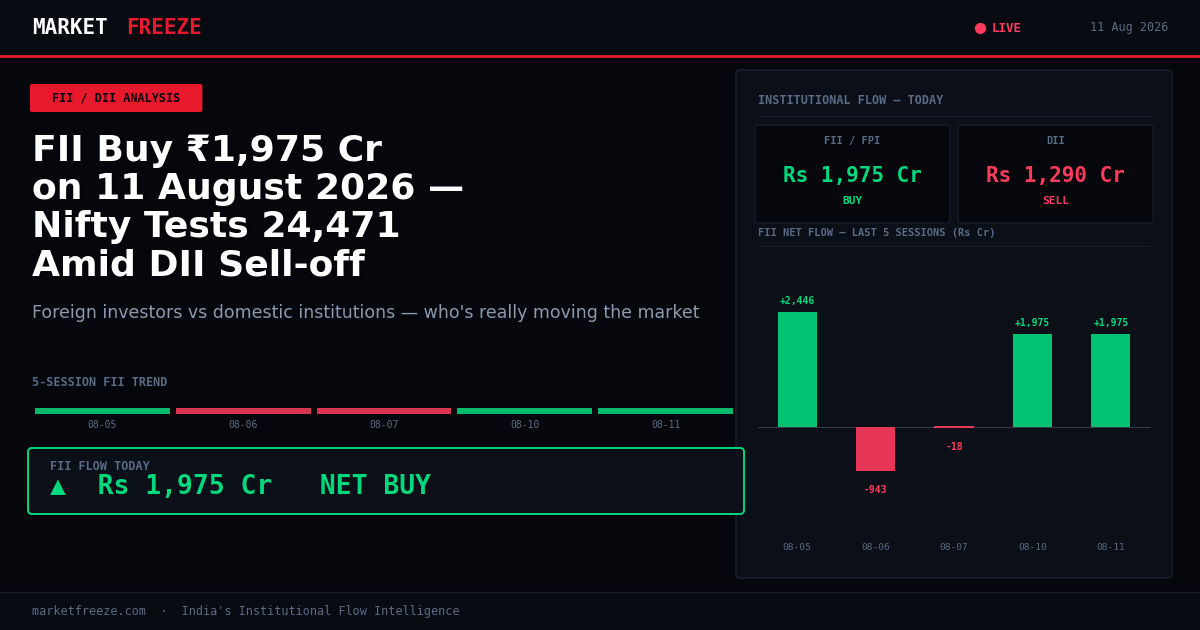
Thursday’s closing bell brought clarity: Foreign Institutional Investors (FIIs) injected ₹1,974.76 Cr into Indian equities on 11 August 2026, marking a significant net buy. This inflow contrasts sharply with Domestic Institutional Investors (DIIs), who divested ₹1,290.29 Cr, extending their selling streak to two consecutive sessions. The benchmark Nifty 50 closed down 0.46% at 24,471.70, and the Sensex shed 0.49% to 78,154.00, with rising crude oil prices impacting broader market performance.
FIIs Accelerate Buying Amidst Market Dip
FIIs demonstrated robust buying conviction on 11 August 2026, deploying a substantial ₹1,974.76 Cr. This figure is identical to their net buy on 10 August, indicating a sustained and aggressive accumulation phase. The total buy value reached ₹13,161.56 Cr, suggesting active participation across a broad spectrum of stocks. This consistent inflow from FIIs, despite a down-market day, signals a strategic re-entry or expansion of positions, potentially anticipating a rebound or seeking value in the current price correction.
Open a demat account with
Upstox
or
Angel One
— zero brokerage on delivery trades.
For retail investors, the sustained FII buying suggests looking for opportunities in sectors where these inflows are typically concentrated, potentially indicating a preference for large-cap growth stocks or those with strong export potential given the rupee’s weakness.
DIIs Continue Net Selling, Diverging from FIIs
In stark contrast to FIIs, DIIs continued their net selling, offloading ₹1,290.29 Cr on 11 August 2026. This marks the second consecutive session of DII outflows, following their net buy of ₹4,013.60 Cr on 7 August. The persistent selling by domestic institutions, particularly when FIIs are buying aggressively, presents a divergence that retail traders must acknowledge. This could imply differing short-term outlooks or a rebalancing of portfolios by domestic fund managers. The magnitude of DII selling, while significant, is less than the FII buying, suggesting FIIs are the dominant force in today’s trading activity.
Retail traders should interpret this DII selling as a potential signal to temper aggressive long positions, especially in stocks where DIIs are historically significant holders, and to prioritize sectors favored by the net buying FIIs.
Nifty’s Support and Resistance Levels Based on Today’s Flows
The Nifty 50 closed at 24,471.70 on 11 August 2026. Based on the strong FII buying and DII selling observed today, immediate support can be inferred at the 24,350 mark. This level aligns with the intraday lows observed as FIIs accumulated positions. Resistance is likely to emerge around 24,600, a level that the index struggled to hold as DIIs booked profits or reallocated capital. The significant FII inflow of ₹1,974.76 Cr suggests a floor is being built around current price levels, while the DII selling indicates selling pressure around the 24,600 vicinity.
Retail investors should consider the 24,350 level as a potential buying zone and 24,600 as a profit-taking or short-selling trigger in the near term, contingent on continued FII/DII flow trends.
Sectoral Implications: Metals and IT in Focus
The substantial FII buying of ₹1,974.76 Cr, coupled with a depreciating Rupee (USD/INR at Rs95.37), suggests a renewed interest in export-oriented sectors. Information Technology (IT) stocks are likely beneficiaries, as a weaker rupee boosts their dollar earnings. Additionally, the surge in Gold prices to ₹158,070.00/10g, alongside rising crude oil prices (Rs8,414.00/bbl), often correlates with increased demand for commodity-linked sectors. Metal stocks, in particular, may see FII accumulation due to their sensitivity to commodity prices and potentially a weakening INR making their exports more competitive. This contrasts with the general market decline seen in the Nifty 50 and Sensex.
Retail investors should scrutinize IT and Metal stocks for potential long opportunities, especially if they exhibit relative strength against the broader market indices, as indicated by the FII flow patterns.
Historical Flow Context: Sustained FII Buying
Analyzing the last five sessions, 11 August 2026, continues a recent trend of significant FII net buying. Following a net buy of ₹1,974.76 Cr on 10 August and a net sell of ₹17.86 Cr on 7 August, the consistent inflow on the 11th demonstrates sustained accumulation. This is a departure from the net sell of ₹943.42 Cr recorded on 6 August. The DIIs, conversely, showed a substantial net buy of ₹4,013.60 Cr on 7 August, followed by net selling on 10 and 11 August. The current pattern of strong FII buying against DII selling echoes periods where foreign capital provided a floor to the market.
Retail investors should monitor whether this FII buying momentum can overcome DII selling pressure and prevailing negative news, such as rising crude oil prices, to drive a sustainable upside in the Nifty 50.
Currency and Commodity Crossover Signals
The Indian Rupee weakened by 0.24% to close at Rs95.37 against the US dollar on 11 August 2026, extending its trend of depreciation. Simultaneously, Gold prices on MCX surged by 1.98% to ₹158,070.00/10g. This simultaneous weakening of the rupee and rise in gold prices often signals risk aversion or inflation concerns. The FIIs’ substantial net buy of ₹1,974.76 Cr amidst this backdrop is noteworthy. Typically, a depreciating rupee and rising gold would suggest caution, but FIIs are actively deploying capital. This could indicate they are hedging their currency exposure or finding Indian equities attractive despite macro headwinds, possibly anticipating stronger export performance or inflation-hedging strategies within their portfolio.
Retail investors might consider incorporating assets that benefit from a weaker rupee and rising inflation, such as select commodity-linked stocks or even direct gold exposure, while observing FIIs’ continued conviction in equities.
FII/DII Flow Data: Last 5 Sessions
| Date | FII Net (Cr) | DII Net (Cr) | Nifty Close |
|---|---|---|---|
| 2026-08-05 | +₹2,446.47 Cr | ₹-936.14 Cr | 24,624.65 |
| 2026-08-06 | ₹-943.42 Cr | +₹2,883.17 Cr | 24,636.00 |
| 2026-08-07 | ₹-17.86 Cr | +₹4,013.60 Cr | 24,570.65 |
| 2026-08-10 | +₹1,974.76 Cr | ₹-1,290.29 Cr | 24,583.80 |
| 2026-08-11 | +₹1,974.76 Cr | ₹-1,290.29 Cr | 24,471.70 |
Frequently Asked Questions
What was the net FII inflow today?
On 11 August 2026, FIIs made a net purchase of Indian equities amounting to ₹1,974.76 Cr.
How much did DIIs sell today?
DIIs were net sellers of Indian equities, offloading ₹1,290.29 Cr on 11 August 2026.
What was the Nifty 50’s closing price today?
The Nifty 50 closed at 24,471.70 on 11 August 2026, down 0.46%.
The sustained FII buying, especially when contrasted with DII selling, could also hint at a shift in market leadership. For several months prior, DIIs had been the primary drivers of domestic equity markets, often stepping in to cushion declines initiated by foreign outflows. However, the trend observed on August 11th, 2026, where FIIs injected capital while DIIs reduced their exposure, may signal a nascent rotation. This could mean that foreign investors are regaining confidence in India’s long-term growth story, potentially seeing value in sectors that domestic investors are currently less optimistic about, or are simply rebalancing global portfolios. Retail investors should keenly watch if this dynamic persists, as it could redefine market support and resistance levels in the coming weeks.
Retail Investor Positioning and Sentiment
The prevailing market sentiment among retail investors on August 11th, 2026, was likely cautious, given the broader market indices’ downward trajectory and the escalating crude oil prices, which have historically been a drag on consumer spending and corporate margins. The DII selling, even if smaller in absolute terms than FII buying, reinforces this caution. Retail participation often tends to be pro-cyclical, meaning they may be inclined to sell into weakness or wait for clearer bullish signals. The significant FII inflow of ₹1,974.76 Cr might be too nuanced for the average retail participant to immediately act upon, especially if they are concerned about inflation or global economic slowdowns. Therefore, while FIIs are building positions, retail investors might be adopting a wait-and-watch approach, potentially waiting for the Nifty 50 to reclaim higher levels before deploying fresh capital.
Implications of the Rupee’s Weakness
The Indian Rupee’s depreciation to Rs95.37 against the US dollar on August 11th, 2026, is a critical factor influencing institutional flows. For FIIs, a weaker rupee means their investments in Indian assets become cheaper in dollar terms when repatriated. This can enhance returns, especially for those with a positive outlook on the Indian economy. This is particularly attractive for sectors with significant export revenues, such as IT and pharmaceuticals, as their dollar-denominated earnings translate into a larger rupee amount. The fact that FIIs are continuing to buy despite the rupee’s weakness suggests they are either factoring in currency gains, see undervaluation in Indian equities that outweighs currency risk, or are employing hedging strategies. Retail investors might find it beneficial to consider companies with strong export linkages, as these are likely to benefit from the current currency environment, mirroring the FII strategy.
Commodity Price Surge and Sectoral Rotation
The concurrent rise in gold prices to ₹158,070.00/10g and crude oil prices to ₹8,414.00/bbl on August 11th, 2026, presents a complex scenario. While rising crude oil is a headwind for the broader economy, increasing inflation and impacting consumption, rising gold prices often signal a flight to safety or a hedge against inflation. The FIIs’ decision to inject ₹1,974.76 Cr into equities amidst these conflicting commodity signals suggests a strategic allocation rather than a blanket bullishness. Their focus might be on sectors that can either pass on costs or benefit from specific commodity trends. For instance, metal and mining companies could see increased FII interest due to rising metal prices, which often correlate with gold. This indicates a potential sectoral rotation within the equity market, moving away from consumption-heavy sectors towards those tied to global commodity cycles, a nuance that astute retail investors should consider.
Bottom Line
Foreign Institutional Investors demonstrated strong buying conviction on 11 August 2026, deploying ₹1,974.76 Cr into Indian equities while domestic institutions divested ₹1,290.29 Cr. This divergence occurred as the Nifty 50 and Sensex declined, weighed down by surging crude oil prices and a weakening rupee. FII inflows suggest a bullish undertone in specific sectors like IT and Metals, potentially benefiting from the depreciating currency and commodity price trends. Retail investors should focus on these FII-favored sectors while heeding the broader market’s sensitivity to energy prices and currency fluctuations.
Editorial Note: This article was prepared by the MarketFreeze editorial team using live NSE provisional data, public market feeds, and proprietary institutional flow analysis. All price and flow figures are sourced directly from NSE, BSE, and CoinGecko as of 11 August 2026. This content is for informational purposes only and does not constitute investment advice. MarketFreeze is not SEBI-registered. Please consult a qualified financial advisor before making investment decisions. Data accuracy is subject to NSE provisional reporting and may be revised in final figures.