Indian Equities Retreat as Surging Crude Oil Dampens Sentiment; FIIs Turn Net Buyers Amidst Sectoral Rotation
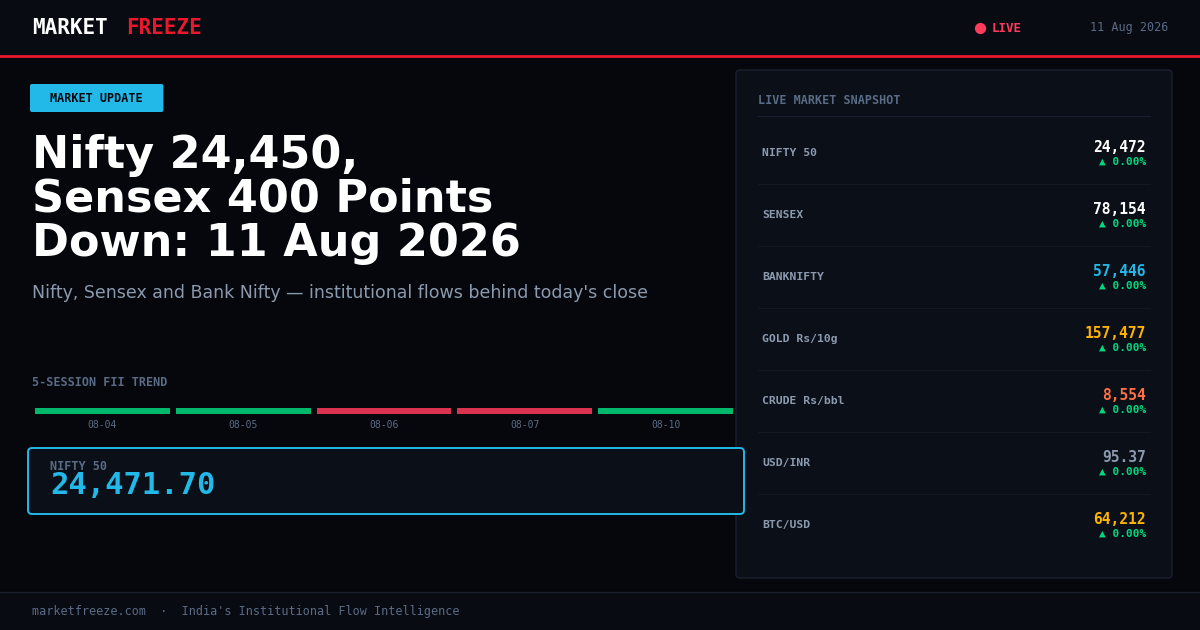
On Tuesday, August 11, 2026, the Nifty 50 closed at 24,471.70, down 0.46%, and the Sensex dropped 0.49% to 78,154.00, primarily driven by elevated crude oil prices that pushed MCX Crude to Rs8,554.00 per barrel, a 2.25% surge. This broad market decline was accompanied by a notable shift in institutional flows, with Foreign Institutional Investors (FIIs) emerging as net buyers to the tune of ₹1,974.76 Cr, while Domestic Institutional Investors (DIIs) were net sellers at ₹1,290.29 Cr, a reversal from their consistent buying in the preceding two sessions.
Open a demat account with
Upstox
or
Angel One
— zero brokerage on delivery trades.
FIIs Inject Capital as DIIs Pare Holdings Amidst Crude Oil Shock
The day’s most significant institutional activity saw FIIs reverse their recent selling trend to become substantial net buyers, injecting ₹1,974.76 Cr into Indian equities. This robust buying by foreign investors stands in contrast to the DIIs, who booked profits, turning net sellers with an outflow of ₹1,290.29 Cr. This inter-institutional flow dynamic suggests a divergence in sentiment, with FIIs potentially viewing the market pullback as a buying opportunity, while DIIs may be de-risking their portfolios in response to the escalating crude oil prices and the subsequent pressure on the broader market indices, which saw the Nifty 50 fall to 24,471.70 and the Sensex to 78,154.00.
Sectoral Divide: IT Shines as Financials and PSU Banks Buckle Under Pressure
The market’s sectoral performance on August 11, 2026, reflected a clear divide, with the Nifty IT index exhibiting resilience, gaining 0.86%. This performance is particularly noteworthy given the broader market decline. Conversely, the Nifty Financial Services index shed 0.68%, with the banking sector also feeling the heat, as evidenced by the Nifty Bank’s 0.42% decline to 57,446.00 and the Nifty PSU Bank index falling 0.55%. The surge in crude oil prices, a significant cost input for many industrial sectors and a factor impacting inflation, likely contributed to the weakness in financial services and banks, which are sensitive to interest rate expectations and economic growth prospects. The Nifty Metal index saw a modest gain of 0.18% and Nifty Realty advanced 0.07%, indicating some pockets of strength, while specific stocks like Triveni Turbine experienced a significant tumble of 5%.
Navigating the Nifty Landscape: Support and Resistance Levels Driven by Recent Flows
Analyzing the institutional flow data from the past five sessions reveals key levels for the Nifty 50. On August 10, when FIIs were net buyers of ₹1,974.76 Cr and DIIs were net sellers of ₹1,290.29 Cr, the Nifty closed at 24,583.80. Prior to that, on August 7, with FIIs being net sellers of ₹17.86 Cr and DIIs net buyers of ₹4,013.60 Cr, the Nifty closed at 24,570.65. On August 6, FIIs were net sellers of ₹943.42 Cr and DIIs net buyers of ₹2,883.17 Cr, with the Nifty closing at 24,636.00. The significant buying by FIIs on August 10, despite the market’s decline to 24,471.70 today, suggests a potential support zone around the 24,450-24,500 level. Conversely, the selling pressure observed on August 6 and 7, coupled with today’s weakness, indicates that the 24,650-24,700 band could act as immediate resistance. A decisive breach above 24,700, supported by sustained FII inflows, would signal a potential shift in momentum, while a fall below 24,450, accompanied by renewed institutional selling, could intensify downside pressure.
Commodity Crosscurrents: Crude Oil’s Ascent and its Shadow on Indian Equities
The day’s market narrative was significantly influenced by commodity price movements, particularly the sharp 2.25% rise in MCX Crude oil to Rs8,554.00 per barrel. This surge in oil prices, a critical import for India, directly impacts the country’s inflation outlook and trade deficit, creating headwinds for the broader economy and equity markets. The supporting news also explicitly linked the market’s pressure to “surging crude oil prices.” This commodity-driven sentiment likely contributed to the day’s overall bearishness and the selling observed in sectors sensitive to input costs and consumer spending. In contrast, Gold MCX saw a positive uptick of 1.60%, closing at Rs157,481.00 per 10g, indicating a potential safe-haven appeal amidst global uncertainties and rising inflation concerns, though this did not translate into broad market buying.
Historical Echoes: Navigating Market Declines with Divergent FII/DII Flows
Examining historical data provides context for today’s institutional activity. On August 6, 2026, FIIs were net sellers of ₹943.42 Cr while DIIs were net buyers of ₹2,883.17 Cr, preceding a period where the Nifty saw a slight uptick in the subsequent two sessions before today’s retreat. Similarly, on August 7, FIIs were net sellers of ₹17.86 Cr and DIIs net buyers of ₹4,013.60 Cr. Today’s scenario, with FIIs turning aggressive buyers amidst a market dip driven by external factors like crude oil, echoes instances where foreign investors have utilized temporary sell-offs to increase their positions. The key difference today is the magnitude of FII buying (₹1,974.76 Cr) against DII selling (₹1,290.29 Cr), suggesting a more conviction-driven entry by FIIs compared to the profit-taking by domestic institutions.
Portfolio Resilience: A Framework for Navigating Crude Oil Volatility
In the current market environment, characterized by rising crude oil prices and divergent institutional flows, investors may consider a strategic portfolio adjustment. A recommended approach involves overweighting sectors less sensitive to crude oil price hikes and potentially benefiting from inflationary trends. The Nifty IT index’s strength today (+0.86%) suggests that technology companies, with their often global revenue streams and lower direct exposure to commodity costs, could offer relative stability. Conversely, reducing exposure to highly cyclical sectors or those with significant import dependencies, such as certain manufacturing or capital goods companies, might be prudent. For instance, maintaining a portfolio allocation where at least 20% is in IT and 15% in defensive sectors like pharmaceuticals, while capping exposure to energy-intensive industries to below 10%, could provide a balanced approach. The observed FII buying today (₹1,974.76 Cr) suggests a potential re-allocation towards growth sectors, while DII selling (₹1,290.29 Cr) indicates a more cautious stance, possibly exiting overvalued or high-risk assets.
Key Levels to Watch
Nifty 50 Support: The confluence of yesterday’s closing level of 24,583.80 and the significant FII buying on August 10 suggests that the 24,450-24,500 zone is a critical immediate support. A sustained hold above this level, especially with continued FII inflows, would be a positive sign. The next significant support would be around the 24,200 mark, which has seen buying interest in the past.
Nifty 50 Resistance: Today’s closing level of 24,471.70, coupled with the intraday low, indicates that the 24,500 level has become a near-term resistance. A move above 24,550, and more importantly, a decisive breach of the 24,650-24,700 band, would be required to negate the bearish sentiment and signal a potential upward trend, with strong follow-through buying from institutions being crucial.
What Changes This Outlook: The primary trigger to watch would be a sustained increase in crude oil prices beyond Rs9,000 per barrel, coupled with a widening trade deficit. Conversely, a sharp correction in crude oil prices back towards Rs7,500-Rs8,000, supported by a positive shift in FII flows (i.e., continued net buying exceeding ₹2,000 Cr daily for three consecutive sessions) and stabilization in global geopolitical tensions, could rapidly alter the market’s trajectory.
| Date | FII Net (Cr) | DII Net (Cr) | Nifty Close |
|---|---|---|---|
| 2026-08-04 | +₹922.26 Cr | +₹1,571.18 Cr | 24,614.90 |
| 2026-08-05 | +₹2,446.47 Cr | ₹-936.14 Cr | 24,624.65 |
| 2026-08-06 | ₹-943.42 Cr | +₹2,883.17 Cr | 24,636.00 |
| 2026-08-07 | ₹-17.86 Cr | +₹4,013.60 Cr | 24,570.65 |
| 2026-08-10 | +₹1,974.76 Cr | ₹-1,290.29 Cr | 24,583.80 |
Frequently Asked Questions
Q: What did FII buy or sell on August 10, 2026?
A: On August 10, 2026, FIIs were net buyers of Indian equities to the tune of ₹1,974.76 Cr.
Q: What did DII buy on August 11, 2026?
A: On August 11, 2026, DIIs were net sellers of Indian equities, with net outflows of ₹1,290.29 Cr.
Q: Is FII buying or selling in August 2026?
A: In August 2026, FII flows have been mixed, with significant buying on August 5 (+₹2,446.47 Cr) and August 10 (+₹1,974.76 Cr), interspersed with selling on August 6 (₹-943.42 Cr) and minimal selling on August 7 (₹-17.86 Cr). Today’s net buying of ₹1,974.76 Cr indicates a renewed buying interest.
Bottom Line
The Indian market experienced pressure on August 11, 2026, with Nifty 50 closing at 24,471.70, predominantly due to a sharp rise in crude oil prices to Rs8,554.00 per barrel. Institutional flows showed a significant divergence, with FIIs turning strong net buyers at ₹1,974.76 Cr, while DIIs were net sellers of ₹1,290.29 Cr. This suggests foreign investors see value in the current dip, particularly in sectors like IT, while domestic institutions are booking profits amid rising commodity costs and potential inflation concerns.
Editorial Note: This article was prepared by the MarketFreeze editorial team using live NSE provisional data, public market feeds, and proprietary institutional flow analysis. All price and flow figures are sourced directly from NSE, BSE, and CoinGecko as of 11 August 2026. This content is for informational purposes only and does not constitute investment advice. MarketFreeze is not SEBI-registered. Please consult a qualified financial advisor before making investment decisions. Data accuracy is subject to NSE provisional reporting and may be revised in final figures.