Bitcoin has traded at $76,840 USD or ₹7,378,176 INR in the last 24 hours, marking a +1.21% increase. The cryptocurrency market is seeing a notable push towards institutional adoption and regulatory clarity today, driven by S&P Global’s acquisition of OpenZeppelin and the SEC’s introduction of an ‘innovation exemption’ for tokenized securities. This dual development signals a maturing ecosystem where established financial players are actively engaging with digital assets and the underlying blockchain technology. While the crypto majors are showing green, the broader implications for Indian retail investors hinge on the interplay between global crypto movements, the USD/INR exchange rate, and domestic institutional flows.
Open a free demat account with
Upstox
or
Angel One
— zero brokerage on delivery trades.
S&P Global’s OpenZeppelin Acquisition Signals Deepening Institutional Integration
The acquisition of OpenZeppelin by S&P Global is a watershed moment, underscoring the increasing demand for robust risk management solutions within the tokenized finance space. OpenZeppelin, a leader in smart contract security and development, will integrate into S&P Global’s Risk Market Services division. This move is not just about acquiring a technology provider; it’s about S&P Global positioning itself to offer critical data and analytics for the burgeoning on-chain economy. For Indian investors, this means that as institutional capital ventures further into digital assets, the infrastructure for assessing and mitigating risks is being built by traditional financial giants. This could pave the way for more regulated and institutional-grade products in the future, potentially impacting the accessibility and perceived safety of cryptocurrencies for a wider Indian investor base. The acquisition builds on S&P Global’s prior investment in crypto data provider Kaiko, further solidifying its commitment to the digital asset landscape.
SEC’s ‘Innovation Exemption’ Opens Doors for Tokenized Securities
The U.S. Securities and Exchange Commission (SEC) has unveiled its long-awaited ‘innovation exemption,’ a five-year blanket waiver that allows for the listing and trading of tokenized securities without requiring registration as an exchange. This regulatory development is profoundly significant for the future of digital asset markets. By providing a clear, albeit temporary, pathway for the trading of tokenized traditional securities, the SEC is fostering an environment conducive to innovation. Indian investors who are also participants in global markets or are considering exposure to tokenized real-world assets may find this exemption a catalyst for increased liquidity and new investment opportunities. The exemption’s duration of five years suggests a period of experimentation and growth, during which the market can demonstrate its viability and inform future, potentially permanent, regulatory frameworks. This proactive approach by the SEC contrasts with the more cautious stance often observed, signaling a potential shift towards embracing blockchain technology within regulated financial products.
USD/INR Dynamics: Hedging Crypto Gains for Indian Investors
Today, the USD/INR stands at ₹96.02. This exchange rate is crucial for Indian retail investors holding cryptocurrencies denominated in USD, such as Bitcoin ($76,840 USD | ₹7,378,176 INR) and Ethereum ($2,463 USD | ₹236,497 INR). A stronger rupee (lower USD/INR) would mean that even if Bitcoin’s USD price remains stable, its INR value would decrease, impacting the realized returns for Indian investors. Conversely, a weaker rupee would amplify any USD gains into larger INR profits. Given the current exchange rate, Indian investors need to factor in these currency fluctuations when assessing their actual portfolio performance. For instance, if an investor were to convert their Bitcoin holdings back to INR today, the exchange rate would directly impact the final INR amount received. This illustrates how the USD/INR rate acts as a critical overlay on global crypto price movements, translating USD-denominated gains or losses into the local currency.
Ethereum and the ETH/BTC Ratio: A Shifting Altcoin Landscape
Ethereum is trading at $2,463 USD or ₹236,497 INR, up +2.38% in the last 24 hours. The ETH/BTC ratio currently stands at 0.0321, indicating that Bitcoin is outperforming Ethereum today. While Ethereum’s absolute gains are positive, the fact that Bitcoin is gaining more ground on a relative basis suggests that investors are favoring Bitcoin’s more established store-of-value narrative or its higher liquidity in the current market environment. This dynamic is important for altcoin investors as the ETH/BTC ratio often serves as a barometer for broader altcoin performance. When ETH outperforms BTC, it typically signals a higher risk appetite and a rotation into other, potentially higher-growth, altcoins. Today’s relative underperformance of ETH against BTC, however, might suggest a more cautious sentiment towards the altcoin market, even with positive price action across the board. Solana, for example, is showing strong gains at $100.32 USD | ₹9,632 INR, up +3.16%, indicating that some altcoins are indeed flying, but the broader trend of altcoin dominance relative to Ethereum is not yet evident.
Fear & Greed Index at Neutral: A Pause Before the Next Move?
The Crypto Fear & Greed Index currently sits at 50/100, indicating a ‘Neutral’ sentiment. Historically, readings in the neutral zone (45-60) are often transitional periods. They do not provide a clear contrarian signal like extreme fear or greed might. Instead, a neutral reading suggests that the market is neither overly euphoric nor excessively fearful, potentially consolidating before a significant directional move. For Indian investors, this neutral phase in global crypto sentiment implies that underlying fundamentals and macro factors, such as institutional flow data and currency movements, will play a more dominant role in driving local market outcomes. The absence of extreme emotions means that price action is likely driven by more rational decision-making, making it crucial to monitor capital flows and regulatory developments closely. The market is at a crossroads, and the next catalyst for a sustained move could emerge from either positive news or shifts in broader financial conditions.
FII Flows and Crypto Capital: A Thesis Under Scrutiny
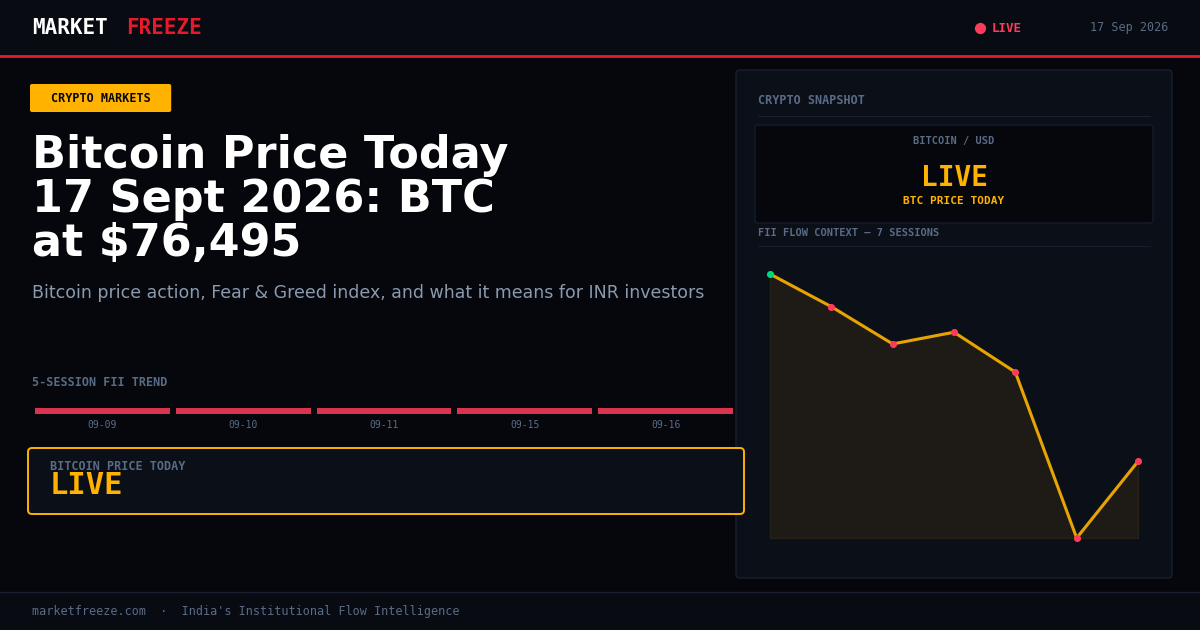
Today, Foreign Institutional Investors (FIIs) have shown net buying of ₹0 Cr in Indian equities, acting as net buyers. This is a significant point of observation when considering the correlation between FII activity and crypto markets. While the FII figure today is flat, the trend over the last five sessions reveals a consistent pattern of FIIs being net sellers in Indian equities, which is then largely offset by robust DII buying. The table below details these flows:
| Date | FII Net (Cr) | DII Net (Cr) | Nifty Close |
|---|---|---|---|
| 2026-09-09 | ₹-583.00 Cr | +₹1,509.00 Cr | 23,431.50 |
| 2026-09-10 | ₹-438.20 Cr | +₹1,025.80 Cr | 23,477.80 |
| 2026-09-11 | ₹-930.90 Cr | +₹1,968.20 Cr | 23,118.60 |
| 2026-09-15 | ₹-2,977.86 Cr | +₹2,686.05 Cr | 23,217.60 |
| 2026-09-16 | ₹-2,032.61 Cr | +₹3,908.23 Cr | 23,270.60 |
The consistent FII outflows from Indian equities, even on days with a net zero figure, raise questions about their overall risk sentiment. Historically, large FII inflows into Indian equities have sometimes coincided with increased risk-on sentiment globally, which can spill over into crypto markets. Conversely, sustained FII outflows might suggest a more risk-off environment, where capital may flow towards perceived safer assets, potentially including Bitcoin as a digital store of value, or away from riskier assets altogether. The flat FII figure today offers little directional clarity, but the underlying trend of net selling warrants close monitoring. If FIIs were to significantly increase their buying in Indian equities, it might signal a broader global capital rotation that could impact crypto flows, both positively and negatively, depending on the specific asset class receiving the capital.
Illustrating Crypto Tax Mechanics with Today’s Bitcoin Price
For Indian investors, understanding the tax implications of crypto transactions is paramount. Let’s consider a hypothetical scenario involving today’s Bitcoin price. Suppose an Indian investor decided to sell 0.5 BTC today. At the current price of $76,840 USD | ₹7,378,176 INR per Bitcoin, the total sale value would be approximately $38,420 USD or ₹3,689,088 INR. Under India’s current tax laws, any gains from the sale of virtual digital assets (VDAs), including cryptocurrencies, are taxed at a flat rate of 30%, plus applicable surcharges and cess. Therefore, if this sale represented a profit, the investor would owe tax on that profit. For example, if the cost of acquiring these 0.5 BTC was $20,000 USD | ₹1,900,000 INR, the taxable gain would be $18,420 USD | ₹1,789,088 INR. The tax liability on this gain would be 30% of ₹1,789,088 INR, which amounts to approximately ₹536,726.40 INR (plus cess). This highlights the importance of meticulous record-keeping for all transactions to accurately calculate taxable gains and ensure compliance with tax regulations. It’s crucial for investors to stay updated on any potential changes in tax laws related to VDAs.
Key Levels to Watch for Nifty
With Nifty closing at 23270.60, and considering the recent FII/DII flow patterns, we observe a trend where DIIs have consistently been net buyers, often offsetting significant FII outflows. This suggests underlying domestic institutional strength supporting the market, even amidst foreign investor caution. For the immediate term, the Nifty’s ability to hold above the 23,000 mark will be critical. If FII outflows accelerate significantly, a test of the 23,000 support level is probable. Conversely, sustained DII buying and any positive shift in FII sentiment could see Nifty aiming for immediate resistance around the 23,400-23,500 levels, which have been tested recently. The neutral Fear & Greed index suggests that the market is not driven by irrational exuberance, making these flow-based levels more relevant as potential turning points.
Bottom Line
Today’s crypto market activity is characterized by institutional integration signals, with S&P Global’s acquisition of OpenZeppelin and the SEC’s ‘innovation exemption’ pointing towards a more structured future for digital assets. While Bitcoin and Ethereum show modest gains, the USD/INR rate remains a key factor for Indian investors’ realized returns. The neutral Fear & Greed index suggests a market pause, making FII/DII flows and currency dynamics the primary drivers for Indian equities. Investors should remain vigilant of these interconnected factors as global and domestic markets navigate evolving landscapes.
Frequently Asked Questions
-
Q: What did FII buy or sell on 2026-09-15?
A: FII were net sellers of ₹-2,977.86 Cr on 2026-09-15.
-
Q: What did DII buy on 2026-09-16?
A: DII were net buyers of +₹3,908.23 Cr on 2026-09-16.
-
Q: Is FII buying or selling in September 2026?
A: Based on the data from the first half of September 2026, FIIs have predominantly been net sellers in Indian equities, with outflows noted on 2026-09-09 (₹-583.00 Cr), 2026-09-10 (₹-438.20 Cr), 2026-09-11 (₹-930.90 Cr), 2026-09-15 (₹-2,977.86 Cr), and 2026-09-16 (₹-2,032.61 Cr). This trend suggests a cautious stance from foreign institutional investors in the Indian equity market during this period.
Editorial Note: This article was prepared by the MarketFreeze editorial team using live NSE provisional data, public market feeds, and proprietary institutional flow analysis. All price and flow figures are sourced directly from NSE, BSE, and CoinGecko as of 17 September 2026. This content is for informational purposes only and does not constitute investment advice. MarketFreeze is not SEBI-registered. Please consult a qualified financial advisor before making investment decisions. Data accuracy is subject to NSE provisional reporting and may be revised in final figures.