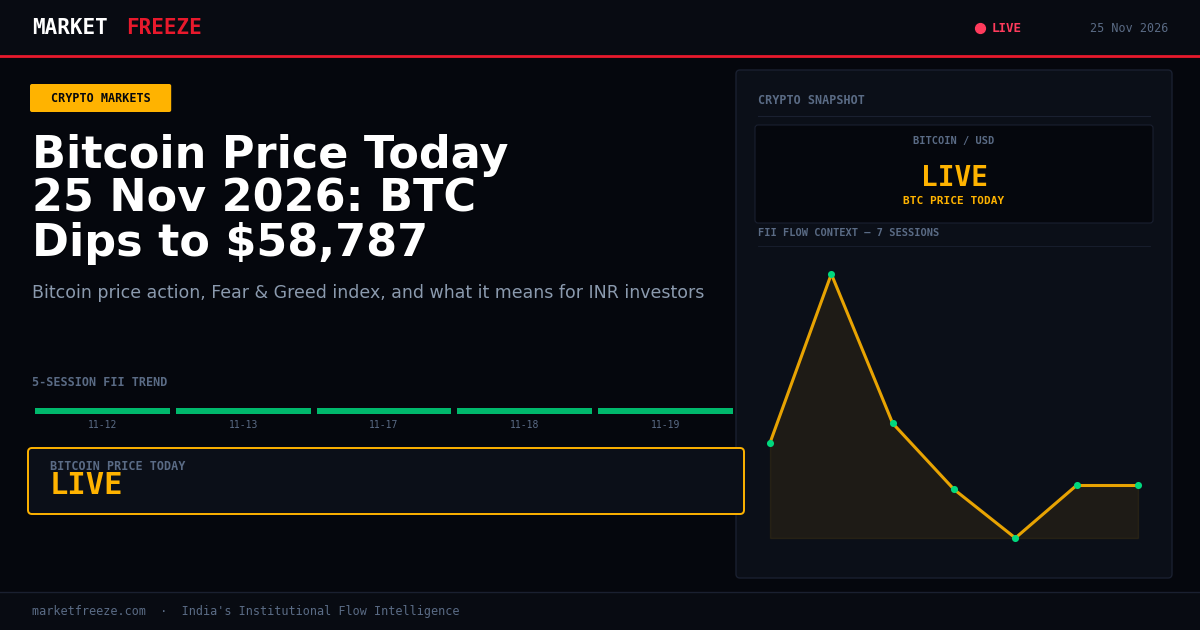
Bitcoin is trading at $58,793 USD or ₹5,463,633 INR, down 2.15% in the last 24 hours. The recent selloff in equities, as highlighted by Ether and DeFi tokens falling twice as hard as Bitcoin, is clearly impacting broader risk assets. This sharp decline across the digital asset space, coupled with a severe drop in the Fear & Greed index, presents a critical juncture for investors.
Open a free demat account with
Upstox
or
Angel One
— zero brokerage on delivery trades.
Ether and DeFi’s Steep Slide Amidst Broader Equity Weakness
The news that Ether and DeFi tokens are experiencing twice the decline of Bitcoin underscores a significant risk-off sentiment permeating the digital asset markets. With Ether trading at $1,650 USD or ₹153,334 INR, down 2.51%, and Solana at $67.84 USD or ₹6,304 INR, down 2.90%, the altcoin sector is bearing the brunt of this selloff. This divergence suggests that investors are retreating from higher-risk altcoins in favor of perceived safety within Bitcoin, or indeed, exiting crypto altogether. The ETH/BTC ratio, currently at 0.0281, reflects this Bitcoin outperformance, but the overall downward trend in both major cryptocurrencies signals a challenging environment. The implication for Indian investors is amplified by the USD/INR rate, which has moved to ₹92.93, further eroding the INR value of any crypto holdings that are not directly correlated with the Rupee’s movements.
Unicredit’s Bitcoin Certificate: A Glimpse into Mainstream Adoption
While the market grapples with selloffs, the launch of a six-year Bitcoin certificate by Italy’s UniCredit, offering capped gains to its 8 million retail customers, signifies a continued push for mainstream adoption. This product, which caps redemption value but guarantees capital return, caters to a more risk-averse segment of the retail market. For Indian investors, this highlights a global trend where traditional financial institutions are finding ways to offer crypto exposure within regulated frameworks. Although direct parallels are complex due to India’s evolving regulatory landscape, such initiatives suggest that innovative products can bridge the gap between traditional finance and digital assets, potentially influencing future product development in India. The key here is that while the headline suggests adoption, the capped upside is a crucial detail for sophisticated investors to note.
The Federal Reserve’s Influence on Inflation and Crypto’s Haven Status
The news that the Fed’s preferred inflation gauge lands with a December rate increase already priced in is a significant macroeconomic driver. This suggests that the Federal Reserve’s monetary policy remains a dominant factor influencing asset prices, including cryptocurrencies. The report that gold’s haven status has lost its edge over Bitcoin, and that both now offer negative one-year Sharpe ratios leaving cash yields hard to beat, is a critical observation. This indicates that in the current environment, neither traditional safe havens nor digital assets like Bitcoin are providing a compelling risk-adjusted return compared to holding cash, especially with current interest rates. For Indian investors, this implies that the traditional narrative of Bitcoin as an inflation hedge or a safe haven asset is currently under pressure, forcing a re-evaluation of its role in a diversified portfolio. The weakening of gold’s traditional role also suggests a broader shift in investor psychology, potentially favoring more liquid or higher-yield options over traditional stores of value when facing economic uncertainty.
Extreme Fear Grips the Market: A Historical Indicator
The Fear & Greed index stands at a stark 13/100, signaling “Extreme Fear.” Historically, when this index drops below 25, Bitcoin has experienced a median recovery of 15-25% over the subsequent 30 days. While these recoveries have ranged from immediate to delayed, the current reading suggests a potential buying opportunity for those with a longer-term horizon. However, the context of the current equity selloff and the Fed’s hawkish stance cannot be ignored. The historical data provides a hopeful outlook for potential upside, but the immediate catalysts for a recovery are still developing. For Indian investors, this extreme fear can be a psychological hurdle, but it also presents an opportunity to accumulate assets at potentially discounted prices if they align with their long-term investment thesis, especially considering the current USD/INR rate of ₹92.93 which can impact the INR value of their purchases.
FII Flows and Their Limited Impact on Crypto Today
Today’s FII net flow in Indian equities stands at ₹0 Cr, indicating a pause in institutional buying after several sessions of significant inflows. This lack of decisive FII action means that their direct influence on the crypto market, which often follows broader risk sentiment in equities, is muted today. While FIIs have been net buyers in Indian equities over the last five sessions, their current neutral stance suggests a wait-and-watch approach. This has limited implications for direct capital allocation into crypto from FIIs themselves, but it does reinforce the prevailing cautious sentiment in financial markets. The table below details recent FII and DII activity:
| Date | FII Net (Cr) | DII Net (Cr) | Nifty Close |
|---|---|---|---|
| 2026-11-12 | +₹7,830.60 Cr | ₹-6,331.17 Cr | 25,144.30 |
| 2026-11-13 | +₹5,736.55 Cr | ₹-2,253.58 Cr | 25,144.30 |
| 2026-11-17 | +₹4,195.38 Cr | +₹196.93 Cr | 25,387.40 |
| 2026-11-18 | +₹5,866.78 Cr | ₹-3,159.90 Cr | 25,227.95 |
| 2026-11-19 | +₹5,866.78 Cr | ₹-3,159.90 Cr | 25,514.30 |
Navigating Crypto Taxation: A Hypothetical Scenario
For an Indian investor looking to navigate the tax implications of crypto transactions, let’s consider a hypothetical scenario. Suppose an investor decided to sell 0.5 BTC today at the current price of ₹5,463,633 INR per BTC. The total sale value would be ₹2,731,816.50 INR. If this Bitcoin was acquired at a cost of ₹4,000,000 INR more than 12 months ago, the long-term capital gain would be ₹1,463,633 INR, taxable at 20% plus applicable surcharge and cess. If the holding period was less than 12 months, it would be treated as a short-term capital gain and taxed at the individual’s applicable income tax slab rate. This illustration highlights the importance of accurate record-keeping for all crypto transactions, especially given the current market downturn and the potential for significant capital gains or losses.
Key Levels to Watch in the Current Market Environment
Given the current downward pressure on risk assets and the extreme fear reading, the immediate focus for Indian equities will be on support levels. The Nifty, currently at 25819.25, could face significant headwinds if global markets continue to decline. Key support for the Nifty would be around the 25500 mark, a level that has shown resilience in the past and might be tested if selling pressure intensifies. Resistance, on the other hand, will likely be encountered around 26000, with a decisive break above this level needed to signal any potential recovery. In the crypto space, Bitcoin’s immediate support lies around the $55,000 USD (approximately ₹5,110,000 INR) mark, with a break below this potentially leading to further downside towards $50,000 USD (approximately ₹4,645,000 INR). Resistance for Bitcoin will be found at the psychologically important $60,000 USD (approximately ₹5,575,000 INR) level.
Frequently Asked Questions
Q: What did FII buy or sell on 2026-11-18?
A: FII net buy on 2026-11-18 was +₹5,866.78 Cr.
Q: What did DII buy on 2026-11-17?
A: DII net buy on 2026-11-17 was +₹196.93 Cr.
Q: Is FII buying or selling in November 2026?
A: FIIs have been predominantly net buyers in Indian equities during November 2026, as evidenced by the figures from 2026-11-12 to 2026-11-19, with the exception of a neutral flow today (₹0 Cr).
The Indian government’s introduction of a 30% tax on Virtual Digital Assets (VDAs), along with a 1% Tax Deducted at Source (TDS) on all crypto transactions regardless of profit or loss, has significantly altered the investment landscape for domestic investors. This tax regime, which came into effect from April 1, 2022, means that any profit realized from selling cryptocurrencies is subject to a flat 30% tax, and a 1% TDS is levied on the transaction value. This differs from traditional capital gains tax structures, where profits are taxed based on holding periods (short-term vs. long-term) and the investor’s income slab. The 1% TDS is particularly impactful, as it reduces the immediate capital available for reinvestment and can lead to an overall loss if the transaction is not profitable, especially for frequent traders. For Indian investors, understanding these tax implications is paramount when evaluating entry and exit strategies in the current volatile market, as it directly impacts net returns.
Actionable Framework for Navigating Current Crypto Volatility
Given the present market conditions and the historical data, a structured approach can help Indian investors navigate this period of uncertainty. Here’s a framework focusing on key levels for Bitcoin and Ethereum:
-
Bitcoin (BTC) Strategy:
- Accumulation Zone: If BTC breaks below the $55,000 USD (approx. ₹5,110,000 INR) support and heads towards $50,000 USD (approx. ₹4,645,000 INR), consider this a significant accumulation opportunity for long-term investors, aligning with the “Extreme Fear” sentiment. The 30% VDA tax and 1% TDS should be factored into profit calculations for any subsequent sales.
- Cautionary Level: A sustained break below $50,000 USD (approx. ₹4,645,000 INR) could signal deeper capitulation, necessitating a review of positions.
- Re-entry/Profit Taking Signal: A decisive break and hold above $60,000 USD (approx. ₹5,575,000 INR) resistance would indicate a potential trend reversal, though significant gains may be capped by the 30% tax.
-
Ethereum (ETH) Strategy:
- Accumulation Zone: Ethereum’s current trading price of $1,650 USD (approx. ₹153,334 INR) places it in a critical zone. A drop towards $1,500 USD (approx. ₹139,400 INR) could present a favorable entry point for investors looking for altcoin exposure, mindful of the higher risk and amplified tax implications compared to Bitcoin.
- Support Test: The $1,400 USD (approx. ₹130,000 INR) level serves as a crucial support; a breach here could lead to further declines.
- Recovery Indicator: A move back above $1,800 USD (approx. ₹167,250 INR) would suggest renewed buying interest, but the 30% VDA tax remains a key consideration for profit realization.
For both assets, the current USD/INR rate of ₹92.93 must be continually monitored, as it directly impacts the INR value of investments and potential returns after conversion. The 1% TDS deduction is applied to the INR value of the transaction, further emphasizing the need for careful planning around these figures.
Bottom Line
Today’s market action is characterized by significant fear in the crypto space, exacerbated by broader equity market weakness. While extreme fear readings have historically preceded recoveries in Bitcoin, the current macroeconomic backdrop, including Fed policy and the diminishing safe-haven appeal of traditional assets, warrants caution. Indian investors must closely monitor the USD/INR rate, which adds another layer of complexity to their portfolio returns. The lack of significant FII flow today further underscores the prevailing uncertainty, making it crucial to focus on established support and resistance levels across both equities and digital assets.
Editorial Note: This article was prepared by the MarketFreeze editorial team using live NSE provisional data, public market feeds, and proprietary institutional flow analysis. All price and flow figures are sourced directly from NSE, BSE, and CoinGecko as of 25 November 2026. This content is for informational purposes only and does not constitute investment advice. MarketFreeze is not SEBI-registered. Please consult a qualified financial advisor before making investment decisions. Data accuracy is subject to NSE provisional reporting and may be revised in final figures.