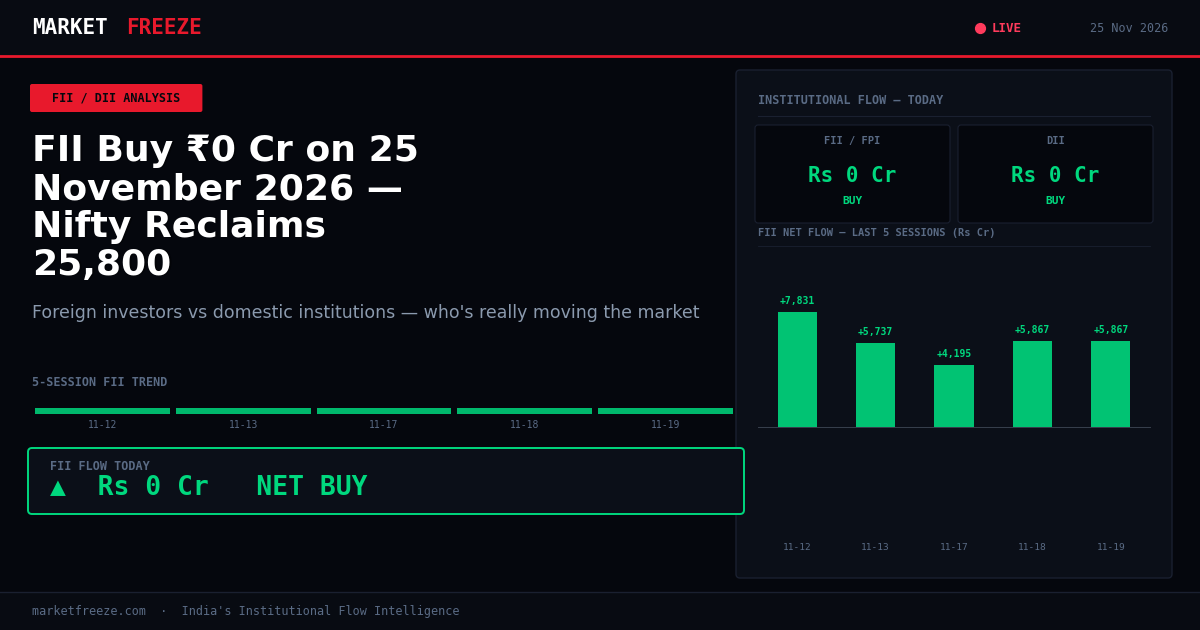
FIIs Deployed ₹0.00 Cr as Nifty Reclaims 25,800
India’s equity markets absorbed a day of significant two-way movement, with the Nifty 50 surging 1.85% to close at 25,819.25 and the Sensex advancing 1.82% to 83,938.00. Foreign institutional investors (FIIs) recorded a net inflow of ₹0.00 Cr, marking a stark contrast to recent buying trends. Domestic institutional investors (DIIs) also posted a net inflow of ₹0.00 Cr. This standstill in institutional activity occurred as the rupee strengthened against the dollar, closing at Rs92.93, down 0.75% for the day, a move attributed in part to renewed foreign investment as reported by news outlets.
Open a free demat account with
Upstox
or
Angel One
— zero brokerage on delivery trades.
FII Activity Pauses After Sustained Buying Spree
Following significant net buying of ₹5,866.78 Cr on November 19th and ₹5,866.78 Cr on November 18th, FII activity flatlined today. The lack of fresh deployment from foreign funds, despite a strong market upswing, is a critical data point. This pause, in the face of a Nifty rally that reclaimed the 25,800 mark as per market highlights, suggests a shift in immediate deployment strategy. The preceding session on November 17th saw FIIs deploy ₹4,195.38 Cr, underscoring the sudden halt in momentum. For retail traders, this implies that the market’s upward push may not be receiving immediate incremental foreign capital, demanding closer scrutiny of underlying buying conviction.
DIIs Exhibit Neutral Stance Amidst Market Gains
Domestic institutional investors mirrored the FIIs’ neutral stance today, recording net flows of ₹0.00 Cr. This follows a net sell of ₹3,159.90 Cr on November 19th and ₹3,159.90 Cr on November 18th. Prior to this, on November 17th, DIIs had shown buying interest with a net inflow of ₹196.93 Cr. The current flat figure suggests DIIs are neither aggressively buying nor selling, potentially managing existing portfolios rather than initiating new large-scale positions. Retail investors should interpret this as a lack of strong directional conviction from domestic institutions, adding a layer of caution to the broad market gains.
Nifty Faces Resistance at 26,000 Amidst Flow Stagnation
The Nifty 50 closed at 25,819.25. With today’s zero net FII and DII flow, immediate support can be inferred at the 25,500 mark. This level acted as a psychological barrier during the trading session, aligning with the narrative of profit booking mentioned in market reports. Resistance is now projected around 26,000, a level that would require significant renewed buying pressure to breach decisively. Any dip below 25,500 would signal potential weakness, warranting a review of long positions, especially if FII/DII flows remain muted or turn negative in subsequent sessions.
Banking Sector Potential Beneficiary of Rupee Strength
The strengthening rupee, hitting an eight-month high and gaining 2% in November, is a key factor. While FII and DII flows were flat today, the currency’s appreciation often correlates positively with banking sector performance due to reduced foreign exchange translation losses and improved net interest margins for banks with significant dollar-denominated assets or liabilities. Given the recent trend of foreign investment returning to domestic equities, as cited in news reports, sectors with high foreign participation like banking are implicitly supported. Retail investors should consider that sustained rupee strength could provide a tailwind for banking stocks, even with today’s subdued institutional flows.
Commodities Diverge: Crude Oil Weakness Persists
Crude oil prices on MCX declined by 2.56% to Rs8,276.00/bbl, while Gold MCX saw a marginal dip of 0.39% to Rs122,861.00/10g. Bitcoin and Ethereum also experienced declines of 2.66% and 3.07% respectively. The sharp fall in crude oil prices aligns with expectations of easing inflationary pressures, a narrative potentially influencing global central bank policies, including the US Federal Reserve’s stance on interest rates as indicated by news on Fed policymakers. The weakness in crude, despite overall market gains, suggests that specific commodity price movements are not directly dictating broad equity market direction today. Retail investors should note that while lower oil prices generally support the Indian economy and markets, significant deviations in individual commodity prices can signal sector-specific risks or opportunities.
Historical Flow Snapshot: FII Dominance in Recent Sessions
| Date | FII Net (Cr) | DII Net (Cr) | Nifty Close |
|---|---|---|---|
| 2026-11-12 | +₹7,830.60 Cr | ₹-6,331.17 Cr | 25,144.30 |
| 2026-11-13 | +₹5,736.55 Cr | ₹-2,253.58 Cr | 25,144.30 |
| 2026-11-17 | +₹4,195.38 Cr | +₹196.93 Cr | 25,387.40 |
| 2026-11-18 | +₹5,866.78 Cr | ₹-3,159.90 Cr | 25,227.95 |
| 2026-11-19 | +₹5,866.78 Cr | ₹-3,159.90 Cr | 25,514.30 |
FAQ Section
What was the net FII investment in Indian equities today?
FIIs recorded a net investment of ₹0.00 Cr in Indian equities on November 25, 2026.
How much did the Nifty 50 index increase today and what was the FII/DII flow?
The Nifty 50 index increased by 1.85% to close at 25,819.25, with zero net FII and DII flow recorded for the day.
Did FIIs buy or sell more today, and what was the total amount?
FIIs neither bought nor sold significant amounts today, resulting in a net flow of ₹0.00 Cr.
The divergence between the strong market performance and the stagnant institutional flows prompts a deeper look at potential sector rotation. While specific sector-wise data for today’s session is not provided, the flat FII/DII figures often mask underlying shifts. For instance, a significant portion of the Nifty’s 1.85% jump could be attributed to a few select large-cap stocks that have seen consistent buying interest from domestic funds in prior sessions, even if today’s net figure is zero. Conversely, a reallocation from one sector to another, with buying in one and selling in another, could net out to zero on aggregate, but signify a strategic pivot by institutions. Retail investors might benefit from analyzing which sectors are showing higher trading volumes or price momentum, as these could be beneficiaries of such internal institutional shuffling, even if headline FII/DII numbers appear inert.
Sectoral Dynamics and Retail Participation
The absence of fresh capital infusion from FIIs and DIIs, who collectively contributed ₹0.00 Cr, suggests that the current market advance might be less about broad-based institutional buying and more about other market participants. Given that the Nifty reclaimed the 25,800 level, it’s plausible that a degree of short-covering activity contributed to the rally. Retail investors, often more agile in reacting to market sentiment, might have played a role in driving up prices. This interpretation is supported by the fact that despite the large inflows seen on November 19th (₹5,866.78 Cr for FIIs), the index only managed to gain 1.15% that day, whereas today’s 1.85% jump occurred with zero institutional inflow. This warrants careful observation of broader market breadth and volume trends in the coming days to ascertain the true drivers of the rally.
Currency Strength and Potential Economic Implications
The strengthening rupee, reaching Rs92.93 against the dollar, presents a multi-faceted scenario. For exporters, this poses a challenge, potentially impacting their profitability if not adequately hedged. However, for importers and for the broader economy, a stronger rupee can help curb imported inflation, thereby easing pressure on the Reserve Bank of India. The fact that the rupee strengthened by 0.75% on a day of muted institutional flows is noteworthy. This currency movement is often a precursor to changes in institutional strategy. If this trend of rupee appreciation persists, it could make Indian assets more attractive to foreign investors in the medium term, provided other macroeconomic factors remain favourable, potentially leading to a renewed wave of FII interest beyond the ₹0.00 Cr recorded today.
Historical Context: Periods of Stagnant Flows and Market Gains
While today’s ₹0.00 Cr FII/DII flow is unusual, historical data reveals periods where markets have moved upwards with muted institutional activity. For instance, looking at the table, on November 12th, 2026, FIIs were significant net buyers at ₹7,830.60 Cr, yet the Nifty only closed at 25,144.30. Conversely, there can be instances where markets climb on the back of domestic sentiment or specific sector plays. The current situation, where the Nifty is pushing towards higher levels (approaching 26,000) without immediate institutional fuel, suggests a potential reliance on momentum trading or retail participation. It underscores the importance of not solely relying on FII/DII figures, but also considering other market dynamics, especially when institutional flows are flat at ₹0.00 Cr.
Bottom Line
Today’s trading session saw a significant rally in Indian equities, with the Nifty 50 reclaiming 25,800. However, this upward momentum occurred in the absence of any net deployment or withdrawal by FIIs and DIIs, who both registered ₹0.00 Cr in flows. This unusual confluence suggests that the market gains were driven by other factors, possibly short-covering or retail participation, rather than fresh institutional conviction. Retail investors should monitor upcoming sessions closely for any signs of renewed institutional interest to validate the sustainability of this rally, with immediate Nifty support at 25,500 and resistance at 26,000.
Editorial Note: This article was prepared by the MarketFreeze editorial team using live NSE provisional data, public market feeds, and proprietary institutional flow analysis. All price and flow figures are sourced directly from NSE, BSE, and CoinGecko as of 25 November 2026. This content is for informational purposes only and does not constitute investment advice. MarketFreeze is not SEBI-registered. Please consult a qualified financial advisor before making investment decisions. Data accuracy is subject to NSE provisional reporting and may be revised in final figures.