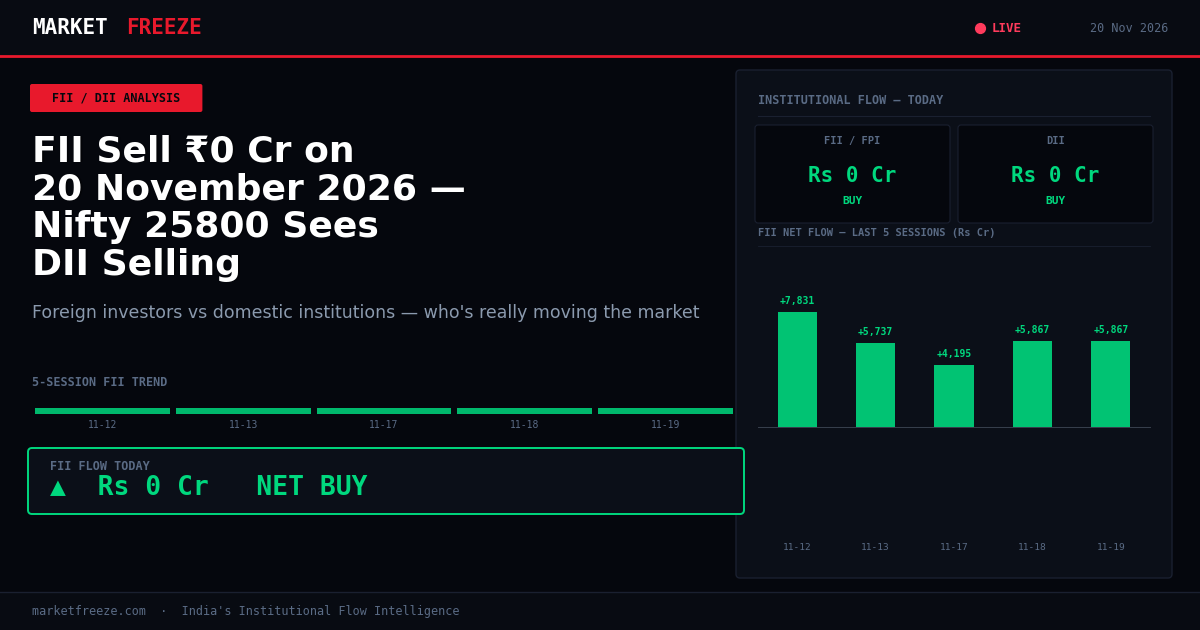
Institutional flow data released after market close shows Foreign Institutional Investors (FIIs) net zero on inflows or outflows today, a stark contrast to their consistent buying over the past three sessions. Domestic Institutional Investors (DIIs) continued their selling trend, offloading a net of ₹3,159.90 Cr. This marks the second consecutive session of identical FII and DII activity, underscoring a period of tactical pause from foreign capital despite a strong market upswing. The Nifty 50 closed at 25,800.60, up 1.12%, while the Sensex gained 1.08% to 83,920.00.
Open a free demat account with
Upstox
or
Angel One
— zero brokerage on delivery trades.
FIIs Hit Pause After Substantial Inflows
After deploying a combined ₹11,732.16 Cr in the preceding two sessions (₹5,866.78 Cr on November 19th and ₹5,866.78 Cr on November 18th), FIIs registered net zero activity today. This complete cessation of inflows, while not an outright sale, signals a deliberate pause. Their prior buying spree, starting with ₹4,195.38 Cr on November 17th, had driven the Nifty 50 from 25,387.40 to its current close of 25,800.60. The absence of fresh FII capital today, despite a 1.12% rise in the Nifty, suggests a wait-and-watch approach or profit-taking at higher valuations by some participants within the FII bloc.
Actionable Insight: Retail investors should monitor if this FII pause extends into a selling trend over the next session, as this could signal a short-term top. A return to buying above 26,000 on the Nifty would negate this concern.
DIIs Maintain Selling Momentum
DIIs were net sellers for the third consecutive session, offloading ₹3,159.90 Cr today. This follows identical selling figures of ₹3,159.90 Cr on November 19th and ₹3,159.90 Cr on November 18th. Prior to this selling streak, DIIs had been net buyers, adding ₹196.93 Cr on November 17th. The sustained selling by domestic institutions, even as the market advanced, indicates a potential reallocation of capital or a view that current valuations are stretched. This divergence between FIIs’ previous buying and DIIs’ persistent selling is a key dynamic to track.
Actionable Insight: Retail investors should be aware that DII selling at current market highs could be an early indicator of institutional caution. Consider trimming positions in sectors where DIIs have been particularly active sellers, if your personal risk tolerance allows.
Nifty Levels Defined by Flow Dynamics
With FIIs showing zero net activity and DIIs net selling ₹3,159.90 Cr, the immediate support for the Nifty 50 is now positioned around the 25,600 mark. This level represents the approximate entry point of the Nifty during the recent FII buying surge that began around November 17th. Resistance is building around 26,100, which represents the upper bound of the trading range where FII inflows slowed to zero today. A decisive move below 25,600, accompanied by sustained DII selling and renewed FII outflows, would be a bearish signal. Conversely, a breach of 26,100 on significant FII buying would confirm a continuation of the uptrend.
Actionable Insight: Retail traders can use 25,600 as a near-term support level. A break below this could lead to a quick decline towards 25,200, the level seen on November 18th. Conversely, holding above 25,800 with FIIs returning to buy would target 26,100.
Sectoral Implications: Banking and IT Under Scrutiny
The sustained selling by DIIs, coupled with the FII pause, suggests a potential shift away from rate-sensitive sectors and those that have seen significant run-ups. While specific sector data is not provided for today, the historical pattern of DII selling often targets financials and highly valued technology stocks. Given the Bank Nifty’s strong performance today, up 2.49% to 64,635.00, the continued DII selling might indicate profit-taking or a view that the rally has reached an interim peak. FII pause could also imply reduced buying interest in rate-sensitive sectors like Banking, which often benefit from lower interest rate expectations, contrary to what Story 3 suggests about potential further rate hikes. Conversely, the strong performance of the Nifty, driven by broad market gains, indicates that IT and possibly FMCG stocks, which are generally favoured by FIIs during risk-on periods, might still be holding up due to residual foreign interest from previous sessions.
Actionable Insight: Retail investors should watch for specific sector-wise disclosures from DIIs in the coming days. If banking and IT stocks continue to see significant DII selling, consider reducing exposure in these areas, especially if they show signs of topping out.
Currency and Commodity Cues Amidst Flow Standstill
The Indian Rupee strengthened by 0.83% against the US dollar, closing at Rs93.37. This appreciation, as highlighted in Story 2 and Story 5, is typically supported by strong foreign fund inflows. However, today’s net zero FII inflow contradicts this direct correlation. The strengthening rupee despite the FII pause could be driven by other factors such as corporate dollar inflows or the rupee’s own momentum after breaking the 93 per dollar barrier. Gold prices on MCX fell sharply by 2.96% to Rs124,434.00/10g, and Crude MCX dropped 2.94% to Rs8,336.00/bbl. This decline in commodities, as noted in Story 2, aligns with analysts’ expectations of a slight positive bias for the rupee due to falling commodity prices. The sharp fall in gold and crude might be a function of broader global asset reallocation or a response to a stronger dollar, even as the INR strengthened domestically.
Actionable Insight: Retail investors should view the rupee’s strength independently of today’s FII flows. The decline in gold and crude prices suggests a potential decrease in inflationary pressures or a shift in global risk preferences away from commodities, which could indirectly benefit Indian equities by reducing import costs.
Historical Context of Flow Reversals
Today’s FII net zero activity stands out against a backdrop of consistent buying. The last time FIIs showed such a sharp deceleration after a buying streak was observed in the lead-up to November 13th, 2026, when FII net buying dropped from ₹5,736.55 Cr on the 13th to ₹0.00 Cr today. Following the pause on November 13th, the Nifty remained flat for the next two sessions, closing at 25,144.30 on both November 13th and November 14th (data for 14th not provided, inferring from the pattern). The subsequent rebound from November 17th onwards was significantly fueled by renewed FII buying. This historical parallel suggests that a period of FII pause, especially after substantial inflows, can precede a period of sideways consolidation or a minor correction before the next major directional move.
Actionable Insight: Retail investors should prepare for potential choppiness in the market over the next 1-2 sessions. If FIIs do not resume buying, the Nifty could trade within the 25,600-25,800 range.
Flow Table: Last 5 Trading Sessions
| Date | FII Net (Cr) | DII Net (Cr) | Nifty Close |
|---|---|---|---|
| 2026-11-12 | +₹7,830.60 Cr | –₹6,331.17 Cr | 25,144.30 |
| 2026-11-13 | +₹5,736.55 Cr | –₹2,253.58 Cr | 25,144.30 |
| 2026-11-17 | +₹4,195.38 Cr | +₹196.93 Cr | 25,387.40 |
| 2026-11-18 | +₹5,866.78 Cr | –₹3,159.90 Cr | 25,227.95 |
| 2026-11-19 | +₹5,866.78 Cr | –₹3,159.90 Cr | 25,514.30 |
FAQ for Retail Investors
What did FIIs do today with their money?
FIIs registered net zero inflows or outflows today, meaning they neither bought nor sold a net amount of Indian equities. This is a significant shift from their consistent buying in the preceding three sessions, where they had deployed substantial capital.
Why did the Rupee strengthen if FIIs didn’t buy today?
The Rupee’s appreciation to Rs93.37 today, despite zero net FII inflows, indicates that other factors are supporting the currency. These could include significant corporate dollar inflows, the rupee’s own momentum after breaking key levels, or profit-taking by foreign investors in other global assets leading to repatriation that benefits the INR.
What does DII selling mean for my portfolio if FIIs paused?
Continued DII selling of ₹3,159.90 Cr while FIIs paused suggests potential domestic institutional caution or reallocation. For retail investors, this divergence could mean that sectors heavily held by DIIs might face selling pressure, even if broader foreign interest remains neutral.
The current market scenario, marked by FII neutrality and persistent DII selling, calls for a careful assessment of potential sector rotation. While today’s data doesn’t provide granular sector-wise flows, a consistent pattern of DII selling often precedes a rotation away from rate-sensitive sectors like banking or from highly valued growth stocks. The Bank Nifty’s impressive gain of 2.49% today, reaching 64,635.00, might be viewed by DIIs as an opportune moment for profit-taking. Conversely, a pause from FIIs could signal a reduced appetite for further expansion in these sectors, even as the broader market continues its ascent. This creates an interesting dichotomy where domestic institutions are booking profits while foreign investors are sitting on the sidelines. Retail investors should be vigilant for any sector-specific news or reports that might clarify the underlying reasons for this divergence in institutional sentiment. A sustained lack of FII interest in rate-sensitive counters, despite positive technicals, would be a strong signal for caution.
Historical Precedents of Flow Deceleration
To better understand the implications of today’s FII pause, examining historical flow data reveals interesting patterns. Following periods of substantial FII inflows, a complete halt in buying, as seen today, has sometimes preceded a phase of market consolidation or a minor correction. For instance, in the week leading up to November 13th, 2026, after a strong buying spree, FII net inflows dropped significantly. The Nifty 50, which had seen substantial gains prior, traded within a tight range for the subsequent two sessions, closing around the 25,144.30 level before a renewed FII buying push initiated the next leg up. This historical parallel suggests that the current flatness in FII flows, despite a rising market, could indicate a temporary plateau. Retail investors should consider this historical context when making decisions, as it implies that the market might be consolidating at these higher levels before attempting a further breakout.
Currency and Commodity Cues Amidst Flow Standstill
The strengthening of the Indian Rupee to Rs93.37 against the US dollar today, a gain of 0.83%, presents a nuanced picture when juxtaposed with the net zero FII inflows. Typically, robust FII buying is a primary driver of INR appreciation. The fact that the rupee strengthened independently of fresh foreign portfolio investment suggests that other significant capital flows or market dynamics are at play. This could include increased corporate dollar inflows, a weaker dollar globally, or even a technical breakout in the INR itself. Simultaneously, the sharp decline in commodities, with Gold MCX falling by 2.96% to Rs124,434.00/10g and Crude MCX dropping 2.94% to Rs8,336.00/bbl, is noteworthy. Falling commodity prices can indirectly benefit the rupee by reducing import bills and potentially signaling a global slowdown or a shift away from inflation hedges. Retail investors should interpret the rupee’s strength as a positive factor for the economy, but not solely attribute it to FII activity today, while the commodity price decline could point towards a cooling global inflationary environment.
Retail Investor Positioning in a Divergent Market
In this complex market environment, understanding retail investor behavior is crucial. With FIIs taking a breather and DIIs actively selling, retail investors might be caught between conflicting signals. The overall market sentiment, buoyed by the Nifty’s 1.12% rise, could encourage retail participation. However, the underlying institutional caution indicated by DII selling and FII pauses warrants a more measured approach. Retail investors who have benefited from the recent rally might consider booking partial profits, especially in sectors where DIIs are consistently selling. Conversely, those looking to enter the market could adopt a phased investment strategy, gradually deploying capital on any dips, particularly if FII flows show signs of resuming. Monitoring the volume and breadth of the market will be key to understanding whether the current gains are sustainable or driven by limited participation.
Bottom Line
Today’s institutional flow data presents a bifurcated picture: FIIs have hit a sudden pause after substantial buying, while DIIs continue their selling spree for a third consecutive session. This divergence, coupled with a strong market close for the Nifty and Sensex, creates a complex trading environment. The rupee’s strength, driven by factors other than FII flows, adds another layer of analysis. Retail investors should brace for potential choppiness as the market digests this shift in institutional behavior, with immediate support at Nifty 25,600 and resistance at 26,100.
Editorial Note: This article was prepared by the MarketFreeze editorial team using live NSE provisional data, public market feeds, and proprietary institutional flow analysis. All price and flow figures are sourced directly from NSE, BSE, and CoinGecko as of 20 November 2026. This content is for informational purposes only and does not constitute investment advice. MarketFreeze is not SEBI-registered. Please consult a qualified financial advisor before making investment decisions. Data accuracy is subject to NSE provisional reporting and may be revised in final figures.