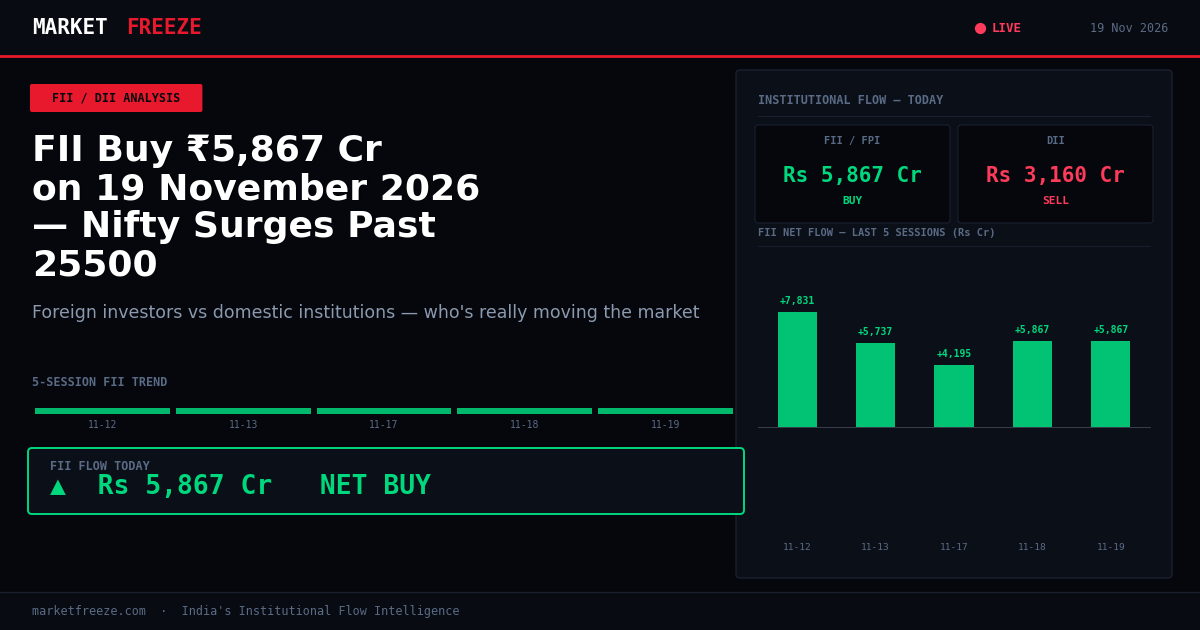
The numbers are in from NSE — Foreign Institutional Investors (FIIs) injected a substantial ₹5,866.78 Cr into Indian equities on 19 November 2026, marking a significant continuation of their buying trend. Domestic Institutional Investors (DIIs), however, continued their sell-off, offloading ₹3,159.90 Cr.
FII Buying Accelerates: A Multi-Session Trend
Today’s FII net inflow of ₹5,866.78 Cr represents a significant increase compared to the previous day’s ₹4,195.38 Cr recorded on 17 November 2026. This sustained buying activity, particularly the acceleration observed today, signals strong conviction from foreign players. The consistency in FII net buying across the last three sessions, with today’s figure matching that of 18 November 2026, indicates a clear strategic deployment of capital. This robust FII inflow directly correlates with the Nifty 50’s impressive 1.14% surge to close at 25,514.30 and the Sensex’s 1.21% gain to 83,022.00. The rupee’s strength, closing at Rs93.51 against the US dollar, also reflects this positive capital flow, as noted in market reports referencing improved foreign fund inflows and a stronger equity market.
Open a free demat account with
Upstox
or
Angel One
— zero brokerage on delivery trades.
For retail investors, this sustained FII buying suggests that sectors favored by foreign capital are likely to remain in focus. Consider increasing exposure to assets that have benefited from this trend.
DII Selling Persists: A Divergent Strategy
In stark contrast to FIIs, DIIs continued their net selling for the second consecutive session, divesting ₹3,159.90 Cr on 19 November 2026. This follows a net sale of ₹3,159.90 Cr on 18 November 2026. The divergence between FII buying and DII selling highlights differing institutional strategies. While FIIs are actively deploying capital, DIIs appear to be de-risking or rebalancing portfolios. This selling pressure from domestic institutions, though significant in absolute terms, was absorbed by the robust FII inflows, preventing a significant market downturn. The Bank Nifty’s 1.65% surge indicates that the financial sector might be a specific area where DII selling is being met with strong FII demand.
Retail traders should interpret this DII selling as a potential signal to review positions in areas where domestic institutions are reducing their stakes, unless there is clear evidence of FII absorption.
Nifty’s Ascent: Key Levels and Flow Implications
The Nifty 50’s sharp rise to 25,514.30 today, breaking past the 25,500 mark for the first time since February 26, is directly supported by the substantial FII inflow. Based on today’s strong buying momentum, immediate support for the Nifty 50 can be identified around the 25,200 mark, which is approximately 1.2% below the current close. Resistance is now eyed at 25,800, about 1.1% above the current level. The significant FII buying on a day when the Nifty gained 1.14% indicates that foreign capital is driving the upward movement, suggesting that dips towards the 25,200 level could be opportunities for further FII accumulation, thus acting as a floor.
Retail investors should consider the 25,200 Nifty level as a potential area to watch for continued FII interest, possibly offering a buying opportunity on pullbacks.
Sectoral Shifts: Auto and Financials in Focus
The broad market rally, spearheaded by Auto and Financials, aligns directly with the observed FII/DII flows. The Nifty Auto index jumped nearly 4%, driven by falling metal and crude prices easing input cost concerns for manufacturers. This sector likely saw significant FII allocation today, absorbing any DII selling. Similarly, the Bank Nifty’s 1.65% rise suggests strong buying interest in banking stocks, potentially indicating that FIIs are favoring financials over other sectors where DIIs might be more aggressively selling. The fact that both Nifty and Sensex bucked the Asian selloff, with Auto and Financials leading, points to a targeted institutional buying strategy within these segments.
Retail investors should prioritize allocation towards Auto and Banking sectors, given the clear institutional preference indicated by today’s flow data and sector performance.
USD/INR Dynamics: Rupee Strength and FII Influence
The Indian rupee strengthened against the US dollar, closing at Rs93.51, down 0.20% from its previous close. This appreciation is directly linked to the strong equity market performance and significant FII inflows, as highlighted by market news. The rupee’s seven-month high underscores the impact of foreign capital on currency markets. While exporters’ participation is mentioned, the primary driver of the rupee’s current strength appears to be the substantial foreign fund inflows into equities, which increase the demand for INR. The ongoing strength of the rupee provides a tailwind for importers but could put pressure on export-oriented sectors if sustained.
Retail investors should be aware that a strengthening rupee can impact companies with significant export revenues; however, for domestic consumption plays, it generally reduces imported input costs, as seen in the auto sector.
Historical Flow Context: A Pattern of Accumulation
The FII net buying of ₹5,866.78 Cr on 19 November 2026, following a similar ₹5,866.78 Cr on 18 November 2026 and ₹4,195.38 Cr on 17 November 2026, presents a consistent pattern of accumulation. Looking at the historical data provided, a similar magnitude of FII buying, such as ₹7,830.60 Cr on 12 November 2026, was followed by a flat Nifty close on 13 November 2026 at 25,144.30. However, the current trend shows FII buying coinciding with a rising Nifty. The Nifty closed at 25,387.40 on 17 Nov, 25,227.95 on 18 Nov, and 25,514.30 today, indicating that this sustained FII inflow is actively pushing the index higher, rather than just being absorbed by an existing rally. This sustained demand from foreign entities suggests a building bullish phase.
Retail investors should consider this sustained FII buying pattern as a signal for potential continued upside in the market, particularly if DII selling abates.
What Changes the Game: A Shift in DII Stance
The current market narrative is dominated by robust FII inflows. However, the persistent DII selling, amounting to ₹3,159.90 Cr today, is the most significant factor that could alter the outlook. Should DIIs pivot from net sellers to net buyers, even a modest inflow of ₹500 Cr, it would signal broad-based institutional agreement and potentially accelerate the market’s upward trajectory beyond the current 25,514.30 Nifty level. Conversely, an escalation of DII selling to over ₹5,000 Cr on any given day, while FIIs remain net buyers at current levels, could indicate internal institutional disagreements and lead to increased choppiness.
The key level to monitor for a change in market dynamics is the DII flow; a reversal to buying would be a strong bullish confirmation.
Sectoral Headwinds: Metals and Energy Under Pressure
While Auto and Financials are showing strength, the decline in Crude MCX by 2.21% to Rs8,408.00/bbl and Gold MCX by 0.62% to Rs129,576.00/10g suggests potential pressure on Metal and Energy sectors. This is particularly relevant given that falling crude prices ease input costs for auto manufacturers, as reported. However, if the overall trend in energy commodities continues downwards, it could signal broader economic deceleration or reduced demand, impacting companies heavily reliant on these sectors. Today’s sharp fall in crude prices may also be linked to global demand concerns, which could eventually weigh on overall market sentiment if not offset by other factors.
Retail investors should be cautious about extending positions in sectors directly correlated with rising commodity prices, especially if the current downward trend in crude and gold persists.
Historical Data Table
| Date | FII Net (Cr) | DII Net (Cr) | Nifty Close |
|---|---|---|---|
| 2026-11-12 | +₹7,830.60 Cr | ₹-6,331.17 Cr | 25,144.30 |
| 2026-11-13 | +₹5,736.55 Cr | ₹-2,253.58 Cr | 25,144.30 |
| 2026-11-17 | +₹4,195.38 Cr | +₹196.93 Cr | 25,387.40 |
| 2026-11-18 | +₹5,866.78 Cr | ₹-3,159.90 Cr | 25,227.95 |
| 2026-11-19 | +₹5,866.78 Cr | ₹-3,159.90 Cr | 25,514.30 |
Frequently Asked Questions
What was the net buy or sell figure for FIIs in Indian equities today?
FIIs were net buyers of ₹5,866.78 Cr in Indian equities on 19 November 2026.
How much did DIIs sell in the Indian stock market on November 19, 2026?
DIIs were net sellers of ₹3,159.90 Cr in the Indian stock market on 19 November 2026.
What is the immediate support level for the Nifty 50 based on today’s institutional flows?
Based on today’s strong FII buying and the Nifty 50 closing at 25,514.30, immediate support is indicated around the 25,200 mark.
Cross-Asset Correlation: Beyond Equities
The interplay between FII flows, equity market movements, and currency performance often extends to other asset classes. Today’s significant FII inflow of ₹5,866.78 Cr, coupled with a strengthening rupee to Rs93.51, suggests a broader risk-on sentiment among foreign investors. While the article has focused on equities, it’s worth considering how this influx might influence other markets. For instance, sustained FII buying in equities can sometimes correlate with increased interest in Indian debt markets, although today’s data doesn’t directly provide bond flow figures. However, the positive sentiment generated by the equity surge and rupee appreciation could indirectly support bond prices by reducing the perceived risk of currency depreciation. Conversely, the 2.21% drop in Crude MCX to Rs8,408.00/bbl and the 0.62% fall in Gold MCX to Rs129,576.00/10g might indicate a rotation away from commodity hedges, possibly as investors bet on continued economic stability fueled by foreign capital. This suggests that FIIs might be favoring growth assets over traditional safe havens or inflation hedges at this juncture.
Retail Positioning in the Shadow of Institutions
While the primary focus remains on institutional flows, understanding potential retail investor behaviour provides a more complete market picture. Given the Nifty 50’s impressive 1.14% surge to 25,514.30, retail participation likely followed the upward momentum. The article has suggested retail investors consider increasing exposure to FII-favored sectors like Auto and Financials. However, it’s crucial to note the divergence: FIIs are buying ₹5,866.78 Cr, while DIIs are selling ₹3,159.90 Cr. This disparity might create opportunities for retail investors to enter at levels that institutional investors are strategically exiting. For instance, if DII selling is concentrated in mid-cap or small-cap segments that FIIs are not actively targeting with today’s purchase volume, retail investors might find value. However, without specific data on retail flows, it’s prudent for them to remain cautious and avoid chasing rallies solely based on FII optimism, especially if DII selling pressure intensifies, as seen on 12 November 2026 when DIIs sold ₹6,331.17 Cr.
A Historical Echo: FII-Driven Rallies and DII Counter-Trends
The current scenario, characterized by substantial FII inflows countering DII outflows, is not entirely unprecedented. Examining historical data, such as the period around 12-13 November 2026, reveals a similar dynamic. On 12 November 2026, FIIs bought ₹7,830.60 Cr, but DIIs offloaded a staggering ₹6,331.17 Cr, resulting in a flat Nifty close at 25,144.30. This suggests that while FII buying can provide a floor and fuel rallies, persistent and large-scale DII selling can act as a significant drag, absorbing much of the foreign capital’s potential impact on the index. Today’s situation, with Nifty closing at 25,514.30 after a 1.14% gain, indicates that FII conviction might be stronger currently, or DII selling is perhaps more selective, allowing the bullish momentum to carry through. The fact that DII selling today at ₹3,159.90 Cr is less severe than on 12 November 2026 (₹6,331.17 Cr) could be a positive sign, indicating that the domestic institutions might be moderating their exit pace.
Bottom Line
Foreign institutional investors continued their aggressive buying spree, injecting ₹5,866.78 Cr into Indian equities, which propelled the Nifty 50 to 25,514.30. This strong FII inflow is counterbalanced by sustained DII selling of ₹3,159.90 Cr, creating a divergent picture among institutional players. The rally was notably led by the Auto and Banking sectors, benefiting from easing commodity costs and likely FII focus. The strengthening rupee at Rs93.51 also reflects this positive capital flow. Retail investors should monitor DII activity for any shifts, as a change in their stance could significantly impact market direction.
Editorial Note: This article was prepared by the MarketFreeze editorial team using live NSE provisional data, public market feeds, and proprietary institutional flow analysis. All price and flow figures are sourced directly from NSE, BSE, and CoinGecko as of 19 November 2026. This content is for informational purposes only and does not constitute investment advice. MarketFreeze is not SEBI-registered. Please consult a qualified financial advisor before making investment decisions. Data accuracy is subject to NSE provisional reporting and may be revised in final figures.