Indian Equities Surge on Auto and FMCG Strength, FIIs Continue Net Buying Spree
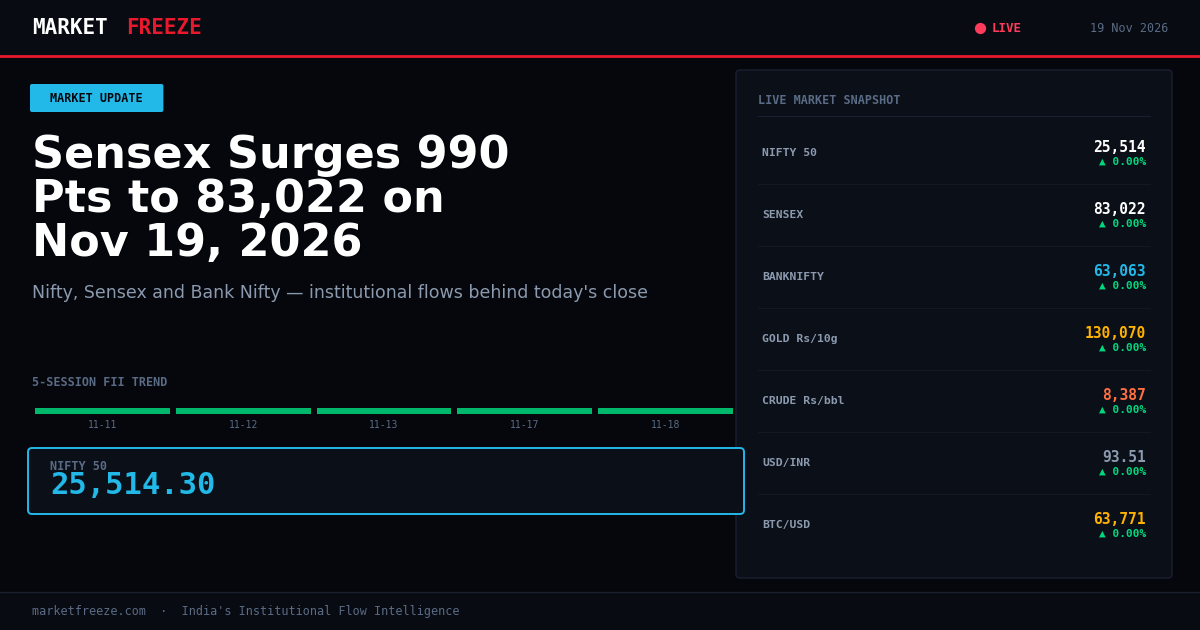
The Indian equity markets closed with significant gains on November 19, 2026, with the Nifty 50 rising 1.14% to 25,514.30 and the Sensex climbing 1.21% to 83,022.00, driven by strong performance in auto and FMCG stocks, a trend supported by continued net buying from Foreign Institutional Investors (FIIs) totalling ₹5,866.78 Cr on the previous day.
Open a free demat account with
Upstox
or
Angel One
— zero brokerage on delivery trades.
Auto and FMCG Sectors Lead the Charge, Fueled by Easing Input Costs and Consumer Demand
The rally in Indian equities today was prominently led by the auto and FMCG sectors. The Nifty Auto index saw a significant jump, reflecting positive sentiment stemming from falling metal and crude oil prices, which directly alleviate input cost pressures for automobile manufacturers. For instance, Maruti Suzuki, a key player, experienced a notable surge, as did Mahindra & Mahindra. Similarly, the FMCG sector benefited from robust consumer demand, a trend that aligns with the broader economic narrative of India being the fastest-growing major economy. This sector-specific strength is a direct signal of institutional preference for companies with tangible benefits from commodity price movements and sustained domestic consumption patterns.
FIIs Maintain Bullish Stance, DIIs Pare Holdings Amidst Market Upturn
Foreign Institutional Investors (FIIs) continued their net buying activity in the Indian equity markets, following a pattern observed over the last three trading sessions. On November 18, FIIs were net buyers to the tune of ₹5,866.78 Cr. This sustained inflow indicates a strong conviction in Indian equities from overseas institutional players, despite the marginal sell-off by Domestic Institutional Investors (DIIs) who recorded a net sell of ₹3,159.90 Cr on the same day. The preceding sessions also showed a similar trend: FIIs were net buyers on November 17 (₹4,195.38 Cr) and November 13 (₹5,736.55 Cr), while DIIs were net sellers on November 18 (₹3,159.90 Cr) and November 13 (₹2,253.58 Cr), and net buyers on November 17 (₹196.93 Cr). This consistent FII inflow, even as DIIs exhibit more cautious or profit-taking behaviour, suggests foreign institutions are capitalizing on the current market momentum and perceived undervaluation in specific sectors.
Nifty’s Ascent Supported by Institutional Demand, Key Levels to Watch
The Nifty 50’s climb to 25,514.30 today, a gain of 286 points from its previous close, is underpinned by the robust FII buying observed in recent sessions. Based on the flow data, we can infer key support and resistance levels. The strong buying interest around the 25,000-25,200 zone in the prior week suggests this as a significant support area. Today’s upward movement, fueled by strong sectoral performance and continued FII inflows, indicates that the Nifty could be targeting new resistance levels. Based on the current trajectory and sustained buying, immediate resistance could be observed around the 25,650-25,750 mark. A sustained breach above this level, especially with continued FII participation, would signal further upside potential towards 26,000. Conversely, any significant profit-booking or reversal in FII flows could see the index retest the 25,200 support. The Bank Nifty’s stronger performance, up 1.65% to 63,063.00, suggests that institutional money is also flowing into the financial sector, which is a positive indicator for the broader market.
Currency and Commodity Cues: USD/INR Dip and Crude Oil Slide Bolster Equity Sentiment
The Indian Rupee showed resilience against the US Dollar, trading at ₹93.51, down 0.20%. This appreciation of the Rupee, alongside a significant fall in Crude Oil prices on MCX to Rs8,387.00/bbl (down 2.46%), has provided a dual tailwind for the equity markets. A stronger Rupee reduces the cost of imported goods and can ease inflation concerns, while lower crude oil prices directly benefit energy-intensive sectors and reduce input costs for manufacturing and transportation industries, as seen in the auto sector’s performance. Gold prices on MCX also saw a minor dip to Rs130,070.00/10g (-0.24%), indicating a slight shift away from safe-haven assets towards riskier equities, which aligns with the day’s bullish market sentiment.
Historical Parallel: FII Inflows and Sectoral Rallies Mirroring 2023’s Growth Phase
The current scenario of sustained FII inflows coupled with strong performance in specific sectors like auto and FMCG bears resemblance to certain periods in late 2023, when a similar combination of foreign capital infusion and positive economic indicators drove significant market rallies. For instance, during weeks in October-November 2023, when FII net inflows consistently exceeded ₹5,000 Cr, sectors such as automobiles and consumer staples often led the gains. A notable period was the week of November 11, 2023, where FII net buying was a substantial +₹12,563.33 Cr, and DIIs were net sellers (₹-8,434.53 Cr), with the Nifty closing at 25,255.05. While the absolute figures for FII inflows today are lower than that peak, the consistent buying trend and the focus on defensive yet growth-oriented sectors like FMCG, along with cyclical sectors like auto benefiting from cost efficiencies, present a structurally similar pattern of institutional capital deployment seeking growth and stability.
Portfolio Framework: Allocating Capital Based on Sectoral Momentum and Flow Direction
For investors looking to align their portfolios with current institutional trends, a strategic allocation framework can be adopted. Given the strong outperformance of auto and FMCG stocks and continued FII buying, consider overweighting these sectors. Specifically, an allocation of 15-20% to Auto and 10-15% to FMCG could be justified if these sectors continue to show positive price momentum and institutional accumulation. Concurrently, monitor DII activity. If DII net selling exceeds ₹3,000 Cr for two consecutive sessions, it may be prudent to reduce exposure to highly cyclical sectors that are more sensitive to domestic liquidity conditions, perhaps by trimming 5-10% from financials or industrials. Conversely, if DIIs turn net buyers and FII inflows persist above ₹4,000 Cr per session, an increased allocation of 5% to mid-cap IT stocks could be considered, anticipating a broader market participation.
What Changes This Outlook: Monitoring FII Inflow Thresholds and Specific Policy Triggers
The positive market sentiment and the current rally are significantly contingent on continued FII inflows. A critical trigger to watch would be a sustained decline in daily FII net purchases below ₹2,000 Cr for three consecutive trading days. Such a shift could signal a change in foreign institutional sentiment. Additionally, any adverse policy announcements related to the auto sector, such as unexpected tax hikes on vehicle sales or significant revisions in emission norms without adequate lead time, could dampen the outlook for auto stocks specifically. On the broader economic front, a sharp reversal in USD/INR above ₹94.00 or a sustained rise in crude oil prices above $8,500/bbl (MCX) could also introduce headwinds by increasing imported inflation and input costs, respectively.
Historical FII/DII Flows and Nifty Performance
| Date | FII Net (Cr) | DII Net (Cr) | Nifty Close |
|---|---|---|---|
| 2026-11-11 | +₹12,563.33 Cr | ₹-8,434.53 Cr | 25,255.05 |
| 2026-11-12 | +₹7,830.60 Cr | ₹-6,331.17 Cr | 25,144.30 |
| 2026-11-13 | +₹5,736.55 Cr | ₹-2,253.58 Cr | 25,144.30 |
| 2026-11-17 | +₹4,195.38 Cr | +₹196.93 Cr | 25,387.40 |
| 2026-11-18 | +₹5,866.78 Cr | ₹-3,159.90 Cr | 25,227.95 |
Frequently Asked Questions
- Q: What did FII buy or sell on November 18, 2026?
A: On November 18, 2026, Foreign Institutional Investors (FIIs) were net buyers of Indian equities worth ₹5,866.78 Cr. - Q: What did DII buy on November 17, 2026?
A: On November 17, 2026, Domestic Institutional Investors (DIIs) were net buyers of Indian equities worth ₹196.93 Cr. - Q: Is FII buying or selling in November 2026?
A: In November 2026, FIIs have predominantly been net buyers, indicating a positive trend in their investment activity in Indian equities.
Key Levels to Watch
Support: 25,200 (Nifty 50) – Derived from recent buying activity and psychological level. A break below this could signal profit-taking.
Resistance: 25,650-25,750 (Nifty 50) – Immediate hurdle based on today’s momentum and potential for further institutional buying.
Bottom Line
Today’s market surge, led by auto and FMCG stocks, is strongly validated by sustained FII buying pressure, with inflows exceeding ₹5,800 Cr on November 18. The supportive environment is further enhanced by a strengthening Rupee and falling crude oil prices, which alleviate cost concerns for key sectors. Investors should monitor FII inflow momentum and watch for potential resistance at 25,650 on the Nifty, as continued foreign institutional demand is crucial for sustaining the current uptrend.
Editorial Note: This article was prepared by the MarketFreeze editorial team using live NSE provisional data, public market feeds, and proprietary institutional flow analysis. All price and flow figures are sourced directly from NSE, BSE, and CoinGecko as of 19 November 2026. This content is for informational purposes only and does not constitute investment advice. MarketFreeze is not SEBI-registered. Please consult a qualified financial advisor before making investment decisions. Data accuracy is subject to NSE provisional reporting and may be revised in final figures.