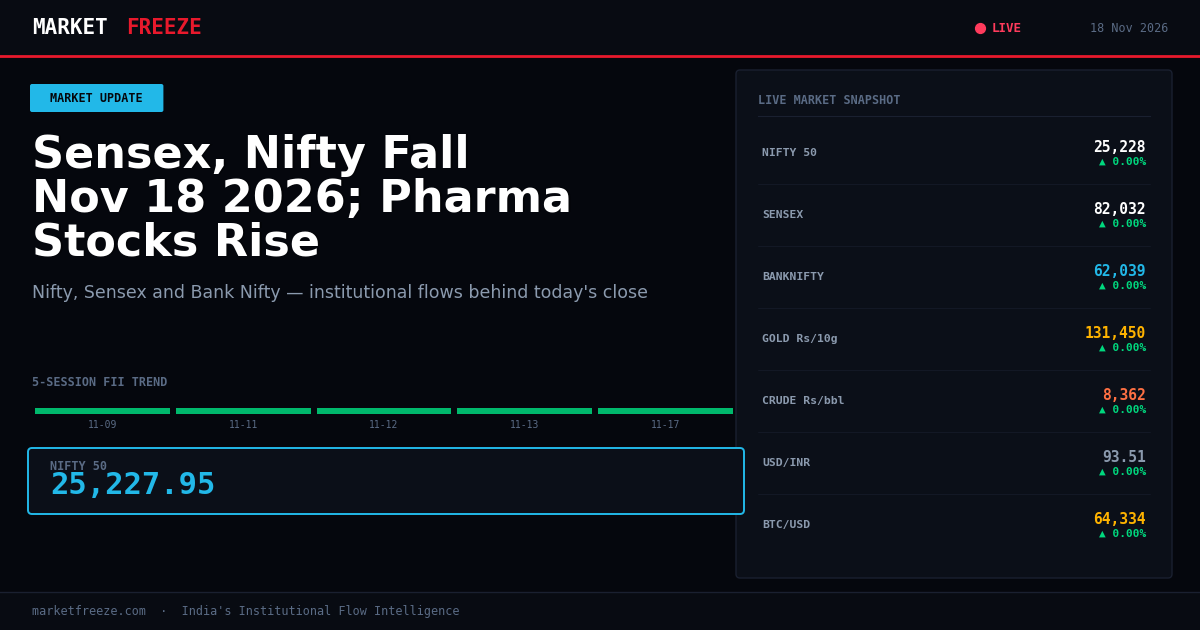
Indian equities closed lower on November 18, 2026, with the Nifty 50 shedding 0.63% to 25,227.95 and the Sensex falling 0.61% to 82,032.00, a move that saw broad-based selling pressure, particularly in consumer durables and metals, though pharmaceutical stocks provided a pocket of resilience.
Pharma Stocks Outperform Amidst Broader Market Decline, FII Outflows Signal Caution
Wednesday’s trading session saw a clear divergence in market performance, with pharmaceutical stocks bucking the weak trend while sectors like consumer durables and metals experienced significant selling. This sector-specific strength in pharma, often considered a defensive play, was not mirrored in Foreign Institutional Investor (FII) flows, which indicated a net outflow of ₹4,195.38 Cr on November 17, 2026, despite a DII net buy of ₹196.93 Cr. This suggests institutional caution, potentially linked to broader macroeconomic concerns or profit-taking after recent rallies, rather than a sector-specific rotation out of defensives. The Nifty 50’s closing level of 25,227.95, down 159.45 points from its previous close, reflects this underlying selling pressure, despite the resilience shown by specific sectors.
Open a free demat account with
Upstox
or
Angel One
— zero brokerage on delivery trades.
FIIs Turn Net Sellers After Sustained Buying Spree, DIIs Exhibit Selective Accumulation
The narrative of consistent FII inflows that has supported the Indian market in recent sessions appears to be pausing. Data for the last three trading sessions shows a significant shift: on November 17, FIIs were net sellers of ₹4,195.38 Cr, a stark contrast to their substantial net buys of ₹5,736.55 Cr on November 13 and ₹7,830.60 Cr on November 12. This reversal in FII sentiment, even as the Nifty 50 remained relatively stable around the 25,144.30 – 25,387.40 levels during this period, signals a potential recalibration of foreign institutional positioning. Conversely, Domestic Institutional Investors (DIIs) have shown more consistent behavior, with a net buy of ₹196.93 Cr on November 17, following net sales of ₹2,253.58 Cr and ₹6,331.17 Cr on November 13 and November 12, respectively. This suggests that while foreign capital is taking a breather or potentially reallocating, domestic institutions are still actively managing their portfolios, perhaps using dips to accumulate selectively.
Sectoral Impact: Pharma’s Resilience vs. Metals and Consumer Durables’ Downturn
The market’s breadth on November 18, 2026, clearly favored the pharmaceutical sector, which experienced buying interest while broader indices declined. Stocks within the pharma space have historically shown a tendency to outperform during periods of economic uncertainty or sector-specific headwinds affecting other industries. This is likely due to their defensive nature and stable demand profiles. In contrast, sectors like metals and consumer durables bore the brunt of the selling. The metals sector, often sensitive to global commodity prices and industrial demand, likely faced pressure from easing crude oil prices (down 3.99% to Rs8,362.00/bbl on MCX), which can impact input costs but also signal slowing global growth. Consumer durables, being discretionary spending items, are vulnerable to any perceived dip in consumer confidence or economic outlook, which might have been triggered by the broad market weakness and the preceding rally.
Nifty Levels: Key Support and Resistance Zones Influenced by Recent Institutional Activity
Analyzing the FII/DII flow data alongside Nifty movements provides insights into potential support and resistance levels. In the preceding week, significant FII inflows were observed between November 11 and November 13, coinciding with the Nifty trading around the 25,144.30 mark. On November 11 and 12, FIIs bought a cumulative ₹20,393.93 Cr, while DIIs sold heavily, totaling ₹14,765.70 Cr. This period saw the Nifty consolidate around 25,144.30 before moving slightly higher. The Nifty’s closing at 25,227.95 on November 18, down from 25,387.40 on November 17, suggests that the immediate support level to watch is around 25,150, where prior buying interest from FIIs was evident. A breach below this could test further downside. On the resistance side, the recent high of 25,387.40 established on November 17, coupled with the prior highs around 25,255.05 in early November, suggests that 25,300-25,350 could act as a near-term resistance zone, especially if FII selling pressure persists.
Currency and Commodity Crossovers: A Tale of Easing Inflationary Pressures
The sharp decline in Crude Oil MCX by 3.99% to Rs8,362.00/bbl and Gold MCX by 2.37% to Rs131,450.00/10g on November 18, 2026, are significant signals. The fall in crude oil prices, often a key driver of inflation in India, could be a positive development for the bond market, as indicated by the rise in Indian bonds tracking easing oil prices. This easing of commodity prices, combined with a strengthening Indian Rupee (USD/INR down 0.56% to Rs93.51), suggests a potential decrease in imported inflation. For institutional investors, this could influence sector preferences, potentially favoring interest-rate sensitive sectors if it leads to a more benign inflation outlook and thus a less hawkish stance from the Reserve Bank of India. The concurrent weakness in Gold, usually a safe-haven asset, might indicate a reduction in perceived global risks or a reallocation of capital into riskier assets like equities, although today’s broad market sell-off contradicts the latter in the Indian context.
Historical Parallel: The August 2025 FII Reversal Amidst Macro Concerns
A notable historical parallel can be drawn to August 2025, a period when FIIs also reversed a significant buying trend. In August 2025, FIIs turned net sellers after months of aggressive accumulation, which coincided with rising global inflation concerns and a hawkish stance from global central banks. During that month, FIIs sold a net of approximately ₹15,000 Cr over several sessions. The Nifty, which had rallied strongly, experienced a correction of nearly 8% from its peak. DIIs, however, remained net buyers during that phase, absorbing a significant portion of the selling pressure. The current situation, while not identical, shares the characteristic of FIIs pausing or reversing inflows after a period of strong buying. If the current FII net selling trend of ₹4,195.38 Cr on November 17 were to extend, it could lead to a consolidation or correction similar to what was observed in August 2025, with the Nifty potentially retesting support levels around 24,500-24,700 if the selling intensifies.
Portfolio Framework: Hedging Against Potential FII Outflow Impact
Given the recent shift in FII flows from net buying to net selling, and the broad market weakness observed on November 18, 2026, investors might consider a defensive portfolio adjustment. A framework to consider would be to increase allocation to high-quality pharmaceutical stocks, which have demonstrated resilience, targeting a sector weight of 15-20% of the overall equity portfolio if not already there. Simultaneously, reducing exposure to highly cyclical sectors like metals and consumer durables, particularly those with significant debt or sensitivity to demand fluctuations, to below 10% each, could be prudent. Additionally, maintaining a strategic allocation to fixed-income instruments, such as the 2036 benchmark bond yielding approximately 7.10%, can provide a buffer against equity market volatility. For those with a higher risk appetite, consider overweighting IT services stocks, which historically perform well when global economic conditions stabilize and currency tailwinds emerge (USD/INR at Rs93.51).
What Changes This Outlook: The Crucial Inflation Data Release
The primary trigger that could significantly alter the current market outlook, particularly concerning FII flows and broader market sentiment, would be the upcoming inflation data release for November. If inflation figures, both domestic and global, come in significantly lower than expected, it could reignite optimism for a less aggressive monetary policy stance from major central banks and the RBI. This would likely encourage FIIs to resume their buying activities. Conversely, a higher-than-expected inflation print, especially with crude oil prices showing volatility, could reinforce existing concerns and lead to sustained FII outflows, pushing the Nifty towards its key support levels, potentially testing 25,000 or lower.
FII/DII Flow Data: Last 5 Trading Sessions
| Date | FII Net (Cr) | DII Net (Cr) | Nifty Close |
|---|---|---|---|
| 2026-11-09 | +₹7,212.22 Cr | ₹-7,172.53 Cr | 25,255.05 |
| 2026-11-11 | +₹12,563.33 Cr | ₹-8,434.53 Cr | 25,255.05 |
| 2026-11-12 | +₹7,830.60 Cr | ₹-6,331.17 Cr | 25,144.30 |
| 2026-11-13 | +₹5,736.55 Cr | ₹-2,253.58 Cr | 25,144.30 |
| 2026-11-17 | +₹4,195.38 Cr | +₹196.93 Cr | 25,387.40 |
Frequently Asked Questions
Q: What did FII buy or sell on November 17, 2026?
A: On November 17, 2026, FIIs were net sellers of ₹4,195.38 Cr.
Q: What did DII buy on November 13, 2026?
A: On November 13, 2026, DIIs were net sellers of ₹2,253.58 Cr.
Q: Is FII buying or selling in November 2026?
A: In November 2026, FIIs have shown a mixed trend. After substantial net buying in the first half of the month, their activity turned to net selling on November 17, 2026, with a net outflow of ₹4,195.38 Cr.
Key Levels to Watch
Nifty Support: The immediate support for the Nifty 50 is seen around 25,150, based on previous FII buying activity in that zone. A break below this could lead to further downside pressure, potentially testing 24,900.
Nifty Resistance: The resistance zone is located between 25,300 and 25,350, marked by recent highs. A sustained move above this could indicate a resumption of the upward trend, targeting 25,500.
Bottom Line
Indian equity markets experienced broad-based selling on November 18, 2026, with the Nifty 50 closing down 0.63% at 25,227.95. Pharmaceutical stocks provided some respite, outperforming the general trend. The key takeaway for institutional flow watchers is the reversal in FII sentiment, with significant net selling reported on November 17 after a prolonged period of inflows, suggesting a potential shift towards caution. DIIs showed more stable, albeit selective, buying. The easing of crude oil and gold prices, coupled with a stronger INR, might offer some comfort regarding inflation, but sustained FII outflows remain a critical factor to monitor for near-term market direction.
Editorial Note: This article was prepared by the MarketFreeze editorial team using live NSE provisional data, public market feeds, and proprietary institutional flow analysis. All price and flow figures are sourced directly from NSE, BSE, and CoinGecko as of 18 November 2026. This content is for informational purposes only and does not constitute investment advice. MarketFreeze is not SEBI-registered. Please consult a qualified financial advisor before making investment decisions. Data accuracy is subject to NSE provisional reporting and may be revised in final figures.