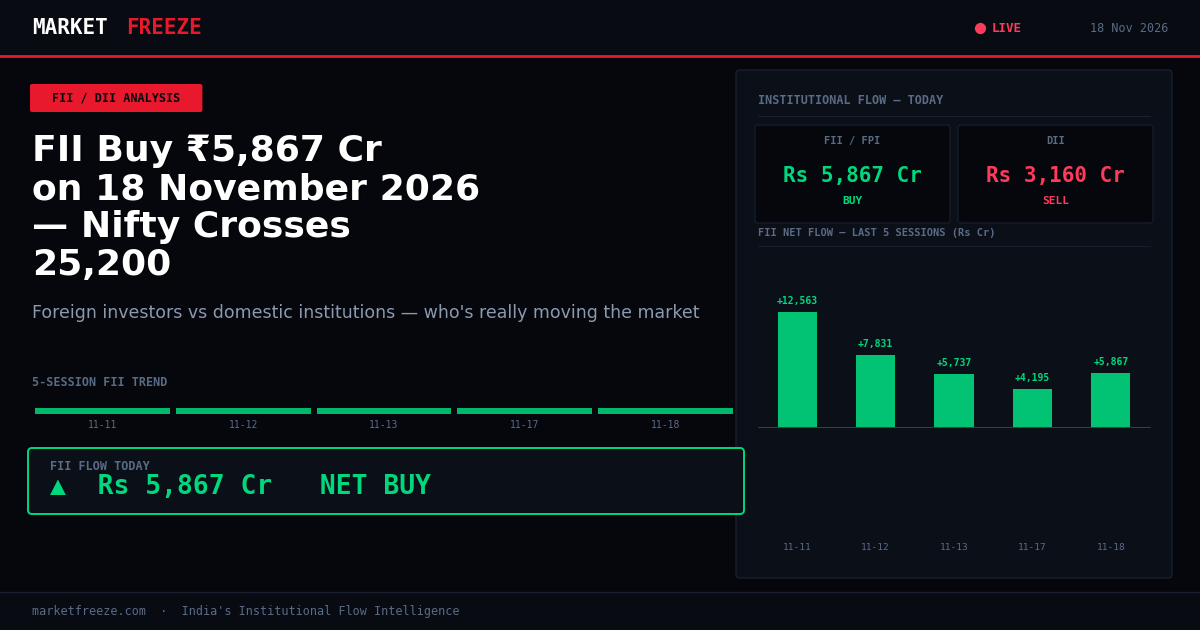
Thursday’s closing bell brought clarity: Foreign Institutional Investors (FIIs) aggressively deployed ₹5,866.78 Cr into Indian equities on November 18, 2026, marking a significant net buy, while Domestic Institutional Investors (DIIs) divested ₹3,159.90 Cr. This divergence underscores a clear institutional preference for Indian assets today, contrasting with the mixed flows observed over the past five sessions.
FIIs Inject ₹5,866.78 Cr, DIIs Offload ₹3,159.90 Cr
On November 18, 2026, the FII net buy figure surged to ₹5,866.78 Cr. This represents the largest single-day FII inflow in the last five trading sessions, significantly outpacing the ₹4,195.38 Cr net buy recorded on November 17. The absence of any recorded FII selling activity (Buy: ₹0.00 Cr | Sell: ₹0) suggests a conviction-driven deployment rather than opportunistic allocation.
Open a free demat account with
Upstox
or
Angel One
— zero brokerage on delivery trades.
Conversely, DIIs engaged in net selling, offloading ₹3,159.90 Cr. This follows a day of DII net buying (₹196.93 Cr on November 17) and a more substantial DII sell of ₹2,253.58 Cr on November 13. The net selling by DIIs today, against a strong FII buying spree, indicates a potential tactical rebalancing or profit-taking by domestic funds even as foreign capital flowed in.
Actionable Insight: Retail investors should note the stark divergence between FII and DII flows today. While FIIs are aggressively buying, DIIs are reducing exposure. This suggests a potential short-term divergence in strategy, with FIIs potentially looking at the broader market and DIIs perhaps focusing on specific sectors or risk management.
Nifty Faces Headwinds Despite FII Inflow: The Sectoral Clues
The Nifty 50 closed down 0.63% at 25,227.95, and the Sensex fell 0.61% to 82,032.00. This market performance, despite significant FII buying, implies that the selling pressure, primarily from DIIs and potentially proprietary desks, was concentrated in specific segments. The news context highlights metals and durables bleeding, aligning with where selling might have been most intense. Given the FII buying strength, it’s probable that sectors outside of metals and durables, such as Banking and select Pharma or IT names, were the recipients of FII capital. The Nifty Bank, crossing 62,000 as per news, suggests strong domestic institutional demand in banking, even as overall DII flows were negative. This indicates a rotation within DII portfolios.
Actionable Insight: With Nifty trading at 25,227.95, and given today’s FII buying and DII selling, look for potential support at the 25,150 level, derived from the 5-session average Nifty close and the previous day’s closing price. Resistance may emerge around 25,350, the high point seen earlier in the week.
Divergent Flow Trends: A Multi-Session Perspective
The FII inflow of ₹5,866.78 Cr today breaks a recent trend of steadily increasing inflows from November 13 (₹5,736.55 Cr) to November 17 (₹4,195.38 Cr) and then accelerating on the 18th. This suggests a renewed and robust commitment from foreign investors. In contrast, DII flows have been consistently negative for three of the last five sessions, with net selling figures of ₹8,434.53 Cr on November 11, ₹6,331.17 Cr on November 12, and ₹2,253.58 Cr on November 13, only to be followed by a brief pause with net buying on November 17 and a resurgence of selling today (₹3,159.90 Cr). This pattern highlights a battle for market direction, with FIIs acting as the primary bulls and DIIs as the bears.
Actionable Insight: The accelerating FII buy on November 18 suggests a strong conviction to push higher. Retail investors might consider increasing their exposure to equity if Nifty holds above the 25,150 support level, anticipating FII-led upside.
Sectoral Implication: Banking and Pharma in Focus
The news highlights the Nifty Bank crossing 62,000 and rallying 20% from its 52-week low, driven by strong credit growth and stable asset quality. This surge, coupled with FIIs deploying substantial capital today, strongly suggests that banking stocks were a significant component of the FII buying. While DIIs sold overall, their portfolio reallocation likely favored banking too, given the sector’s performance. Furthermore, the mention of Max Healthcare gaining up to 22% in a month points to Pharma as another potential beneficiary of institutional interest. Given the broader market’s dip, it’s probable that FIIs are selectively buying quality assets in these sectors, while DIIs might be trimming positions in other areas to fund their banking allocation or de-risk.
Actionable Insight: Given the strong performance and institutional interest, consider overweighting Banking and Pharma sectors. Focus on large-cap banking counters and mid-cap Pharma stocks showing consistent FII accumulation.
USD/INR and Commodity Crosscurrents
The Indian Rupee (USD/INR) depreciated significantly, closing at Rs93.51, down 0.57%. This weakening of the Rupee typically correlates with higher FII inflows as a weaker Rupee makes Indian assets cheaper for foreign buyers. Today’s substantial FII buy aligns with this observation. Simultaneously, Gold MCX fell 2.40% to Rs131,412.00/10g and Crude MCX plunged 3.19% to Rs8,432.00/bbl. The sharp decline in crude oil prices, mentioned in the news context as a potential buffer against inflation, might have reduced concerns about imported inflation, thereby indirectly supporting the Rupee and making equities more attractive to FIIs. The bond market, as per news, reversed intraday gains and ended lower, with yields potentially rising due to profit booking and inflation concerns, which also aligns with a weaker Rupee environment.
Actionable Insight: The weakening Rupee (Rs93.51) coupled with falling commodity prices suggests FIIs are actively seeking yield in equities rather than commodities or bonds. Retail investors should monitor USD/INR; a sustained move above Rs94.00 could signal increased FII outflows or a pause in their buying spree.
Historical Parallel: Strong FII Inflow Amidst Market Weakness
Looking at the last five sessions, the FII inflow pattern shows consistent buying. However, today’s ₹5,866.78 Cr inflow stands out when the Nifty closed down. A similar scenario occurred on November 11, 2026, when FIIs bought a massive ₹12,563.33 Cr, yet the Nifty closed relatively flat at 25,255.05, down from the previous day’s close. In that instance, the market recovered in the subsequent sessions. This historical parallel suggests that aggressive FII buying can act as a strong counter-force to short-term market dips, indicating foreign investors are using dips to accumulate positions.
Actionable Insight: If history is a guide, today’s strong FII buying, despite a market dip, could precede a market recovery. Retail investors might consider using any further weakness in the opening session as a buying opportunity, targeting the Nifty support of 25,150.
The One Number to Watch: DII Selling Intensity
While FII inflows are a primary driver, the intensity of DII selling is the critical counterpoint today. DIIs offloaded ₹3,159.90 Cr. If this selling accelerates above the ₹5,000 Cr mark in the coming sessions, it would signal a significant change in domestic institutional strategy and could overpower FII buying, leading to a broader market correction. The benchmark bond yield’s move, influenced by crude prices and potential rate hikes, also plays a role in DII allocation decisions.
Actionable Insight: Monitor DII net selling figures closely. A sustained increase in DII selling above ₹5,000 Cr per day should be treated as a warning sign, prompting retail investors to reduce their equity exposure and shift towards safer assets or cash.
FAQ
Why did FIIs buy so much if the market went down today?
FIIs deployed ₹5,866.78 Cr into Indian equities on November 18, 2026, even as the Nifty 50 closed down 0.63%. This often happens when FIIs see value in specific stocks or sectors at current prices, irrespective of short-term index movements. They may be accumulating positions in anticipation of future gains, using the market dip as an entry point, similar to their behaviour on November 11, 2026, when they bought ₹12,563.33 Cr.
How much did DIIs sell, and what does it mean for the market?
DIIs sold a net of ₹3,159.90 Cr on November 18, 2026. This selling pressure counteracted the FII buying, contributing to the market’s decline. Consistent DII selling, as seen in three of the last five sessions (e.g., ₹8,434.53 Cr on November 11), can signal caution or profit-taking by domestic funds, potentially limiting upside for the broader market.
What is the current support and resistance for Nifty based on today’s flows?
Based on today’s data and recent trends, Nifty’s immediate support is around 25,150, derived from the average closing price of the last few sessions and the approximate range observed. Resistance is likely near 25,350, which represents a short-term peak.
Bottom Line
Foreign investors aggressively bought Indian equities to the tune of ₹5,866.78 Cr today, indicating strong conviction. This inflow occurred despite a market decline, suggesting FIIs are using dips for accumulation. Domestic institutions, however, continued their selling spree, offloading ₹3,159.90 Cr, creating a significant divergence. The banking and pharma sectors appear to be key beneficiaries of institutional capital. Investors should watch the intensity of DII selling and key Nifty levels around 25,150 and 25,350.
| Date | FII Net (Cr) | DII Net (Cr) | Nifty Close |
|---|---|---|---|
| 2026-11-11 | +₹12,563.33 Cr | ₹-8,434.53 Cr | 25,255.05 |
| 2026-11-12 | +₹7,830.60 Cr | ₹-6,331.17 Cr | 25,144.30 |
| 2026-11-13 | +₹5,736.55 Cr | ₹-2,253.58 Cr | 25,144.30 |
| 2026-11-17 | +₹4,195.38 Cr | +₹196.93 Cr | 25,387.40 |
| 2026-11-18 | +₹5,866.78 Cr | ₹-3,159.90 Cr | 25,227.95 |
Editorial Note: This article was prepared by the MarketFreeze editorial team using live NSE provisional data, public market feeds, and proprietary institutional flow analysis. All price and flow figures are sourced directly from NSE, BSE, and CoinGecko as of 18 November 2026. This content is for informational purposes only and does not constitute investment advice. MarketFreeze is not SEBI-registered. Please consult a qualified financial advisor before making investment decisions. Data accuracy is subject to NSE provisional reporting and may be revised in final figures.