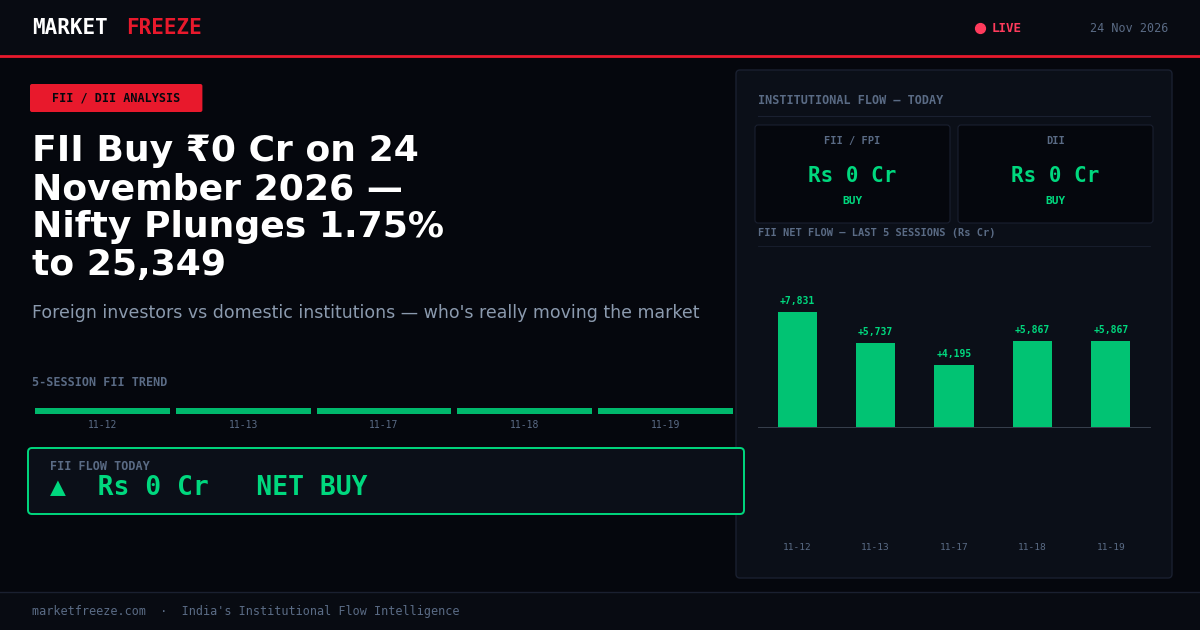
NSE provisional data confirms Foreign Institutional Investors (FIIs) recorded ₹0.00 Cr net buy today, marking a complete halt in their aggressive buying streak seen over the previous sessions. Domestic Institutional Investors (DIIs) also saw their net selling position reverse to ₹0.00 Cr for the day. This drastic shift from significant FII inflows to zero net activity, coupled with DIIs flattening their selling, occurred as the Nifty 50 plunged 1.75% to close at 25,349.65 and the Sensex dropped 1.77% to 82,436.00.
Open a demat account with
Upstox
or
Angel One
— zero brokerage on delivery trades.
FII Activity Stalls After Record November Inflows
Today’s ₹0.00 Cr FII net figure represents a sharp deceleration from the substantial buying observed recently. For the last three recorded sessions prior to today, FIIs were net buyers, deploying ₹5,866.78 Cr on November 19th and 18th, and ₹4,195.38 Cr on November 17th. This aggressive buying had contributed to an 11% rally in BSE Sensex for November, as highlighted by news reports stating over ₹1 lakh crore in FII inflows this month. The cessation of net buying today, coinciding with a market downturn, suggests a pause or profit-taking by foreign entities, especially after the preceding rally.
Actionable Insight: Retail investors should monitor if this pause in FII buying translates into sustained selling pressure or is merely a temporary breather, given the prior strong inflows.
DIIs Neutralise Selling Pressure Amid Market Decline
Domestic Institutional Investors (DIIs), who had been consistent net sellers in the preceding two sessions (₹3,159.90 Cr on Nov 19th and 18th), also registered ₹0.00 Cr net activity today. This shift from net selling to zero net activity suggests that DIIs did not aggressively step in to buy on the dip, nor did they continue their selling spree. This could indicate a lack of strong conviction in either direction during today’s sharp market fall. On November 17th, DIIs were net buyers to the tune of ₹196.93 Cr, showing a more positive stance then.
Actionable Insight: The absence of significant DII buying on a down day, despite their recent selling trend, implies that domestic funds are not providing a strong support floor at these lower levels.
Nifty Faces Immediate Resistance at 25,600 as Flows Cease
With Nifty closing at 25,349.65 and FII net flows turning to zero, the immediate resistance level to watch is the recent intra-day high, which is around 25,600. A sustained close above this level would be required to signal a potential resumption of buying interest. Support is now seen at the day’s low of approximately 25,250. The abrupt halt in FII buying, which had supported the market’s upward trajectory (closing at 25,514.30 on Nov 19th), suggests that these levels are now facing selling pressure.
Actionable Insight: Traders should consider reducing long exposure if Nifty fails to reclaim 25,600, as the lack of FII buying indicates limited upside potential.
Banking Sector Weakness Amplified by Flow Reversal
The Bank Nifty’s significant fall of 3.17% to 62,585.00 aligns with the cessation of FII buying and the halt in DII selling. Historically, FIIs have been significant participants in the banking sector. Today’s flat net flow suggests they are not deploying fresh capital into this segment, which is typically sensitive to liquidity and interest rate expectations. News reports mentioning that 22 out of 30 Sensex stocks closed in the red, with banking and metal stocks leading losses, confirms this broad-based weakness. The previous FII buying streaks often provided support to financials.
Actionable Insight: Given the sharp decline in Bank Nifty and the lack of FII support, retail investors should avoid aggressive long positions in banking stocks until FIIs show renewed buying interest in the sector.
IT Sector Shows Resilience Amidst Broader Sell-off
While banking and metal stocks led the decline, news indicated that technology shares gained. This divergence suggests that FIIs may have continued to favour the IT sector, even as their overall net buying activity dropped to zero. The resilience of IT stocks, even when overall indices are falling, often reflects sustained institutional interest driven by global demand for tech services and potential benefits from a weaker rupee. The MSCI Asia-Pacific index rising 4.6% and Japan’s Nikkei gaining 4.5% due to Nvidia’s CEO return (Story 5) could also indirectly support Indian IT firms through increased global AI trade optimism.
Actionable Insight: Retail investors holding IT stocks should look for opportunities to add on further dips if the sector shows signs of decoupling from the broader market decline, indicating potential FII favouritism.
USD/INR Moves Higher as Risk Aversion Emerges
The Indian Rupee weakened against the US Dollar, with USD/INR trading at Rs93.00, up 0.24%. This move, occurring alongside a sharp equity market decline and a halt in FII inflows, suggests a return of risk aversion. Typically, when FIIs are buying heavily, the rupee tends to strengthen or remain stable due to increased dollar inflows. The weakening rupee today, despite zero FII net buy, indicates that selling pressure in equities might be prompting some repatriation of funds or a general flight to safety, which supports the dollar against the rupee.
Actionable Insight: A sustained move in USD/INR above Rs93.00, especially on days with equity weakness, could signal increased risk aversion and potentially deter FIIs from re-entering the market aggressively.
Nvidia’s Influence on Global Markets and Indian Equities
News regarding Nvidia’s leadership announcements and potential revival of the AI trade in Asia (Story 5) is noteworthy. While US stock futures slipped as Nvidia lost momentum in pre-market trade (Story 4), Asian markets, including Japan’s Nikkei, saw significant gains. This global backdrop, where tech valuations are being reassessed, can have ripple effects. Today’s halt in FII flows and the broader market sell-off in India might be partly a reaction to global profit-booking, as suggested by the US futures’ decline, rather than solely domestic factors.
Actionable Insight: Retail investors should track global tech indices and Nvidia’s price action closely, as any sustained downturn in this space could lead to further outflows from Indian IT and related sectors.
Historical Context: Flow Pause and Market Reversal
Looking at the historical data, a complete halt in FII net buying after a series of strong inflows has preceded periods of consolidation or minor corrections. For instance, after the FII net buy of ₹5,866.78 Cr on Nov 18th and 19th, today’s zero inflow marks an abrupt stop. The Nifty closed at 25,514.30 on Nov 19th and fell to 25,349.65 today. While not a direct parallel, periods where FII inflows suddenly cease, particularly after significant rallies, have often led to short-term pullbacks as the market digests previous gains without fresh institutional impetus.
Actionable Insight: The current situation, where FII flows have dried up after a rally, suggests that the market may be entering a phase of price discovery downwards, making it prudent to be selective with new long positions.
FAQ Section
What was the net FII and DII flow in Indian equities today, November 24, 2026?
Today, November 24, 2026, FII net flow was ₹0.00 Cr (Buy) and DII net flow was ₹0.00 Cr.
How much did the Nifty 50 and Sensex fall today?
The Nifty 50 fell by 1.75% to close at 25,349.65, and the Sensex dropped by 1.77% to close at 82,436.00.
What was the FII net inflow trend over the last 3 sessions before today?
Before today, FIIs were net buyers, with inflows of ₹5,866.78 Cr on November 19th and 18th, and ₹4,195.38 Cr on November 17th.
FII/DII Flow Data: Last 5 Sessions
| Date | FII Net (Cr) | DII Net (Cr) | Nifty Close |
|---|---|---|---|
| 2026-11-12 | +₹7,830.60 Cr | ₹-6,331.17 Cr | 25,144.30 |
| 2026-11-13 | +₹5,736.55 Cr | ₹-2,253.58 Cr | 25,144.30 |
| 2026-11-17 | +₹4,195.38 Cr | +₹196.93 Cr | 25,387.40 |
| 2026-11-18 | +₹5,866.78 Cr | ₹-3,159.90 Cr | 25,227.95 |
| 2026-11-19 | +₹5,866.78 Cr | ₹-3,159.90 Cr | 25,514.30 |
The abrupt cessation of FII buying, which had been a strong tailwind for the market throughout November, prompts a closer look at potential sector rotation. While IT stocks displayed resilience, the significant drop in the Bank Nifty, coupled with the halt in DII selling (suggesting they aren’t aggressively buying the dip), points to a potential reallocation of capital. If FIIs are indeed pausing their broad market buying, they might be shifting towards defensive sectors or specific growth pockets that have yet to participate fully in the recent rally. The recent rally saw broad participation; a pause could signal a rotation into quality names with stable earnings, away from more speculative plays that might have benefited from the preceding liquidity surge.
Sectoral Divergence and Potential Rotation
The contrast between the resilience of IT stocks and the sharp decline in banking and metal sectors is a critical indicator. With FIIs registering a net of ₹0.00 Cr today after substantial inflows, the question arises: where is their capital being deployed, or more importantly, where is it being redeployed from? The fact that technology shares gained, even as the broader market plunged by over 1.75%, suggests a continued favouritism towards this segment. This could imply that FIIs are not exiting the market entirely but are selectively trimming exposure in interest-rate sensitive sectors like banking, which saw significant losses. The previous FII buying had provided a floor for these indices, and their absence today means less institutional support.
Actionable Insight: Investors should analyze which sectors are holding up despite the broad market weakness. A sustained divergence, like the one seen today with IT outperforming, could signal a short-term sector rotation driven by institutional preferences for earnings visibility and global demand.
Retail Investor Positioning Amidst FII Pause
With institutional flows turning neutral today, the positioning of retail investors becomes a crucial factor in determining short-term market direction. Retail investors, often acting on momentum or reacting to news, might have been caught on the wrong foot by the sudden halt in FII buying. Given that FIIs had been net buyers consistently over the preceding sessions, many retail investors might have entered long positions anticipating further upside. The current market drop of over 1.75% on both indices, coupled with the zero net flow from FIIs and DIIs, could lead to increased retail selling if fear sets in, exacerbating the decline.
Actionable Insight: Retail investors should be wary of panic selling. The absence of institutional buying today doesn’t necessarily mean a sustained downturn; it could be a temporary pause. Monitoring retail sentiment indicators could provide clues about potential capitulation points.
Commodity Linkages and Currency Moves
The weakening of the Indian Rupee to Rs93.00, a gain of 0.24% for the dollar, warrants attention beyond just equity flows. A stronger dollar and a weaker rupee typically correlate with commodity prices, especially for importers. While specific commodity data for today isn’t provided, a general risk-off sentiment, indicated by the equity sell-off and currency depreciation, often leads to a rise in safe-haven assets. The halt in FII buying could be a precursor to a broader global deleveraging, which might impact commodity demand and, consequently, the currencies of commodity-exporting nations. India, being a net importer of many commodities, would feel the pinch of a weaker rupee and potentially higher commodity prices.
Actionable Insight: Keep an eye on key commodity prices (like crude oil and gold) and their correlation with the USD/INR. A sustained weakening of the rupee beyond Rs93.00, especially on days with equity weakness, could signal broader economic headwinds that FIIs are preemptively reacting to.
Bottom Line
Today’s trading session witnessed a dramatic halt in institutional activity, with both FIIs and DIIs registering zero net flows amidst a significant market downturn. The Nifty 50 fell 1.75%, with banking and metal stocks bearing the brunt of the selling. This abrupt stop in FII buying, which had fueled an 11% rally in November, suggests a pause in their bullish stance, potentially due to global profit-booking and reassessment of tech valuations. Retail investors should exercise caution and await clear signs of renewed institutional buying, particularly in the banking sector, before making significant new positions.
Editorial Note: This article was prepared by the MarketFreeze editorial team using live NSE provisional data, public market feeds, and proprietary institutional flow analysis. All price and flow figures are sourced directly from NSE, BSE, and CoinGecko as of 24 November 2026. This content is for informational purposes only and does not constitute investment advice. MarketFreeze is not SEBI-registered. Please consult a qualified financial advisor before making investment decisions. Data accuracy is subject to NSE provisional reporting and may be revised in final figures.