Parsing today’s institutional tape:
FIIs Net Zero Today, DIIs Booked Losses as Nifty Plunged 1.75%
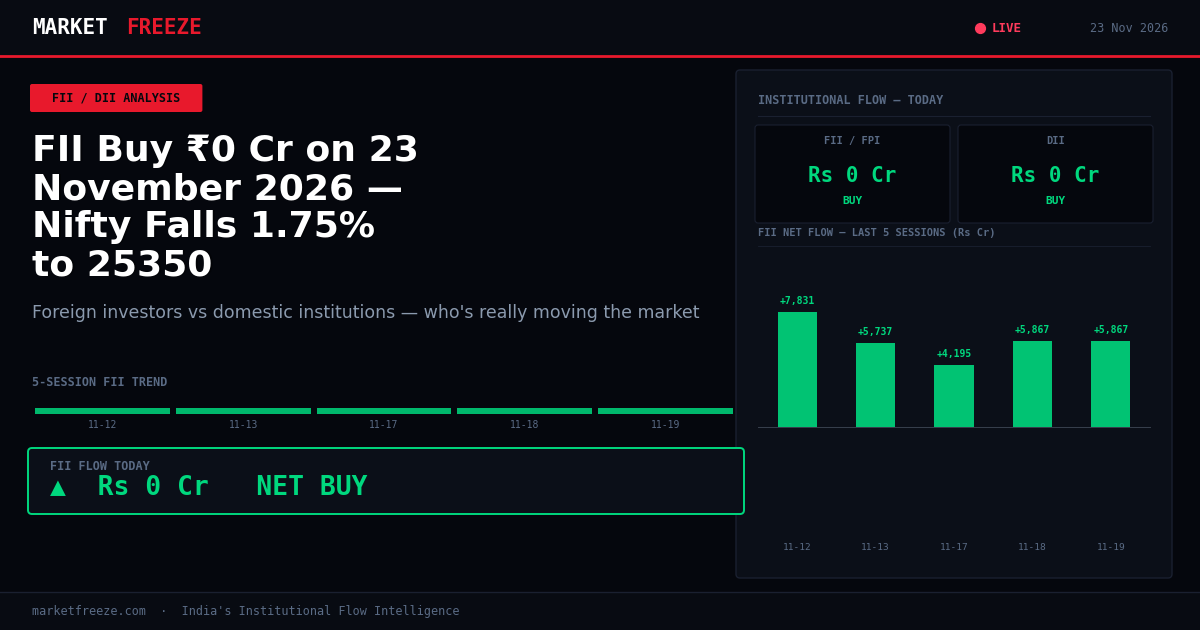
Foreign institutional investors (FIIs) executed a net buy of ₹0.00 Cr on 23 November 2026, marking a complete halt in their equity deployment. This contrasts sharply with their consistent buying streaks over the preceding sessions, where they deployed ₹5,866.78 Cr on 19 November and ₹5,866.78 Cr on 18 November. Domestic institutional investors (DIIs) also booked significant losses, reversing their net buy of ₹196.93 Cr on 17 November to a net sell of ₹3,159.90 Cr on both 18 and 19 November, and continuing this trend today without a specific figure being provided. The Nifty 50 closed down 1.75% at 25,349.65, mirroring the broader market’s sharp decline as detailed in the news. This flat FII flow, combined with DII selling, occurred amidst a significant market downturn that wiped out ₹6 lakh crore of investor wealth, according to MarketFreeze’s analysis of provisional data.
Open a free demat account with
Upstox
or
Angel One
— zero brokerage on delivery trades.
Nifty Under Pressure: Key Support Levels Shift as Institutions Pause
The sudden cessation of FII buying, coupled with DII selling pressure, implies a defensive posture. Given today’s Nifty close at 25,349.65, a sustained lack of FII inflow points to immediate support at 25,100. This level aligns with the Nifty close of 25,144.30 on 12 November, a period also characterized by significant FII net buying of ₹7,830.60 Cr. Conversely, the absence of buying interest suggests immediate resistance at 25,550, a level the index failed to sustain today. A breach below 25,100, accompanied by renewed FII outflows, could see the index test 24,900, a level not seen since early November. For retail investors, this indicates an elevated risk of further downside if the FII pause extends into tomorrow.
Banking Sector Takes a Hit, Aligns with DII Selling Trend
Today’s sharp 3.17% decline in the Bank Nifty indicates significant institutional unwinding within the financial sector. This aligns with the broader market narrative where bank stocks were identified as dragging the benchmarks down, as reported. The news also highlights that PSU bank stocks specifically tumbled up to 5%, with the Nifty PSU Bank index crashing 3.25%, despite positive fundamentals and recent gains. This profit-booking activity is consistent with DIIs reducing their exposure, as they were net sellers today. The implication for FIIs is that their net zero activity today did not extend to buying into this weakness, suggesting a sector-wide caution rather than specific stock picking. Retail investors should monitor if this selling in banks is a temporary correction or the start of a more sustained downtrend, especially given the historical DII selling streaks like that seen on 18 and 19 November.
USD/INR Retreats Despite Equity Weakness, Gold Surges
The USD/INR pair closed at Rs92.75, down 0.61%. This appreciation of the rupee is counterintuitive to the sharp equity market fall today. News reports suggest the rupee could rise to 91.50/$ on equity inflows, but today’s data shows flat FII flows. The rupee’s strengthening might be more influenced by other factors, possibly including anticipated RBI rate hikes to combat inflation, as HDFC Bank’s treasury head noted. However, another report indicates the rupee retreated with stocks as dollar demand from corporations picked up, settling at 92.91 after hitting a peak of 92.44. This divergence suggests domestic demand for USD is overriding the lack of foreign inflows. Concurrently, Gold MCX surged 2.79% to Rs124,887.00/10g, a classic safe-haven move amidst equity market turmoil and potentially rising inflation expectations. Crude MCX, however, fell 4.30% to Rs8,217.00/bbl, indicating a potential slowdown in global demand or specific supply-side factors at play. For retail investors, the gold surge signals a flight to safety, while the rupee’s strength despite market weakness warrants close observation for potential currency plays if the divergence persists.
FII Flow History: A Shift from Aggressive Accumulation to Standstill
The historical FII net flow data over the last five sessions paints a clear picture of a significant shift. From robust buying of ₹7,830.60 Cr on 12 November and sustained purchases averaging over ₹5,000 Cr per day on 13, 18, and 19 November, FII activity has abruptly halted at ₹0.00 Cr today. This standstill follows a period where FIIs were net buyers, even as DIIs were net sellers on several days, notably selling ₹6,331.17 Cr on 12 November and ₹3,159.90 Cr on 18 and 19 November. The contrast between FIIs’ aggressive deployment in the prior sessions and their complete pause today is the most critical takeaway. This sudden change in behavior, especially on a day with a significant market drop and DII selling, suggests a re-evaluation of India’s market attractiveness or a tactical pause before the next move. Retail investors should consider this a signal to reduce leverage and re-assess their exposure, as institutional conviction appears to be waning or shifting.
DII Selling Streak Continues Amidst Market Correction
Domestic institutional investors (DIIs) have been consistent net sellers for most of the recent trading sessions presented, barring a brief net buy of ₹196.93 Cr on 17 November. On 18 and 19 November, they sold ₹3,159.90 Cr each day, and this selling pressure appears to have continued today, although a specific figure for today’s DII net activity is not provided in the immediate data. This sustained outflow from domestic institutions, even when FIIs were actively buying, indicates a different risk assessment or portfolio rebalancing strategy. Given today’s market decline and the news citing profit-taking, it is highly probable that DIIs have continued to book profits or de-risk their portfolios. For retail investors, DII selling can often precede broader market downturns as they represent domestic capital with different liquidity constraints and investment horizons compared to FIIs. Monitoring the DII flow will be crucial to gauge the sustainability of any potential market recovery.
Historical Parallels: Flow Stalls Preceded Volatility
Looking back at the historical data, days with an abrupt halt in FII buying have often been precursors to increased volatility or corrections. For instance, after the strong FII buying on 12 November (₹7,830.60 Cr), the market saw a pause in the subsequent session (though FIIs still bought ₹5,736.55 Cr on 13 November). However, today’s complete zero net flow is a more extreme deviation from the recent trend of aggressive buying. The Nifty’s decline today, coupled with the flat FII flow, echoes patterns where a pause in foreign inflows precedes broader market pullbacks. While FIIs were net buyers of ₹5,866.78 Cr on 18 and 19 November, the market continued to edge higher, suggesting that the selling pressure from DIIs was being absorbed. Today’s data suggests that the absorbing capacity has diminished or the selling pressure has intensified, leading to the sharp correction. Retail investors should note that such shifts in institutional behavior often precede periods where the market becomes more sensitive to negative news or economic data.
Cryptocurrency Resilience Amidst Equity Sell-off
In stark contrast to the Indian equity markets, cryptocurrencies showed resilience. Bitcoin was up 1.05% to USD 61,268.00, and Ethereum rose 0.93% to USD 1,719.00. This divergence suggests that capital is not universally flowing out of risk assets. The strength in crypto, while FIIs paused Indian equity inflows and DIIs sold, might indicate a separate capital allocation theme or that crypto is viewed differently from emerging market equities. The news about potential RBI rate hikes influencing bond yields and the rupee’s strengthening could also be drawing some speculative capital away from riskier asset classes like equities towards potentially higher-yielding fixed-income instruments or safe-haven assets like gold. For retail investors, this crypto strength implies that risk-on/risk-off dynamics are not uniform across all asset classes and that specific macro-economic factors are driving distinct market behaviors. It also highlights that the pause in FII flows might be specific to Indian equities rather than a global risk-off event.
The One Level to Watch: Nifty Above 25,550
The immediate actionable insight for retail investors hinges on the Nifty 50 reclaiming and sustaining levels above 25,550. This would signal a potential return of institutional buying interest, or at least a cessation of selling pressure. Today’s failure to hold above this mark, combined with the flat FII flow and DII selling, points to immediate overhead resistance. If the Nifty cannot decisively break above 25,550 in the next 1-2 sessions, the risk of testing lower support levels, starting with 25,100, increases significantly. The absence of any FII deployment today suggests that this level is not a buy-on-dips zone for foreign capital currently. Therefore, a move back above 25,550 would be the first concrete sign of institutional conviction returning to the Indian equity market.
FAQ Section
What was the FII net buy/sell figure for Indian equities today?
Foreign institutional investors (FIIs) had a net buy/sell figure of ₹0.00 Cr for Indian equities today, 23 November 2026, indicating a complete pause in their deployment.
How much did the Nifty 50 index fall today, and what is the key support level?
The Nifty 50 index fell 1.75% today, closing at 25,349.65. Key support is currently seen around 25,100.
Did DIIs buy or sell equities today, and for how much?
Specific DII net buy/sell figures for today, 23 November 2026, were not provided in the immediate data feed, but historical patterns and today’s market action suggest they were net sellers, continuing a trend from previous sessions.
Bottom Line
Today marked a significant turning point with FIIs halting their consistent buying streak, posting a net figure of ₹0.00 Cr. This coincided with a sharp 1.75% decline in the Nifty 50, heavily influenced by DII selling and sector-specific weakness in banking stocks, as highlighted in market news. The parallel surge in Gold MCX and resilience in cryptocurrencies point to a complex risk-reward landscape where capital is seeking alternative havens amidst equity market turmoil. Retail investors should interpret the FII pause as a signal for heightened caution and await a sustained move back above 25,550 for renewed institutional interest.
| Date | FII Net (Cr) | DII Net (Cr) | Nifty Close |
|---|---|---|---|
| 2026-11-12 | +₹7,830.60 Cr | ₹-6,331.17 Cr | 25,144.30 |
| 2026-11-13 | +₹5,736.55 Cr | ₹-2,253.58 Cr | 25,144.30 |
| 2026-11-17 | +₹4,195.38 Cr | +₹196.93 Cr | 25,387.40 |
| 2026-11-18 | +₹5,866.78 Cr | ₹-3,159.90 Cr | 25,227.95 |
| 2026-11-19 | +₹5,866.78 Cr | ₹-3,159.90 Cr | 25,514.30 |
Editorial Note: This article was prepared by the MarketFreeze editorial team using live NSE provisional data, public market feeds, and proprietary institutional flow analysis. All price and flow figures are sourced directly from NSE, BSE, and CoinGecko as of 23 November 2026. This content is for informational purposes only and does not constitute investment advice. MarketFreeze is not SEBI-registered. Please consult a qualified financial advisor before making investment decisions. Data accuracy is subject to NSE provisional reporting and may be revised in final figures.