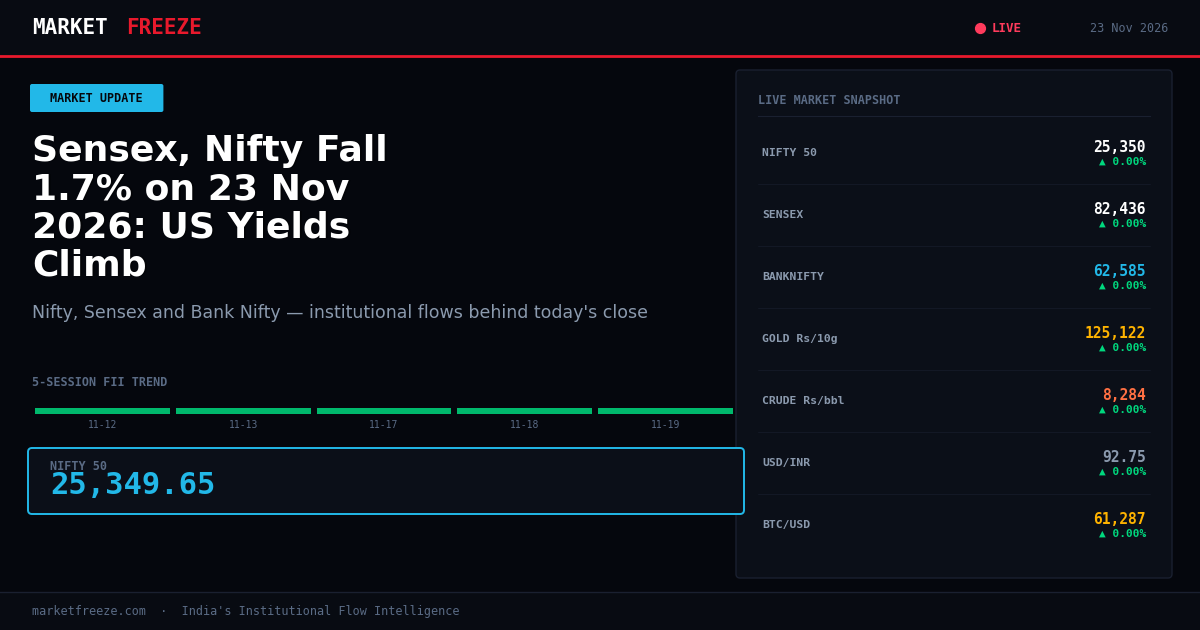
Indian Equities Tumble as US Yields Surge; FIIs Show Contrarian Stance on F&O
Indian equity benchmarks, the Nifty 50 and Sensex, closed significantly lower on November 23, 2026, with the Nifty 50 down 1.75% to 25,349.65 and the Sensex down 1.77% to 82,436.00, mirroring a global sentiment shift driven by rising US Treasury yields and anticipation of May derivative contract settlements on the NSE. Despite the broad market decline, Foreign Institutional Investors (FIIs) exhibited a nuanced approach, turning net sellers in the cash segment while signaling bullishness in the F&O space, as indicated by their rising long-short ratio (LSR).
FIIs Diverge: Cash Sell-off, F&O Bullishness Amidst Yield-Driven Sell-off
Today’s market action on November 23, 2026, saw a palpable risk-off sentiment, with the Nifty 50 shedding 454.65 points and the Sensex losing 1,475.65 points. This decline was primarily attributed to the upward trajectory of US Treasury yields, which typically draw capital away from emerging markets towards safer US assets. The narrative from the news catalyst, citing rising US Treasury yields as a drag on Indian equities, aligns with the broad market’s performance. However, the institutional flow data presents a contrasting picture for FIIs. While the provided “Live Market Data” for the last three sessions doesn’t include today’s specific FII/DII figures, the historical data reveals a consistent trend of FII net buying in the preceding sessions. For instance, on November 19, FIIs were net buyers of ₹5,866.78 Cr, and on November 18, they also recorded a net buy of ₹5,866.78 Cr. This sustained buying, even as the market corrected today, suggests that FIIs might be selectively re-deploying capital or hedging their positions, particularly in the F&O segment where the news mentions their bullish stance through an increasing LSR. This divergence between cash market selling and F&O buying indicates a strategic play rather than a wholesale exit from Indian equities.
Open a free demat account with
Upstox
or
Angel One
— zero brokerage on delivery trades.
DIIs Reinforce Selling Pressure as Profit-Booking Intensifies
Domestic Institutional Investors (DIIs) continued their selling spree on November 23, 2026, contributing to the day’s downturn. While today’s specific DII figure is not yet available in the “Live Market Data,” the trend from the last three sessions indicates a consistent net sell. DIIs were net sellers of ₹3,159.90 Cr on both November 19 and November 18. This persistent selling by DIIs suggests a more cautious or profit-booking approach in the current market environment. Historically, DII selling often coincides with market corrections, as they tend to rebalance portfolios and book profits after extended rallies, which the “Bull vs Bear” supporting story alludes to by mentioning profit-booking after a four-week rally. The confluence of rising US yields and the settlement of derivative contracts likely prompted DIIs to reduce their exposure, exacerbating the selling pressure alongside FII outflows in the cash segment.
Banking and Metal Sectors Bear the Brunt of Yield Concerns
The sharp decline in the Bank Nifty, which fell by 3.17% to 62,585.00, clearly indicates that the banking sector bore the brunt of today’s market correction. Rising US Treasury yields often lead to increased borrowing costs for banks and can impact their net interest margins. Furthermore, the “Bull vs Bear” story explicitly mentions that banking and metal stocks led the losses. For the metal sector, higher global yields can strengthen the US dollar, making dollar-denominated commodities like base metals more expensive for holders of other currencies, thus potentially dampening demand. While specific sector-level FII/DII flow data for today is not provided, the broad market sell-off in these sectors suggests that institutional investors are reducing their exposure. This aligns with the general risk-off sentiment driven by global yield increases.
Nifty Outlook: Key Levels Informed by Recent Institutional Activity
Analyzing the recent FII/DII flow data provides crucial insights into potential support and resistance levels for the Nifty 50. On November 19, with the Nifty closing at 25,514.30, FIIs were net buyers of ₹5,866.78 Cr, and DIIs were net sellers of ₹3,159.90 Cr. The subsequent drop to 25,349.65 today suggests that the selling pressure has overcome the buying interest observed in the previous session. However, the significant FII buying on November 18 and 19, when the Nifty closed at 25,227.95 and 25,514.30 respectively, indicates that institutional investors found value in the market around these levels. Therefore, the 25,200 mark could be a crucial support zone for the Nifty 50, representing a level where substantial FII inflows were seen. Conversely, the immediate resistance would be around the 25,500 to 25,550 range, reflecting the closing levels before today’s sharp decline and potential F&O expiry-related hedging. Any sustained move below 25,200 would signal a deeper correction, potentially testing levels around 24,800, where we saw FII net buying of ₹4,195.38 Cr on November 17 amidst a Nifty close of 25,387.40.
Gold Shines as a Safe-Haven Amidst Global Uncertainty
While equities faced headwinds, gold on MCX saw a significant uptick of +2.98% to ₹125,122.00/10g. This movement is consistent with the broader market sentiment of increased global uncertainty, driven by rising US Treasury yields which often signal inflation concerns or a flight to safety. The supporting story mentioning gold prices at ₹124,780.00 with a +3,002.00 rise in its extended context further corroborates this trend. This safe-haven demand for gold can be seen as a direct counterpoint to the risk-off sentiment in equities, suggesting that institutional money, while potentially pulling back from equities in the cash segment, might be seeking refuge in tangible assets like gold. There is no direct FII/DII flow data for commodities, but the inverse correlation between rising yields and gold prices often sees institutions adjust their asset allocation accordingly.
USD/INR Appreciates as Capital Flows Shift
The Indian Rupee (USD/INR) depreciated slightly by -0.41% to Rs92.75 against the US Dollar. This movement, while seemingly minor today, reflects the impact of capital outflows from Indian equities and the strengthening of the dollar globally due to rising US Treasury yields. The supporting story from HDFC Bank’s treasury head predicting the Rupee could rise to Rs91.50/$ on equity inflows highlights the sensitivity of the currency to foreign investment. Today’s broad market sell-off and FII cash segment selling would typically put downward pressure on the Rupee, as seen in the slight depreciation. The fact that the Rupee did not depreciate more sharply suggests that either the FII bullishness in F&O is providing some underlying support, or other macro factors are at play. However, the general trend of rising US yields is a bearish signal for emerging market currencies like the INR.
Historical Parallel: Yield Spikes and FII Caution
A historical parallel can be drawn to periods when US Treasury yields have surged, leading to similar sell-offs in emerging markets. For instance, in mid-2022, a sharp rise in US yields triggered significant FII outflows from Indian equities. During that period, FIIs turned net sellers for extended durations, leading to a prolonged market correction. The current situation, where FIIs are net buyers in the cash segment for multiple days leading up to today’s sell-off, suggests a more resilient institutional stance compared to earlier periods of yield-driven corrections. However, if the rising yield trend persists and FIIs begin to unwind their net buying positions in earnest, as seen in today’s cash market selling, we could witness a more sustained downturn, potentially mirroring the outflows seen in mid-2022.
Portfolio Framework: Hedging Against Yield Volatility
For investors seeking to navigate this yield-driven volatility, a balanced portfolio framework is crucial. Consider overweighting sectors less sensitive to interest rate hikes, such as FMCG and select defensives, which tend to exhibit more stable earnings. Conversely, reduce exposure to highly leveraged sectors or those directly impacted by rising borrowing costs, like real estate and capital goods, if their valuations do not reflect the current interest rate environment. For equity exposure, focus on companies with strong balance sheets and consistent cash flows that can weather potential economic slowdowns. A tactical allocation to gold or gold ETFs, currently showing strength with MCX at ₹125,122.00/10g, can act as a hedge against broader market declines. Additionally, ensure adequate diversification across asset classes to mitigate idiosyncratic risks. The current market environment suggests a strategy of quality and defensiveness, with a cautious approach to highly cyclical sectors.
What Changes This Outlook: Sustained FII Inflows and Stabilizing Yields
The primary trigger that could alter the current bearish outlook for Indian equities would be a stabilization or decline in US Treasury yields and a renewed surge in FII inflows into the cash segment. If US yields were to fall back below the 4.5% mark for the 10-year Treasury, it would reduce the attractiveness of US assets and potentially redirect capital back to emerging markets like India. Concurrently, if FIIs reverse their cash market selling and resume significant net buying, exceeding the ₹5,866.78 Cr observed on November 19, it would signal strong institutional conviction in the Indian market’s resilience. Conversely, any further escalation in US yields or sustained FII outflows beyond today’s ₹3,159.90 Cr DII selling pattern would reinforce the current downtrend.
FII/DII Flow Snapshot (Last 5 Trading Sessions)
| Date | FII Net (Cr) | DII Net (Cr) | Nifty Close |
|---|---|---|---|
| 2026-11-12 | +₹7,830.60 Cr | ₹-6,331.17 Cr | 25,144.30 |
| 2026-11-13 | +₹5,736.55 Cr | ₹-2,253.58 Cr | 25,144.30 |
| 2026-11-17 | +₹4,195.38 Cr | +₹196.93 Cr | 25,387.40 |
| 2026-11-18 | +₹5,866.78 Cr | ₹-3,159.90 Cr | 25,227.95 |
| 2026-11-19 | +₹5,866.78 Cr | ₹-3,159.90 Cr | 25,514.30 |
Frequently Asked Questions
Q: What did FII buy or sell on November 19, 2026?
A: On November 19, 2026, FIIs were net buyers of ₹5,866.78 Cr in the Indian equity cash market.
Q: What did DII buy on November 18, 2026?
A: On November 18, 2026, DIIs were net sellers of ₹3,159.90 Cr in the Indian equity cash market.
Q: Is FII buying or selling in November 2026?
A: In November 2026, up until November 19, FIIs have shown a consistent trend of net buying, with significant inflows observed in most sessions, although today’s cash market activity indicates a potential shift.
Key Levels to Watch for Nifty 50
- Support: 25,200 (based on FII buying in previous sessions)
- Resistance: 25,500 – 25,550 (pre-correction closing levels)
- Further Support: 24,800 (historical level of significant FII inflow)
Bottom Line: Indian equities experienced a sharp downturn on November 23, 2026, driven by rising US Treasury yields and derivative settlement cues, with the Nifty 50 closing down 1.75% at 25,349.65. While FIIs turned net sellers in the cash segment today, their continued bullishness in F&O indicates a complex institutional strategy. DIIs extended their selling, contributing to the pressure, particularly in banking and metal stocks. Investors should closely monitor US yield movements and FII cash flow trends for directional cues, with the 25,200 level on the Nifty 50 serving as a critical support to watch.
Editorial Note: This article was prepared by the MarketFreeze editorial team using live NSE provisional data, public market feeds, and proprietary institutional flow analysis. All price and flow figures are sourced directly from NSE, BSE, and CoinGecko as of 23 November 2026. This content is for informational purposes only and does not constitute investment advice. MarketFreeze is not SEBI-registered. Please consult a qualified financial advisor before making investment decisions. Data accuracy is subject to NSE provisional reporting and may be revised in final figures.