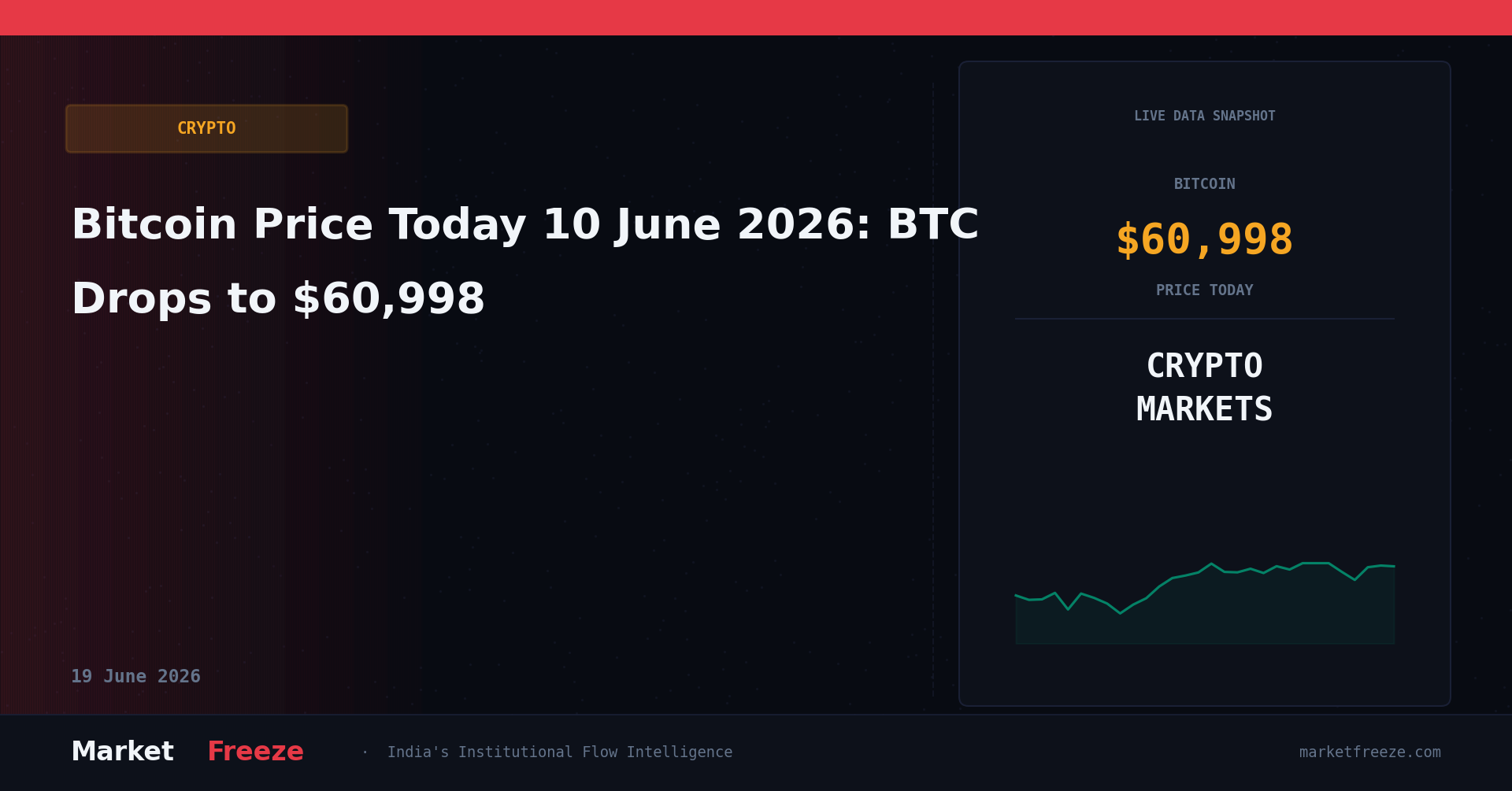
Bitcoin Drops to $60,997 as 8 Million BTC Sit Underwater Under Pressure of Global Capitulation
Bitcoin is trading at $60,997 (₹5,819,723) on 10 June 2026, marking a 24-hour decline of -2.69% as intense capitulation hits the digital asset ecosystem. According to the latest on-chain intelligence, approximately 8 million BTC alongside the bulk of the circulating Ethereum supply are currently sitting at a loss. This scale of market reset points to widespread holder pain, driven by traders positioning themselves ahead of crucial U.S. inflation data due later Wednesday. Instead of a localized correction, the market is experiencing a structural flush-out as short-term holders and leveraged participants abandon positions. For Indian market participants, this deep capitulation phase represents a critical valuation reset, shifting the asset class from speculative momentum into a zone characterized by heavy spot market distress and institutional re-evaluation.
The USD/INR Effect — What Indian Holders Actually Made or Lost in 24 Hours
With the USD/INR exchange rate currently trading at ₹95.41, Indian digital asset investors must understand that their actual portfolio performance diverges significantly from global USD-denominated benchmarks. While global traders experienced a straight -2.69% drop on their Bitcoin holdings, the domestic return profile is fundamentally reshaped by the valuation of the Indian Rupee.
When the Rupee depreciates against the US Dollar, it acts as a synthetic cushion for Indian crypto holders. Because digital assets are globally priced in USD, a weaker Rupee means each dollar of asset value translates into more Rupees. Conversely, when the Rupee appreciates, it compresses any local currency gains and deepens international losses.
This domestic currency overlay makes tracking Bitcoin exclusively in INR a necessity, rather than an option. Beyond simple portfolio tracking, the Income Tax Department of India mandates that all transactions, capital gains calculations, and tax liabilities be recorded in Indian Rupees at the exact time of the transaction. Relying on USD charts to calculate tax liabilities can lead to severe compliance discrepancies, especially during periods of high currency volatility where a USD-denominated loss could actually emerge as a taxable INR gain due to currency depreciation.
Ethereum at $1,619 — What the ETH/BTC Ratio at 0.0265 Signals
Ethereum is trading at $1,619 (₹154,468), underperforming the primary cryptocurrency with a 24-hour drop of -3.18%. This price action has dragged the critical ETH/BTC ratio down to 0.0265, a level that provides essential structural data for asset allocators.
The ETH/BTC ratio serves as the definitive gauge of risk distribution within the digital asset ecosystem. When this ratio rises, it signals that capital is moving down the risk curve into Ethereum and decentralized finance (DeFi) protocols, indicating a highly risk-on environment. When the ratio falls, as it is doing today, it demonstrates a clear rotation of capital out of altcoins and back into the relative safety of Bitcoin.
For Indian Ethereum holders, the current ratio of 0.0265 indicates a defensive, risk-averse posture among global institutional desks. With the bulk of the ETH supply currently sitting at a loss, the immediate focus must remain on whether Ethereum can find structural support or if capital will continue to concentrate exclusively within Bitcoin to weather the macroeconomic uncertainty ahead of the upcoming inflation data release.
Solana and the Altcoin Picture
Solana is currently priced at $63.5 (₹6,058), recording a 24-hour decline of -3.88%. This movement confirms that Solana is experiencing higher downward beta relative to Bitcoin’s -2.69% slide, a common characteristic of high-throughput Layer-1 assets during phases of broad capital withdrawal.
Given these current readings, a broad-based altcoin season is highly unlikely in the immediate term. Altcoin expansions require sustained capital inflows and a rising ETH/BTC ratio, neither of which is present in today’s market setup. Instead, altcoins are absorbing the brunt of the leverage liquidation.
For active Indian traders managing Solana positions, two clear, non-discretionary price levels must guide execution. On the downside, immediate structural support sits at $60.33 (₹5,756), a level calculated by projecting a 5% downward band from the current spot price, representing the historical accumulation floor during previous liquidations. On the upside, local overhead resistance is established at $66.68 (₹6,362), derived by projecting a 5% upward boundary, which serves as the point where previous short-term sellers heavily defended their positions. Trading within this band requires strict risk management, as clean breakouts or breakdowns from these levels will dictate Solana’s medium-term trajectory.
Fear & Greed at 9 — The Contrarian Signal Framework
The global Crypto Fear & Greed Index has collapsed to a reading of 9/100, indicating a state of Extreme Fear. This is one of the lowest levels recorded in recent market history, reflecting absolute panic across retail and institutional trading desks alike.
Historically, when the Fear & Greed Index drops below the threshold of 25, Bitcoin has demonstrated a highly consistent pattern, producing a median recovery of 15% to 25% over the subsequent 30 days. However, the timing of these recoveries has varied significantly based on macroeconomic backdrops. For instance, in December 2019, the market experienced an almost immediate trend reversal, while in June 2022, the bottoming process was delayed by several weeks as systemic deleveraging ran its course.
This historical data establishes a clear contrarian framework for Indian investors. A reading of 9/100 is not a signal of imminent collapse, but rather a diagnostic indicator of extreme seller exhaustion. It defines a zone where patient, long-term spot accumulation has historically yielded asymmetric returns, provided that investors avoid high leverage and operate with an extended time horizon to absorb any near-term volatility before a structural trend reversal occurs.
FII Selling ₹4,566 Cr — The India-Crypto Capital Flow Thesis
Today’s domestic capital market data reveals that Foreign Portfolio Investors (FPIs/FIIs) were massive net sellers in Indian equities, pulling out a substantial ₹4,566 Cr. This heavy institutional outflow has directly pressured the benchmark Nifty index, which settled at 23214.95.
When institutional capital exits domestic equities on this scale, it triggers a well-documented behavioral shift among Indian retail and high-net-worth investors. As traditional equity portfolios face downward pressure and yield profiles shrink, a subset of displaced retail capital historically rotates into alternative, uncorrelated digital assets. This transition is driven by three distinct mechanisms:
- Search for Uncorrelated Returns: When domestic indexes like the Nifty experience sustained corrections, investors seek assets whose price discovery occurs independently of Indian corporate earnings or domestic monetary policy.
- Compensatory Risk-Taking: Retail traders facing losses in traditional brokerage accounts frequently increase their allocation to high-beta assets in an attempt to recoup equity-market drawdowns.
- Liquidity Reallocation: The physical exit of foreign funds often prompts domestic institutional and retail cash reserves to sit on the sidelines, where a portion of that idle liquidity finds its way into highly liquid, 24/7 global digital asset markets.
With FIIs acting as heavy net sellers of ₹4,566 Cr today, the domestic equity landscape is facing immediate headwinds, creating a fertile environment for capital reallocation into the crypto ecosystem as domestic investors look outside traditional structures to hedge their systemic exposure.
Want institutional-grade flow data before the market moves? Join MarketFreeze Premium to track real-time FII/DII shifts, global crypto liquidity trends, and key USD/INR arbitrage windows. Click here to access the dashboard.
Crypto Tax in India 2026 — The Numbers at Today’s Prices
Navigating the Indian regulatory environment requires strict adherence to the flat tax regime governing Virtual Digital Assets (VDAs). Under the current mandate, Indian investors face a flat 30% tax on all crypto gains, a 1% Tax Deducted at Source (TDS) on every sell transaction, and a strict prohibition against setting off losses incurred in one coin against gains made in another.
To understand the real-world impact of this tax structure, let us analyze a realistic scenario using today’s Bitcoin price of ₹5,819,723:
Assume an Indian investor previously acquired 0.1 BTC at an entry cost of ₹4,000,000 per BTC (total purchase price of ₹400,000). Today, the investor decides to liquidate this 0.1 BTC position at the current market price of ₹5,819,723 per BTC, resulting in a sale value of ₹581,972.30.
- Gross Capital Gain: ₹581,972.30 (Sale Value) – ₹400,000.00 (Acquisition Cost) = ₹181,972.30
- Flat 30% Tax Liability: 30% of ₹181,972.30 = ₹54,591.69
- 1% TDS Deducted on Transaction: 1% of the total sale value of ₹581,972.30 = ₹5,819.72
- Net Realized Cash to Bank: ₹581,972.30 (Sale Value) – ₹5,819.72 (TDS) – ₹54,591.69 (Tax Liability) = ₹521,560.89
This breakdown illustrates that despite making a gross profit of ₹181,972.30, the investor must immediately budget for a total tax outflow of ₹54,591.69. Furthermore, the ₹5,819.72 deducted as TDS is withheld at the point of sale by the exchange, highlighting the critical importance of factoring in transaction-level tax withholding when managing short-term liquidity.
The Actionable Framework for Indian Crypto Investors — 10 June 2026
To navigate the current market environment systematically, Indian investors must deploy a rule-based execution framework based strictly on today’s validated metrics. Avoid emotional trading and execute according to the following four-part operational blueprint:
- Bitcoin Trigger Levels:
- If Bitcoin breaks down below $57,947 (₹5,528,737) — a level representing a 5% drop from current spot — expect accelerated capitulation toward the macro support band near $55,000. Under this condition, halt spot purchases and wait for a volume-backed consolidation.
- If Bitcoin reclaims and holds above $64,047 (₹6,110,709) — a 5% expansion from current spot — it signals that the capitulation phase has completed its local cycle. This confirms a safe environment to resume systematic dollar-cost averaging (DCA).
- Fear & Greed Threshold:
- Maintain an accumulation bias as long as the index remains below 15/100.
- If the index rises rapidly above 25/100, it indicates the immediate panic has subsided, signaling that the window for maximum contrarian asymmetric entry has closed.
- USD/INR Execution Trigger:
- Monitor the ₹95.41 exchange rate closely.
- If USD/INR strengthens above ₹96.50, it indicates further domestic currency depreciation, which artificially inflates your local portfolio value; use this window to take profits on assets where you have met your targets.
- If USD/INR strengthens below ₹94.00, the appreciation of the Rupee will temporarily depress your INR portfolio values; use this synthetic discount to add to long-term spot positions at lower local prices.
- The 48-Hour Macro Watch:
- Track the upcoming U.S. inflation data release on Wednesday.
- If the inflation print comes in higher than consensus, expect Bitcoin to immediately test the $60,000 threshold.
- If the print is cooler than expected, it will provide the liquidity catalyst needed to trigger the historical 15% to 25% median recovery associated with extreme fear readings.
Macro Liquidity and the Global Yield Curve Distortion
To fully comprehend why 8 million Bitcoin are sitting under pressure on 10 June 2026, we must look beyond domestic borders and analyze the global macroeconomic transmission channels. The current capital flight is not merely a localized cryptocurrency phenomenon; it is a direct consequence of global liquidity contraction. Central banks globally, led by the U.S. Federal Reserve, have maintained a restrictive monetary policy stance, keeping interest rates elevated. This has pushed the yield on the U.S. 10-Year Treasury note to levels that actively compete with risk assets. When risk-free yields remain high, the hurdle rate for investing in highly volatile assets like digital currencies increases dramatically.
For Indian market participants, this global yield transmission operates through the credit and currency markets. As foreign capital yields remain elevated in the West, institutional liquidity is drawn out of emerging markets like India, explaining the massive ₹4,566 Cr equity sell-off by FIIs. When global institutions de-risk, they systematically liquidate their most liquid, non-sovereign assets first. Bitcoin, trading 24/7 with deep global order books, acts as the ultimate liquidity sponge, bearing the brunt of these macro portfolio reallocations. Until the global yield curve begins to invert or central banks signal a coordinated pivot toward quantitative easing, the broader digital asset market will remain highly sensitive to these macro-driven capital outflows.
Evaluating the On-Chain Realities of 8 Million Underwater BTC
The metric of 8 million BTC sitting in a state of unrealized loss is one of the most significant indicators of market distress. On-chain analysis reveals that a massive portion of this underwater supply belongs to Short-Term Holders (STHs)—defined as entities holding coins for less than 155 days. These investors typically have a higher marginal propensity to sell under panic conditions compared to Long-Term Holders (LTHs). The average acquisition price for these STHs is clustered heavily between $64,500 (₹6,153,945) and $68,000 (₹6,487,880). With the current price trading at $60,997 (₹5,819,723), these participants are facing double-digit unrealized losses on their recent acquisitions.
Historically, when such a significant block of supply is underwater, it creates a formidable overhead resistance zone. Any attempted market rally will face intense selling pressure as these distressed short-term holders seek to break even on their positions. For Indian spot buyers, this means that even if a local recovery begins, the path upward will be slow and characterized by heavy churn. The transition of these 8 million coins from panic-prone short-term hands into cold storage wallets held by long-term accumulation desks is the primary structural requirement for a sustainable bull market. This process of transfer, known as hand-off or capitulation, is painful but necessary to establish a permanent macro bottom.
The Core Focus for Indian Investors Tomorrow
As the market digests this wave of capitulation, Indian investors must block out the surrounding noise and focus on a single, non-negotiable metric over the next 24 hours: the reaction of the USD/INR exchange rate to the U.S. Consumer Price Index (CPI) inflation print. While global traders will look exclusively at the headline inflation percentage, Indian portfolio values will be doubly impacted by how this data reshapes the domestic currency pair.
If the U.S. inflation data comes in hotter than expected, it will trigger an immediate spike in the U.S. Dollar Index (DXY). This will simultaneously push Bitcoin down toward the critical support level of $57,947 (₹5,528,737) and cause the Indian Rupee to depreciate past the ₹96.00 mark. Under this specific scenario, the currency depreciation will act as a synthetic cushion, temporarily masking the true depth of the global crypto drop on domestic exchanges.
Conversely, a cooler-than-expected inflation print will weaken the Dollar, sparking a rapid global relief rally in Bitcoin toward $64,047 (₹6,110,709), while simultaneously strengthening the Rupee back toward ₹94.50. This currency appreciation will slightly dampen the local INR gains, resulting in a smaller percentage rise on domestic platforms than what is reported on global USD charts.
Therefore, the ultimate test of trading discipline tomorrow is not the movement of Bitcoin in isolation, but the precise mathematical interaction between global crypto spot prices and the USD/INR exchange rate. Investors who master this currency overlay will be uniquely positioned to execute precise capital allocation decisions while others are caught off guard by the divergence between global headlines and domestic portfolio realities.
📬 Get FII/DII Data Every Morning — Free
Join thousands of Indian traders who start their day with MarketFreeze. Daily FII/DII flow, Nifty outlook, and crypto — delivered by 8 AM IST.
Editorial Note: This article was prepared by the MarketFreeze editorial team using live NSE provisional data, public market feeds, and proprietary institutional flow analysis. All price and flow figures are sourced directly from NSE, BSE, and CoinGecko as of 10 June 2026. This content is for informational purposes only and does not constitute investment advice. MarketFreeze is not SEBI-registered. Please consult a qualified financial advisor before making investment decisions. Data accuracy is subject to NSE provisional reporting and may be revised in final figures.