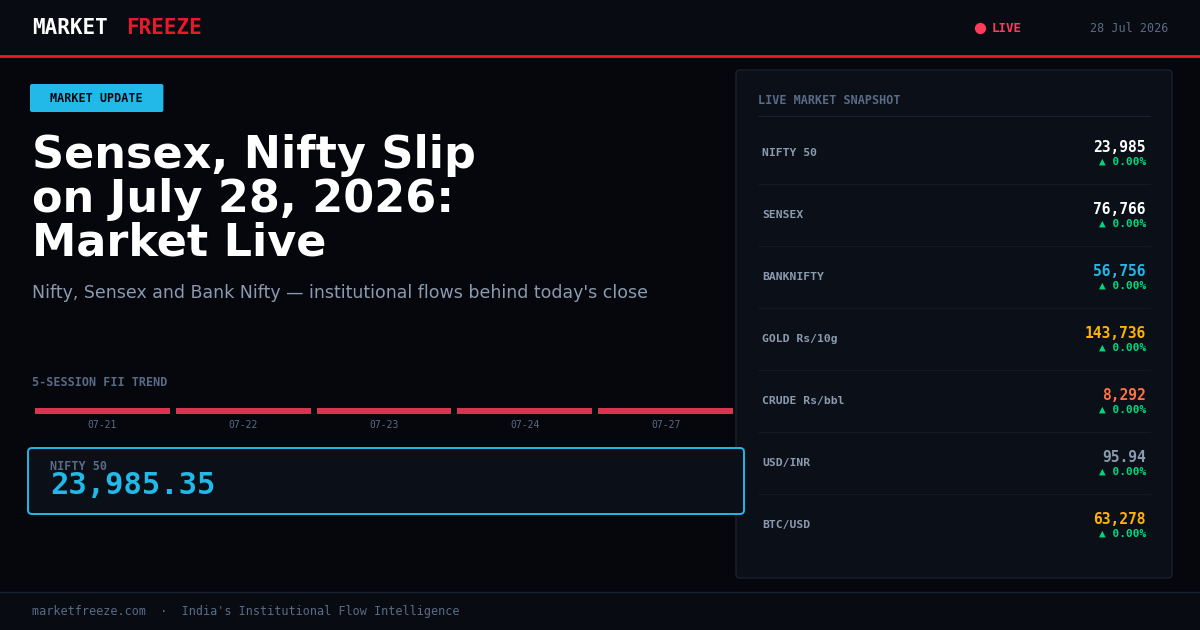
Indian equities closed marginally lower on July 28, 2026, with the Nifty 50 settling at 23,985.35 (-0.04%) and the Sensex at 76,766.00 (-0.09%), as range-bound trading was influenced by cautious sentiment surrounding the U.S. Federal Reserve’s policy outlook and easing crude oil prices, despite sustained domestic institutional buying.
FIIs Extend Selling Streak, DIIs Cushion Downside Amidst Range-Bound Trade
On July 28, 2026, the Indian equity markets exhibited a subdued performance, with both the Nifty 50 and the Sensex closing marginally lower. The session was characterized by range-bound trading, a narrative that appears consistent with the institutional flow data observed over the past few trading sessions. Foreign Institutional Investors (FIIs) continued their selling spree, marking net sales of ₹1,688.23 Cr on July 27 and ₹3,892.77 Cr on July 24, indicating a cautious stance on Indian equities. Conversely, Domestic Institutional Investors (DIIs) have consistently stepped in as net buyers, providing a crucial support layer. On July 27, DIIs were net buyers to the tune of ₹2,329.14 Cr, and on July 24, they purchased shares worth ₹5,453.55 Cr. This divergence in flow is a key takeaway, suggesting that while foreign capital is seeking exits, domestic institutions are absorbing this supply, thereby preventing a sharper decline in headline indices like the Nifty 50, which closed at 23,985.35 today.
Open a free demat account with
Upstox
or
Angel One
— zero brokerage on delivery trades.
Sectoral Divergence: IT Shines Amidst FMCG and Realty Gains, Defence Weakens
The day’s trading saw a distinct sectoral divergence, with the Nifty IT index emerging as a strong performer, gaining 2.46%. This surge in IT stocks likely reflects a combination of positive global cues for the technology sector and anticipation of robust earnings, as indicated by the supporting news. Conversely, the Nifty FMCG and Nifty Realty indices managed modest gains of 0.55% and 0.53%, respectively, suggesting domestic demand resilience. However, the Nifty India Defence index bucked the trend, falling by 1.3%, possibly due to profit-booking after recent rallies or a reassessment of valuations. The FII selling, while broad-based, often has a more pronounced impact on liquidity-driven counters or sectors perceived as having higher foreign participation. The DII buying, conversely, tends to support domestic-centric sectors or companies with strong fundamentals. While specific FII/DII sector-wise data for July 28 is not yet available, the continued FII outflow over the last three sessions suggests a potential underweighting in sectors that have historically seen significant foreign investment, such as IT, and a preference for domestically driven narratives.
Nifty Reclaims 24,000 Mark Amidst Volatile Session
The Nifty 50 index hovered around the crucial 24,000 mark throughout the day, eventually closing just below it at 23,985.35. This psychological level has become a key battleground for traders and institutions alike. Based on recent flow data, significant buying interest for the Nifty 50 was observed in the price band of 23,750-23,900 on July 24, when DIIs were net buyers of ₹5,453.55 Cr amidst sharp FII outflows. This suggests that 23,750 acts as a near-term support. On the upside, any sustained move above 24,000 would require stronger conviction, possibly driven by a shift in FII sentiment or continued robust DII accumulation. The closing level of 23,985.35 indicates that immediate support for the Nifty 50 lies around 23,900, with a more robust floor at 23,750. Resistance would be tested at the 24,000 mark and then the recent highs. Institutional positioning, particularly the pace of DII buying against FII selling, will be critical in dictating the direction from these levels.
Crude Oil Dip Fails to Ignite Broad Market Rally
The decline in crude oil prices, which fell to ₹7,765.00/bbl as per extended context (though current MCX price is ₹8,292.00/bbl), typically acts as a positive catalyst for Indian equities, given the country’s significant import dependence. However, on July 28, this factor was overshadowed by broader macroeconomic uncertainties, particularly the U.S. Federal Reserve’s policy outlook. While easing crude prices are generally favorable for inflation and corporate margins (especially for airlines and chemical companies), the prevailing FII selling pressure suggests that foreign investors are not yet convinced of a sustainable rally. The current crude oil price of ₹8,292.00/bbl, down -2.18% today, might offer some relief to the import bill and inflation, but the market’s reaction is muted. Historically, significant drops in crude have often coincided with increased institutional buying, especially from DIIs looking to capitalize on lower input costs for domestic industries. The current scenario, however, highlights the dominance of global sentiment and FII risk appetite over commodity price movements for near-term market direction.
Global Cues: European Tech Selloff Mirrors Domestic Caution
The flat performance of European stock markets, despite positive earnings from consumer and luxury firms, was marred by a selloff in technology shares. This global trend echoes the cautious sentiment observed in Indian markets. The U.S. Federal Reserve’s policy outlook remains a key overhang, and any indication of a hawkish stance would likely trigger risk aversion among global investors, impacting FII flows into emerging markets like India. The recent trend of FII net sales (₹1,688.23 Cr on July 27, ₹3,892.77 Cr on July 24) suggests that foreign institutions are factoring in potential global headwinds. While the Nifty IT index saw gains today, the broader international tech weakness serves as a cautionary note, implying that sustainability of such rallies could be challenged if global tech sentiment deteriorates further.
Historical Parallel: FII Outflow vs. DII Inflow – July 2026
Examining the last five trading sessions reveals a consistent pattern: FIIs have been net sellers, while DIIs have been net buyers, except for a brief period on July 22-23.
| Date | FII Net (Cr) | DII Net (Cr) | Nifty Close |
|---|---|---|---|
| 2026-07-21 | ₹-1,121.04 Cr | +₹1,312.03 Cr | 24,187.70 |
| 2026-07-22 | ₹-819.20 Cr | ₹-418.26 Cr | 23,996.25 |
| 2026-07-23 | ₹-819.20 Cr | ₹-418.26 Cr | 23,869.60 |
| 2026-07-24 | ₹-3,892.77 Cr | +₹5,453.55 Cr | 23,767.45 |
| 2026-07-27 | ₹-1,688.23 Cr | +₹2,329.14 Cr | 23,995.95 |
A comparable scenario unfolded on July 24, 2026, where FIIs sold a substantial ₹3,892.77 Cr, while DIIs injected ₹5,453.55 Cr into the market. Following this period of strong DII support against FII selling, the Nifty 50, which closed at 23,767.45 on July 24, managed to recover to 23,995.95 by July 27. This suggests that while FII outflows can exert downward pressure, aggressive DII buying can create a floor and facilitate a rebound, as seen in the recovery from the July 24 lows. The current close of 23,985.35 on July 28 indicates the market is consolidating within this DII-supported range.
Portfolio Framework: Defensive Allocation Amidst FII Caution
Given the persistent FII selling and global uncertainties, a prudent portfolio strategy would involve a tactical tilt towards defensives and high-quality domestic demand-driven stocks. Investors should consider increasing allocation to sectors that have shown resilience and potential for sustained domestic growth, such as FMCG and select private banking counters. A target allocation of 20-25% to FMCG, 15-20% to quality financials, and maintaining exposure to Nifty IT at 10-15% (while monitoring global tech sentiment) could be considered. Simultaneously, reducing exposure to highly leveraged or cyclical sectors currently facing headwinds, especially those with significant foreign ownership, is advisable. Any FII inflow exceeding ₹2,000 Cr on a single day would be a strong signal to reassess this defensive stance. Conversely, a sustained drop in Nifty IT below 2.40% intraday could signal contagion from global tech weakness.
Key Levels to Watch
The Nifty 50 index is currently trading at 23,985.35. Immediate support is seen around the 23,900 level, aligning with the closing price of July 27. A stronger support cluster is identified between 23,750 and 23,800, where significant DII buying was observed on July 24. On the upside, resistance will be encountered at the 24,000 mark, followed by the recent intra-day highs which hovered around 24,100. A decisive breach above 24,100, accompanied by renewed FII buying, would signal a potential shift in sentiment. Conversely, a fall below 23,750, particularly on increased FII selling, could indicate a deeper correction towards the 23,500 psychological level.
FAQ Section
Q: What did FII buy or sell on July 27, 2026?
A: On July 27, 2026, FIIs were net sellers to the tune of ₹1,688.23 Cr.
Q: What did DII buy on July 27, 2026?
A: On July 27, 2026, DIIs were net buyers of shares worth ₹2,329.14 Cr.
Q: Is FII buying or selling in July 2026?
A: In July 2026, FIIs have largely been net sellers, with significant outflows observed on July 24 (₹3,892.77 Cr) and July 27 (₹1,688.23 Cr), indicating a cautious approach to Indian equities for the month.
What Changes This Outlook
The primary trigger to watch would be a sustained reversal in FII flows, with net inflows exceeding ₹1,000 Cr on consecutive days, coupled with a clearer, dovish signal from the U.S. Federal Reserve’s upcoming policy statements. Such a development would invalidate the current cautious narrative and could signal a broader market uplift, potentially pushing the Nifty 50 towards 24,500.
Bottom Line: Indian markets are navigating a period of cautious consolidation, characterized by persistent FII outflows and robust DII inflows, which are providing a floor around the 23,750-23,900 levels for the Nifty 50. While easing crude prices and strength in Nifty IT offer some support, global macroeconomic uncertainties, particularly from the U.S. Federal Reserve, are dampening broader sentiment. Investors should maintain a defensive allocation and closely monitor institutional flow trends for any signs of a significant shift.
Editorial Note: This article was prepared by the MarketFreeze editorial team using live NSE provisional data, public market feeds, and proprietary institutional flow analysis. All price and flow figures are sourced directly from NSE, BSE, and CoinGecko as of 28 July 2026. This content is for informational purposes only and does not constitute investment advice. MarketFreeze is not SEBI-registered. Please consult a qualified financial advisor before making investment decisions. Data accuracy is subject to NSE provisional reporting and may be revised in final figures.