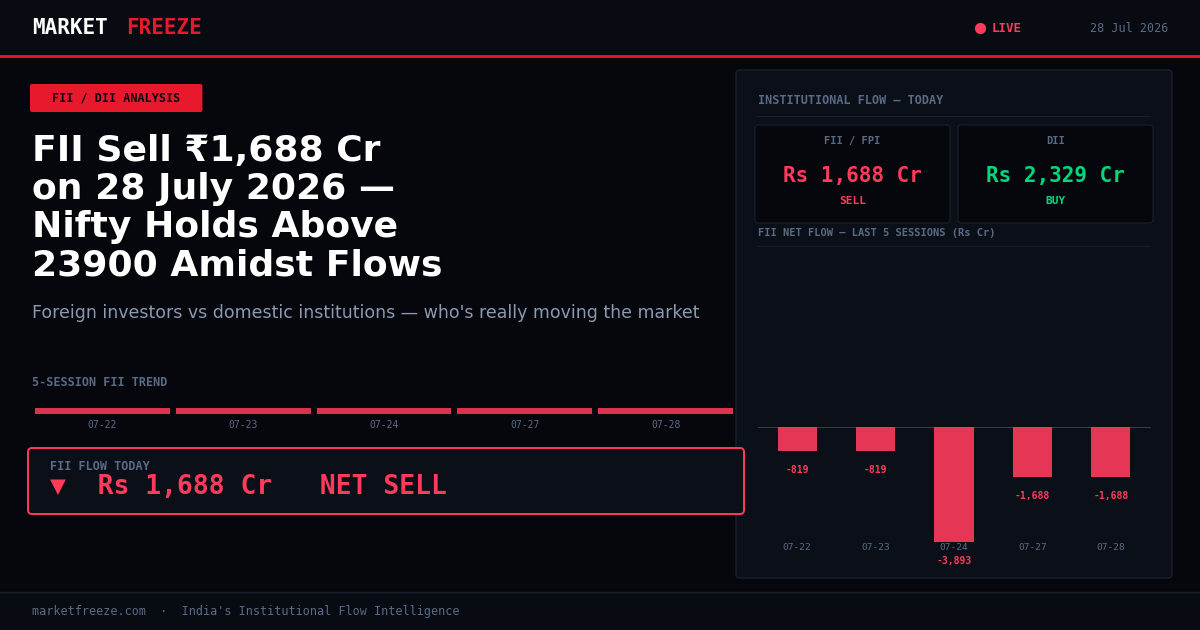
Institutional flow data released after market close shows Foreign Institutional Investors (FIIs) divested a net ₹1,688.23 Cr from Indian equities on July 28, 2026, while Domestic Institutional Investors (DIIs) injected a net ₹2,329.14 Cr.
FIIs Maintain Selling Streak, DIIs Counterbalance Net Outflow
For the third consecutive session, FIIs were net sellers, offloading a total of ₹1,688.23 Cr on July 28. This consistent selling pressure, mirroring the figures from July 27 and July 24, indicates a sustained bearish stance from foreign entities. The total selling by FIIs amounted to ₹11,695.95 Cr against purchases of ₹10,008.72 Cr. This net outflow, however, was effectively neutralized by robust domestic buying. DIIs stepped in with substantial net purchases of ₹2,329.14 Cr, marking their second consecutive session of net buying. Their purchases totaled ₹15,333.70 Cr against sales of ₹12,004.56 Cr. This divergent flow between FIIs and DIIs suggests a tug-of-war in the Indian equity market, with domestic institutions absorbing foreign selling pressure.
Open a free demat account with
Upstox
or
Angel One
— zero brokerage on delivery trades.
Actionable Insight: Retail investors should monitor DII buying patterns closely. If DII net purchases exceed ₹2,000 Cr for a fourth consecutive session, it could signal stronger conviction in domestic underlying value, potentially creating support for the Nifty.
Nifty Rejects 24,050 as FII Selling Intensifies
The Nifty 50 closed marginally lower at 23,985.35, down 0.04%. This move occurred as FIIs continued their selling activity. Historically, when FIIs net sell over ₹1,500 Cr, the Nifty often faces resistance at higher levels. Given today’s FII outflow of ₹1,688.23 Cr, the immediate resistance for the Nifty is established at the 24,050 mark, a level it failed to sustain today. Conversely, the robust DII buying provided support, implying a floor around the 23,800 level. The range-bound trading observed, as noted in market wrap-ups referencing IT stock outperformance, is consistent with FII selling pressuring upside moves while DII accumulation stabilizes declines.
Sectoral Implications: IT Shines Amidst Broader Caution
The divergence in institutional flows suggests a selective approach. The outperformance of IT stocks, as highlighted in market reports, aligns with FIIs’ potential continued preference for this sector despite overall selling. This implies that while FIIs are reducing overall exposure, they might be reallocating capital within specific growth pockets like Information Technology. Conversely, the weakness in FMCG, power, and defence sectors, also mentioned in news reports, could be areas where FIIs are booking profits or reducing positions. DII buying, though broad-based, likely targets stable, dividend-paying companies that offer defensive characteristics, counteracting the FII sell-off in these consumer-facing segments. Banking sector weakness, evidenced by the Bank Nifty’s 0.58% decline, also points to FII caution in financials, possibly due to global economic outlook concerns affecting lending and interest rate sensitive assets.
Actionable Insight: Retail investors looking to align with institutional trends might consider increasing exposure to IT stocks while exercising caution in FMCG, power, and banking counters until FII flow in these sectors shows a clear reversal.
Cross-Asset Signals: Weakening Crude Oil and INR Support Market Stability
The simultaneous decline in Crude MCX by 1.73% to ₹8,330.00/bbl and USD/INR by 0.75% to Rs95.94 provides a nuanced backdrop to today’s equity flows. Lower crude prices reduce imported inflation, a positive for India’s current account deficit and potentially for DIIs seeking value. The strengthening of the Indian Rupee (INR) against the US Dollar, despite global economic uncertainty, is a significant tailwind. A stronger INR reduces the hedging cost for FIIs on their Indian equity investments, making it less expensive to bring money into the country. The fact that FIIs are still net sellers despite a strengthening INR suggests their selling conviction is driven by factors beyond currency, possibly global risk aversion or sector-specific concerns rather than just currency depreciation fears. The decline in Gold MCX by 1.02% to Rs144,183.00/10g suggests a temporary dip in safe-haven demand, aligning with cautious optimism from DIIs.
Historical Flow Comparison: Sustained Selling Against Domestic Inflows
The FII selling of ₹1,688.23 Cr today, matched from the previous session, marks the third consecutive day of net outflows. This pattern is not unprecedented. Looking at the last five sessions, the period between July 22 and July 23 saw FII net selling of ₹819.20 Cr each day, accompanied by DII net selling. The subsequent sharp increase in FII selling to ₹3,892.77 Cr on July 24 was met with a massive DII buying of ₹5,453.55 Cr, showing a similar defensive posture from domestic institutions. Today’s data suggests DIIs are continuing this role of absorbing FII selling, albeit at a slightly lower but still substantial magnitude compared to July 24. The Nifty closing at 23,985.35 on July 28, compared to 23,767.45 on July 24, indicates that this DII support has managed to keep the index from breaking down significantly despite the persistent FII outflows.
FII/DII Net Positions (Last 5 Sessions)
| Date | FII Net (Cr) | DII Net (Cr) | Nifty Close |
|---|---|---|---|
| 2026-07-22 | ₹-819.20 Cr | ₹-418.26 Cr | 23,996.25 |
| 2026-07-23 | ₹-819.20 Cr | ₹-418.26 Cr | 23,869.60 |
| 2026-07-24 | ₹-3,892.77 Cr | +₹5,453.55 Cr | 23,767.45 |
| 2026-07-27 | ₹-1,688.23 Cr | +₹2,329.14 Cr | 23,995.95 |
| 2026-07-28 | ₹-1,688.23 Cr | +₹2,329.14 Cr | 23,985.35 |
FAQ Section
What was the net FII selling figure today?
FIIs were net sellers of ₹1,688.23 Cr in the Indian equity market on July 28, 2026.
How much did DIIs buy and sell today?
DIIs were net buyers of ₹2,329.14 Cr, with total purchases of ₹15,333.70 Cr and sales of ₹12,004.56 Cr.
What is the Nifty support level based on today’s flows?
Given the strong DII buying counteracting FII selling, the support for the Nifty is indicated around the 23,800 mark.
Global Cues and Emerging Market Dynamics
While today’s domestic flows paint a picture of resilience, it’s crucial to consider the broader global sentiment influencing FII behaviour. The current selling pressure from foreign investors might be partly driven by a general risk-off sentiment in emerging markets, as global investors reassess their portfolio allocations amidst rising geopolitical uncertainties and the prospect of prolonged higher interest rates in developed economies. Although the Indian Rupee showed strength, a move of 0.75%, this alone is not sufficient to overcome a pervasive global cautiousness. FIIs often exhibit herd behaviour, and if a significant outflow trend begins in other emerging markets, India, despite its strong fundamentals, can also become a target for profit-booking. The consistent selling by FIIs for three consecutive days, even with a strengthening INR, points to a deeper strategic re-evaluation rather than short-term currency arbitrage. This suggests that until global headwinds subside, FII flows might remain volatile, placing a greater onus on domestic investors to provide stability.
Retail Investor Positioning Amidst Institutional Tug-of-War
The pronounced divergence between FII selling and DII buying creates a complex environment for retail investors. While DIIs have demonstrated a strong commitment, absorbing significant portions of FII outflows, particularly evident in the period of ₹5,453.55 Cr DII buying on July 24, it’s important for retail participants to understand their own positioning. The current market, with its defence at 23,800 and resistance at 24,050, suggests a range-bound scenario. Retail investors who are overly leveraged or positioned for a strong directional move might find themselves in a difficult spot. On the other hand, those with a longer-term horizon and a focus on quality stocks, perhaps those favoured by DIIs (like stable dividend payers), could benefit from the accumulation at these support levels. The fact that DIIs consistently bought over ₹2,000 Cr for two consecutive sessions, including today’s ₹2,329.14 Cr, signals a conviction in domestic economic prospects that retail investors can potentially leverage, provided they maintain disciplined investment strategies.
Sectoral Rotation: A Deeper Dive into IT and Other Segments
The resilience of IT stocks, even as FIIs offload capital broadly, warrants a closer look. This outperformance, which has been a recurring theme, suggests that IT companies might be perceived by FIIs as having strong defensible earnings, global demand, and potentially lower exposure to domestic consumption slowdowns. For instance, if the aggregate FII selling across all sectors was concentrated in consumer-facing businesses, while selective buying or reduced selling occurred in IT, it indicates a strategic reallocation within the foreign investor base. Conversely, the reported weakness in FMCG and power sectors, segments that are typically seen as defensive, might indicate that FIIs are not only booking profits but also actively reducing exposure to areas they previously considered safe havens. This could signal a shift in their risk perception, where even traditionally defensive sectors are now viewed with caution, potentially due to valuation concerns or anticipation of a broader economic slowdown. The banking sector’s 0.58% dip, despite DII support, could also be attributed to FII concerns about asset quality in a potentially slowing growth environment.
Implications of Currency Strength on FII Strategy
The strengthening of the Indian Rupee by 0.75% to Rs95.94 is a significant development that warrants further consideration regarding FII flows. Typically, a stronger INR makes Indian assets more expensive for foreign investors, especially after accounting for hedging costs. The fact that FIIs are net sellers despite this favourable currency movement suggests that their selling decisions are driven by factors overriding currency considerations. This could include a preference for other emerging markets perceived as having better risk-reward profiles, or a reassessment of India’s growth trajectory in light of global economic conditions. The persistence of FII selling, even when the currency is moving in their favour, might indicate a more fundamental rebalancing of global portfolios, where India’s weightage is being reduced irrespective of short-term currency fluctuations. This is a crucial signal for market participants, suggesting that the prevailing FII selling trend is not merely a reaction to currency depreciation fears but a more deeply rooted strategic adjustment.
Bottom Line
FIIs continued their net selling for the third straight session, offloading ₹1,688.23 Cr, while DIIs stepped in with robust net buying of ₹2,329.14 Cr. This dynamic kept the Nifty trading within a defined range, with resistance at 24,050 and support at 23,800. Sectoral analysis suggests continued FII preference for IT stocks despite overall selling, while FMCG, power, and defence sectors face pressure. Retail investors should monitor DII inflow strength as a gauge for market stability.
Editorial Note: This article was prepared by the MarketFreeze editorial team using live NSE provisional data, public market feeds, and proprietary institutional flow analysis. All price and flow figures are sourced directly from NSE, BSE, and CoinGecko as of 28 July 2026. This content is for informational purposes only and does not constitute investment advice. MarketFreeze is not SEBI-registered. Please consult a qualified financial advisor before making investment decisions. Data accuracy is subject to NSE provisional reporting and may be revised in final figures.