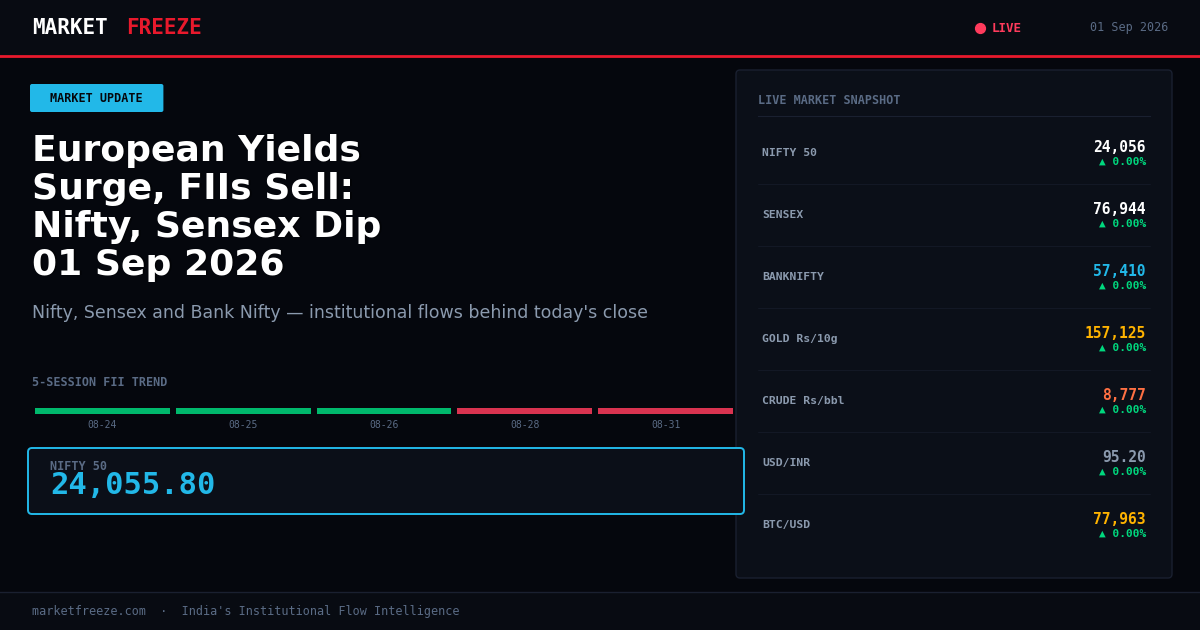
European Bond Yield Surge Fuels Caution, FIIs Continue Net Selling Amidst Crude Oil Rally
01 September 2026: European bond yields surged today, mirroring global inflation concerns and prompting a cautious undertone in European equities, which saw the STOXX 600 edge up by only 0.04%, while Indian benchmarks, Nifty 50 and Sensex, closed marginally lower at 24,055.80 and 76,944.00 respectively, as Foreign Institutional Investors (FIIs) continued their net selling spree for the second consecutive session, offloading ₹5,039.80 Cr, even as Domestic Institutional Investors (DIIs) provided a cushion with a net buy of ₹5,183.93 Cr.
Open a free demat account with
Upstox
or
Angel One
— zero brokerage on delivery trades.
Global Bond Yield Spikes Trigger FII Exodus from Indian Equities
The primary driver of today’s market sentiment, and crucially, FII behaviour, appears to be the resurgent global inflation narrative, evidenced by the sharp rise in European government bond yields. This surge, echoing similar movements in Japan where yields hit a 30-year high of 3%, signals a recalibration of risk appetite among global investors. The immediate impact on Indian markets is the continued net selling by FIIs, who divested a substantial ₹5,039.80 Cr today. This follows a similar pattern on 31 August 2026, where FIIs also sold a net of ₹5,039.80 Cr. The current market close of the Nifty 50 at 24,055.80, down 0.10%, and the Sensex at 76,944.00, down 0.02%, reflects this cautious sentiment. The rising global bond yields typically lead to a higher cost of capital, making equities less attractive relative to fixed income. For FIIs, this often translates into a reduction in their exposure to emerging markets like India, which are perceived as higher risk in such an environment. The sustained selling pressure from FIIs, particularly after a period of net buying from 24 August 2026 to 26 August 2026 (when they bought a net of ₹1,181.66 Cr and ₹502.63 Cr respectively), indicates a potential shift in their allocation strategy driven by macroeconomic headwinds.
DIIs Provide Crucial Support as FII Selling Intensifies
While FIIs continued their net selling, DIIs demonstrated significant buying conviction, offsetting a portion of the outflow. DIIs were net buyers of ₹5,183.93 Cr today, a robust figure that has been consistent over the last two sessions (also ₹5,183.93 Cr on 31 August 2026). This sustained DII buying is critical for market stability, especially when FII flows turn negative. On 26 August 2026, DIIs were exceptionally active buyers with ₹6,425.16 Cr. Their current net buying on 01 September 2026 suggests domestic institutions are leveraging the dip or are confident in the underlying Indian economic growth story, irrespective of global jitters. The contrast between FII outflows and DII inflows highlights a divergence in institutional sentiment, with domestic funds absorbing the selling pressure from foreign investors. This behaviour is crucial for maintaining support levels in the broader market.
Banking Sector Faces Pressure as Bond Yields Climb
The surge in global bond yields and domestic inflation concerns have disproportionately impacted the banking sector. Today, the Bank Nifty closed significantly lower, down 1.06% to 57,410.00. Rising bond yields typically depress the value of existing bond portfolios held by banks, leading to mark-to-market losses. Furthermore, higher borrowing costs can impact net interest margins (NIMs) for banks, as they face increased costs for funding. This is particularly relevant when considering the potential for central banks to raise interest rates to combat inflation, a scenario that seems increasingly likely given the global yield movements. The impact on banks is further compounded by the fact that they are often significant holders of government bonds. The sharp decline in Bank Nifty suggests that institutional investors, including FIIs, may be reducing their exposure to the financial sector, anticipating further headwinds from rising interest rates and potential credit slowdowns. The auto sector also experienced losses, likely due to concerns about higher financing costs impacting demand for vehicles.
Crude Oil Rally Adds to Inflationary Concerns, but Benefits Energy Stocks
Amidst the broader market caution, crude oil prices saw a notable uptick, with MCX Crude trading up 1.88% to ₹8,776.00/bbl. This rise in oil prices, partly attributed to escalating Middle East tensions as indicated by supporting news, adds another layer to the inflationary concerns. Higher crude oil prices directly translate to increased input costs for various industries, including transportation, manufacturing, and chemicals, potentially exacerbating inflation. However, for the energy sector itself, this represents a positive development. European energy stocks, for instance, gained 1.4%, aligning with the broader trend of rising oil prices. In India, while the overall market was subdued, companies with significant exposure to the oil and gas sector might see an uplift in their earnings prospects. The sustained rise in crude oil, coupled with surging bond yields, creates a complex environment for policymakers and investors alike, balancing growth concerns with inflation management.
Nifty Levels to Watch: Support at 23,900 as FII Selling Persists
Given the persistent FII selling pressure and the cautious global sentiment, the Nifty 50 faces immediate support around the 23,900 to 24,000 mark. The index closed today at 24,055.80, indicating it is trading precariously close to this key support zone. Any further erosion below 23,900 could trigger increased selling, potentially pushing the Nifty towards the 23,500-23,700 range, where significant DII buying was observed in the past (e.g., around the 24,219.05 close on 24 August 2026, which was followed by buying). On the upside, resistance is likely to be encountered around the 24,150-24,250 levels, particularly if FIIs start to reverse their selling trend or if positive news emerges. The Bank Nifty’s sharp decline to 57,410.00 suggests a lower support level for this index could be around 56,500-57,000, with resistance at the 58,000-58,500 band.
Historical Parallel: August 2022’s Yield Surge and FII Reversal
A historical parallel can be drawn to August 2022, when a similar global surge in bond yields, driven by inflation fears and aggressive rate hikes by major central banks, led to significant FII outflows from emerging markets. During that period, FIIs were net sellers for several consecutive weeks, leading to a broad market correction. The Nifty, which had traded around the 17,500-18,000 mark, saw a sharp drawdown. The current situation, with yields at multi-year highs and renewed inflation concerns, mirrors that period. If the current trend of rising yields persists and central banks signal further tightening, we could see a sustained period of FII selling, similar to what was observed in August 2022. The key difference today is the relatively higher levels of Indian indices and the presence of strong DII support, which might moderate the extent of any potential decline.
Currency Crossover: INR Strengthens Against USD Amidst Global Dollar Weakness
While global inflation concerns and rising bond yields are key themes, the Indian Rupee (INR) showed remarkable resilience, appreciating by 0.46% against the US Dollar to trade at Rs95.2. This strength in the INR, despite the global risk-off sentiment and rising yields which typically favour the dollar, suggests a significant weakening of the US dollar globally or specific positive factors influencing the INR. The appreciation of the Rupee is beneficial for importers and can help in controlling imported inflation. For institutional investors, a strengthening currency can offset some of the losses in equity markets if they are repatriating funds. However, the continued FII selling indicates that the primary driver for their decisions remains the macroeconomic outlook and relative attractiveness of Indian equities, rather than short-term currency movements.
Portfolio Framework: Diversification and Sectoral Allocation in a Yield-Sensitive Environment
In the current environment of rising global bond yields and persistent FII selling, investors should consider a portfolio framework that prioritizes capital preservation and selective growth. A balanced approach would involve:
- Reduced Equity Allocation: Consider a tactical reduction in overall equity exposure, particularly in rate-sensitive sectors like banking and high-growth technology stocks, if their valuations are stretched.
- Increased Allocation to Defensive Sectors: Focus on sectors with strong pricing power and stable demand, such as FMCG, pharmaceuticals, and select utilities, which tend to perform better during periods of economic uncertainty and rising inflation.
- Commodity Exposure: Given the rise in crude oil prices, consider a modest allocation to energy stocks or commodity-linked instruments, provided they align with risk tolerance.
- Fixed Income Re-evaluation: With bond yields rising, fixed-income instruments become more attractive. Investors might consider extending duration cautiously in high-quality corporate bonds or government securities, keeping in mind the potential for further rate hikes.
- Focus on Quality: Prioritize companies with strong balance sheets, consistent cash flows, and low debt levels. These businesses are better equipped to navigate a challenging economic landscape.
For instance, an investor could consider reducing their allocation to Bank Nifty constituents by 5-7% and increasing their allocation to select FMCG companies by 3-4%, provided their current portfolio has more than 10% exposure to banking and less than 8% to FMCG. The key is to remain agile and adjust allocations based on evolving macroeconomic data and institutional flows.
What Changes This Outlook: A Sustained Drop in Global Bond Yields
The primary trigger that could alter the current cautious outlook for Indian equities and halt the FII selling would be a sustained and significant drop in global bond yields. If inflation fears abate and central banks signal a pause or reversal in interest rate hikes, bond yields could decline sharply. This would make equities more attractive once again, potentially leading to a reversal in FII flows. Specifically, a move in the US 10-year Treasury yield back below the 4.0% mark, and a similar decline in European bond yields, would be a strong signal for institutional investors to increase their risk appetite. Alternatively, a sudden de-escalation of geopolitical tensions in the Middle East could also ease oil price pressures and contribute to a more positive global sentiment, indirectly benefiting Indian markets.
Historical FII/DII Flow Data (Last 5 Trading Sessions)
| Date | FII Net (Cr) | DII Net (Cr) | Nifty Close |
|---|---|---|---|
| 2026-08-24 | +₹1,181.66 Cr | +₹2,493.41 Cr | 24,219.05 |
| 2026-08-25 | +₹1,181.66 Cr | +₹2,493.41 Cr | 24,334.55 |
| 2026-08-26 | +₹502.63 Cr | +₹6,425.16 Cr | 24,207.75 |
| 2026-08-28 | ₹-5,039.80 Cr | +₹5,183.93 Cr | 24,175.65 |
| 2026-08-31 | ₹-5,039.80 Cr | +₹5,183.93 Cr | 24,080.40 |
Frequently Asked Questions
- Q: What did FII buy or sell on 01 September 2026?
- A: FIIs were net sellers of ₹5,039.80 Cr on 01 September 2026.
- Q: What did DII buy on 01 September 2026?
- A: DIIs were net buyers of ₹5,183.93 Cr on 01 September 2026.
- Q: Is FII buying or selling in September 2026?
- A: Based on the first trading day of September 2026, FIIs are currently net sellers, having sold ₹5,039.80 Cr on 01 September 2026.
Bottom Line
Today’s market action was dominated by global inflation concerns driving up bond yields, leading to continued net selling by FIIs amounting to ₹5,039.80 Cr, while DIIs provided substantial support with a net buy of ₹5,183.93 Cr. The banking sector bore the brunt of rising yields, closing down 1.06% on the Bank Nifty. Despite the cautious undertone, the Indian Rupee strengthened against the US Dollar to Rs95.2, and MCX Crude prices rose by 1.88% to ₹8,776.00/bbl. Investors should brace for continued choppiness, with key Nifty support at 23,900 and resistance at 24,150, until global yield pressures ease or FII flows reverse decisively.
Stay Ahead of the Curve. Subscribe to MarketFreeze.com for daily institutional flow intelligence.
Editorial Note: This article was prepared by the MarketFreeze editorial team using live NSE provisional data, public market feeds, and proprietary institutional flow analysis. All price and flow figures are sourced directly from NSE, BSE, and CoinGecko as of 01 September 2026. This content is for informational purposes only and does not constitute investment advice. MarketFreeze is not SEBI-registered. Please consult a qualified financial advisor before making investment decisions. Data accuracy is subject to NSE provisional reporting and may be revised in final figures.