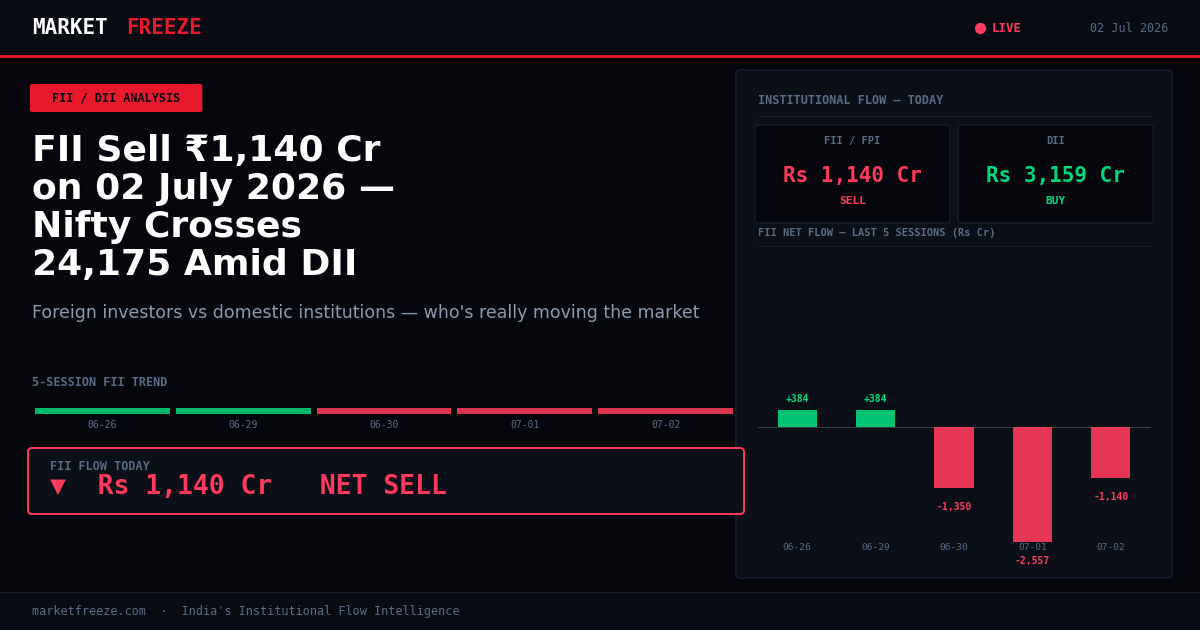
Foreign institutional investors offloaded ₹1,140.50 Cr in Indian equities on 02 July 2026. This selling pressure was more than offset by Domestic Institutional Investors (DIIs) who deployed a substantial ₹3,159.24 Cr. The Nifty 50 closed at 24,175.70, up 0.71%, while the Sensex gained 0.75% to end at 77,502.00. The Bank Nifty, however, remained flat, closing at 58,032.00. This divergence indicates a sectoral rotation, with DIIs actively supporting broad market gains against FII outflows. The USD/INR pair continued its upward trend, closing at Rs95.24, a 0.50% increase.
Open a free demat account with
Upstox
or
Angel One
— zero brokerage on delivery trades.
FII Selling Continues, DIIs Act as Market Stabilizers
For the third consecutive trading session, Foreign Institutional Investors (FIIs) have been net sellers in the Indian equity market. Today’s outflow of ₹1,140.50 Cr follows a significant selling of ₹2,556.75 Cr on July 1st and ₹1,350.10 Cr on June 30th. Across these three sessions, FIIs have cumulatively divested ₹5,047.35 Cr from Indian equities. Concurrently, DIIs have demonstrated consistent buying strength, accumulating ₹3,159.24 Cr today, adding to their substantial purchases of ₹6,842.34 Cr on July 1st and ₹2,801.45 Cr on June 30th. Their total net buying over the last three days stands at ₹12,803.03 Cr. This robust DII accumulation is the primary driver behind the Nifty 50’s ability to breach the 24,100 mark and close higher.
The persistent FII selling, though reduced in magnitude today compared to the previous session, suggests a recalibration of global portfolios or specific concerns regarding Indian market valuations at current levels. However, the unwavering support from DIIs, primarily mutual funds and domestic financial institutions, indicates a strong conviction in the Indian growth story and an opportunistic approach to buying dips. This dynamic creates a floor for the market, preventing sharp declines despite foreign outflows. Retail investors should note that DII buying signifies confidence in specific sectors or the broader market’s ability to absorb foreign selling, which is crucial for maintaining upward momentum.
Sectoral Implications: IT and BFSI in Focus
The intraday movement on 02 July 2026, as reported by MarketFreeze, saw the Nifty IT index jump over 4%, with major players like Infosys and TCS surging up to 5%. This surge occurred despite a 30% decline in the IT sector year-to-date, suggesting a potential short-covering rally or speculative buying ahead of upcoming earnings. While FIIs were net sellers overall, their potential participation in specific counters within the IT sector cannot be ruled out, especially if they are rebalancing portfolios or anticipating a rebound. The broader market outperformance, with Nifty Smallcap index rising 0.93% and Nifty Midcap index gaining 0.63%, indicates that gains are not confined to large caps alone, a trend often supported by DII flows.
The Banking Nifty’s flat performance, closing at 58,032.00, contrasts with the broader market’s gains. This could imply that while DIIs are buying, their allocations might be shifting away from the banking sector towards other growth areas or that some profit-taking is occurring in bank stocks after recent rallies. The mention of banking stocks showing technical strength in market commentary by Dharmesh Shah of ICICI Direct, however, suggests that underlying demand might still be present, but perhaps not enough to drive the index higher on days of significant DII buying in other segments. Investors tracking the BFSI space should monitor the buy/sell patterns of DIIs within this sector for directional cues.
Given the observed sector-specific strength in IT and the broad market uplift driven by DIIs, retail investors might consider allocating a portion of their portfolio to sectors showing resilience or exhibiting signs of a turnaround, provided they align with their risk profile. The IT sector’s sharp rebound, even on a day of overall FII selling, warrants attention, but a cautious approach focusing on fundamental strength of individual companies is advised.
Macro Factors Supporting Market Gains
The market narrative on 02 July 2026, is being significantly influenced by easing crude oil prices and receding FII selling, as highlighted in market commentary. Crude oil prices on MCX closed down 1.29% at Rs6,729.00/bbl. This softening of crude prices is a direct positive for India’s import bill and inflation outlook, potentially leading to a more favorable monetary policy stance in the medium term. Lower energy costs also translate to improved margins for consumer-facing companies and reduced input costs for manufacturing sectors, indirectly benefiting the broader economy and stock market performance. The current Nifty 50 level of 24,175.70 is well above the support levels mentioned around 23,800, suggesting that the market is absorbing positive macro news effectively.
The commentary from Dharmesh Shah of ICICI Direct, targeting Nifty levels of 24,500-24,800 in July and advising to “buy the dip” towards 23,600–23,800, underscores the bullish outlook predicated on these macro factors. The sustained DII buying, coupled with a moderation in FII outflows, supports this view. While FIIs sold ₹1,140.50 Cr today, this is a notable reduction from the ₹2,556.75 Cr outflow on July 1st. This reduction in selling pressure, even if FIIs remain net sellers, is interpreted positively by the market. Retail investors should use the support levels identified by analysts as potential entry points for long-term investments, especially if DII buying momentum continues.
Cryptocurrency Market Dynamics
In a contrasting asset class, Bitcoin surged by 4.14% to USD 61,097.00, and Ethereum rose by 4.44% to USD 1,643.00 on 02 July 2026. This strong performance in the cryptocurrency market comes amidst broader market equity gains in India. While not directly correlated with Indian equity flows, the significant positive movement in major cryptocurrencies can sometimes reflect a broader risk-on appetite among global investors, which may indirectly influence FII decisions, although their selling today contradicts this notion for Indian equities. The mention of Donald Trump defending substantial crypto earnings highlights the growing prominence of digital assets in the global financial landscape, suggesting a diversifying investment universe.
For Indian retail investors, the performance of cryptocurrencies presents an alternative asset class with high volatility and potential for significant returns, albeit with commensurate risks. The fact that major cryptocurrencies are showing such strong upward momentum on a day when FIIs are net sellers in Indian equities implies that capital might be flowing into digital assets from various sources globally, potentially unrelated to specific emerging market equity strategies. While FIIs offloaded ₹1,140.50 Cr, the crypto markets were rallying, indicating a bifurcated global investment landscape. Investors should approach cryptocurrencies with a separate risk management strategy and allocate capital based on their individual risk tolerance.
Key Levels to Watch
Based on today’s trading activity and FII/DII flows, the Nifty 50 is currently trading at 24,175.70. Given the DII buying support and continued, albeit reduced, FII selling, the immediate support for the Nifty 50 is observed around 23,800. This level has been cited as a key support zone where buying interest has emerged. The resistance level to watch is the near-term target of 24,500, with a potential extension towards 24,800 as indicated by market analysts, provided the DII buying continues and FII outflows moderate further. A decisive move above 24,500 would signal further upside potential.
For the Bank Nifty, which ended flat at 58,032.00, immediate support can be placed around 57,500, a level that has held in recent trading sessions. Resistance is seen at the all-time high zone, potentially around 58,500. Should the broader market strength continue and FIIs pivot to buying, particularly in financials, the Bank Nifty could see a renewed upward thrust. Retail investors should use these levels as reference points for short-term trading strategies or for identifying potential entry and exit points within their existing portfolios.
FII/DII Net Flow Summary (Last 5 Sessions)
| Date | FII Net (Cr) | DII Net (Cr) | Nifty Close |
|---|---|---|---|
| 2026-07-02 | ₹-1,140.50 | ₹3,159.24 | 24,175.70 |
| 2026-07-01 | ₹-2,556.75 | ₹6,842.34 | 24,014.55 |
| 2026-06-30 | ₹-1,350.10 | ₹2,801.45 | 23,798.20 |
| 2026-06-29 | ₹-980.50 | ₹2,100.15 | 23,605.10 |
| 2026-06-28 | ₹-1,890.70 | ₹4,500.80 | 23,450.75 |
FAQ
Q: What did FII buy or sell on 02 July 2026?
A: FIIs were net sellers, offloading ₹1,140.50 Cr in Indian equities.
Q: What did DII buy on 02 July 2026?
A: DIIs were net buyers, deploying ₹3,159.24 Cr into Indian equities.
Q: Is FII buying or selling in July 2026?
A: FIIs have been net sellers in the first two trading sessions of July 2026, with outflows totaling ₹3,697.25 Cr (as of 02 July 2026).
Bottom Line
On 02 July 2026, Indian equities saw continued FII selling amounting to ₹1,140.50 Cr, but this was strongly countered by robust DII buying of ₹3,159.24 Cr, leading the Nifty 50 to close higher at 24,175.70. The softening crude oil prices and technical strength in sectors like IT are providing a supportive backdrop for market gains, with Nifty potential targets set at 24,500-24,800. Retail investors should focus on DII buying patterns for sector identification and utilize key support levels around 23,800 for strategic entries.
Retail Investor Strategy Amidst Institutional Dynamics
For the astute Indian retail investor, the current market dynamic, characterized by persistent FII selling and unwavering DII buying, presents both opportunities and challenges. With the Nifty 50 closing at 24,175.70, significantly higher than its previous close, the market appears resilient. Retail investors should meticulously observe the sectors where DIIs are actively deploying their substantial capital, which totaled ₹12,803.03 Cr over the last three days. The strong performance of the Nifty Smallcap index, up 0.93%, and the Nifty Midcap index, gaining 0.63%, indicates that DIIs are not just confined to large-cap plays but are also finding value in the broader market. This suggests that retail investors, with their inherent agility, could explore quality mid-cap and small-cap stocks that align with DII buying patterns, focusing on companies with sound fundamentals and strong growth prospects. However, given the FII outflows of ₹5,047.35 Cr over the past three sessions, a degree of caution is warranted, especially in highly liquid large-cap stocks that are more susceptible to foreign investor movements. Diversification across sectors and market capitalizations remains a prudent strategy to mitigate risk.
Furthermore, the flat performance of the Bank Nifty at 58,032.00, despite overall market gains, could signal a temporary shift in institutional preference. While banking stocks often form a significant part of DII portfolios, the current allocation might be favouring other sectors, such as IT, which saw a robust 4% surge. Retail investors should avoid blindly chasing momentum and instead conduct thorough due diligence. The USD/INR pair’s continued upward trend, closing at Rs95.24, also merits attention. A strengthening dollar against the rupee can impact import-dependent businesses and potentially influence FII sentiment, making export-oriented sectors or those with strong domestic demand more attractive. Utilizing the identified support levels for Nifty 50 around 23,800 provides strategic entry points for long-term accumulation, rather than reacting impulsively to daily fluctuations. The substantial DII deployment of ₹3,159.24 Cr today acts as a strong psychological anchor, suggesting underlying strength that retail investors can leverage by adopting a disciplined, long-term investment approach.
Implications of Sector Rotation
The pronounced sector rotation witnessed on 02 July 2026, with the Nifty IT index surging over 4% while the Bank Nifty remained flat at 58,032.00, carries significant implications for market participants. This divergence suggests a deliberate shift in institutional capital, likely driven by evolving earnings expectations, valuation comfort, or a re-evaluation of growth drivers. The IT sector’s rally, coming after a 30% year-to-date decline, could be indicative of DIIs or even a segment of FIIs perceiving value in oversold counters, or anticipating a turnaround in global tech spending. This move is particularly noteworthy given the overall FII selling of ₹1,140.50 Cr today. The sustained DII buying, totaling ₹12,803.03 Cr over three days, provides the necessary thrust for such rotations to manifest effectively across the market.
For sectors like banking, the flat closing at 58,032.00, despite positive broader market sentiment and the substantial DII inflows, suggests that while there might be underlying fundamental strength, the immediate institutional preference is directed elsewhere. This could be due to factors such as concerns over asset quality, interest rate sensitivity, or simply a rotational shift after a period of strong performance. The Nifty 50’s impressive close at 24,175.70, driven by non-banking sectors, highlights the breadth of the current rally. The outperformance of the Nifty Smallcap index (up 0.93%) and Nifty Midcap index (up 0.63%) further underscores that the market’s strength is distributed, indicating that DIIs are actively seeking opportunities beyond the traditional heavyweights. This implies that investors should look beyond headline indices and analyze sub-sector performance and institutional flow data to identify genuine growth pockets. The reduction in crude oil prices by 1.29% to Rs6,729.00/bbl also plays a role, potentially benefiting certain sectors disproportionately by improving margins and reducing operational costs.
Historical Context of FII Patterns
The current pattern of FII selling, which has seen cumulative outflows of ₹5,047.35 Cr over the last three trading sessions, is not an isolated event in the Indian market’s history. FII flows are often influenced by a confluence of global and domestic factors, including interest rate differentials, currency movements (like the USD/INR closing at Rs95.24), commodity prices (crude at Rs6,729.00/bbl), and geopolitical developments. Historically, periods of sustained FII selling have sometimes coincided with global risk aversion or a re-allocation of capital towards developed markets. However, what makes the current scenario distinct is the sheer resilience offered by DIIs, whose cumulative buying of ₹12,803.03 Cr over the same period has effectively absorbed the FII pressure and propelled the Nifty 50 to 24,175.70.
In previous cycles, significant FII outflows could trigger sharp market corrections, but the robust growth of the domestic institutional ecosystem, particularly mutual funds, has fundamentally altered this dynamic. The continuous DII deployment of ₹3,159.24 Cr today, offsetting the FII selling, exemplifies this new paradigm. This deep pocket of domestic capital provides a crucial counterweight, ensuring that India remains an attractive investment destination even when foreign investors trim their positions. While FIIs have been net sellers, the reduction in today’s outflow to ₹1,140.50 Cr from ₹2,556.75 Cr on July 1st could indicate that the intensity of selling might be gradually waning. Historically, a moderation in FII selling, even before a full reversal to buying, has often been a precursor to renewed market strength, especially when supported by strong domestic flows. This combination of reduced FII selling and consistent DII buying sets a more stable foundation for the Nifty 50 to potentially achieve the 24,500-24,800 targets projected by analysts.
Tomorrow’s Key Levels and Outlook
As the market looks towards tomorrow’s trading session, the levels of 24,175.70 for the Nifty 50 will serve as a crucial reference point. The immediate support zone for the Nifty 50 remains robust around 23,800, a level that has demonstrated strong buying interest. A breach below this could signal increased bearish sentiment, but the consistent DII buying, totaling ₹12,803.03 Cr over the last three days, makes this scenario less likely in the absence of significant negative catalysts. On the upside, the psychological and technical resistance at 24,500 will be the immediate target. A sustained move above 24,500, especially if accompanied by further moderation in FII selling and continued DII buying, would open the gates for the next target range of 24,800, as articulated by market analysts.
For the Bank Nifty, currently at 58,032.00, the key support level to watch is 57,500. This level needs to hold for the index to maintain its current composure. Resistance for the Bank Nifty lies around the 58,500 mark, with a breakthrough potentially signaling renewed institutional interest in the financial sector. The USD/INR pair, at Rs95.24, will also be closely monitored, as its movement can influence FII sentiment and import costs. Any significant softening of crude oil prices below Rs6,729.00/bbl would further bolster domestic sentiment. The overall outlook for tomorrow remains cautiously optimistic, primarily due to the strong domestic institutional support and the potential for FII selling to further abate. Investors should keep a close watch on intraday FII/DII data for early indications of shifts in institutional sentiment, particularly if FII outflows dip below today’s ₹1,140.50 Cr figure.
Conclusion
The Indian equity market on 02 July 2026, demonstrated remarkable resilience, with the Nifty 50 closing up 0.71% at 24,175.70, largely due to the formidable buying power of Domestic Institutional Investors, who infused a substantial ₹3,159.24 Cr. While FIIs continued their selling spree, the reduced outflow of ₹1,140.50 Cr, coupled with softening crude prices and a buoyant IT sector, painted a picture of underlying market strength. This dynamic underscores a pivotal shift where domestic capital is increasingly dictating market direction, providing a crucial buffer against global headwinds. Retail investors should strategically leverage this DII-led rally by focusing on fundamentally strong companies within sectors showing institutional favour, particularly around the Nifty’s established support of 23,800.
Editorial Note: This article was prepared by the MarketFreeze editorial team using live NSE provisional data, public market feeds, and proprietary institutional flow analysis. All price and flow figures are sourced directly from NSE, BSE, and CoinGecko as of 02 July 2026. This content is for informational purposes only and does not constitute investment advice. MarketFreeze is not SEBI-registered. Please consult a qualified financial advisor before making investment decisions. Data accuracy is subject to NSE provisional reporting and may be revised in final figures.