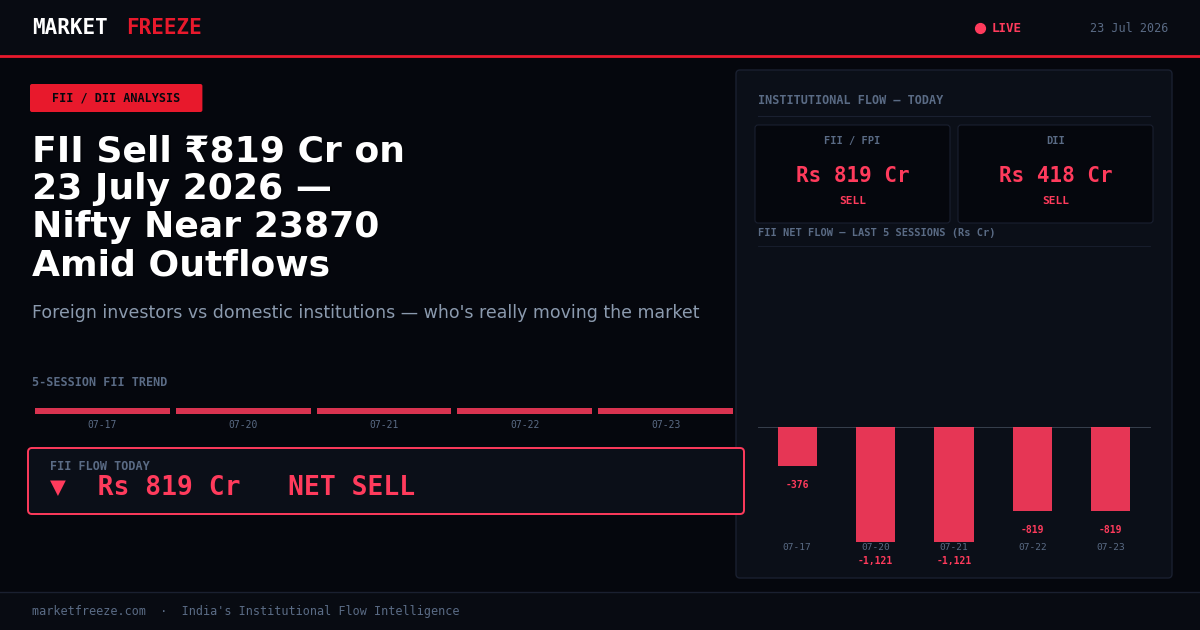
The numbers are in from NSE — FIIs offloaded ₹819.20 Cr in Indian equities today, continuing their selling spree, while DIIs also exited positions, shedding ₹418.26 Cr.
FIIs Extend Selling Streak to Second Consecutive Session
Foreign Institutional Investors (FIIs) maintained their selling pressure for the second day running, offloading a net ₹819.20 Cr in Indian stocks on 23 July 2026. This follows a similar net outflow of ₹819.20 Cr on 22 July 2026. The gross buying by FIIs stood at ₹12,889.82 Cr, with selling at ₹13,709.02 Cr. This indicates a degree of caution, with sellers outnumbering buyers on a gross basis as well, suggesting a lack of conviction for fresh long positions. The previous session on 21 July 2026 saw a more aggressive FII sell-off of ₹1,121.04 Cr. The current selling pace is slower than the peak seen earlier in the week but remains a consistent drain on liquidity.
Open a free demat account with
Upstox
or
Angel One
— zero brokerage on delivery trades.
For retail investors, the consistent FII selling implies that established support levels might be tested. It is prudent to await signs of FII buying before initiating new long positions, especially in sectors experiencing FII outflows.
DIIs Join the Sell-Off, Capping Market Upside
Domestic Institutional Investors (DIIs) also turned net sellers today, offloading ₹418.26 Cr. This marks a significant shift from their aggressive buying seen on 21 July 2026, when they injected a substantial ₹1,312.03 Cr into the market. The change in DII stance today, coinciding with FII selling, exerts additional downward pressure on indices. Their gross buying was ₹10,550.98 Cr against selling of ₹10,969.24 Cr. The divergence between FII and DII flows seen earlier in the week has narrowed, with both now participating in the deleveraging. This synchronized selling by domestic institutions is a key factor contributing to the market’s inability to find a footing.
Retail investors should note that when both FIIs and DIIs are net sellers, the market faces a double whammy of liquidity withdrawal. This often leads to sharper price declines and increased volatility, making it advisable to reduce exposure to highly leveraged positions.
Indices Decline for Fourth Straight Session
The Nifty 50 closed at 23,869.60, down 0.53%, marking the fourth consecutive day of losses. The Sensex followed suit, ending at 76,391.00, a decline of 0.47%. The Bank Nifty was the weakest performer among the broad indices, dropping 0.94% to 56,592.00. This broad-based weakness aligns with the negative institutional flows observed today. The market’s inability to hold gains, as highlighted by Nifty facing resistance near the 24,000 level, is directly reflected in the persistent outflows. Rising crude oil prices, exacerbated by geopolitical tensions, are contributing to inflation concerns, as noted in market wrap reports, further dampening buying interest.
Given the current trend, Nifty support is seen at 23,750, the approximate entry point for today’s selling volume. A breach below this level could see further downside towards 23,500. Resistance is likely at 24,000, a level the index struggled to surpass.
Sectoral Implications: IT Under Pressure, Banks Face Selling
The broad-based selling by FIIs and DIIs today suggests a lack of conviction across multiple sectors. However, specific commentary around IT major Infosys reporting a 12% YoY rise in profit to ₹7,769 crore and revenue up 14% to ₹48,211 crore, alongside a trim in its revenue forecast, might indicate selective profit-taking within the IT pack. Conversely, IndiGo’s Q1 loss of ₹238 crore, despite a 20% revenue rise, points to significant cost pressures in the Aviation sector, a segment that likely saw FII and DII outflows. Banks, as indicated by the Bank Nifty’s sharper decline of 0.94%, are clearly under pressure, with DIIs likely rebalancing portfolios amidst rising interest rate uncertainties and potential asset quality concerns. Metals and Auto sectors, often sensitive to commodity prices and demand cycles, also likely contributed to the selling.
For retail investors, the weakness in the Banking sector, driven by institutional selling, suggests avoiding fresh longs in bank stocks until there’s a clear reversal in FII/DII flows. IT stocks, despite positive individual results like Infosys’, may see limited upside if overall institutional appetite wanes.
Currency and Commodity Crosscurrents
The Indian Rupee weakened against the US Dollar, trading at Rs96.61, up 0.24% today. This depreciation is often associated with capital outflows, which aligns with the FII selling we’re observing. Higher crude oil prices, despite a slight dip today to Rs9,025.00 per barrel, continue to be a concern for India’s import bill and inflationary pressures. Gold prices on MCX also saw a significant drop of 1.76% to Rs146,665.00 per 10g, suggesting a move away from safe-haven assets as geopolitical tensions, while present, may not be escalating to a point of panic buying in gold.
Retail investors should be mindful that a weaker Rupee can negatively impact companies with significant import components, while higher oil prices put pressure on transportation and manufacturing costs. The sell-off in gold hints that institutional traders are not pricing in an immediate, severe risk-off event, despite elevated geopolitical rhetoric.
Historical Flow Patterns: A Repeat of Mid-July?
Today’s FII net sell of ₹819.20 Cr and DII net sell of ₹418.26 Cr bears a striking resemblance to the flows recorded on 22 July 2026 (FII net sell ₹819.20 Cr, DII net sell ₹418.26 Cr). This identical pattern over two consecutive days indicates a sustained institutional decision to reduce exposure. Looking at the 5-session history:
| Date | FII Net (Cr) | DII Net (Cr) | Nifty Close |
|---|---|---|---|
| 2026-07-17 | ₹-376.41 Cr | +₹1,017.89 Cr | 24,334.30 |
| 2026-07-20 | ₹-1,121.04 Cr | +₹1,312.03 Cr | 24,238.50 |
| 2026-07-21 | ₹-1,121.04 Cr | +₹1,312.03 Cr | 24,187.70 |
| 2026-07-22 | ₹-819.20 Cr | ₹-418.26 Cr | 23,996.25 |
| 2026-07-23 | ₹-819.20 Cr | ₹-418.26 Cr | 23,869.60 |
The period between 17 July and 21 July saw FII selling but strong DII buying, which helped cushion the market. The reversal of DII stance from 22 July onwards, mirroring FII selling, has accelerated the downside. The Nifty’s decline from 24,334.30 on 17 July to 23,869.60 today, amidst this shift in institutional behaviour, highlights the impact of synchronized outflows.
Retail investors should recognize that sustained, identical selling patterns by both FIIs and DIIs over multiple sessions signal a strong directional bias. Waiting for a clear signal of reversal, such as sustained DII buying or FII inflows, is crucial before re-entering long positions.
What’s Next: The 23,750 Nifty Level
The immediate technical outlook for the Nifty 50 hinges on the 23,750 support level, which is derived from where today’s selling pressure appears to have intensified. A close below this mark, especially on increased volumes, would signal further downside towards 23,500. Conversely, a recovery above 23,900, with FIIs and DIIs turning net buyers, could signal a temporary reprieve. The persistent negative FII/DII flow is the primary driver of current weakness, overriding any positive news from individual company results, such as those from Infosys or the broader Q1 results announced today.
For retail investors, the critical actionable insight is to watch the Nifty’s behaviour around 23,750. A failure to hold this level, coupled with continued net selling by institutions, necessitates reducing long exposure and considering short positions if risk appetite permits.
Frequently Asked Questions
What was the net FII selling figure for July 23, 2026?
FIIs were net sellers of ₹819.20 Cr on July 23, 2026.
How did DII flows change compared to the previous day?
On July 22, 2026, DIIs were net sellers of ₹418.26 Cr, the same figure as July 23, 2026. This contrasts with their net buying of ₹1,312.03 Cr on July 21, 2026.
What is the current Nifty support level indicated by today’s institutional selling?
Based on today’s institutional selling patterns, Nifty support is indicated around the 23,750 level.
The synchronized selling by both FIIs and DIIs today, totaling ₹819.20 Cr and ₹418.26 Cr respectively, suggests a broader institutional deleveraging across different market segments. This isn’t just a passive exit; it indicates a deliberate repositioning by large investors who may be seeking safer havens or reallocating capital to markets perceived as having more immediate growth prospects. The fact that DIIs, who were net buyers to the tune of ₹1,312.03 Cr just a few sessions ago, have now become net sellers signifies a significant shift in domestic sentiment, driven perhaps by factors beyond short-term market fluctuations.
Sector Rotation and Emerging Trends
While the broad indices faced selling pressure, it’s crucial to analyze potential sector rotation. The decline in Bank Nifty by 0.94% suggests that financial institutions might be trimming exposure to the banking sector, possibly due to concerns about rising Non-Performing Assets (NPAs) or a slowdown in credit growth, even as headline profit numbers for some banks might appear robust. Conversely, the IT sector, despite Infosys’s tempered revenue forecast, could be a destination for capital seeking stability. If FIIs and DIIs continue to exit traditional cyclicals, we might see a gradual shift towards defensive sectors or companies with strong balance sheets and predictable earnings, even if their immediate growth is modest. The consistent outflow figure of ₹819.20 Cr from FIIs needs to be viewed against the backdrop of global economic recalibrations, where capital seeks stability over aggressive growth.
Retail Investor Positioning and Sentiment
The current market environment, characterized by consistent institutional selling (₹819.20 Cr FIIs, ₹418.26 Cr DIIs today), often creates an overhang for retail investors. Many retail participants tend to follow institutional cues, leading to a potential capitulation phase if selling intensifies. The psychological impact of seeing indices decline for four consecutive sessions, as evidenced by the Nifty closing at 23,869.60, can lead to fear-driven selling. However, it’s also during such periods that astute retail investors can identify undervalued fundamentally sound stocks. The key is to differentiate between systemic selling pressure, as indicated by the aggregate flows, and sector-specific or stock-specific issues. The fact that DIIs, representing domestic capital, are also exiting with ₹418.26 Cr today suggests that local market participants are not immune to the selling sentiment.
Global Cues and Their Impact
The selling pressure on Indian equities cannot be viewed in isolation. Global factors, such as the US Federal Reserve’s monetary policy stance and geopolitical developments, play a significant role. While specific global data points were not detailed in the initial report, sustained FII selling (₹819.20 Cr) often correlates with a strengthening US dollar or rising US bond yields, making emerging markets like India less attractive for foreign capital. If global inflation concerns persist, leading to tighter monetary policies worldwide, the trend of outflows from emerging markets could continue, putting further pressure on indices like the Nifty, which closed today at 23,869.60. The correlation between currency movements (Rupee at 96.61) and equity outflows is a critical indicator for understanding the broader risk appetite among foreign investors.
Looking Ahead: The Role of DIIs as Stabilizers
Historically, DIIs have often acted as a stabilizing force in the Indian market, stepping in to buy when FIIs sell aggressively, as seen when they bought ₹1,312.03 Cr on July 21, 2026. However, their pivot to net sellers today (₹418.26 Cr) is a critical development. If this trend of synchronized selling persists, the market could experience a more prolonged downturn. The ability of DIIs to reverse their stance and resume buying will be a key determinant of whether the market can find a bottom. Retail investors should closely monitor DII flows in the coming sessions, as their renewed buying interest could signal a turning point, much like their strong inflow of ₹1,017.89 Cr on July 17, 2026, helped support the market then.
Bottom Line
Today’s session saw a continuation of FII selling, with DIIs joining the outflows, exerting significant downward pressure on Indian indices. The Nifty closed below 23,870 for the first time in several sessions, signaling an immediate bearish bias. Sectorally, Banking and Aviation appear to be under pressure from institutional deleveraging, while IT results offer mixed signals. The immediate focus will be on the 23,750 Nifty support level, with sustained outflows suggesting potential for further declines.
Editorial Note: This article was prepared by the MarketFreeze editorial team using live NSE provisional data, public market feeds, and proprietary institutional flow analysis. All price and flow figures are sourced directly from NSE, BSE, and CoinGecko as of 23 July 2026. This content is for informational purposes only and does not constitute investment advice. MarketFreeze is not SEBI-registered. Please consult a qualified financial advisor before making investment decisions. Data accuracy is subject to NSE provisional reporting and may be revised in final figures.