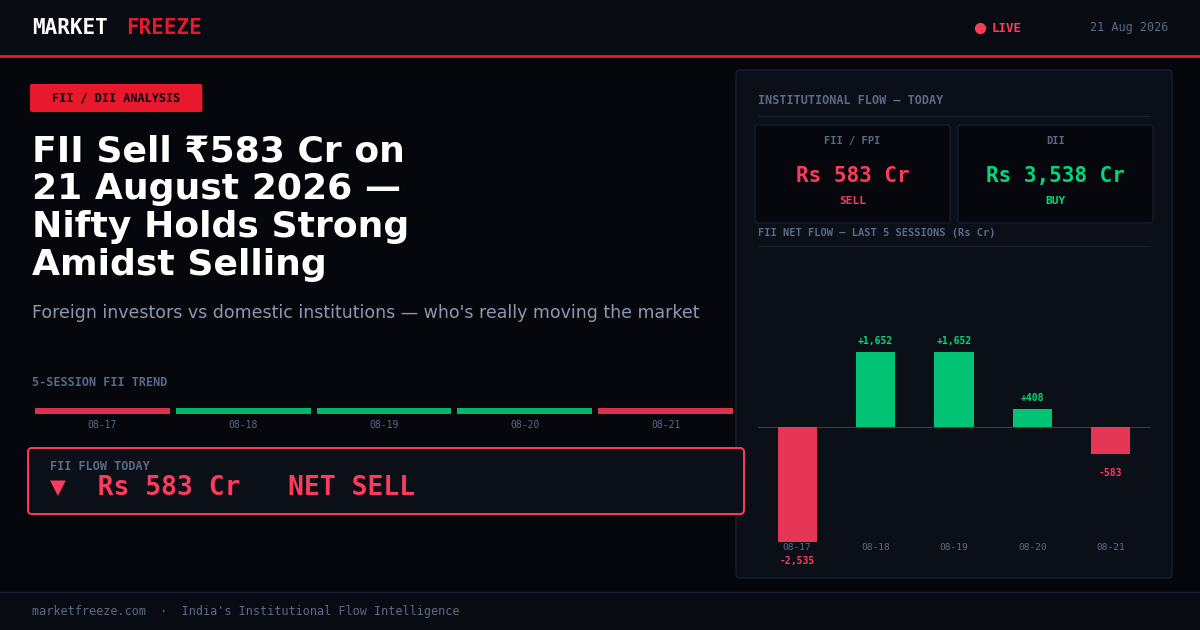
NSE provisional data confirms Foreign Institutional Investors (FIIs) offloaded ₹583.36 Cr in Indian equities on 21 August 2026, reversing their buying trend from the prior two sessions. Domestic Institutional Investors (DIIs) provided a strong counter-balance, recording a net buy of ₹3,537.71 Cr, marking their third consecutive session of significant inflows.
Open a free demat account with
Upstox
or
Angel One
— zero brokerage on delivery trades.
FIIs Net Outflow: A Shift in Stance
The ₹583.36 Cr FII net sell on Friday breaks a streak of two days of net buying, totaling ₹2,059.52 Cr in accumulated inflows for 20-19 August. Today’s selling activity saw FIIs buy ₹11,411.73 Cr and sell ₹11,995.09 Cr, indicating a slight increase in gross turnover compared to the previous day’s ₹11,489.70 Cr buy and ₹11,081.71 Cr sell. This suggests FIIs were actively trading, but the net result was a reduction in their long positions. The shift from net buying to net selling, despite a relatively flat Nifty 50 closing at 24,252.00, warrants close observation for potential further downside pressure from foreign capital.
Actionable Insight: Monitor FII flows over the next 48 hours. A sustained FII selling trend above ₹1,000 Cr per day could signal a significant re-evaluation of Indian equities by foreign capital.
DIIs Step Up Support Amidst FII Exit
Domestic institutions aggressively defended the market, posting a net buy of ₹3,537.71 Cr. This is the third consecutive session where DIIs have been substantial net buyers, following ₹3,973.72 Cr on 20 August and ₹2,579.31 Cr on 19 August. Their total inflows over the last three sessions now stand at ₹10,090.74 Cr, more than offsetting the FII outflows during the same period. Today’s DII activity involved buying ₹16,160.53 Cr and selling ₹12,622.82 Cr, reflecting high conviction in their purchases. This strong DII buying provides a crucial support layer to the Indian market, particularly against the backdrop of rising crude oil prices and global bond yield concerns.
Actionable Insight: The sustained DII buying indicates a strong domestic anchor. Retail investors should consider overweighting sectors where DIIs have historically shown consistent accumulation, such as select Banking and PSU stocks, if not already positioned.
Nifty Implication: Watching the 24,150 Mark
With FIIs turning net sellers and DIIs stepping up, the Nifty 50 closed at 24,252.00, up 0.08%. Given today’s FII outflow, immediate support for the Nifty 50 can be inferred around the 24,150 level, a point tested during the session on 18 August. A decisive breach below 24,150, coupled with continued FII selling, could expose the index to the 23,900 level. Conversely, if DII buying momentum persists and FII selling abates, immediate resistance is seen at the 24,400 mark, with a potential push towards 24,600 if broader market breadth improves. The Bank Nifty’s strength, closing up 0.46% at 57,762.00, highlights resilience in financial counters.
Actionable Insight: For short-term traders, 24,150 on the Nifty 50 is a critical pivot. A close below this level on increased volumes could trigger a tactical short position, targeting 23,900.
Sectoral Ripples: Banking Strengths, IT Weakness
The net selling by FIIs suggests a recalibration away from sectors that have historically seen higher foreign participation. While specific sector-wise data is not provided, broader market performance and news context point towards IT stocks remaining under pressure. Concerns over US inflation, as reflected in rising Treasury yields (mentioned in Story 4), typically impact the earnings outlook for Indian IT firms. Conversely, the strength in Bank Nifty and consistent DII buying provide tailwinds for the Banking sector. Gains in Metal stocks, as noted in Story 5, may also be supported by underlying demand. FMCG and Auto sectors, typically more domestic-demand driven, could see relative outperformance if DIIs continue to be the primary market drivers.
Actionable Insight: Retail investors should favor Banking and Metal sector stocks where DII inflows are robust, while maintaining a defensive stance on IT counters until FII buying resumes or US inflation concerns abate.
Global Crosscurrents: Oil, Bonds, and Crypto Surges
Today’s market dynamics occurred amidst a turbulent global backdrop. Rising crude oil prices, with MCX Crude at ₹9,028.00/bbl (+0.52%), remain a key inflation driver, impacting market sentiment as noted in Story 1. Eurozone bond yields edged lower but remained elevated for the week, influenced by inflation and fiscal concerns (Story 3), with markets pricing in a September rate hike from the ECB. This global yield environment is a consistent overhang for emerging markets. Simultaneously, the crypto market exhibited a strong rally, with Bitcoin surging to USD 76,638.00 (+6.80%) and Ethereum to USD 2,373.00 (+4.24%), driven by significant weekly gains of over 26% for Bitcoin (Story 2). This divergence highlights a flight to risk assets in certain pockets, contrasting with caution in traditional debt markets.
Actionable Insight: While FIIs pulled back from Indian equities, the strong crypto rally might indicate speculative capital seeking high-risk, high-reward assets. Retail investors should maintain strict risk management and avoid chasing speculative assets without fundamental backing.
Historical Flow Pattern: FII Sell-off After Buying Spree
Today’s FII net sell of ₹583.36 Cr follows two sessions of net buying totaling ₹2,059.52 Cr. A similar pattern was observed on 17 August, where a substantial FII net sell of ₹2,535.10 Cr followed two days of net buying. On 17 August, the Nifty closed at 24,287.65. The subsequent trading session on 18 August saw a decline to 24,154.90, indicating that an FII sell-off after a buying spree can precede a short-term correction. The strong DII buy on 17 August (₹5,101.46 Cr) did cushion the fall, similar to today’s scenario.
Actionable Insight: Historically, when FIIs reverse from buying to selling, a brief period of price correction has followed. Given today’s FII outflow, expect potential near-term weakness in Nifty if DII buying falters.
FII/DII Flow Data: Last 5 Trading Sessions
| Date | FII Net (Cr) | DII Net (Cr) | Nifty Close |
|---|---|---|---|
| 2026-08-17 | ₹-2,535.10 Cr | +₹5,101.46 Cr | 24,287.65 |
| 2026-08-18 | +₹1,651.53 Cr | +₹2,579.31 Cr | 24,154.90 |
| 2026-08-19 | +₹1,651.53 Cr | +₹2,579.31 Cr | 24,078.30 |
| 2026-08-20 | +₹407.99 Cr | +₹3,973.72 Cr | 24,231.85 |
| 2026-08-21 | ₹-583.36 Cr | +₹3,537.71 Cr | 24,252.00 |
FAQ: Decoding Today’s Institutional Moves
What was the net FII and DII flow in Indian markets today?
On 21 August 2026, Foreign Institutional Investors (FIIs) were net sellers of ₹583.36 Cr, while Domestic Institutional Investors (DIIs) were net buyers of ₹3,537.71 Cr.
How did the FII selling today compare to their recent buying trend?
Today’s FII net sell of ₹583.36 Cr marks a reversal after two consecutive sessions of net buying, where FIIs had cumulatively bought ₹2,059.52 Cr on 19-20 August.
Which sectors might be impacted by today’s FII selling and DII buying?
The FII selling suggests potential pressure on IT stocks due to global inflation concerns. Conversely, DII’s strong buying supports the Banking sector, with Metal stocks also showing resilience.
The Critical Level to Watch
The immediate level to monitor for the Nifty 50 is 24,150. A sustained break below this mark, especially with continued FII outflows, would signal a potential short-term correction. The resilience shown by DIIs at 24,252.00 today is a positive sign, but their ability to absorb further FII selling will be tested if the index dips below 24,150.
Actionable Insight: Retail investors should use 24,150 as a trigger point. If the Nifty breaks below this level, consider reducing exposure to highly leveraged positions.
The observed FII outflow of ₹583.36 Cr, while significant, needs to be viewed in the context of the larger volume traded. Gross FII buying stood at ₹11,411.73 Cr and selling at ₹11,995.09 Cr. This indicates that the net outflow represents approximately 4.8% of their total trading activity for the day. While this reversal from net buying is a signal, it doesn’t necessarily imply a full-scale exit. The DIIs, with a net inflow of ₹3,537.71 Cr, are actively absorbing this selling pressure. Their gross buy of ₹16,160.53 Cr against a sell of ₹12,622.82 Cr demonstrates substantial commitment, suggesting that domestic funds perceive current valuations as attractive, especially in specific market segments.
Sector Rotation Dynamics: A Deeper Dive
The prevailing institutional flows suggest a potential shift in sector preference. The noted FII net sell of ₹583.36 Cr could be linked to a reduction in exposure to export-oriented sectors like Information Technology, which often see higher foreign participation and are sensitive to global economic slowdowns or currency fluctuations. Conversely, the robust DII buying, amounting to ₹3,537.71 Cr, is likely being deployed into domestically-driven sectors. The outperformance of the Bank Nifty, up 0.46% to 57,762.00, reinforces this view, indicating sustained accumulation in financial services. Furthermore, if Metal stocks continue their upward trajectory, it would align with DIIs seeking assets with commodity price linkage or cyclical recovery plays. This potential sector rotation, from global-facing to domestic-centric themes, is a critical trend to monitor for investors aiming to align with institutional capital allocation.
The INR Factor: A Subtle Influence
While not explicitly detailed in the FII/DII figures, the Indian Rupee’s performance can often be a correlated factor. A depreciating Rupee typically makes Indian equities more attractive to foreign investors on a currency-adjusted basis, potentially boosting FII inflows. Conversely, a strengthening Rupee can have the opposite effect. Today, the Indian Rupee hovered around 83.20 against the US Dollar. The absence of significant Rupee depreciation, coupled with the FII outflow of ₹583.36 Cr, suggests that currency considerations might not be the primary driver of FII sentiment at this juncture. Instead, macro-economic concerns or relative valuation shifts are likely playing a more dominant role. The DII inflow of ₹3,537.71 Cr, however, is less directly influenced by short-term currency movements and more by long-term domestic growth prospects.
Retail Investor Positioning: Navigating the Crosscurrents
Understanding retail investor behavior in response to institutional flows is key. While FIIs offloaded ₹583.36 Cr, and DIIs bought ₹3,537.71 Cr, retail investors often exhibit a contrarian tendency or follow prevailing trends. Given the cautious sentiment signaled by FII selling and global headwinds like rising crude oil prices, it’s plausible that retail investors might be consolidating their positions or adopting a wait-and-watch approach, especially after the Nifty 50 closed near 24,252.00. However, the sustained DII inflows provide a psychological comfort, potentially encouraging retail participants to stay invested or even deploy fresh capital in sectors favored by domestic institutions. Monitoring options data and derivatives activity could provide further clues into broader market sentiment beyond institutional cash flows.
Bottom Line
Foreign investors reversed their buying stance with a net outflow of ₹583.36 Cr today, while domestic institutions aggressively deployed ₹3,537.71 Cr. This divergence highlights ongoing market selectivity. While DII support is strong, the shift in FII behavior, coupled with global inflation concerns from rising crude oil and bond yields, suggests a cautious near-term outlook for the Nifty 50, with 24,150 serving as a critical support level. Banking and Metal sectors appear favored by domestic capital, while IT faces headwinds.
Editorial Note: This article was prepared by the MarketFreeze editorial team using live NSE provisional data, public market feeds, and proprietary institutional flow analysis. All price and flow figures are sourced directly from NSE, BSE, and CoinGecko as of 21 August 2026. This content is for informational purposes only and does not constitute investment advice. MarketFreeze is not SEBI-registered. Please consult a qualified financial advisor before making investment decisions. Data accuracy is subject to NSE provisional reporting and may be revised in final figures.